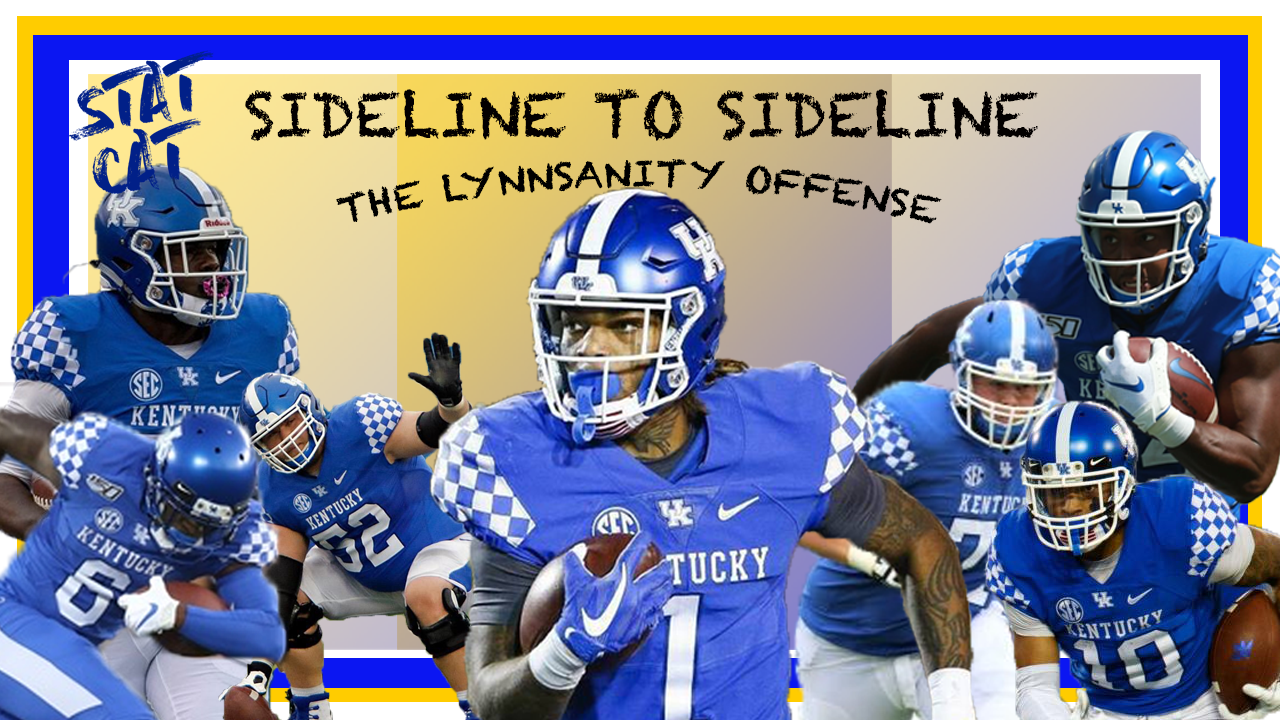
Sideline to Sideline: The Lynnsanity Offense
Entering the bye week after a humbling loss to South Carolina, Kentucky’s staff had a lot of things to address in order to save the Wildcats’ season. The offense looked dead and its defense looked discombobulated as the first third of the season concluded.
Trotting out a hurt Sawyer Smith and doubling down on the passing game was as inept as it was infuriating for many Blue Blooded Kentucky fans. I would bye lying if I said I didn’t vomit verbal abuse during the duds against Mississippi State and South Carolina.
Eddie Gran’s squadron was trying to right itself on the fly after not one — but two substantial injuries to his top two passers. It was immediately apparent something was amiss down at Mississippi State with the high volume of fluttery passes Smith slung that afternoon.
Two quick frustrating losses were almost enough for some BBNers to jump ship a month into the season. Errant throws, low percentage chances, a severe lacking in splash plays, and a run game that offered little solace permeated UK’s offense in Weeks 4 and 5.
The growing pains of replacing seven defensive starters were gruesome to watch. A majority of the first-year starters are poor tacklers. UK’s secondary is as thin in the ranks as it is young.
Stoops’ Troops appeared to be out-manned when not playing teams out of the MAC. Against their first 3 SEC opponents, UK’s defense fell within the SEC’s Bottom5 in Forced Three-and-Out Rate, Turnover Rate, Touchdown Rate, and Yards/Game.
Plus during that span, they were in the Bottom3 in Overall Defensive Success Rate, Tackle-For-Loss Rate, Explosive Play Allowed Rate, and Havoc Rate — a disgustingly frustrating display against offenses who in hindsight have some major flaws.
While the outlook for the remainder of the schedule looked bleak with what the Cats showed over the first month-plus, it’s lone bright spot was Lynn Bowden.
Until that point, Bowden was forcefed targets on both screens, deep shots, and 3rd Down chances. Due to the aforementioned shattershot passing, he entered UK’s first bye week as one of the more inefficient receiving options on account to the volume of opportunities he was given. Sure, he put up respectable traditional numbers as no other SEC player saw as many targets as him over the first five games. On a per snap basis, However, UK saw a low rate of returns relative to the rest of the conference.
Yet when the ball was put in his hands, Bowden got many ‘a butts across the Commonwealth to leap out of their seats. A change had to be made in order to maximize their resources and get everything back on track.
Smith’s health was a major issue and clearly affected his play. With no other choice besides thrusting Walker Wood into the fray, Mark Stoops and Eddie Gran decided to go down swinging with their all-purpose X-factor quarterbacking the Wildcats. After all, UK has strangely become accustomed to receivers dropping back to pass over the last decade or so.
So far, it has paid off.
UK has rebounded with two wins in three contests; it’s only blemish was the first ever Stoops-Era shutout at the hands of a Top-10 Georgia team in a monsoon in Athens.
So HOW has UK done this? It’s not like UK wasn’t trying to increase instances of getting Bowden the ball prior to supplanting Smith.
All of UK’s favorite plays for the Bowden-led attack have been seen minus a few wrinkles in Gran’s Lexington stint. I’m sure you have heard the stories of Gran spending his entire off-week scouring hours of tape of teams in similar predicaments looking for looks UK could implement with Bowden.
Before we get into the nitty gritty, know I will talking a lot in terms of "Success Rate". All yards are not created equal. Gaining 5 yards on 3rd and 4 is much better than gaining 5 yards on 2nd and 10 situationally. Success Rate aims to measure all yardage in this manner. In order for a play to be "successful" it needs to: net 50% of yards to gain on 1st Downs, 70% of yards to gain on 2nd Downs, and 100% of yards to gain on 3rd and 4th Downs. Keep that in mind. Now, to the good stuff.
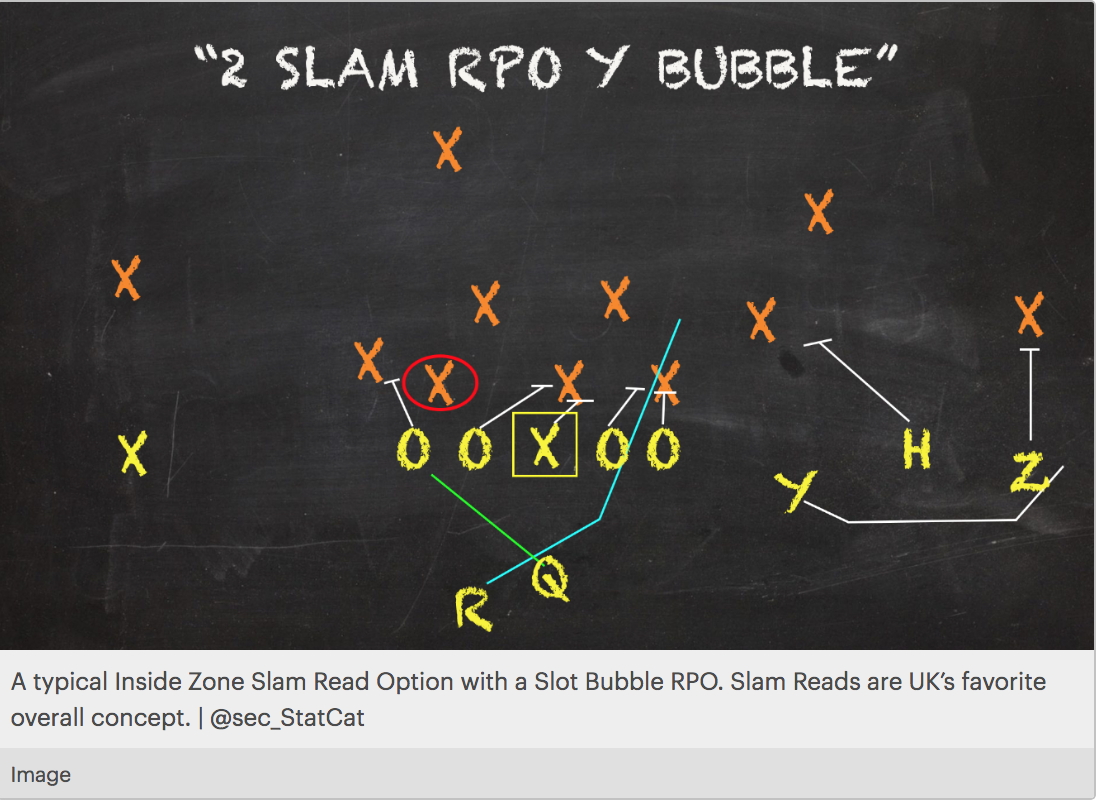
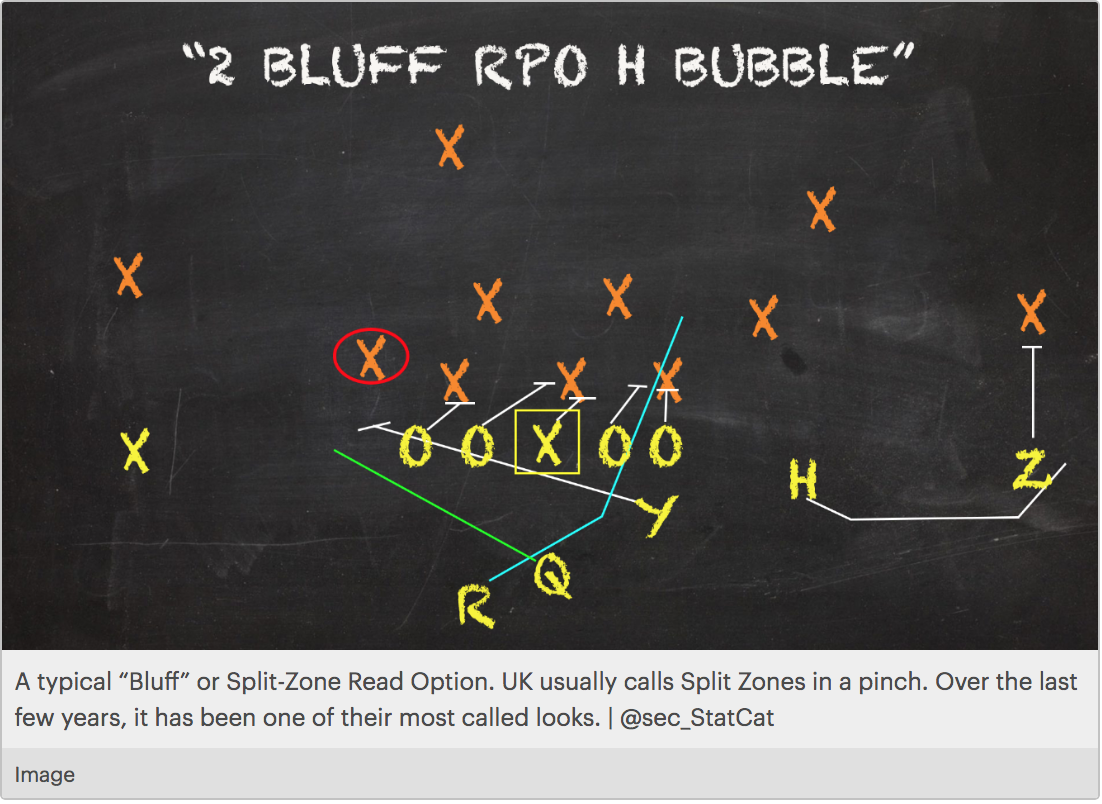
Their favorite concept on the year, as is the case with most SEC teams, was the Inside Zone Slam Read. This remains to be their favorite with Bowden, especially on first downs. Inside Zone Slam Reads and Bluff Reads have gotten 17 and 8 1st Down reps, the most and third-most of any subconcept during Weeks 7-9. Though Lynn has only attempted two RPO attempts over the last month, it is very common for these to have route tags attached like slot bubbles, wideout tunnels, or Stick concepts. Overall, 27 Slam Reads and 10 Bluff Reads have been called over the last month, which rank first and fourth respectfully.
While the two combined for a 50% Success Rate going into the first bye week, the Lynnsanity Offense has struggled mightily executing both Slam and Bluff Reads. Over the last three games, oft-run Slam Reads post a 29% Success Rate and Bluffs a 20% clip. Four of the five explosive carries occurred against Arkansas including a pair of 20 yard runs by AJ Rose with a TD. The other was AJ Rose’s 20 yard scoring scamper against Missouri last week. Outside of those, it’s been a blah play and is usually three yards through a cloud of dust.
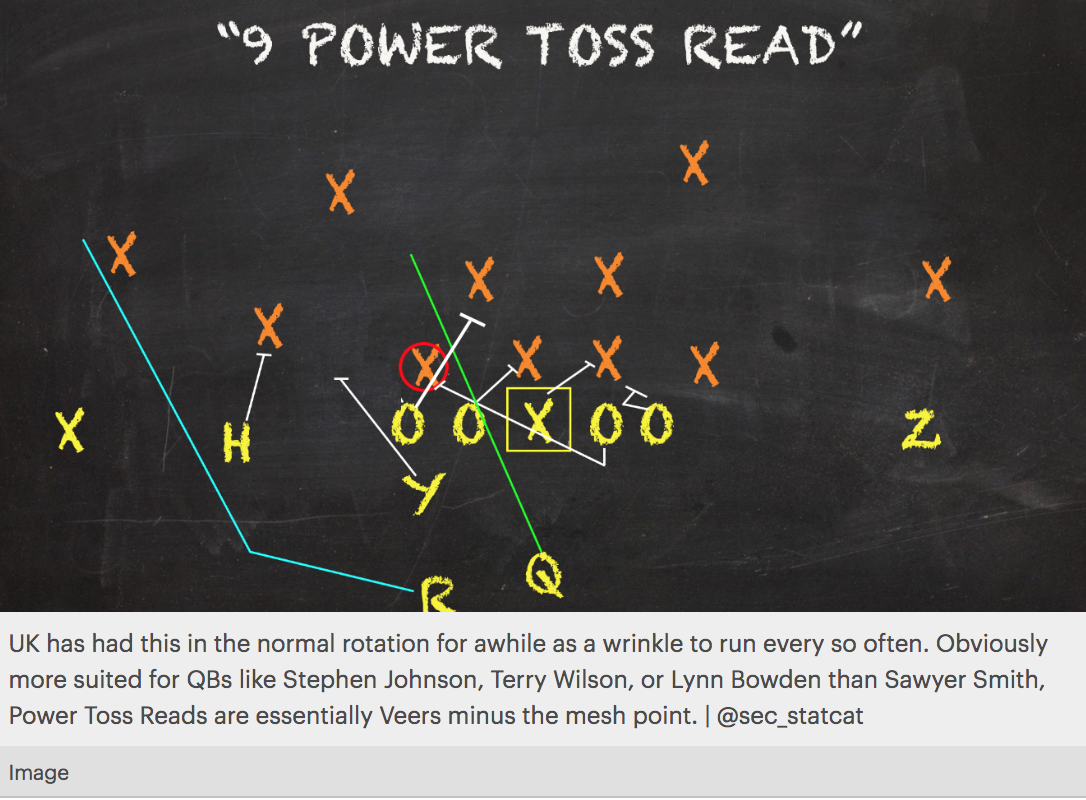
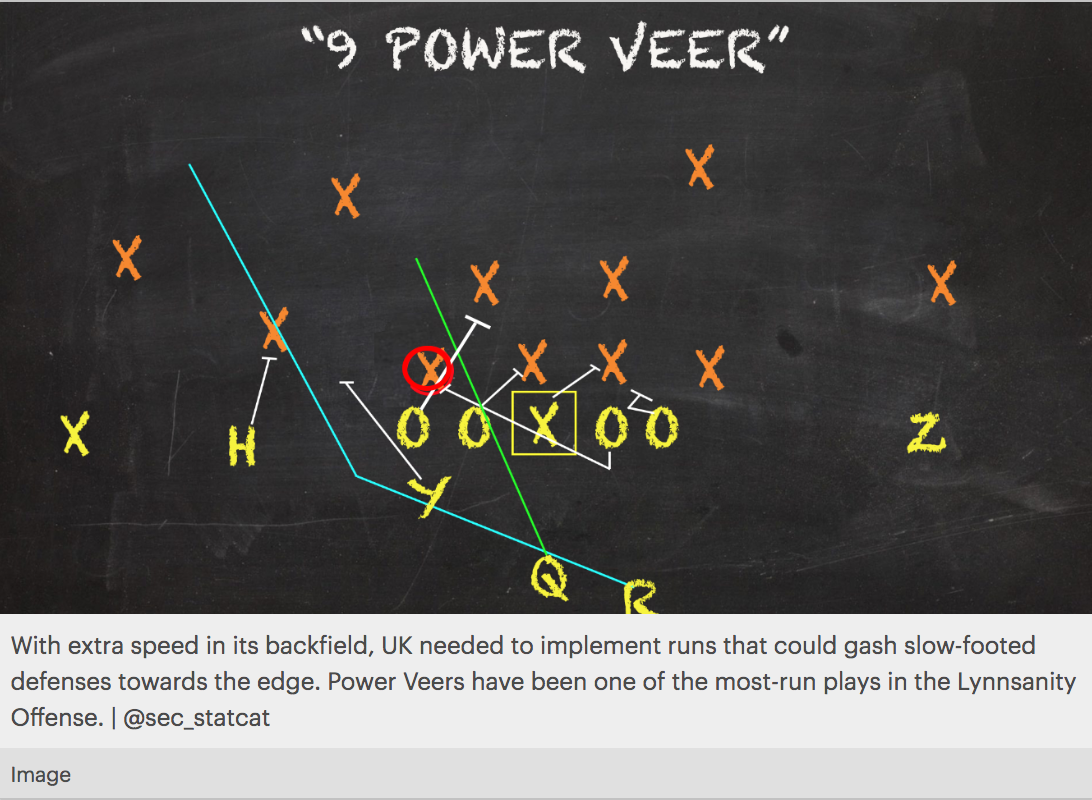
SEC teams such as Auburn and Mississippi State have had success this season using power concepts to get their QB’s involved in the run game with Inverted Power Veers and Power Toss Reads. UK has sporadically called these in the past under Gran. Remember, Terry Wilson had a few good gains on the toss read variety against Florida in the Swamp last season. Its only natural for offenses to try and get their speed towards the edge of the formation and these plays aim to do just that.
Functionally, Inverted Power Veers and Power Toss Reads are the exact same play with one difference between the two: the mesh point between the QB and RB. Unlike normal reads plays that call for the running back to work towards the playside action with the QB keying on a backside defender, these Outside Power Reads are designed for both potential runners to attack playside with a hard crease set by a backside puller.
On Veers, the back still crosses the QB’s face en route to the edge. On Power Toss Reads, the back often is already aligned to the side he’ll be running his toss action hence not required to mesh with the QB in order for him to make his read.
If the defense overflows outward, the QB keeps the ball and hits the crease created by the puller north and south. But if it is lagging or hesitant to respect the edge, the back gets it whether it be via a quick pitch or a normal shotgun handoff.
UK only called five Outside Power Reads on the year before Week 7. In the Lynnsanity Offense, Power Veers have been called 17 times with Power Toss Reads getting an additional 9 looks making them the second and sixth most-called design since the bye. Power Toss Reads saw hefty usage against Arkansas but have only seen one rep since. Veers have been far more consistent with the presence within UK’s script.
Power Toss Reads have been a little worst than their brother mostly because of the lack of big gains running the look. From Weeks 7-9, they have a 44% Success Rate on a 4.22 yards per attempt but haven’t accounted for a gain over ten yards. But as a favorite look against Arkansas, it helped spark two good completions. A RPO off one found Allen Dailey Jr. for a conversion, and a play fake using that action created Justin Riggs’ 31 yard gain.
Power Veers have posted a 47% Success rate on 5.59 yards per attempt. But the subconcept’s success has diminished each passing week as has its ability to spring splash runs. Despite being responsible for three gains of 10+ against the Hogs, it only gained one explosive carry against Georgia with zero last week against Missouri.
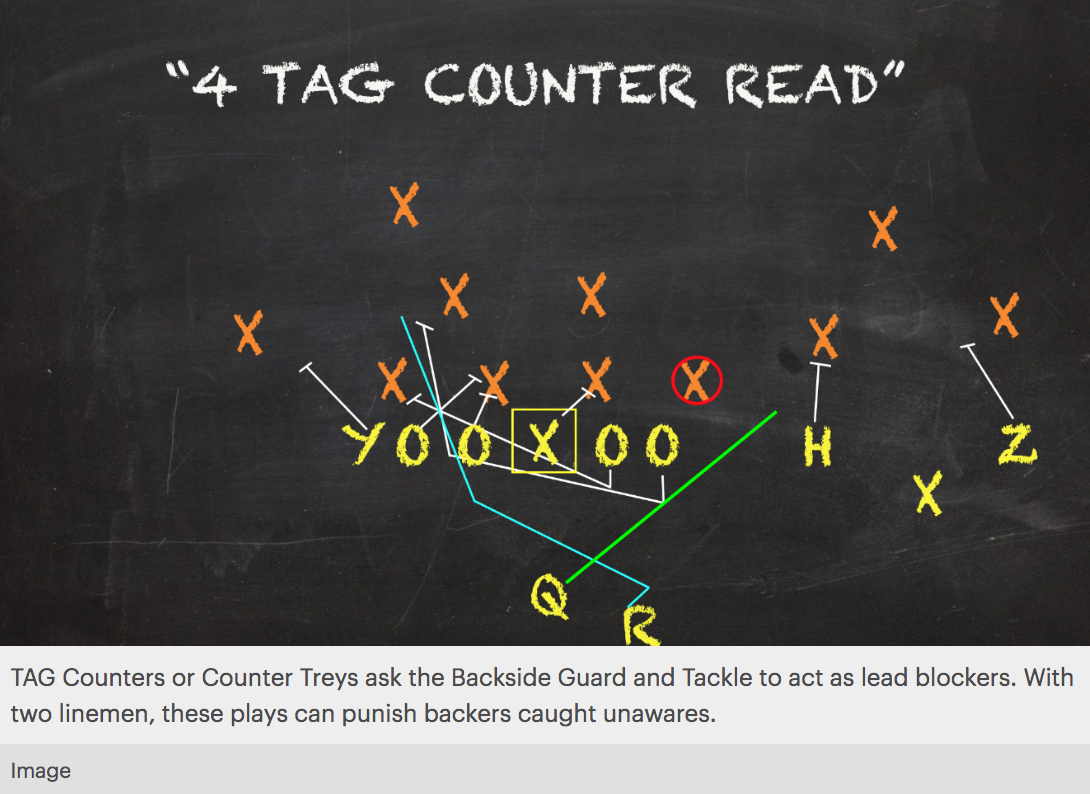
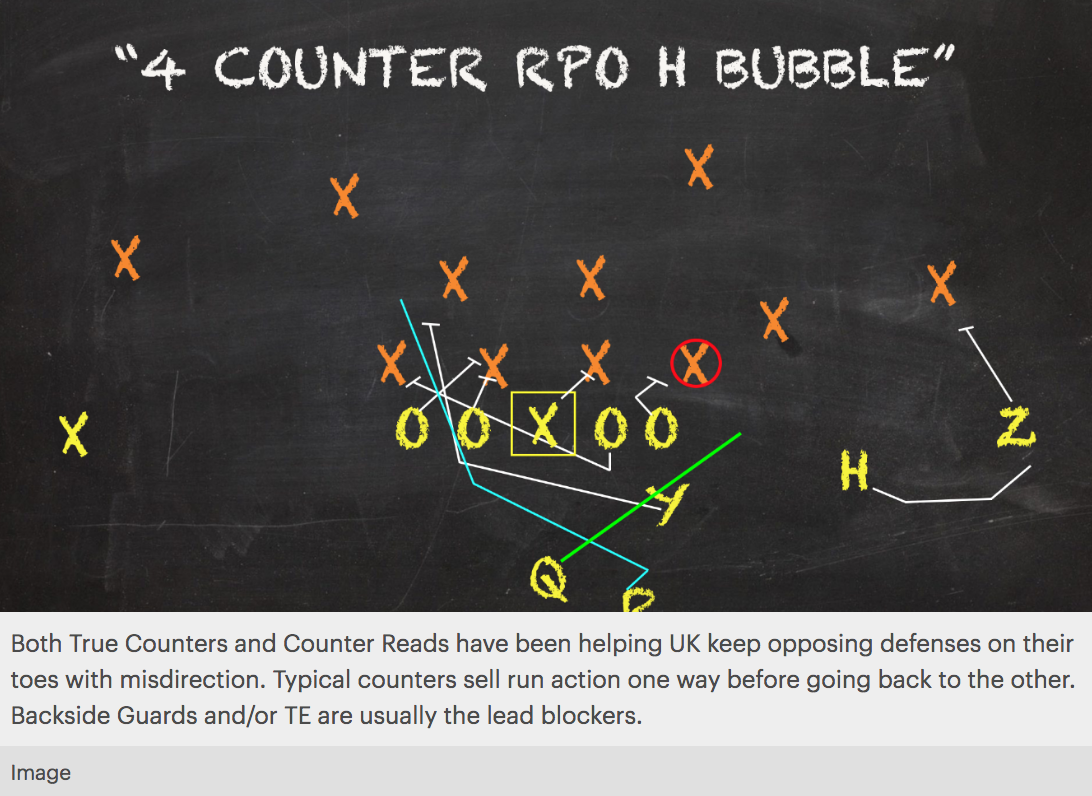
With such a heavy-handed approach, misdirections through counters have been a big part of the Lynnsanity Offense. First, let’s talk about the ones of the basic variety. When Terry Wilson and Sawyer Smith lead the offense, 18 Counters were called and were one of the Cats’ best looks with volume. Consisting of over 4% of total calls in that span, Counters were successful on nearly 60% of reps from Weeks 1-6. Most were reads plays. But they really weren’t that featured on as much as zones.
Over the last month, UK has called nine Counters for their backs. Six have been traditional designs with the backside guard and/or offset tight end acting as pullers. Three have been of the tackle and guard - aka TAG or Counter Trey - variety.
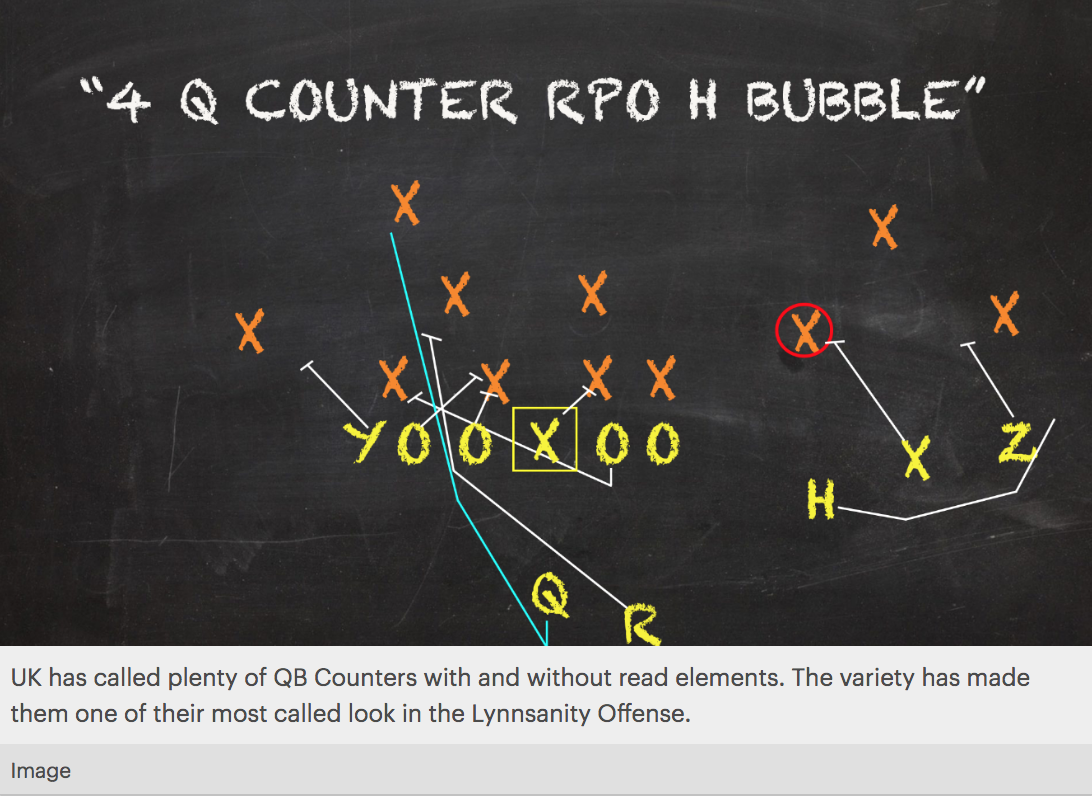
But with Bowden obviously being the focal point of the Lynnsanity Offense, plenty of misdirections have been drawn up to get him going.
Gran has called 12 QB Counters with an additional six QB TAG Counters. While half of the former exhibited read aspects, all of the latter have utilized option elements either through handoff mesh points or RPO outlets.
Though a necessity to keep defenses on their toes, Counters have not been overly successful for the Lynnsanity Offense. Looking at traditional variety, True Counters have a 31% Success Rate on 4 yards/attempt while ones with read aspects have been even worse. Those have only been successful on 29% of tries and have averaged a mere 2.89 yards/attempt.
Counters where the backside Tackle and Guard have pulled have been there best. Like I said, all of these have been reads of some sort. Two-thirds of TAG Counters’ reps have met their goals averaging over 15.5 yards/attempt.
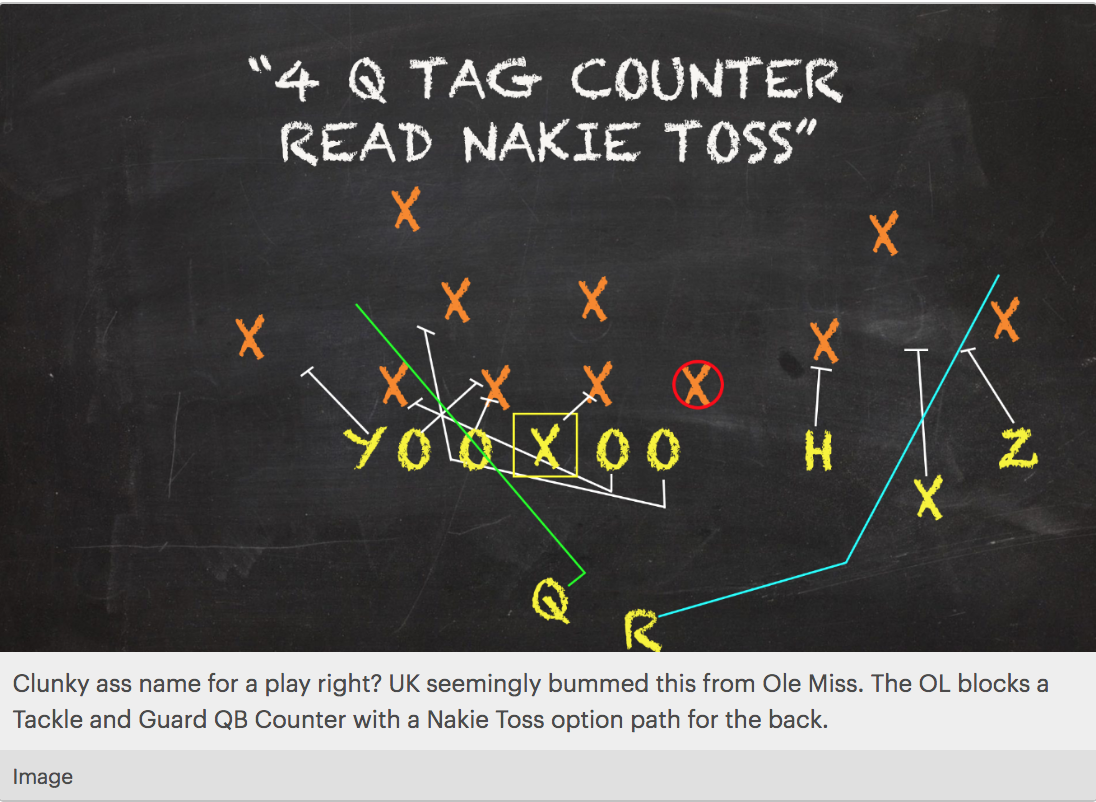
Using a wrinkle they seemingly bummed from Ole Miss’ struggling and sputtering attack, Kentucky has combined a TAG Counter for Bowden with an option to toss it to the back on the edge. The line blocks its typical rules and the outside receivers are the only blockers should the back receive the pitch.
They debuted this look for the first time since Gran has been their playcaller last week against Missouri. Execution was nearly flawless. Overall, this look got five reps. On the four where Bowden kept the ball towards this TAG Counter action, Kentucky racked up 92 yards. Two carries topped 30 yards with one resulting in a touchdown. For a run play, that is otherworldly explosiveness. It’s lone blemish was the only time the back received the toss option. On that play, Chris Rodriguez netted one yard. But with a 80% Success Rate and a 23 yards/attempt, I think the Cats were more than okay with that look’s production.
While the first gained five yards, Bowden popped a 51 yarder the very next play followed by a 15 yarder the snap after that. Game over. The Good Guys won.
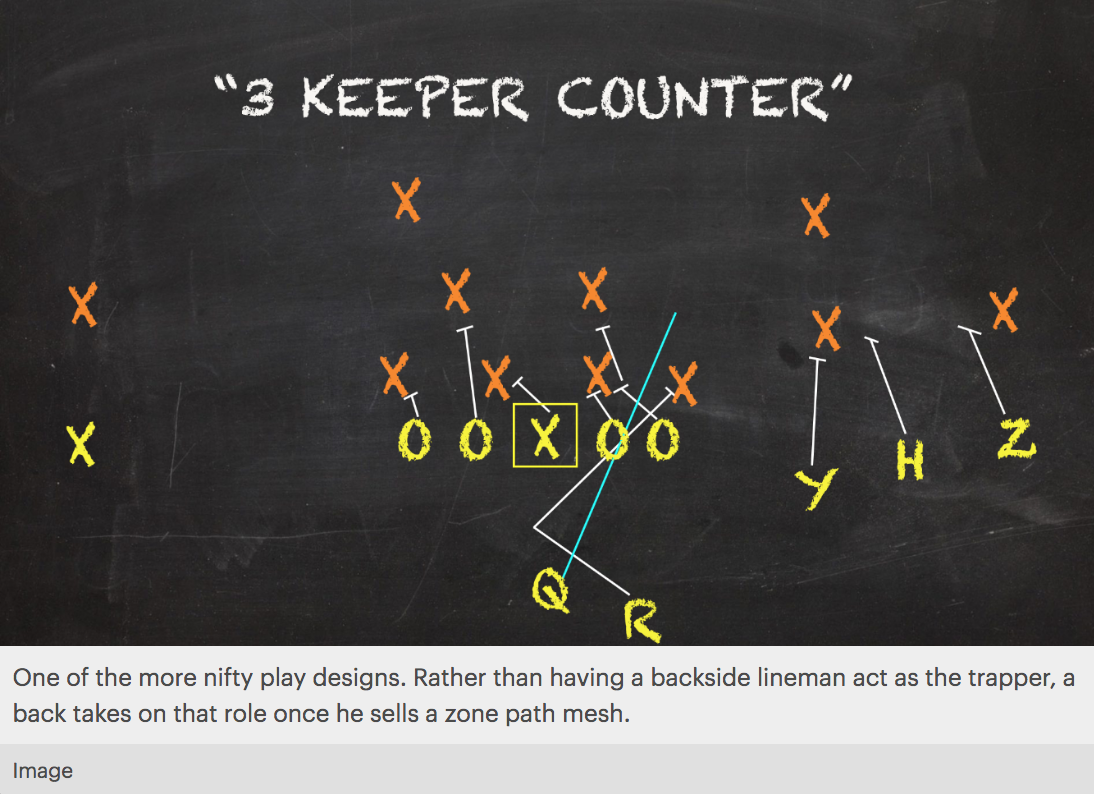
Unlike the Counter plays I talked about above, this is a version where no backside blockers pull to set up the edge for the ball carrier. That role is taken on by the back. Yes, the back. But there’s another twist. Not only is the back the trapper, but he does so AFTER faking an inside zone path.
Let’s back up a bit for a second. As aforementioned, UK’s favorite subconcept has been the Inside Zone Slam Read. So this kind of design is perfect for countering defenses expecting this. By “meshing” with the QB and with the OL blocking a normal inside zone flow, all is left for the back to do is bend back and set the edge for the QB keeper. You can probably guess why I decided to name this look a Keeper Counter.
The Lynnsanity Offense has featured the Keeper Counter 10 times with 3 reps netting over 10 yards. Since being installed, this look has a 60% Success Rate and a 10 yard/attempt average. Though heavily inflated by its production in the Arkansas game, this look has proved to be effective within UK’s heavy Inside Zone Read scheme.
The pass game has lacked the same creativity and ingenuity of the run game. Instead of crafting up clever screens or tagging manbeating routes via RPOs for Bowden to get easy completions, this staff has opted to let their aerial assault live on a wing and a prayer. As the BBN has seen, the Lynnsanity Offense is as shot happy as a drunk on St. Patrick’s Day.
With the ample amount of Cover 1 and Cover 0 this offense has face in defense’s attempts to curb the Cats on the ground, their wideouts have been getting a lot of one-on-one chances. However, Bowden’s connections with his targets downfield have been as spotty as phonecall reception in an elevator.
The concepts seeing the most love through the air have been Shot Variations (10), All Verts (3), Floods (3), and Utah Passes (3). Of the 10 Shots, five have been Solos (single deep routes usually a fade, streak, or post) and four others have been Fade combos.
No SEC passer has a higher average depth of target over the last month than Bowden. His clip of 18.6 yards is almost double the SEC average from Weeks 7-9. In the same span, Bowden’s passing ranks in the SEC’s Bottom3 in Completion%, Accuracy%, Depth Adjusted Accuracy% while being in the Bottom5 in Success Rate with the 6th worst First Down + Touchdown Rate. With all the previously mentioned information, I’m sure you can guess he also has the league’s lowest RPO Throw Rate. Plus, he is one of seven SEC QBs since Week 7 without a screen attempt. Though an athlete by trade, a passer he is not. And the staff seems okay with that.
So let’s do a quick recap before forging ahead with our conclusion. UK has gone all in on Lynn Bowden to fuel it’s offense. Previously making him the SEC’s most targeted receiver, Kentucky has made Bowden the conference’s most featured offensive player. With a number of versatile run designs and basic bombs, UK has won two out of its last three games.
But what if I told you despite the winning, the Lynnsanity Offense’s efficiency is actually worse than the product the Cats put out Weeks 1-5?
The Lynnsanity Offense has morphed a fairly pass-happy team into the most grounded approach in the SEC. In Weeks 1-6, UK had the 5th highest Pass Rate in the conference with 56.4%. In Week 7-9, UK has a Pass Rate of 24.7% — the lowest in the conference.
With drastic increase in focus, clocks have had no issue dripping steadily through their ball games. As a result, UK’s number of plays run per game has shrunk. Before their first bye, the Cats ran the 8th most plays with a 69.2. Since Week 7, the Cats have averaged 56.7 offensive plays, which is the fewest in the SEC.
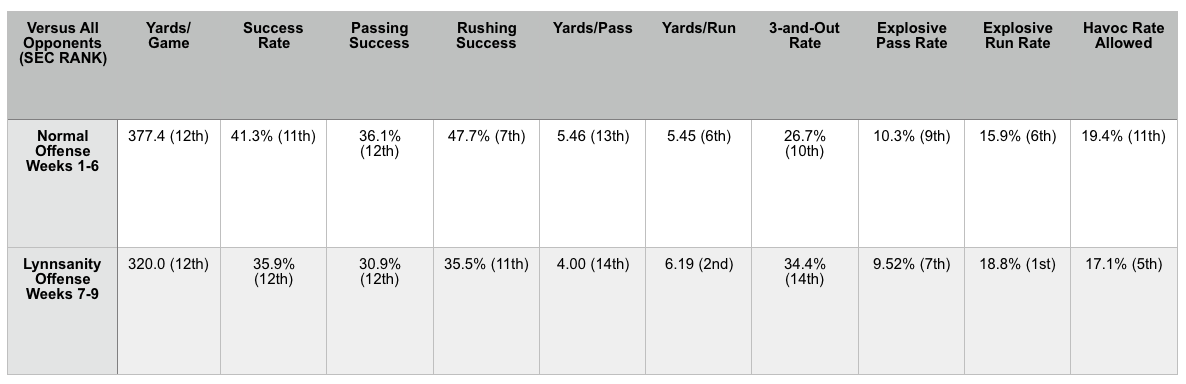
With less plays being run, it’s not a shocker UK would average less yards per game due to less chances. But, that’s a volume number and not an efficiency number.
Gran’s unit’s Overall Success Rate has dropped from 41.3% to 35.9%. While obviously passing was bound to be negatively affected, UK’s Rushing Success Rate is actually much worse off despite having the SEC’s second highest yards/rush over the last month. Not that passing hasn’t been hurt, because it has. But with how the Lynnsanity Offense is setup, it has been pretty remarkable Kentucky has been able to win despite moving backwards in terms of rush efficiency.
But here’s the thing: Bowden is one of the most electric players in the country when he has the ball in his hands. You might have made this conclusion with UK’s rise in yards/rush and decrease in Rushing Success Rate, but Bowden is hit or miss. The Cats have catapulted from 6th in Team Explosive Run Rate in Weeks 1-6 to 1st over the last three games. This is all because of the magic Bowden’s legs have created as of late.
Of SEC rushers with at least 20 designed carries, Bowden has the best Explosive Run Rate and is the only player in the conference with a clip north of 30%. Bowden is also in the Top5 in Broken Tackle Rate and Top10 in percentage of runs that gain a First Down or Touchdown. For what it’s worth, Bowden’s Rushing Success Rate is right at the SEC average.
Yet despite the potency and big-play potential, the narrowed-focused offense that this has become has been easy to nail from down-to-down for Defensive Coordinators. UK’s offense, already prone to suffering three-and-outs, dropped from 10th to last in the SEC.
To be frank, Kentucky could not win this way if it’s defense didn’t play its part. Again, it’s not like they had a sterling start to this year. The tweaks and mentality Stoops and Brad White have implemented since the first bye have been very encouraging.
Sure, they played one of the worst offenses in the SEC at Kroger Field, combatted a Georgia team in a car wash, and took advantage of a Missouri team seemingly in a tailspin. But you know what? UK’s Defense has been one of the best in the conference over the last month.
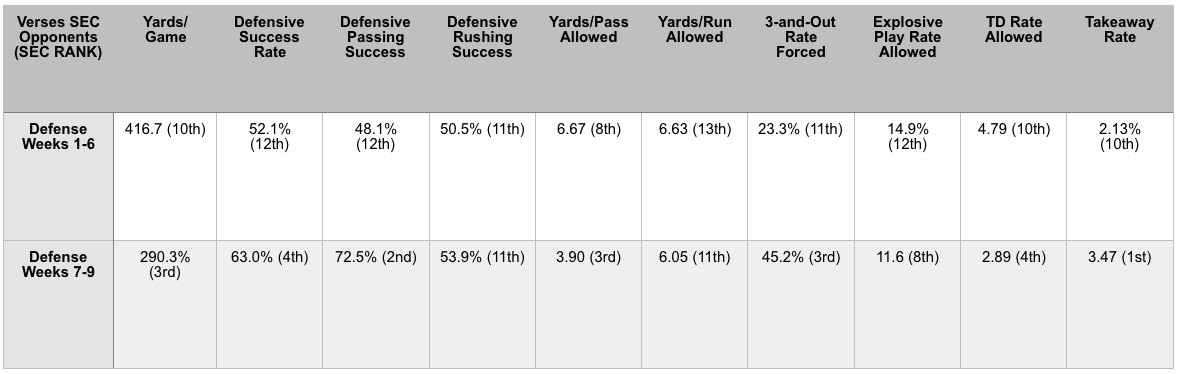
While UK still is a rather bad defense against the run, this unit has been one of the best in the conference versus the pass since Week 7. Sure the elements have played a massive part in their ascension up the rankings, but praise is due. It’s not a great recipe for the Lynnsanity Offense to play from behind. However, this defense has kept games manageable.
With the increase of runs on the other side of the ball, UK’s Defense also saw a decrease in their average plays/per game. And like their offensive counterparts, they have played the least amount of snaps on average over the last three games in the SEC.
They have forced so many three-and-outs as of late that their clip has almost doubled compared to their rate before the first bye. Plus, UK’s Defense has tightened up on explosive gains for opponents and allowing TDs while generating the SEC’s best Takeaway Rate in October.
While the early pass happy-approach paired with a pitiful defense never quite matched Stoops’ DNA, winning in this fashion with a stifling pass defense, takeaway machine, and ground-control - yet highly explosive offense - has to elate him thoroughly. Clearly, Big Blue’s margin of error too thin for my liking. Questions remain on if the Lynnsanity Offense and this newfound defense is sustainable or not.
Exiting its second bye, UK is right at .500. Getting that bowl bid is very much still in play.
For Jimmie and Joes, X’s and O’s, and any stat you wanna know, visit SECStatcat.com