2020: Regular Season Offensive Superlatives
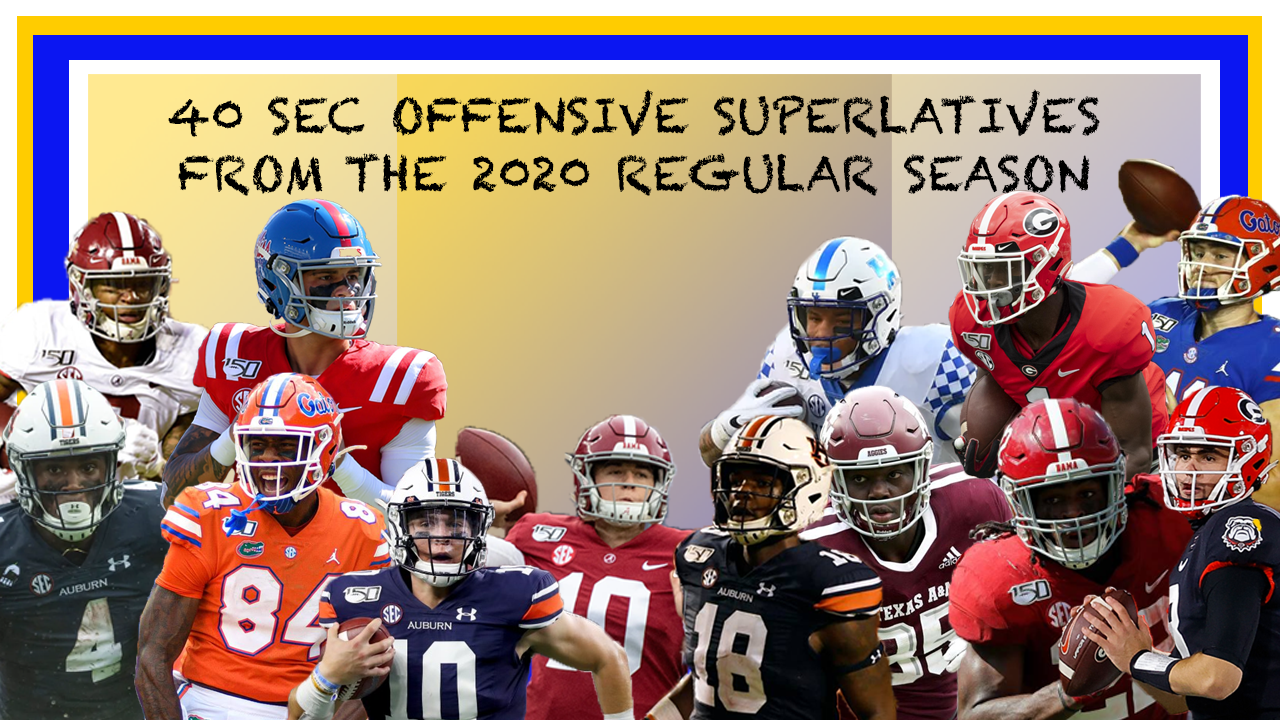
The SEC's 2020 Regular Season Offensive Superlatives
Passers
Most Accurate Passer: Feleipe Franks
While Arkansas really likes to tag routes on top of their run schemes, Feleipe Franks’ precision on nonRPO or screen patterns was the SEC’s best. Franks was the only SEC passer to top 60% in Depth Adjusted Accuracy on dropback attempts. DAA% applies more weight based on how far the ball travels downfield. Mac Jones actually has the best raw Accuracy%, which functions like Completion% and disregards depth of target. Franks’ 62.8% clip only came up a few points short of Joe Burrow’s 64.6% Depth Adjusted Accuracy from last season. His bottom line was hurt by a conference-high 13.6% Drop Rate. Under the gun often, Franks still finished in the SEC’s top5 in Interceptable Pass Rate and Defender Disruption Rate. But the next superlative hammers home why the depth-adjusted element adores Arkansas’ passer.
Best Deep Thrower: Feleipe Franks
Feleipe Franks was money on 16 of his 25 deep attempts this fall. His 64% Accuracy on throws 20+ yards downfield was the highest in the SEC by over 16 percentage points. His 60% Completion/Success Rate also was tops. Despite his bucket throws, Franks only directed 10.5% of his attempts deep — good for 4th lowest in the conference. Doing quick math, you can see he averaged only 2.5 such throws/game. Play action was used on 72% of his shots — 13 points more than the conference’s play fake king Mac Jones. Still, his prudence paid off. While four were interceptable, a defender only got his mitts on one of his deep throws. Plus, he was one of three SECers with at least 20 deep attempts to not log an interception on such targets.
Sideline Painter: JT Daniels
JT Daniels still has his dissenters, but there’s no denying his results. Along with finding explosive gains, his accuracy down the sideline certainly provided Georgia an element its passing game had been lacking. On dropback sideline throws beyond the line of scrimmage, Daniels’ 66.7% Completion and 60% Accuracy each are tops within the SEC. And despite his abbreviated playing time, his nine First Down+TD tosses in this context by volume crack the conference’s top5. Daniels league-leading 83.3% Adjusted Completion is nearly 20 points higher than the next man’s in line. Plus, no other SECer directed a higher percentage or their attempts towards the sideline than his 18.5% clip.
Mr. Quick Trigger: Colin Hill
With South Carolina overly sticking with a West Coast passing scheme under Mike Bobo, grad transfer stopgap Colin Hill ended up averaging a league-low 2.39 seconds to throw on dropback attempts. Though a beat slower than the SEC’s leaders last season, Hill was the only conference passer with a clip under 2.42. South Carolina’s line allowed one of the highest Pressure Rates, but Hill himself only saw an average amount of duress relative to the rest of the SEC. For what it’s worth, the Gamecock also owned the SEC’s quickest time to throw on pressured dropbacks with a 2.77 clip.
The Mona-Lisa Saperstein (The Wooooorst): KJ Costello
KJ Costello came into this fall with some decent expectations. But considering he was benched midseason in favor of a noodle-armed freshman, it’s safe to say those aspirations largely failed to be met. Two years ago, he was one of the Pac-12’s most prolific passers. And though he entered 2020 coming off an injury in an entirely new environment, his pairing with Mike Leach was seen as a element that could help the Air Raid get off the ground immediately in Starkville. While Week 1’s win vs. LSU showed what might have been, Costello soon soured and looked overly inept in SEC play. Of SEC QBs with at least 60 touches, he was the only one with a negative Expected Points Added/play. His 27.1% First Down+TD Rate was the league’s lowest, and his 13.8% Interceptable Pass Rate was the highest. With a bottom3 Y/A, only UK’s Terry Wilson posted a worse Success Rate than his 39.1% clip.
The Light Lifter: Bo Nix
This award probably should go to Feleipe Franks, but I’m giving it to Bo Nix. As far as passing goes, Franks tops Nix in yards, touchdowns, and screen+RPO throw makeup. But the gaps aren’t too far apart. Nix has tossed the SEC’s most such attempts and completions by volume. Plus, Franks found efficiency as a deep passer. The Tiger didn’t. 2019’s SEC Freshman of the Year finished in the bottom2 in within the SEC in Completion% and Accuracy% on throws 10+ yards downfield in his lone year under Chad Morris’ tutelage. With Nix’s failed to progress in 2020 as a dropback passer. So, he was ultra-reliant on screen+RPO throws to buoy his numbers. Looking at Nix’s overall profile, he is bottom3 within the conference in Air Yard makeup with a 38.4% clip. The sophomore saw 31% of his yards, 34% of his attempt, 44% of his completions, and 27% of his touchdowns come off screen+RPO plays. And that’s excluding his production in the ground game…
Mr. Money Down: JT Daniels
JT Daniels only logged 18 3rd Down attempts in SEC play. Despite that limited sample, he overwhelmingly was the SEC’s most efficient passer on the money down. His downfield accuracy hasn’t been great in these spots, but his 72.2% Success Rate, 27.8% Explosive Pass Rate, and 83.3% Completion, and 14.6 Y/A lead the SEC by significant margins. A third of his 3rd Down passes resulted in a tuddy. While you don’t want to play too many 3rd Downs, it’s always nice to have a passer with the knack for moving the chains. His 3rd Down play has greatly helped his Expected Points Added/Play hold the SEC’s silver medal entering bowl season.
Scrambler: Matt Corral
This time last year, many were propping up John Rhys Plumlee as the best scrambler in the SEC. With his dazzling highlights and speed that jumped off the screen, that stance wasn’t a hard one to take. Though mobile himself, Matt Corral was the more refined passer of the pair, which ultimately give him the inside track to win back the starting gig in Lane Kiffin’s first year. Flash forward to today and no SEC passer has accumulated more than Corral’s 248 yards on sacks+scrambles nor his 16 first downs+touchdowns. By a rate basis, 38% of Corral’s scrambles went for either a conversion or a score and 52.4% resulted in success. Adding to his top-notch backyard ball profile, Corral also accumulated the SEC’s 4th-most passing yards and first downs+TDs on a league-high 58.4% Success Rate on throws outside the pocket.
Lucky Duck: Kyle Trask
With an overly blah run game and a defense that was frequently a let down, Kyle Trask often pressed. Either due to his desire to spark a big play or overwhelming trust in his receivers, the Gator hasn’t been a stranger to testing tight windows the last two seasons, which has resulted in a bunch of interceptable pass attempts. Keeping the ball out of harm’s way was one of his major red flags entering the season. Last year, Trask’s 27 were the SEC’s second-most. This year, only Vanderbilt freshman Ken Seals has tossed more than his 31. While other SECers see anywhere from 20%-70% of their interceptable passes result in picks, Trask’s rate is a mere 16.1%. Only midseason replacements Max Johnson and J.T. Daniels put up a lower clip. But considering the volume of passes Trask has logged in 2020, he’s very fortunate to not have suffered from more turnovers through the air. If that had occurred, no chance he would’ve been a Heisman finalist.
Midrange Master: Mac Jones
Though Mac Jones’ profile entering the year was a bit murky, one of his apparent strengths was his elite intermediate passing ability. As pinpoint as last year’s Heisman was on midrange attempts, Jones’ numbers even outdid Burrow’s in these spots. His chops delivering great passes on throws between 11-19 yards downfield carried over to 2020. Of SECers with at least 20 intermediate throws, the Tider’s 71.3% Accuracy is the conference’s best by 6 percentage points. No one else sports a Depth Adjusted Accuracy or Completion% that are both in the 70’s. He is one of two SECers with a midrange Y/A over 12.9. Despite logging 20 less midrange attempts, Jones only trails Kyle Trask’s league-leading 1,202 yards and 11 TDs by 100 and one TD, respectively. Jones only threw six uncatchable intermediate targets this year. By a rate basis, his 7.5% clip was the lowest in the conference and the only one in the single-digits.
Best Behind the Chains: Mac Jones
Though Steve Sarkisian and his troops mostly have stayed on schedule this season, his passer has been the SEC’s best when behind the chains. Despite the conference’s 4th-lowest percentage of passes in these spots, Mac Jones sports the top First Down+TD Rate (50.8%) and Success Rate (58.2%). Plus, the Alabammer owns the SEC’s second-best Uncatchable Pass Rate (9%), Depth Adjusted Accuracy (60.9%), Interceptable Pass Rate (4.1%) and Y/A (13.1). Jones mostly has maximized his chances. Along with his sterling stat line, he only has suffered from one sack without a single throwaway behind the chains entering bowl season. Even when facing a lot of yardage in the shadow of his own goalposts, Jones showed immense poise. Inside his own 20-yard line, he has completed 14/15 passes for a league-high 60% First Down+TD Rate.
Inside Man: Matt Corral
With the likes of super slot Elijah Moore and the versatile Kenny Yeboah, it shouldn’t be a major surprise Matt Corral targeted inside receivers often. Seeing that he owns the SEC’s top Success Rate (68.3%) and Y/A (13.9) targeting inside pass catchers, the high usage is justified. Along with the third highest percentage of attempts directed towards these positions in the conference, Corral put up a top3 Explosive Pass Rate, Depth Adjusted Accuracy, and First Down+TD Rate. By volume, only Kyle Trask logged more yards, conversions+scores, and attempt. Both of his top targets are due to depart this offseason, so it remains to be seen if Corral will keep looking inside in 2021.
Mr. Clutch: Mac Jones
Mac Jones and Alabama’s offense hasn’t been tested much in 2020. With the nation’s best offense, they have dictated the majority of its drives and have scored a lot of points along the way. Jones has only logged 36 attempts when the Tide have either up or down 14 points in the second half this fall — good for 13th most in the conference. When asked to dropback, No other SEC can challenge Jones’ numbers in these spots. He’s completed 89.2% of his throws with 59.5% of them resulting in either a conversion or a score on a 14.0 Y/A. Jones has only tossed three uncatchable attempts and one turnover-worthy ball in this parameter. Perhaps that changes in the playoff when contests are bound to be tighter. But as of now, Jones has performed wonderfully in the clutch.
Back-shoulder Specialist: Kyle Trask
Kyle Trask puts a lot of trust into his pass catchers. Along with his proclivity to test tight windows, Trask has tossed an SEC-high 13 back-shoulder fades entering bowl season. Arguably the ultimate timing route, it’s nearly impossible to defend when a passer and his target are one the same page,. Seven of his back-shoulder fades were directed towards Kyle Pitts; four were completed. Trask logged five tuddys with this route without a single interceptable attempt. Bo Nix was the only other SECer to throw a back-shoulder TD and he only had one. Trask (138) and Nix (146) were the only conference QBs to accumulate over 100 yards with back-shoulder fades.
Tight Window Targeter: Ken Seals
Vanderbilt’s offense isn’t stacked with burners or difference-makers. With a freshman passer, undersized line, and mediocre receiving corps, the Commodores were at a constant struggle this season to get their air attack off the ground. While the schemes helped Vandy improve year-over-year, this unit was still overly toothless. No SEC QB had to direct a higher percentage of his attempts to tight windows than Ken Seals’ 30.6% clip. At least he managed to complete half of his passes — a feat only a few other SECers accomplished. Obviously, the results weren’t great. Seals finished below the conference average in Y/A, Success Rate, Depth Adjusted Accuracy%, and First Down+TD Rate on contested attempts. Among his 32 interceptable pass attempts on the year, 22 occurred on tight-window targets.
Road Dog: Kyle Trask
As the SEC’s passing volume king, Kyle Trask is going to own most of the traditional metrics no matter how they’re sliced up. That said, I was a little surprised to see he leads the conference in passing yards and touchdowns as a visitor when his team has trailed. Though others logged more completions and attempts, Trask tossed for 150 yards more than the next SECer in line. Only Will Rogers topped his 46 passing first downs in this context. Along with the sturdy volume numbers, Trask’s play made sure his team could rally on the scoreboard. With the conference’s 2nd-highest average depth of target in these spots (10.9), Trask is either first or second within the SEC in Success Rate (57.7%), Explosive Pass Rate (17.8%), Yards/Attempt (9.80), and Depth Adjusted Accuracy (61.8%). Of 15 conference passers with at least 30 such tries, Trask is one of three to not log an INT on the road.
Catchers
The Creators: George Pickens, DeVonta Smith, Kyle Pitts
I hate to divi up this award to three players, but they all are equally deserving. Creating completions by going above and beyond is one of the best ways for a pass catcher to provide value other than consistently being on the receiving end of touchdowns. Whether its winning a crazy jump ball, toe tapping along the sideline, or making an unreal adjustment, George Pickens, DeVonta Smith, and Kyle Pitts separated themselves from the rest of the pack in this regard. Pickens owns a conference-best 10.2% Creation Rate across his 49 targets. Smith created the most catches and touchdowns with seven and three, respectively. Kyle Pitts was the best of both worlds posting six catches (two TDs) and a 9.23% Creation Rate.
Butterfingers: Seth Williams
It’s one thing to drop a pass when a dude crunches your backbone or you’re traveling through traffic. The excuses are harder to accept when the drops occur when you’re wide open. Though Seth Williams can create catches for himself on 50/50 chances, he has consistently lacked concentration on gimme opportunities during his time on the Plains. He entered 2020 with 10 uncontested drops on his resume. This year, Williams logged 6 — tied for most in the SEC. No other conference receiver topped his alarming 13.6% such Drop Rate. Though he and his running mate Anthony Schwartz were no strangers to abundant inaccurate targets, it was undoubtedly dispiriting for Bo Nix to see one of his most trusted pass catchers frequently exhibit butterfingers.
Electric Outlet: DeVonta Smith
As phenomenal as Devonta Smith is as a up-and-down pass catcher, he’s always been a potent playmaker no matter where or how he’s utilized. As far as screens and RPOs go, no other SECer topped Smith’s 10.7 Yards/Target, 44.7% First Down+TD Rate, 34 catches, or 407 yards. While others are more reliant on non-dropback attempts to fuel their numbers, Smith was still given a healthy amount of outlet usage. About a quarter of his yards and touchdowns and a third of his yards came from these designs. Though an increasingly tertiary element to Alabama’s offense, Steve Sarkisian is always keen on capturing easy yards on the perimeter with his go-to targets.
Duke of the Double Move: Elijah Moore
Elijah Moore didn’t see the most targets on multi-break routes this season, but his 39.6 yards/target and 85.7% Catch Rate are tops within the SEC entering bowl season. With the heavy slant usage in Ole Miss’ offense, sluggo patterns were Lane Kiffin’s go-to deep double move for his primary pass catcher. Of Moore’s 277 yards off multi-break routes, 206 came off slant+gos. The rest of his yards came off a juke and out-and-up. The latter accounted for one of his two tuddys. The only deep double move Moore failed to haul in was a blaze out — essentially a deep pivot route — versus Arkansas that resulted in an interception. Only Kadarious Toney and DeVonta Smith matched Moore’s four explosive catches on multi-breakers within the SEC.
Safety Valve: Elijah Moore
Elijah Moore fielded his fair share of targets in 2020. Only DeVonta Smith sports a higher share of his team’s pass attempts than Moore’s 36.1% within the SEC. Already a receiver a QB can lean on, Moore has caught all but one of his targets when his passer faced pressure. His lone non-catch was an uncatchable throw. Owning the highest such Target Share in the SEC with a 29.2% clip, Moore is tops in Y/T (16.6), Success Rate (71.4%), First Down+TD Rate (64.3%), and Depth Adjusted Catch Rate (100%) within the conference. Along with his wonderful efficiency in these spots, Moore’s 232 yards and 13 catches are the second most by an SEC receiver this season.
Off-Target Catches: Elijah Moore
This section of the superlatives has taken a very Hotty Toddy turn with the 3rd straight award going to Elijah Moore. But his ability to corral wayward passes justifies another piece of hardware. Both his raw 46.2% Catch Rate and 68.7% Depth Adjusted Catch Rate on inaccurate targets sit atop the conference. The latter omits uncatchable targets. In that context, Moore hauled in 12 of his 16 such chances for 158 yards. Only one of his failed chances was a drop. Despite his prowess for catching off-target attempts, Moore saw one of the lowest Uncatchable Target Rates in the SEC. The only conference pass catchers with a lower clip than his 25.7% rate are Treylon Burks, Jalen Wydermeyer, and John Metchie.
Deep Specialist: Braylon Sanders
Braylon Sanders’ 20.2 average depth of target is an SEC-high entering bowl season. With that, no other player in the conference with at least eight tries has seen a higher percentage of their chances come off deep attempts than his 42.1% clip. In fact, no other SECer is north of 37%. Sanders’ 62.5% Catch Rate is top5 worthy and his 24.3 Yards/Deep Target is the conference’s sixth-best. All three of his non-catches were uncatchable targets. No other SECer posts a perfect Depth Adjusted Catch Rate on deep tries. For what it’s worth, Ole Miss’ main man Elijah Moore is next in line with a 92% clip.
It’s Not ALL his Fault: Jalen Brooks
If a receiver faces a good amount of inaccurate targets, odds are he’ll be near the floor in the efficiency metrics. That notion gets accentuated when the off-target throws are swapped for outright uncatchable attempts. No SEC receiver saw a higher rate of uncatchable targets across their profile than Jalen Brooks. The Wingate University transfer force fed aggressive opportunities as soon as he received eligibility midseason. Despite his offense’s strong desire to get him the ball, 42.4% (14/33) of his targets had no chance of being caught. As you might guess, no SECer enters bowl season with a lower Catch Rate (33.3%), Success Rate, (24.2%) Yards/Target (3.03) with at least 30 tries. While the wayward tosses certainly lowered Brooks’ ceiling, he himself left a decent amount of plays on the field per his six drops and forgettable 36.3% Depth Adjusted Catch Rate, which omits uncatchable balls.
Doing it on the Do-or-Die Down: Kadarious Toney
Kadarious Toney was the SEC’s king at catching passes on 3rd Down. In the spot where moving the chains is the utmost premium, the Gator posts a conference-high 27 targets, 21 catches, 356 yards entering bowl season. Plus, no SECer has managed to turn his opportunities into big gainers as well as Toney. His 29.6% Explosive Catch Rate and eight 20+ receptions hold the SEC’s gold medal. His splash plays have helped his volume display some efficiency. On 3rd Down tries, Toney is top4 in Yards/Target, top7 in Catch Rate, and top10 in Success Rate amongst SECers with at least ten money down targets.
Red Zone: Jalen Wydermeyer
With their physical traits often giving them mismatch advantages or heavy-set play actions helping them glide to uncovered parts of the end zone, tight ends are natural weapons to exploit in the red zone. Though a sneakily efficient pass catcher in his own right as a freshman, Jalen Wydermeyer provided immense value to his offense as a receiving inside his opponent’s 20-yard line this season. Of his ten red zone targets, six of his seven catches resulted in a TD. Along with that, his 80% Success Rate is tops within the SEC entering bowl season as is Wydermeyer’s 9.40 Y/T. Looking at his two non-catches in this area of the field, one was a drop and the other was an uncatchable attempt.
YAC Monster: Jaylen Waddle
Look, I’m going to level with you. This is Jaylen Waddle’s award. Even though he’s been sidelined for a few months, his stats at the time of his injury remain elite and deserve recognition. In 2019, Waddle led all SECers with a 12.0 yards after the catch average. Because he isn’t a damn fluke, he kept the good times rolling for the Tide’s passing game. Amongst conference pass catchers with at least 25 targets, his 11.2 clip this year too is a league-high even if it dipped a little year-over-year. Though overshadowed by Alabama’s other premier wideouts, Waddle has outdone all of them consistently in a number of metrics. Outside of his superb YAC figures, Waddle has led the conference in Deep Catch Rate three straight years with the SEC’s top Y/T (19.2), Success Rate (68.9%), and First Down+TD Rate (68.9%) in 2020. Plus, his ridiculous 1.42 Expected Points Added/play is significantly the conference’s best. DeVonta Smith owns the SEC’s next highest with a 1.01 clip. Behind Waddle’s 11.2 YAC average, the next closest non-running back was Kenny Yeboah’s 9.30 clip.
What have you done for me lately?: Kayshon Boutte
Though Kadarious Toney has been more successful and DeVonta Smith has used his recent highlight plays to fuel an upstart Heisman bid, no SECer has produced more yards or seen more targets than LSU freshman Kayshon Boutte over the last three weeks. His last two games especially have been incendiary as the Tigers’ desperately searched for wins and any sign of life to buoy its offense. Since Week 11, Boutte has accounted for over a third of LSU’s targets delivering 527 yards, 27 catches, and 19 first down+TDs. A third of his catches in this span have gone for 20 or more yards. His nine by volume are tied with Toney for most within the conference in this sample. All the while, no SECer has fielded as many as his six uncatchable targets the last three games — an element that has hurt his overall efficiency. Still, Boutte showed he will likely help anchor LSU’s pass attack for 2021 thanks to his clutch performances.
Give it a Little Tappy. Tap, Tap, Tap-a-roo: Josh Ali
Tap — or Utah — passes are glorified jet sweep handoffs. No offense leaned on this tactic to help get their primary receiver the ball more than Kentucky. With the one of the conference’s most ineffective pass attacks, the Cats had to resort to desperate measures to produce elements to aid its ground-heavy approach. Josh Ali was a recipient of 11 Utah targets for 94 yards. No other SECer topped nine and 42, respectively. Though only two moved the chains with one going for 20+ yards, Ali’s 8.55 Y/T on such designs led the conference amongst those with at least four tries. For what it’s worth, Ali’s overall Y/T on the year was 6.56. So while gimmicky, Utah passes certainly provided value for Ali and UK’s dismissible air game.
Rushers
Late Down Specialist: Chris Rodriguez
For the second-straight SEC season, Chris Rodriguez delivered one of the conference’s best rushing stat lines as far as efficiency is concerned. Entering bowl season, he leads the SEC in Yards/Rush (6.86) and Success Rate (68.3%). Though there are plenty of areas to his game to love, CRod is unabashedly phenomenal at moving the chains on 3rd and 4th downs. Overall, the Wildcat failed on only one of his 19 late down runs. Tank Bigsby is the other conference ball carrier with at least 8 such tries that has cracked the 90% Success Rate threshold. Typically aided by plenty of short porches, Rodriguez has converted all 15 of his chances with three yards or less to gain. Both of his late down TDs have come in short yardage situations. Among SEC backs, Rodriguez’s 18.6% attempt makeup from late down carries is the 3rd-highest.
Plain Breaker: Najee Harris
When discussing the SEC’s best rusher, Najee Harris is usually most folks’ pick. As the bell cow back for Alabama’s bruising run game, Harris is often looked upon to act as a closer for his offense. The low-red zone is typically the best place for backs to show off their value. While converting first downs are all well and good, points are the name of the game. They certainly are at a premium in the low-red zone. Harris enters bowl season with an SEC-high 24 goal-to-go carries. The Tider has managed to turn 15 of those tries into tuddys. But putting up laudable metrics by volume is only part of the equation. No other conference ball carrier with at least eight designed goal-to-go attempts tops his 62.5% Touchdown Rate or his 79.2% Success Rate. All three of his late down chances cracked the plain. The only blemish from his outstanding output in these spots was his lone career fumble vs. Ole Miss.
Hardest to Tackle: Kenny McIntosh
On a per carry basis, Kenny McIntosh was overly the hardest SEC ball carrier to tackle this season. Though his iffy workload made his usage inconsistent, the Bulldog broke 23 tackles across his 42 designed runs for a Broken Tackle Rate of 54.8%. No other conference rusher with at least 35 tries managed to break 43%. Other backs like Najee Harris or Kevin Harris might have been able to break more tackles by volume, but McIntosh simply was more efficient. Despite a bottom12 rush yards before contact average (1.93), McIntosh’s ability to bust out of defenders’ grasps allowed him to finish with the SEC’s 4th-best YAC average (3.67), 9th-best Explosive Run Rate (16.7%), and 10th-best Success Rate (52.4%). While early contact usually hinders a back’s production and efficiency, McIntosh showed he can do some heavy lifting if needed.
Stuffed: Rocko Griffin
Vanderbilt’s run game had a rough go of it in 2020. Behind a tiny, hodgepodge of an O-Line, no conference offense put up a worse Rushing Success Rate (37.9%) or yards before contact average (1.50) than the Commodores. They were 3x more likely to suffer from a negative carry than a 10+ gain. Rocko Griffin was the poster child for the ‘Dores’ futility on the ground. An insane 75.7% of his carries went for three yards or less. No other SEC ball carrier with at least 35 designed tries came close to topping that. The next two closest in line were NaQuan Wright and Snoop Conner who each put up a 62% clip. Griffin was second-to-last within the conference in average yards before and after contact. With such a high number of wasted carries on his resume, it shouldn’t be a shock that his -0.22 Expected Points Added/play represents the conference floor.
The Kylin Hill Cutback Award: Tank Bigsby
I track a decent amount of odd things. One particular metric I started charting was whether ball carriers stick with their blocking upfront or cut against the grain of the design. Kylin Hill was one of those backs that loved to go rogue and cutback. He singularly was the biggest reason I made this an “official” stat for us. After implementing the metric, Hill lived up to that reputation with one of the highest Cutback Rates in the SEC when it was all laid out. So to honor him, Hills name dons our running back cutback award. But with the Bulldogs adopting Mike Leach’s Air Raid and Hill’s midseason departure from the program, the door was opened for someone else to claim this superlative. Of conference ball carries with at least 35 carries, only three cutback more than 20% of the time. Two were Tennessee Volunteers. The other is our Cutback Champ: Tank Bigsby. The Auburn freshman went opposite his blockers on an SEC-high 29% of his tries. The reasons for this vary. But I will say when titan of a tight end JJ Pegues was used as a split zone edge setter, Bigsby was more inclined to look towards the backside of read options. Plus, this one-cut style created new angles for defenders, which helped the newbie break a good amount of tackles.
Most Power Yards: Kevin Harris
While most SEC run games anchor on zone looks, South Carolina is among the few that prefer power and gap schemes to fuel their rushing efforts. In this context, Kevin Harris — like most of South Carolina’s rushing attack — was generally all or nothing. He was just as likely to suffer a loss as produce a touchdown (10.8%) on power looks. Despite his inconsistency, no other SEC rusher tops his 565 power yards entering bowl season. Thanks to 15 explosive carries on these snaps, Harris’ 6.81 Y/C is a top4 figure within the conference. All in all, Harris’ power run makeup in both yards and attempts stands as the SEC’s 6th-highest.
Most Zone Yards: Tank Bigsby
Gus Malzahn’s offense, no matter who is calling the plays, frequently features Inside Zone Reads; common knowledge in this day and age. But with that, his backs get plenty of chances to wear down fronts with bread-and-butter B-gap zones. In addition to those and other zone looks, Tank Bigsby accumulated an SEC-high 675 yards. Living up to his namesake, Bigsby is a hoss of a ball carrier and was consistently one of the best tackle breakers in the SEC. This was accentuated in these spots. On zones, his 50 broken tackles and 48.5% BT Rate are both tops within the conference. The former is 11 more than the next man in line. Thanks to his ability to get extra yards after contact, Bigsby’s Yard/Carry (6.55) and First Down+TD Rate (42.7%) each sit inside the SEC’s top3.
Mr. “Catch me Outside”: AJ Rose
AJ Rose was overly a dismissible ball carrier in 2020. Though his volume figures were okay in a committee backfield and half of his runs ended in success, a 0.12 Expected Points Added/play was the definition of mediocre relative to the rest of the conference. But when Rose busted outside the bookends, he posted an SEC-high 13.1 Yards/Carry. His “Rosey” stat line in this context hardly stops there. Of rushers with at least 12 outside carries, no SECer comes close to challenging Rose’s 68.8% Broken Tackle Rate or 87.5% Success Rate. Both led the conference by about 12 and 20 percentage points, respectively. More prone to breaking off a big gainers, only Ainias Smith bests his 37.5% Explosive Run Rate on outside runs entering bowl season.
Set up to Fail: Malik Davis
Even when ahead of schedule, running is a less efficient way to move the ball than throwing. Turning towards the ground when behind the chains is typically a fool’s errand. Florida’s rushing attack slowly soured as 2020 progressed. Setting their backs up to fail with ample carries behind the chains is partially to blame for that. While NaQuan Wright saw the SEC’s 2nd-highest rush attempt makeup in these spots, Malik Davis’ 35.3% clip was tops. Only Terry Wilson proved to be less-efficient snatching conversions or scores than Davis. No one, however, was less-successful. The Gator only managed to produce a lousy 14.3% Success Rate on his 21 tries behind the chains. Ironically, he boasts the highest rush yards before contact average among Florida’s main ball carriers in these spots. Still, such a high number of carries with low-likelihood of value anchored Davis’ overall clip near the conference floor. Only six backs sport a lower overall Success Rate entering bowl season than his 37.3% clip.
The Closer: Tank Bigsby
As talented as a late game runner as Najee Harris is, Tank Bigsby has been the SEC’s most successful rusher in crunch time. In 4Q or OT snaps with a margin of eight points or less, Bigsby’s 57.3% Success Rate and 38.1% First Down Rate both led the conference amongst ball carriers with at least 12 such tries. Harris has the edge in Yards/Carry thanks to a third of his clutch carries going for 10+ yards. But the Tiger tackle breaker saves some of his hardest carries when the game is on the line. Of his 58 broken tackles, 13 have come in these spots. No other conference rusher has more than eight, which helps his eye-popping 61.9% Broken Tackle Rate look down on his contemporaries. Over 15% of Bigsby’s carries and 18% of his yards have come in the final stanza with Auburn either up or down a score.
Gettin’ by with a Little Help from my Tight ends: Chris Rodriguez
Already the SEC’s most successful rusher, Chris Rodriguez saw some of his best carries when UK lined up with at least two tight ends. Though his usage from these personnel groupings was average relative to the rest of the conference, his output was extraordinary. Excluding goalline sets, Rodriguez averaged 7.78 Y/C on a sizzling 81.3% Success Rate. The latter leads the conference by roughly 18 percentage points entering bowl season. Though CRod was no slouch when the Cats opted to use 10 or 11 personnel, both figures are considerable improvements upon his 6.68 and 63.1% respective clips. Much of Rodriguez’s production in these spots came from his hard rushing style. No conference ball carrier tops his 5.13 YAC average from multi-tight end sets.