Which Offense Ya Got: 2019 LSU vs. 2020 Alabama?
Which Offense Ya Got: 2019 LSU vs. 2020 Alabama?
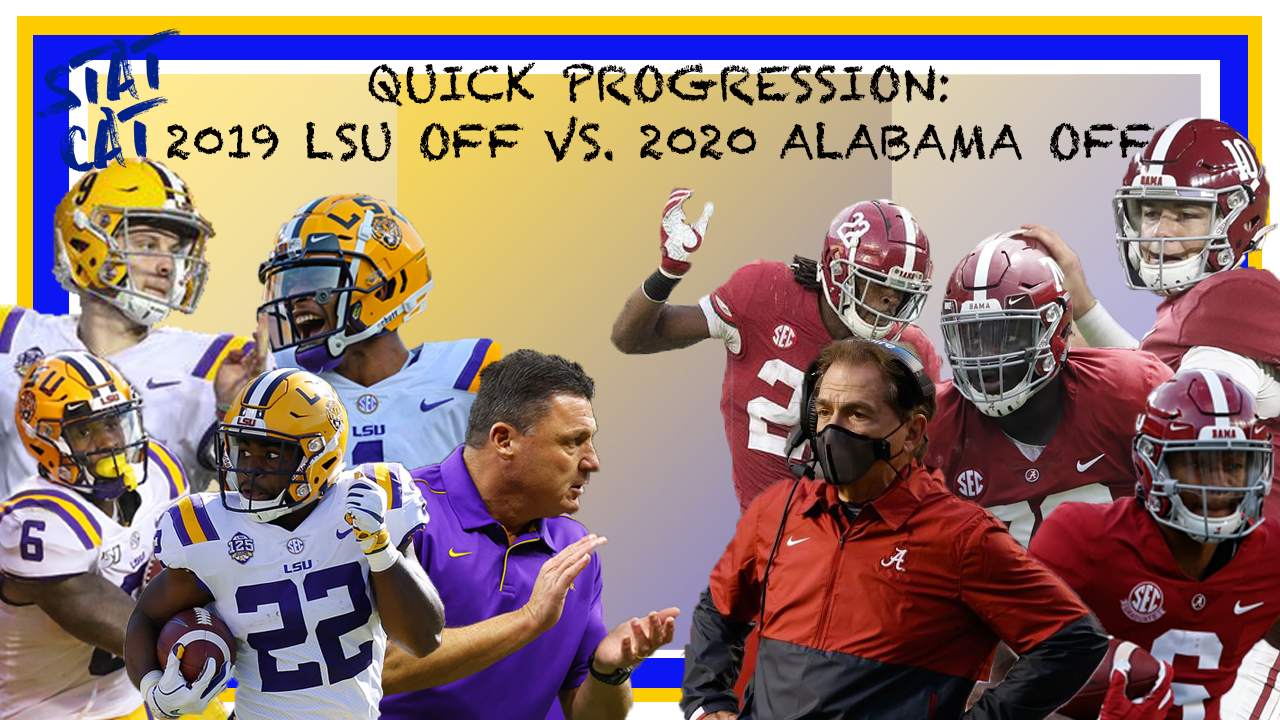
Ah yes. The sports debate staple: who ya got? As long as we have sports to watch, we will always argue who is better. Even when games have been decided on the field, we are not immune to returning to this premise to yell over the nuts and bolts regarding our favorite sports teams.
With the offensive revolution that has taken place the last half-decade or so, units are putting up eye-popping stats like never before. First, it was Chip Kelly’s “basketball on grass” at Oregon. Then, it was Lincoln Riley’s rendition/evolution of the balanced Air Raid. After that, LSU flipped its script and rode a spread Run-and-Shoot scheme on the way to greatness. Just a few days ago, Alabama was the latest college offense to be inaugurated into the G.O.A.T discussion.
With three Heisman finalists, the most efficient passer in NCAA history, a Joe Moore Award-winning line, and one of the most voluminous run scorers the SEC has every seen, it’s obvious why the Tide has entered the chat. They are unequivocally deserving.
But recency bias aside, the latest isn’t always the greatest. LSU’s 2019 offense put up their fair share of points and impressive wins while collecting scores of accolades. Up until this past weekend, Joe Burrow and ‘dem boys from the bayou had one of the most solid cases for the best college offense ever. Now, that claim comes with dissent and what about-isms from a fellow SEC West fan base.
All due respect to the non-SEC offenses who previously raised the bar to its current level, but the last two national champs set modern marks for SP+ offensive rating and Points/Scoring Opportunity. As impressive as Oklahoma’s 0.51 Expected Points Added/play was versus the nation’s 13th hardest schedule in 2018, it failed to win a playoff game. On the other hand, LSU trounced seven top10 opponents with Alabama beating three in the top5. Their level of difficulty was harder, hence I view them in a higher light.
Both 2020 Alabama and 2019 LSU averaged about 48 points and over 540 yards per game by exhibiting aggressive mentalities. The pair were well-stocked with bruising backs and talented playmakers on the perimeter. Each team had passers that displayed excellent precision and someone take home the Heisman.
LSU was pass-first, audible heavy, and honed in on a core set of plays. Alabama strove for effective balance through various tactics like motions, play actions, and distributing reps across numerous looks. It can seem like an apples and oranges exercise comparing these two offenses due to differing M.O.s and schedule makeups, but we all know that won’t stop diehards from embracing the debate on which one is better. Without delving into strength of schedule or which style you prefer, let’s measure these two offenses up with the help of some advanced stats.

Like our traditional stats suggests, there isn’t a whole lot of separation on the surface. Each was equally explosive (despite Bama’s prevalence through the air and LSU’s on the ground), sound at preventing turnovers, and consistent at making something happen after contact. Sure LSU amassed more yards/game and put up a better TD Rate, but Alabama wasted fewer drives and had more scoring drives on average. While there are some clear edges, these figures failed to present a clear-cut winner.

When looking at the situational breakout, we get a better idea of how each offense liked to operate. As aforementioned, LSU was primarily buoyed by its aerial attack while the Crimson Tide were much more balanced. The Tigers dropped back to pass on 60% of their early downs compared to Alabama’s 48% clip. While you’d think the offense more prone to pass would be more efficient based on the idea the average pass gains more than the average run, Alabama bested LSU in Success Rate on all three downs in both facets. Both the Tide’s overall and early down Passing Success Rates were almost four points better in comparison. Though these offenses’ clips on the ground were about the same on first and second down, Alabama was significantly more efficient on the money down. While the margin between the Pass Success Rates increased by roughly a point, the Tide’s 3rd Down Rushing Success Rate was about 16 percentage points better than the Tigers’.
Though it’s not in the tables, 2020 Alabama even bests 2019 LSU in Expected Points Added/play and Points/Scoring Opportunity. The Tide’s 0.489 and 5.1 respective clips top the Tigers’ 0.466 and 4.7. While I can personally vouch for the stat tables, these numbers come from CollegeFootballData.com.
After looking at those splits, Saban’s squad gets the slight nod. But as much as I’d love to make this a shorter article, I’d be doing a disservice not digging deeper or putting their overall numbers into context. With dominant offenses, both Alabama and LSU logged their fair share of garbage time snaps. While still preferable to the average, each produced worse results when the game wasn’t in jeopardy. So to better gauge the Tide’s and the Tigers’ outputs, I went one step further and only examined snaps where the margin on the scoreboard was 17 points or less.

Like you’d suspect with zeal and effort at maximum levels, each offense shows gains in these spots compared to their overall figures. But while our overall stats were mostly an even split between these two historic SEC West offenses, Alabama is the clear victor head-to-head as far as these metrics are concerned.
In our applied parameter, the 2020 Crimson Tide averaged a touchdown every tenth play, a 10+ yard run or 20+ yard pass every fifth play, and a three-and-out on less than 5% of its drives. That’s just stupid. Again, what LSU put up was very good too; but the figures Steve Sarkisian’s offense produced this season was unprecedented in the modern era.
Despite maintaining a more balanced style of play, the Tide averaged over 9 yards/play on competitive snaps this season, which was over a yard better than their overall clip. That was so thanks to Alabama’s proclivity for securing consistent chunk gains. When up or down by 17 points, the Tide averaged a gain of 15 or more yards on every sixth snap. As potent as their ground game was, Mac Jones and Co. put up an otherworldly 21% Explosive Pass Rate — a.k.a. percentage of throws that net 20 yards or more, when their aggression was present. In comparison, LSU’s such clip last year was a 13.7%.

Without getting into the play calling philosophies (and believe me, I wondered whether or not to put that shit in here), Alabama’s already superior situational stats further accentuated themselves comparatively in this context. Though still far less pass-heavy than the Tigers, the Tide dropped back more on early downs and took their efficiency to the next level. While LSU’s spread-and-shoot style sported a Passing Success Rate near 60%, over two-thirds of Alabama’s throws met situational goals this season on competitive snaps. That kind of dependable down-to-down consistently with their aforementioned potency is usually something you only see in a video game playing on varsity-level difficulty. But, this happened in real life during a pandemic.
Alabama’s overall and early down Passing Success Rate in this context both improved by over seven percentage points. As insane as rocking a 63.2% clip on first and second down is in general, the Tide posted a robust 70% clip when the margin was 17 points or less. Even when pressed into crunch spots on 3rd downs, Alabama converted on well over half of its tries through the air. Despite the volatile on-off nature of these downs, the Tide’s 54.4% such Passing Success Rate trumped the 2020 SEC average by over 18 points. The next closest clip in conference play the last three season’s was LSU’s 48.7% from last year.
The run returns were flatter than their passing counterparts. Once again, the Tide topped LSU in Rushing Success Rate and held a considerable lead on the do or die down. Interestingly enough, however, the Tigers were better hitting goals on early downs on the ground — even if only barely. But there’s no question Alabama distanced themselves from LSU’s 2019 output when applying our parameter.
By the numbers, Alabama was the preferable offense and probably the best ever. Though the traditional and overall stats make the initial prognosis much more murky, the Tide’s excellence really shines through when taking away inconsequential drives from their sample.
I’m not the only one who is going gaga over what this offense accomplished this season. The Sabanites were so transcendent this season that Bill Connelly, mastermind of ESPN’s SP+ Index, recently calculated them to be the best team ever. That only happens if you are truly special on one (or both) sides of the ball. With their recent thumping over blue blood Ohio State, the SP+ gives Alabama a score of 99.718, which by definition is the closest a team has come to being perfect in the history of the sport as far as that metric is concerned.
You can still think Joe Burrow is better than Mac Jones or that the collection of Ja’Marr Chase, Terrace Marshall Jr, Justin Jefferson, and Thad Moss is more desirable than Alabama’s cavalcade of pass catchers. The talent argument will undeniably rage on for decades. Hell, I know some of you certainly will ride and die with “Neck” blaring the background while reciting impressive stat nuggets from 2019 until you’ve passed out face-first into a bowl of gumbo. Still, Alabama’s offense wins this argument by the numbers.
While others will look to belittle what this team accomplished due to rosters, schedules, and operations being topsy-turvy during this trying time, I will do no such thing. Though this kicker has lost weight since each passing fall seemingly produces a new candidate for the claim of “Best Offense Ever” and could carry some recency bias, the 2020 Tide in is the G.O.A.T. of college offenses.