2020 Offensive Play Calling: Kentucky
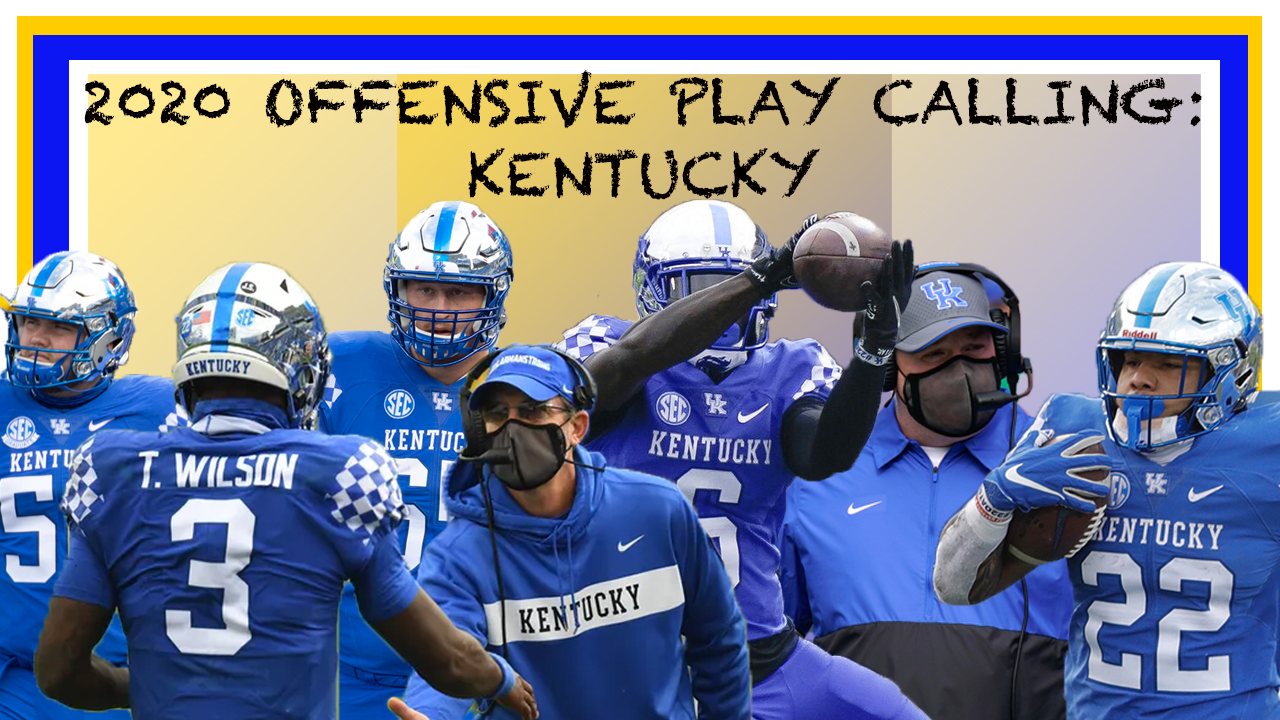
2020 Offensive Play Calling: Kentucky
UK’s 2020 offense suffered from much of the same ailments that has plagued most of Mark Stoops’ teams. Though gifted one of the best lines in the country in addition to three quality backs, the Cats finished among the worst passing offenses in the Power5 for the third straight season. Handcuffed more than ever with subpar passers, lack of team speed, and a scheme that increasingly put the run game first, Kentucky finished in the triple digits in Points/Game and Yards/Game. Their 5.0 Yards/Play was a full yard lower than Eddie Gran’s first year calling plays five years ago. Sensing change was needed to reinvigorate his offense, Stoops opted to part with his offensive braintrust in lieu of a disciple of the Sean McVay coaching tree.
Sure, the Cats’ conservative ways were a hard habit to kick considering the circumstances, but UK still accomplished some decent things in 2020. Though the Lynnsanity offense provided plenty of highlight plays, it was far from a consistent attack down-to-down. With help of its veteran O-Line, UK was one of four SEC offenses to finish with at least a 50% Rushing Success Rate. Its overall clip inched up about four percentage points and its TD Rate actually improved against conference foes. Like you’d hope and expect, the Big Blue Wall helped the Cats remain a top5 offense generating rush yards before contact. But again, the shortcoming of Kentucky’s passing game was biggest catalyst for the change in Big Blue's offensive cabinet. No SEC team passed less often than the Cats and for good reason. UK’s Passing Success Rate was six points lower than the next closest conference offense, and the Cats 20 explosive passes represented the SEC’s floor.
Though the results were rather ho-hum on the whole, this staff was more creative than the credit they received. Granted, a lot of what they called was bland and straightforward. But plenty of wrinkles caught my eye and earned my respect despite the overly watered-down style of play. The basis of UK’s offense wasn’t next-level stuff, but I still wanted to walk you through their best looks to examine what schemes the new play caller might incorporate in his presumably heavy Off-Tackle modus operandi. In order to present a clearer depiction of UK’s 2020 offense, I broke out their concepts when the Cats were either up or down 18 points. That way, less garbage time snaps snuck in and skewed our sample. I studied Kentucky’s favorite run and pass looks, its top yardage gainers, and its most successful concepts.
MOST FEATURED RUN CONCEPTS
1. Inside Zone Slam Read: 22.1% Play Share, 6.62 Y/A, 50.8% Success Rate
UK’s offense has revolved around the Inside Zone ever since Gran came to Lexington. That’s not too much of a secret. But, the play shares between the subconcepts have shifted over time…as well as the concept group’s overall usage as a whole. Two years ago, Inside Zone Reads accounted for a fifth of UK’s offense. Last year, their play share shot past 25%. This past fall, they made up almost a third of UK's offensive play calls. Eddie Gran often was hammered by dissenters as a Conservative Charlie. To reiterate, I felt he was was more creative than his perception (it's like the BBN was more than ready to forget the magic trick he and his staff pulled in 2019). Still, it’s hard to buck those claims looking at UK’s 2020 script. Half of UK’s Inside Zone Reads failed to crack three yards. Though it certainly fueled a bunch of futile tries, the Cats were the only SEC offense to finish with Success Rates north of 50% for both Slam and Bluff Reads. I get a lot of BBNer’s frustration with “another run up the middle”. But, there was method to the monotony.
Breaking out the concept group in our parameter, the basic Slam Read carried the most weight. In fact, UK’s play share for that look was more than any other clip across the SEC. Moreover, no other conference offense topped the Cats’ 6.62 Y/A. The Slam Read was UK’s favorite concept on all downs. But of course as the go-to play, the Slam Read was heavily featured early and often. It accounted for over a quarter of UK’s first down calls. But despite averaging over 7.0 Y/A, the look’s Success Rate dropped to 45.2% in those spots. The Slam Read was its best self on third down. There, it averaged a dazzling 9.25 Y/A on a 68.8% Success Rate.
2. Inside Zone Bluff Read: 10.4% Play Share, 6.44 Y/A, 54.1% Success Rate
In addition to being the only conference offense to boast over a 50% Success Rate for both of the primary Inside Zone Reads, the Cats are the only ones who can claim they averaged over six yards per pop running the Slam and Bluff Reads as well. As a concept group, Gran favored to direct these runs to the left. But despite the 55/45 split on carry share, the explosive run split was 19 to 17.
As far as the Bluff Read goes, it composed over a tenth of UK’s script. Certainly secondary to the Slam Read over the course of the schedule, the look managed to own the lion’s share of the Cats' attempts in a few games. The Tennessee, Alabama, and Florida games accounted for 47% of the Bluff Read’s tries with each repping the look a dozen times. But when up against two of their hardest opponents without their best rusher, the Cats only mustered two explosive carries off this concept. Against the Crimson Tide and the Gators, the Bluff Read produced a Y/A under four yards along with a paltry 37.5% Success Rate. With that in mind, it should go to show how kickass the Cats were in comparison against their other opponents executing this Inside Zone Read. After all, it finished as one of this offense's most successful looks.
3. Power Veer: 4.24% Play Share, 6.32 Y/A, 48.0% Success Rate
Beyond its two predominantly featured Inside Zone Reads, the Cats had a pair of complimentary wrinkles it turned to sporadically. The first was the Inverted Power Veer. Some know this as the “Lamar Jackson play”, and it’s a total flip to UK's base looks' run rules. While it still has a read element, this design sends both potential ball carriers towards the same side of the center. Almost all read options send their rushers to differing sides with the back operating as the dive/give player and the QB as the edge/keep player. That element, too, is swapped on the Power Veer. Throw in a backside guard puller and a few downblocks, and you have a total bizarro compliment to an Inside Zone. Since the Power Veer incorporates the QB as the downhill runner, it can allow ones quick-of-foot to seize a crease in the blink of an eye and promptly hit the defense’s second level.
The Power Veer was exclusively an early down play with each first and second downs logging 12 attempts a piece. The look, however, unquestionably generated its best results on first down. In those spots, its Y/A and Success Rate jumped up to 6.83 and 58.3%, respectively. Gran really picked his spots with this look. Though it goaded Wilson into being more headstrong as a rusher, only three games saw this concept repped at least four times. Five games featured it less than twice. The Power Veer’s highest usage came in Week 2 against Ole Miss where a third of the play’s tries in our sample occurred. Just as many (8) went for at least ten yards over the course of the season.
4. Counter Read: 3.74% Play Share, 8.36 Y/A, 68.2% Success Rate
Other than the Power Veer, this play offered UK’s zone heavy a literal counter on how to deal with overanxious defenses. Though the Cats had a few separate Counter plays, the traditional rendition with a read option was arguably this offense’s best look. It indisputably was their top concept on the ground. Besides the fact that over two-thirds of Counter Read’s reps won situationally, this run play averaged nearly 8.4 yards per pop, a threshold only one of Kentucky’s most featured passes managed to best.
This was another early down specialist for the Cats. All 22 of its reps in our sample took place in those spots. The Counter Read was especially explosive on firsts where it just missed out on averaging a fresh set of downs per touch. While that might have not been the base in actuality, it’s hard to challenge the play when it consistently gained at least five yards in our parameter. Week to week, its usage was incredibly wishy-washy. Again, UK featured plenty of Counter looks (Tackle, Keeper, Bash to mention a few) as auxiliary run concepts, in the play action game, and as eye candy on other designs. But the traditional Counter Read saw two reps or less in six games. Counter Read’s laudable stat line is highly inflated by a 72-yarder versus Ole Miss (You know, the one where AJ Rose prematurely celebrated before being caught from behind). That game happened to feature eight of the look’s 22 attempts in our parameter. Outside of Rose’s bittersweet scamper, the Counter Read only logged three other explosive carries the remainder of the year, two of which occurred in the bowl game.
5. Wildcat Set Inside Zones: 3.23% Play Share 2.26 Y/A, 68.4% Success Rate
So, this is kind of a cheat. Since the Wildcat is more of a package than an outright concept, I felt iffy writing about this. But then again, if there’s any SEC team that’s the poster child for using the Wildcat as of late, it’s Kentucky. The BBN probably has some bittersweet feelings about this set. While it helped the Cats grind out a number of key wins and help UK win in short yardage situations over the course of the Gran Era, it was undoubtedly a low ceiling play. Slams and split zones from the Wildcat combined to account for a fairly decent play share in UK’s ground-heavy scheme this year. Between the two, there really wasn’t any favoritism on the call sheet. Granted with plenty of short porches and manageable to-go situations, the Cats were able to bash forward for successful gains.
Like you might suspect, Rodriguez was the bellcow back from these sets. Of the 19 in our sample, he fielded 15 carries and boasted a 80% Success Rate. It’s just unfortunate the remaining carries by the other backs yielded crappy results. UK’s game versus Florida was the only instance this season the Wildcat failed to make an appearance. But of course, the Cats followed that up with six reps and two scores from the set over their last two games.
MOST FEATURED PASS CONCEPTS
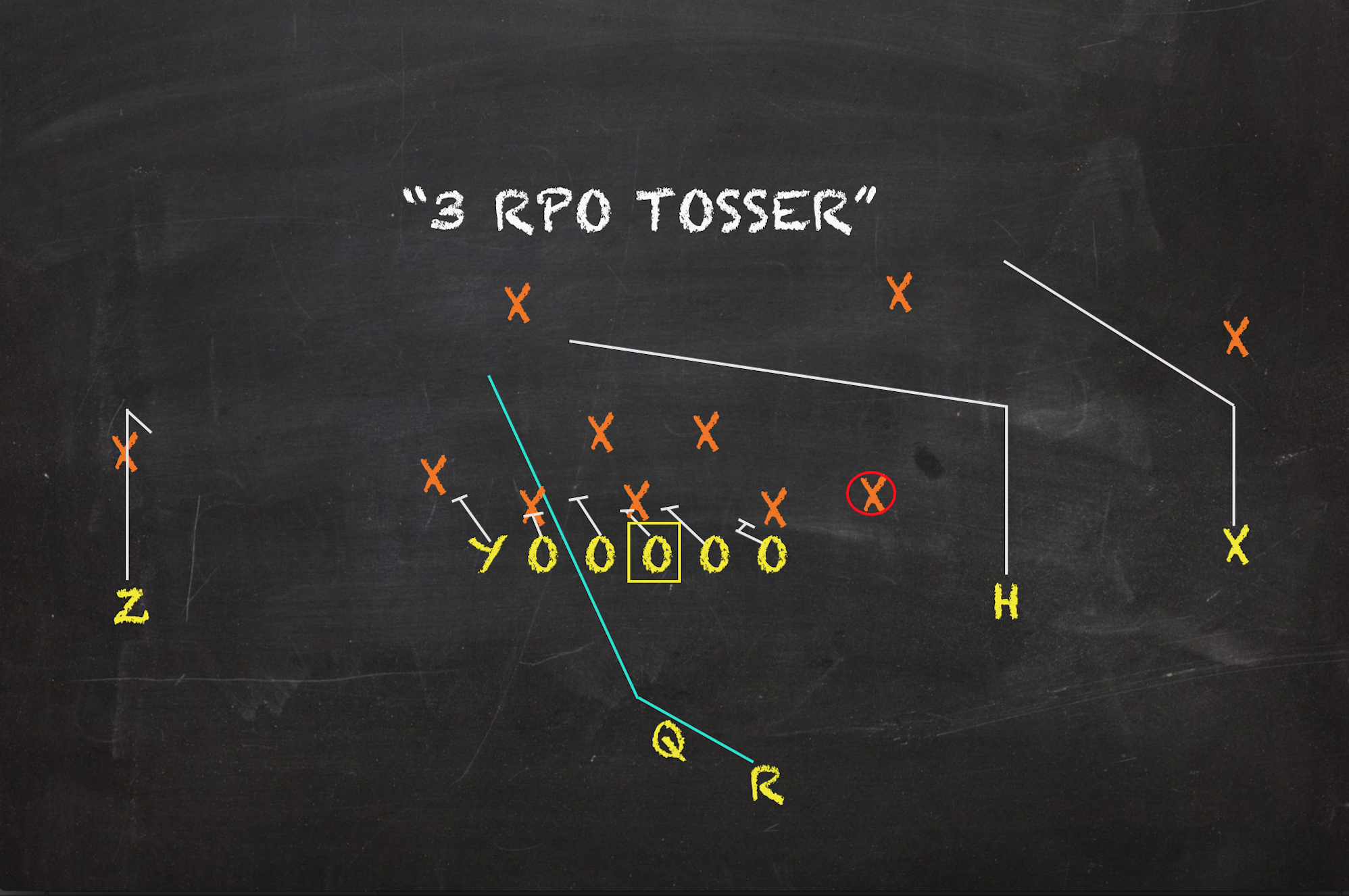
1. Tosser: 3.57% Play Share, 6.48 Y/A, 42.9% Success Rate
Double slant patterns — or Tosser in my vernacular — were paired with a plethora of other pass concepts. Since slants are natural manbeaters, they are friendly routes to plug on the backside of zone beating combos as a failsafe. To mention a few, the Cats coupled Tosser with Spot, Stick, Shock, slot fade, Corners, Wheelie Switch, quick out+vert, and a tunnel screen in the dropback game. Additionally, Tosser was also used as an RPO outlet. Disregarding our parameter, Tosser was seen 38 times over the course of UK’s season; it was outright targeted 28 times. Though slants can often be safe and easy routes to target, Kentucky just couldn’t summon adequate success targeting Tosser in 2020. Outside of Tosser’s sub-50% Success Rate in our sample, the Cats only caught 68% of their total slants chances all year. For what it’s worth, the slant doubled the next most targeted route 34 to 17.
Tosser composed three-fourth of the Slant Variations targeted when the Cats were either up or down 18 points. For whatever reason, the bulk of Tosser’s occurred on second down where UK matched its cumulative Success Rate. All in all, Josh Ali was unsurprisingly the Cats’ best receiver on Slant Variations catching all seven of his targets for 69 yards in our sample.
2. All Verts: 3.06%, 2.56 Y/A, 16.7% Success Rate
In spots when the run game failed and put the offense behind the chains, most times Gran and Co. didn’t get too cute. More often than not, they’d lean heavily on All Verts to help give the Cats a spark. Even without looking at that woeful bottomline, we all sure as hell know didn’t happen. Including all snaps, All Verts was featured on 40 snaps, which is even more than Tosser. But this deep concept was only targeted 23 times with 12 sacks/scrambles, and five checkdowns. In our sample, most of All Verts reps predictably took place on third down. What was also foreseeable was UK’s futile efforts executing this look. Only two of the 12 got the job done in those spots. Overall, the Cats’ passers were a combined 0/4 throwing deep.
Sadly, two of All Verts best gains came from scrambles. And, you can partly thank Vanderbilt’s sad sack of a defense for enabling UK's long of 27 yards. Before that point, the Cats had failed to log a single successful rep on this look. Parameter or not, none of this concepts completions topped 15 yards all season. Though “repped” 18 times in our sample, only six saw a downfield attempt in the field of play. The concept’s lone catch was a 13-yarder to Keaton Upshaw. In addition to these plays, the Cats dialed up 13 Vertical Shots, which were equally inept and ineffective.
3. Convoy Screen: 2.38% Play Share, 5.71 Y/A, 28.6% Success Rate
When you have a passing offense that struggled to stretch the field like UK’s, incorporating plenty of Screens almost comes with the territory. Often operating as an extension of the run game by attempting to get the ball to a playmaker in space with a convoy of lead blockers, Jailbreak Screens were the Cats’ third favorite pass concept in our sample. Despite that, their usage was a bit wonky; five of the 14 Convoys occurred in Week 1 versus Auburn. But from the Tennessee to the Vandy game, this concept seen twice in each of those four contests. After that, only two showed up on Kentucky's script its remaining four games.
The lone generated explosive Convoy Screen completion happened to come against the Tigers on the Plains. Only one other attempt netted a gain over ten yards for the rest of the year. Generally speaking, Screens have a lot of moving parts and things that need to go right in order for them to overly work. For the most part, they are desperation designs frequently reserved for behind the chain situations or third downs. Though that down saw the look sport its best Y/A, half of Convoy’s reps in our sample took place on third down.
4. Meshes: 2.04% Play Share, 6.58 Y/A, 50.0% Success Rate
Since UK’s receivers weren’t the best bunch at creating separation from defenders, opponents frequently sought to man them up and lock them down. Mesh is naturally a pattern than is designed to deal with such coverages. The look’s intersecting drag routes aim to create friction much like a pick in basketball that could lead to a receiver gaining a step on his man. Meshes provided Kentucky’s overly colorless passing game with some solace. Technically one of its most successful concepts, this Rub Variation saw half of its targets in our sample work. Almost all of its Mesh designs were of the Kelly rendition. Named for a design Chip Kelly hammered home, this version of the Mesh consists of a playside HB wheel and sit hook in addition to our primary combo.
All but one of Kentucky’s targeted Meshes in our sample occurred on the money down. Only the Slam Read and All Verts outrepped this look on thirds, but no pass play bested its such 54.5% Success Rate. Regardless of parameter, Mesh only generated two explosive catches all season. One of them came from the Kelly variety and the other was a running back mesh design in Week 1 against Auburn.
5. Utah Pass: 2.04% Play Share, 10.3 Y/A, 50.0% Success Rate
There are a lot of stats I can point to in order to illustrate how sad and frustrating UK’s pass game was this season. But I personally find it hilarious that this offense’s best pass look came from a glorified Jet Sweep/Tap pass. This design is as close as a run as a pass gets. Despite that premise, Gran displayed nice ingenuity with eye candy frequently featured on this concept. In addition to the Jet motion needed for this play to work, the Cats commonly feigned a Tackle Counter action to “block” playside defenders by freezing them in place as they tried to diagnose what the hell was going on.
In our sample, the Cats averaged about one Utah pass per game and saw half of them work. To play off defenses expecting the Cats to call a downhill run, this lateral tap pass was overwhelmingly an early down play. Of the 12 in our sample, only one took place on a later down. First down experienced its best figures. There, this concept saw two-thirds of its reps end in success while averaging 12 yards per pop.
6. Wheelie Switch: 1.70% Play Share, 7.00 Y/A, 30.0% Success Rate
Only 11 targets separated UK’s most repped pass target from its sixth. With runs gobbling up the majority of UK’s calls, passes naturally saw less chances. And since UK really struggled to find consistent patterns through the air that were also worthwhile, this staff was constantly left searching for answers. Though other pass attacks discovered positive value with Wheelie Switches this season, UK failed to crack the code despite trying a number of different designs on that concept. Only three of the ten targeted in our sample worked out well for Big Blue. During the first two games, a Wheelie+Bubble screen pairing accounted for four of the six seen. But after that, it completely vanished. On the opposite side of the coin, a running back Wheelie and slot Tosser combo from a trip nub formation was seen eight times after UK’s second bye week after not logging a single try before that point. Though visible, the double slant pattern outnumbered the Switch in targets.
Over the course of the entire season, the Wheelie Switch generated three explosive completions including its first overall attempt. Along with the 33-yarder against Auburn that was responsible for the look’s longest gain, Ali was the recipient of the look’s other splash gain that resulted in a touchdown against Missouri. Though Wheelie was the most featured Switch subconcept from this offense, Scissor was its most potent. All three wound up as completions and averaged 28.0 Y/A.
TOP YARDAGE GAINERS
1. Inside Zone Slam Read 882 yards, 6.62 Y/A, 50.8% Success Rate
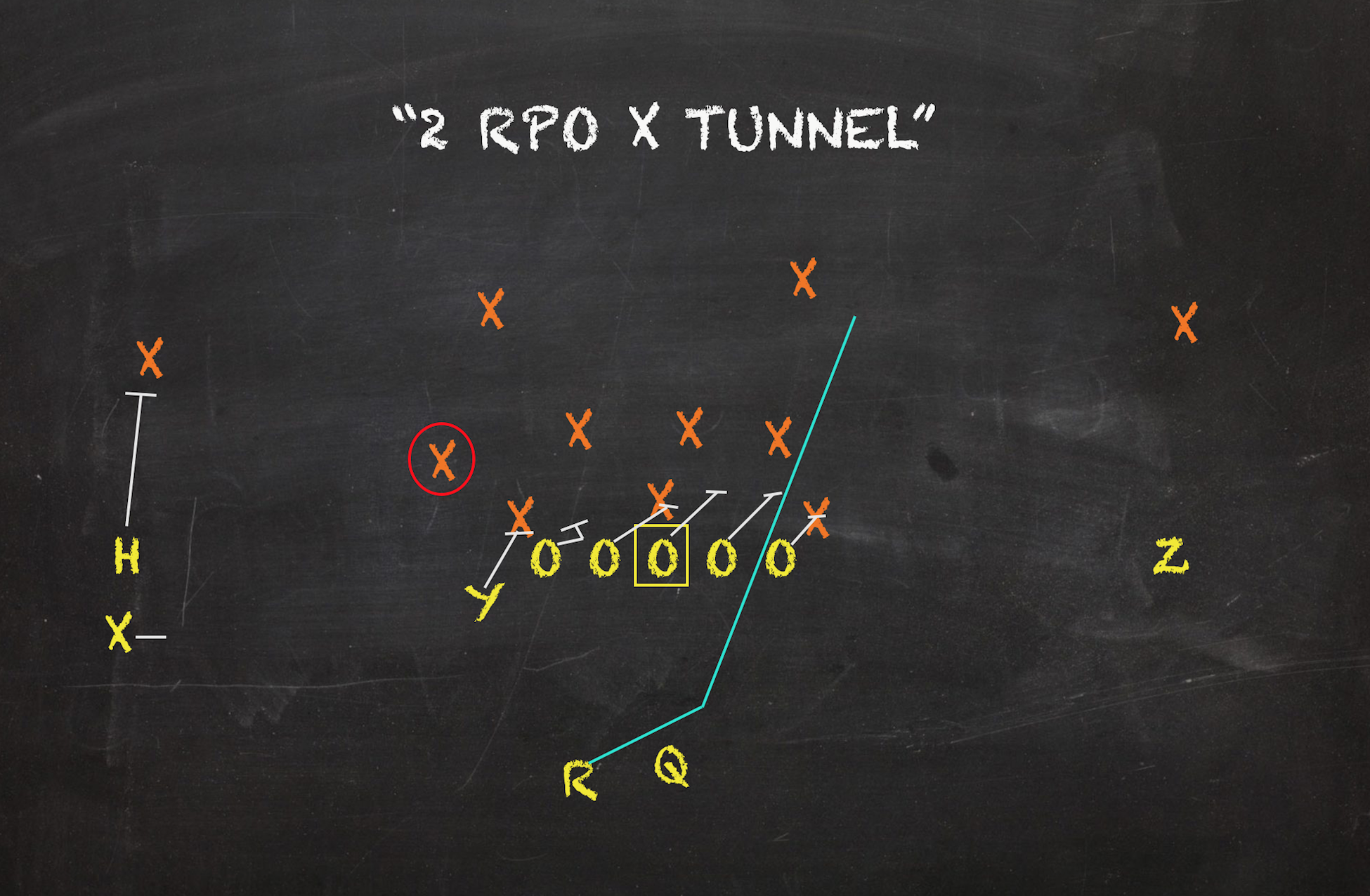
The Slam Read topping this list shouldn’t be a shocker in the slightest. Again, UK repped this look more than any other conference offense featured any other concept this season. In our sample, the Cats almost racked up 900 yards on its 133 tries; over 500 and 70 more than the next concept in line, respectively. Sure, the volume it received definitely played a part in its massive output; but one in seven Slam Reads went for at least ten yards regardless of the score margin. The only defense to prevent an explosive carry against this look was Georgia’s. Like most things in this conference, its best outing was versus Vanderbilt’s hapless defense. Ten of the 18 attempts against the ‘Dores went for either a first down or a score along with five explosive carries. As a fitting tribute to his tenure as offensive coordinator, Gran’s last play call for the Blue and White was a 79-yard Inside Zone Slam Read.
2. Inside Zone Bluff Read: 371 yards, 6.44 Y/A, 54.1% Success Rate
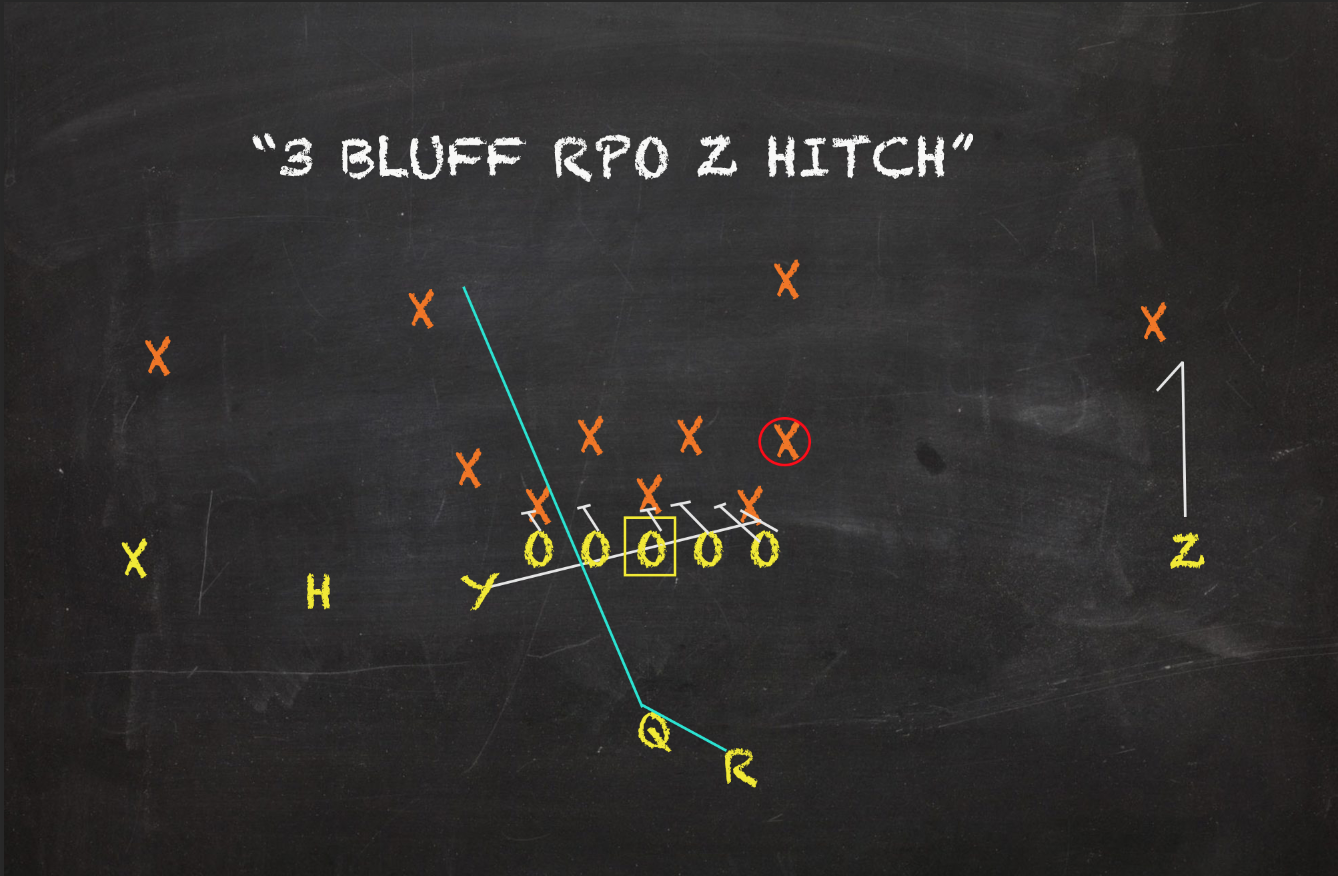
As this offense’s secondary concept, I’m sure you could’ve guess that the Bluff Read generated the second most yards. Though it’s Y/A was lower than Slam Read’s, this concept’s Explosive Run Rate finished just under 17%. In our parameter, however, the Cats only generated a single 10-plus yard carry the first month of the season. Three teams held UK without an explosive Bluff Read carry: Auburn, Ole Miss, and UGA. Unsurprisingly, its long also was a 74-yarder against Vandy. In total, four topped more than 20 yards with three of them coming in the bowl game including Chris Rodriguez’s icing late minute tuddy.
Taking a step back again and looking at the concept group as a whole, Rodriguez and AJ Rose each totaled 78 attempts on Inside Zone Reads. But like his production as a whole, Car Ram Rod raced on by the senior in both efficiency and total output. Even though Rose was more prone to an explosive carry on these looks, Rodriguez’s Success Rate and Y/A were 13 percentage points and 1.5 yards better in comparison. Though the main inside zone give was the primary source of production, UK’s QBs combined to account for 12% of these tries. Both managed to sport at least a 50% Success Rate. Terry Wilson’s was a fantastic 65%, which even bested CRod’s clip. Plus, over a fifth of his keeps went for at least ten yards.
3. Counter Read: 184 yards, 8.36 Y/A, 68.2% Success Rate
When breaking out this concept’s production in our sample, 40% of the Counter Read’s yards came on a single carry, 20% came on its remaining explosive carries, and 40% of its output came via its modest gains. In addition to the eight calls in the Ole Miss Game, the bowl game was the only other instance of this look getting a fair share of extended reps in 2020. Over two-thirds of the concept’s tries in our parameter occurred in those spots. Considering one of those games was in Week 2 and the other closed out the season, you can see how the traditional Counter Read was largely a matchup, game-flow kind of design rather than one in which Gran consistently showed a lot of confidence.
4. Power Veer 158 yards, 6.32 Y/A, 48.0% Success Rate
The Power Veer might not have received as much reps as UK’s bread and butter zones or have been as incendiary as its Counter Read, but it still delivered value for this offense. The Power Veer’s design is nicely set up to compliment Inside Zone Reads; and as a sucker play, it performed quite well birthing big gainers. Again, basically a third of its tries went for ten yards or more. Moreover, these chances accounted for over 70% of its yards. But naturally with a Success Rate under 50%, the Power Veer was Kentucky’s least consistent run play among its favorite looks. Perhaps that was due to setting up the gun-shy Wilson as a primary ball carrier. Including its Toss Read counterpart, Wilson commanded half of the concept group’s carries but sported a dismissible 35.7% Success Rate. (Joey Gatewood proved to be even less effective on his three attempts). But when UK’s backs got a chance to attack the edge, they combined for a 62% Success Rate.
5. Tosser: 136 yards, 6.48 Y/A, 42.9% Success Rate
The Cats failed to log a single explosive Slant Variation target in our sample. In case you hadn’t noticed this season, UK’s offense wasn’t full of guys on the perimeter who could take a slant to the house. Of course, it was very much the opposite. Though the Cats compiled 210 yards on slants over the season, Tosser’s gains were predominantly through modest attempts. Only six of the 21 targeted Tossers went for ten yards or more. The double slant pattern’s best day came versus Tennessee where all four of its calls resulted in a first down while averaging ten yards per pop. That game also housed Ali’s 16-yarder that resulted as the concept’s longest rep.
6. Utah Pass: 123 yards, 10.3 Y/A, 50.0% Success Rate
Thanks to a couple of splash plays, this tap pass design rounds out Kentucky’s top yardage gainers. Utah’s two explosive attempts accounted for 48% of this concept’s production in our parameter. Of the dozen tries, 11 were directed to UK’s best receiver, Josh Ali. The lone non-Ali rep was an interesting wrinkle to AJ Rose from 21 personnel that faked a slot reverse. That try happened to result in one of the two explosive Utah passes on the year. That one in particular highlighted the nine attempts this concept received over UK’s last three games. When including all snaps, the only route that racked up more yards than Utah’s 135 was the slant.
MOST SUCCESSFUL CONCEPTS
1. Wildcat Set Inside Zones: 3.23% Play Share 2.26 Y/A, 68.4% Success Rate
The Wildcat was a later down, short yard specialist for UK’s offense. Looking at Slam and Split Zone reps specifically, almost three-fourth’s of those reps saw a distance to gain of three yards or less. It’s not like these looks were asked to do too much. Fall forward and move the chains. Again, the large majority of this set’s production was tied to Rodriguez. But when breaking out the concept group into Slams and Split Zones, the latter was the better of the two looks. But despite Split Zones trumping its Success Rate 80% to 55.6%, Slams were responsible for three of the concept group's four combined scores.
2. Counter Read: 3.74% Play Share, 8.36 Y/A, 68.2% Success Rate
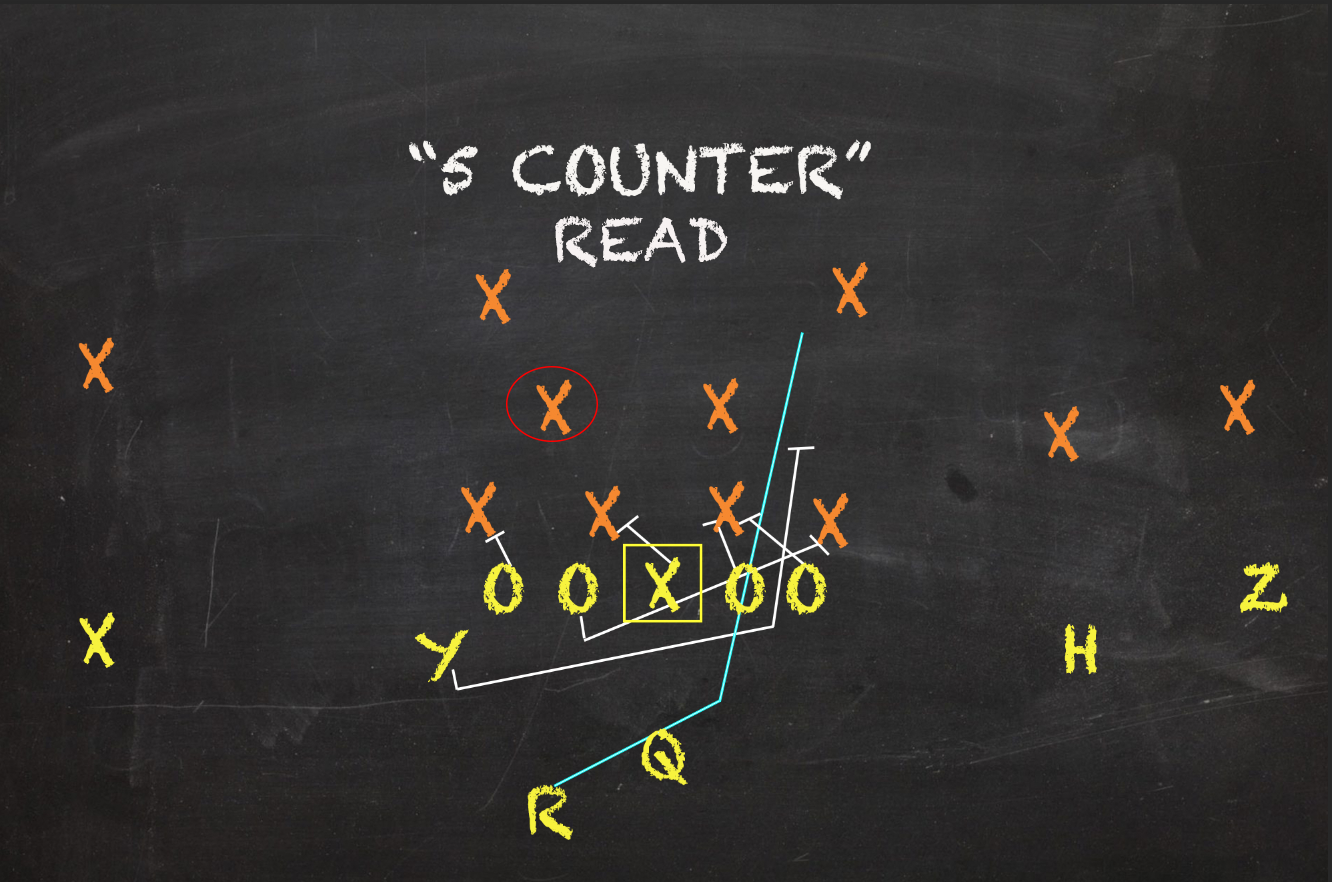
Sure, the Counter Read might have had its bottomline buoyed by one splash run against a rather bad defense. But based on its sterling Success Rate, it deserved more chances based on its dependability to keep this offense on schedule. Kentucky only finished with two negative tries on this look. Again, they doubled that figure in terms of explosive carries. And while four 10-plus yarders might not seem like much, a 18.2% Explosive Run Rate is more than serviceable in my book. Gran opted to spread the wealth around across various misdirections based on personnel and opponent. While the Counter Read sported 68.2% Success Rate, the remaining 35 Counter wrinkles in our parameter combined for a 37.1% Success Rate.
3. Inside Zone Bluff Read: 9.85% Play Share, 6.40 Y/A, 53.5% Success Rate
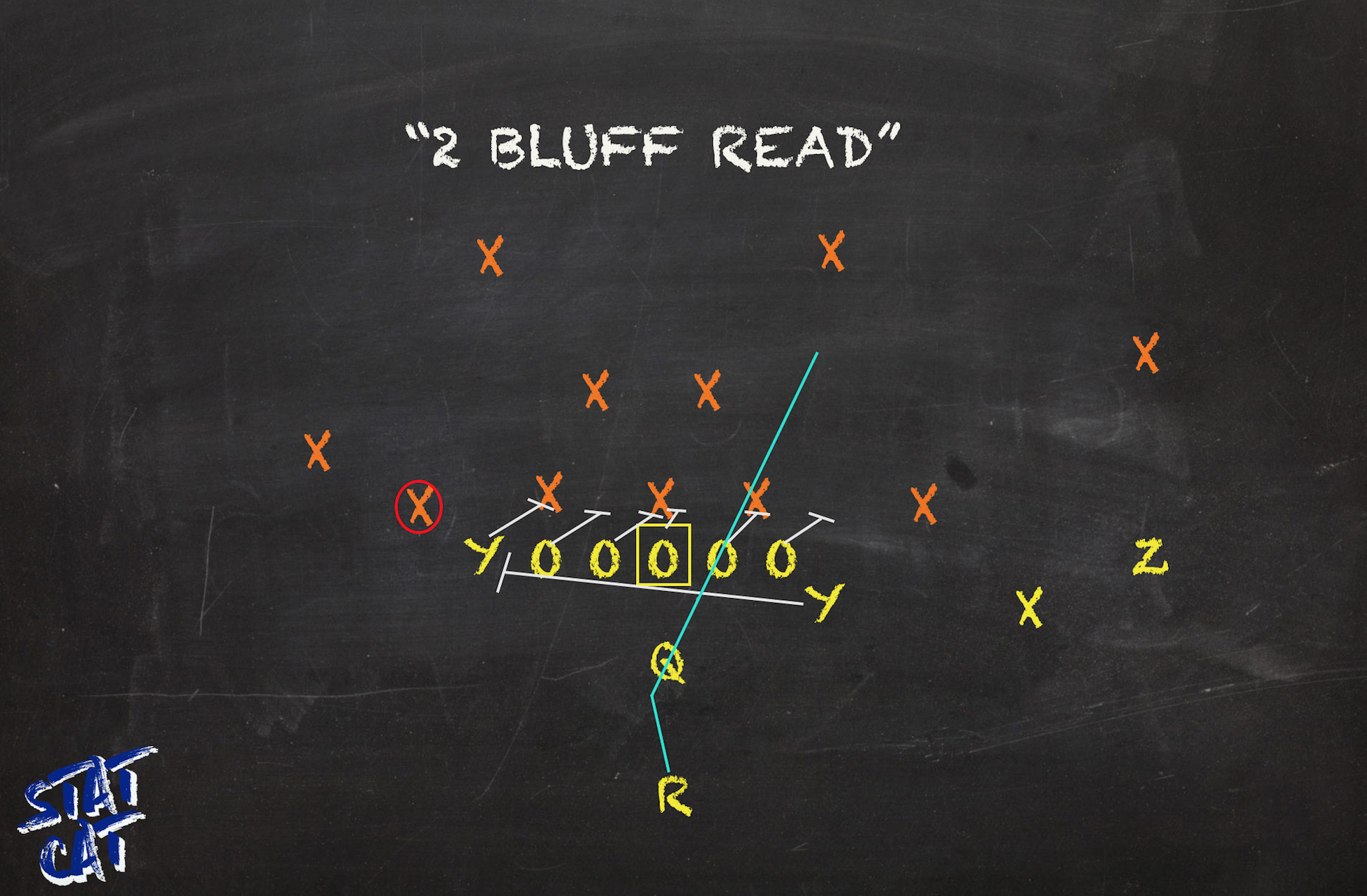
Granted, UK’s lackluster pass game had a role in allowing three run concepts to finish as this offense’s most successful plays. But let’s not pretend that the Cats didn’t take care of business on these looks. It’s always good optics when one of an offense’s favorite plays its also one of its best. Like the Slam Read, the Bluff Read received the majority of UK's tries on first downs. But unlike its brother concept, half of its chances gained at least five yards. Furthermore, it wasn’t as dependable on third downs. In terms of results, it was rather mediocre per its 44.4% Success Rate. But on a per play basis, its 1.56 Y/A was kinda shameful. The Bluff Read was its best self on second down. There, this split zone read delivered a robust 9.7 Y/A and 62.5% Success Rate.
4. Smash Variations: 2.55% Play Share, 6.33 Y/A, 53.3% Success Rate
Smash patterns combined to be this offense’s most successful pass play. Over the course of our sample, a few subconcepts came together to total 15 reps. For whatever reason, most occurred on second down where the group put up a cumulative 62.5% Success Rate. Of the three major wrinkles (traditional Smash, Corners, and Bench), Bench logged the most targets with seven and buoyed the group’s overall figures. This out+corner rendition of the Smash pattern provided a handful of easy completions facilitated by stack or bunch sets. These alignments overly prevented press coverage from smothering UK’s receivers prior to them making their downfield breaks. For what it’s worth, both of the other two Smashes finished below a 50% Success Rate in our sample.
5. Inside Zone Slam Read: 22.1% Play Share, 6.62 Y/A, 50.8% Success Rate
UK’s most repped concept rounds out its most successful looks. Considering four of the run-heavy offense’s five most called plays wound up on this list, I’d say that’s a fairly resounding win for this rushing attack. On the other hand, this occurrence provided further ammunition for dissenters of this offense to voice their frustrations on how none of UK’s moderately-repped pass concepts topped a 50% Success Rate. Oddly enough, five teams managed to hold the Cats below that mark defending the Slam Read. Four of them occurred in consecutive games ranging from the Mississippi State to the Georgia game. In addition to the bowl game in which the Slam Read failed to see half of its reps work, the Cats only put up a 35.5% Success Rate in those contests executing this look. At least, Kentucky beat up on its other foes with the Slam Read. In its other six games, the Slam Read’s Success Rate soared to 63.4%. While a pair of these matches included facing two of the SEC's worst defenses, this stint also included the games versus top5 teams Alabama and Florida.