2021 Draft Stuff: Projecting the SECers Passing Floors
2021 Draft Stuff: Projecting the SECers Passing Floors
Everyone loves quarterback talk. Since it's the most important position in the sport and a passer's ability often can be the difference between victory or defeat — or sustained success or maintained mediocrity — extra weight is put into analyzing these fellows. While most fans are content with volume stats like completions, yards, and touchdowns scored, the archaic metrics do little to tell the story of how a passer actually operates.
Naturally, a passer's overall figures will reflect his entire body of work. Pressured, clean, screen, RPO, dropback, deep, 3rd Down attempts and others criteria are all merged together to form cumulative stats. But because no passer's style of play or scheme is exactly the same as another's, varying factors can help skew a quarterback's perception based on his final output. What if a passer leaned more on screens or lived on the wild side by pressing downfield more often or benefited from being a game manager? These questions go largely unanswered glancing at a box score.
This is where I come in — at least in regards to talking about the SEC quarterbacks. As much I wanted to examine the passing bars of Trevor Lawrence, Justin Fields, Trey Lance, Zach Wilson, Ian Book, and the other prospective passers, let’s be real: talking about SEC passers just means more. But in all seriousness, I’ve charted every offensive snap within the SEC the last three seasons. So, I’d like to think I have a good amount of dirt on these guys.
I get the tale of the tape and the Good, Ole Fashioned Eye Test reign supreme for many talent evaluators during draft season. But you can still determine a minimum threshold to expect from a passer based on his past performance in college despite the hodgepodge of philosophies. In order to determine which passers are actually good, we need to break off extra schematic elements that could in theory help boost a quarterback's output. As eager as I know some of you are to strip superfluous aspects away from a passer's profile, we first need to measure our passers’ baseline exiting college. Since no one should gives AF about production against the Poop States of the world, I only included results against Power5 opponents. And to give us a larger sample, our scope includes the last two seasons.
At a Glance

Mac Jones

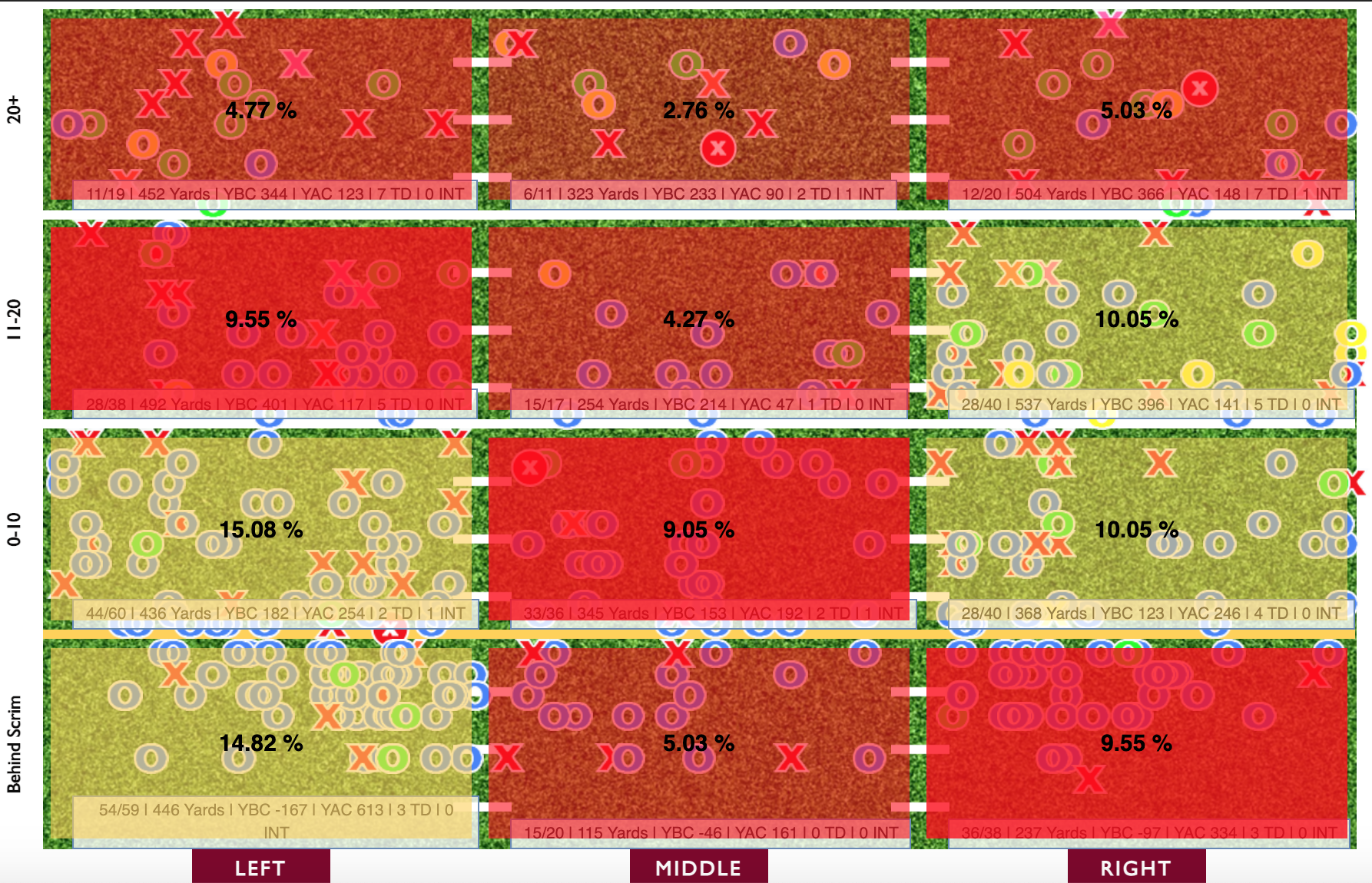
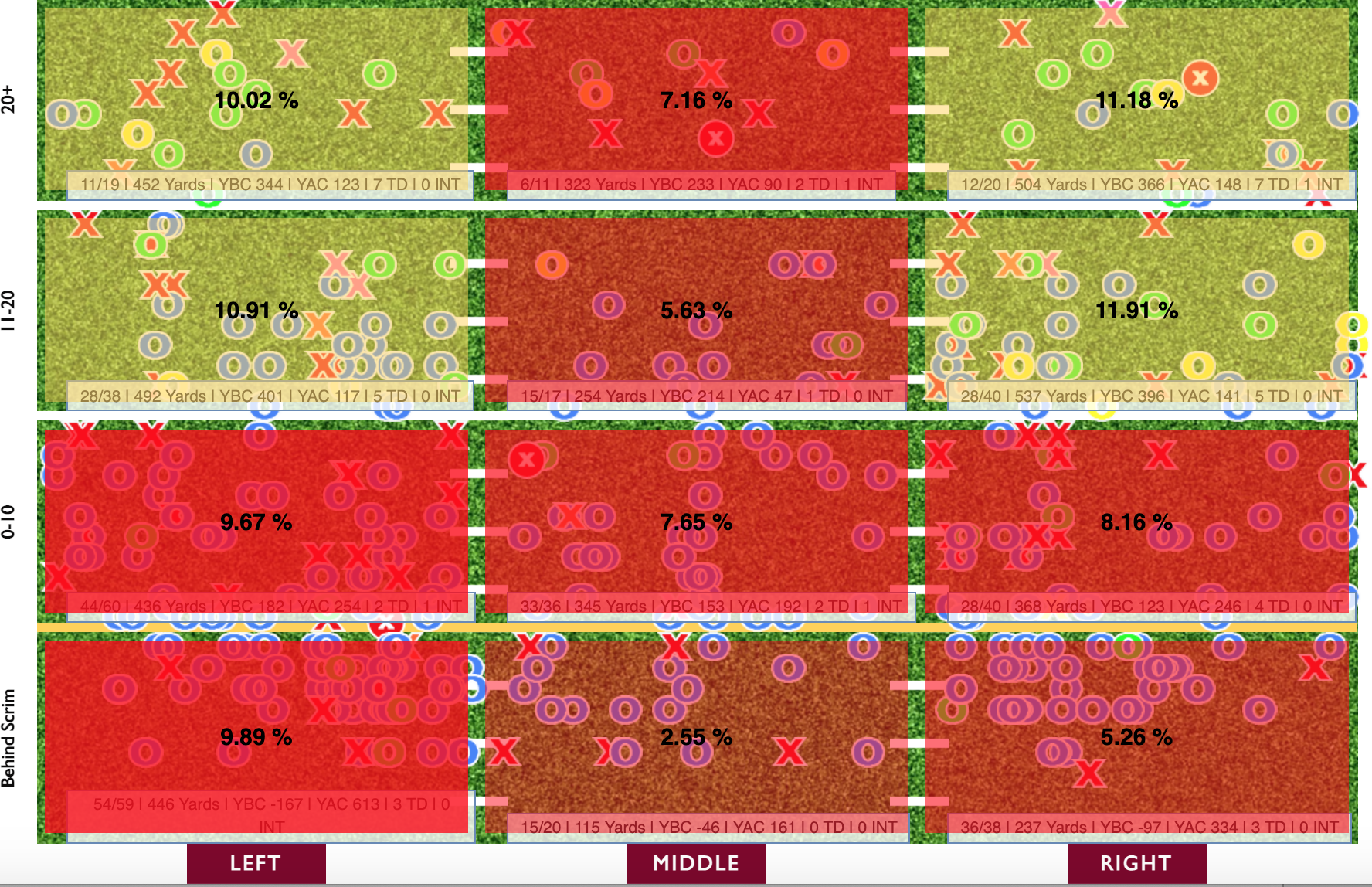
Michael McCorkle “Mac” Jones was college football’s golden boy passer in 2020. And, that’s saying something with Sunshine slinging the pill over at Clemson. Jones presented a fairly sturdy passing floor entering the season, but the Tider initially was a facilitator. Due to his inexperience, a significant amount of his attempts were logged outside of dropback situations when he filled in for the injured Tua Tagovailoa. Over half of these snaps incorporated some form of play fake. Despite the rinky-dink facade, Jones provided an upgrade in terms of verticality for Alabama’s offense. No disrespect to the Throwin Samoan, but there was a reason Steve Sarkisian opted to play more “west coast” to suit his strengths. In addition to the Tide taking more shots, Jones emerged as an elite midrange passer. His such metrics even trumped 2019’s Heisman. Playing off those characteristics, Sark retooled his aerial offense to lean into deception tactics, play action, and stretching the field versus single-high coverages this past fall.
Mac Jones' 2020 Target Heat Map Mac Jones' 2020 Yard Heat Map
Though some crimson cries clamored for Bryce Young to start the season and haters in other fan bases were convinced he was nothing more than a game manager, Jones responded by leading the nation in cumulative Expected Points Added. Continuing the trend of one-upping the dude who preceded him, Jones set records in copious metrics while boasting the best season Pro Football Focus has ever graded for a QB. Blessed with electric team speed and an updated scheme that aggressively strove to disorient and knock out opponents, Alabama’s offense finished as an all-timer with Mac at the helm. The results on the surface cannot be knocked. I mean every time I look at his Completion% from this past season, I think to myself, “That can’t be right.” Naturally as he quarterbacked an undefeated team through an all-SEC slate while putting up video game-like stats on the way to a national title, Jones eventually caught the attention of NFL scouts. Against his four hardest defensive opponents in ESPN’s SP+ ratings (Georgia, Ohio State, Notre Dame, and Texas A&M), Jones boasted an incredible 88.9% Adjusted Completion%, 66.4% Success Rate, 12.0 Y/A, and 60.4% Depth Adjusted Accuracy. Of course, you all should know by now that he’s being projected as a solid 1st round pick.
Jones’ overall profile suits the modus operandi from quarterbacks of yesteryear who overly preferred to function as pocket passers. Though I get the Brady comps, I’m reminded more of a much less-spry Ryan Tannehill or Kirk Cousins type. His 40-time resembles Eli Manning’s so that should stress Mac’s limited mobility. That isn’t to say he isn’t an athlete, but no offense is dreaming of maximizing his talents via Inverted Power Veers or Bash Counters. Jones could drop a little bit in the draft for that reason. Plus, critics will be sure to bring up a third of his pass attempts used true play action, and nearly 30% of his throws targeted behind the line of scrimmage in 2020. But even if he dealt with a loaded deck, Jones doesn’t press, avoids danger, exhibits elite accuracy, and has made his share of big time throws. After all, his Touchdown Rate more than doubled his Interceptable Pass Rate over the last two seasons. Jones’ top-end arm strength isn’t premium, but it’s not like he will have to be any bit of a nibbler at the next level. Again, his best trait is his intermediate precision. The last two seasons, over two-thirds of his passes between 11-19 yards downfield have been on-target. I have my doubts he can lead an NFL offense solo without the aid of a run game, play action, or weapons out-wide, but Jones’ general resume makes him unquestionably worth the consideration.
Kyle Trask

Kyle Trask’s career arc almost sounds like something you’d see in a Disney movie. Overshadowed by teammate D’Eriq King, Trask rode the pine all throughout high school but managed to put up sturdy stats in his limited snaps. Doing what he could, he mustered a three-star rating and was ranked the 92nd pro-style quarterback. But Trask only received a single Power5 offer. Guess which school that turned out to be. Though he only played in three games in three years prior to his breakout performance in 2019, Trask immediately impressed when his number was called. Like you’d expect from a kid who hadn’t logged a start since he was 14, he made the most of his playing time often testing tight windows and opting to go down swinging. While his predecessor (who I’ll talk about in a bit) was a bit hesitant, Trask was eager to see if his guys could make a play. Though he was a bit of a lug and certainly made his fair share of risky throws, the Gator showed off very nice accuracy and decision-making to the point only Joe Burrow and Tua Tagovailoa bested the majority of his stats within the conference by the end of the season. And despite a volatile style of play that was buoyed by screens and performance under pressure, Trask’s passing floor remained as good as anyone’s entering 2020.
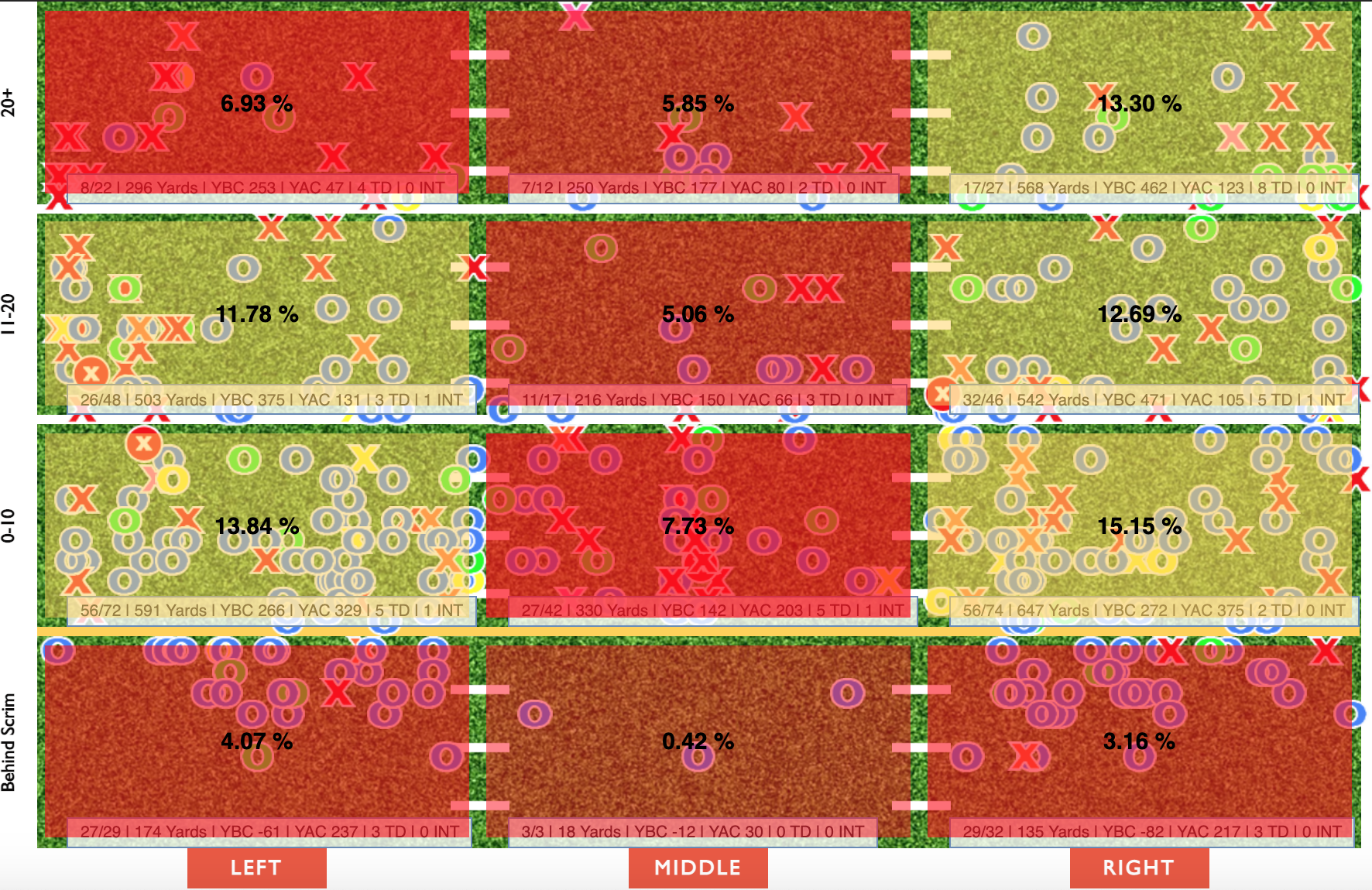
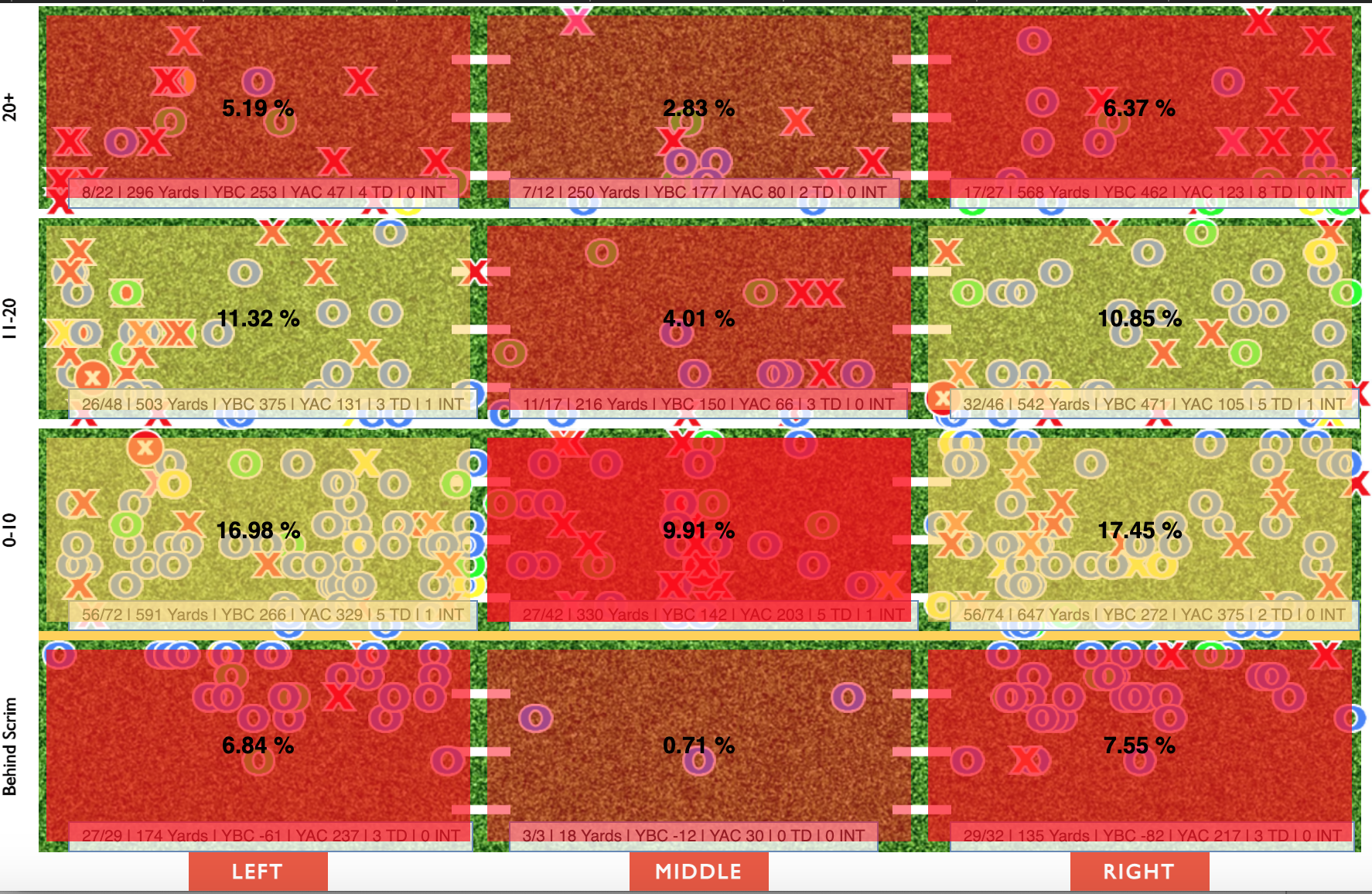
Kyle Trask's 2020 Yard Heat Map Kyle Trask's 2020 Target Heat Map
Used to having to put Florida’s offense on his back thanks to the Gator’s underperforming ground game, Trask was maximized this past fall. While some could call Trask a compiler, it’s not as if he didn’t display consistency or high-end precision with the increased volume. The Gators increased their Pass Rate to 61% (only Mississippi State’s Air Raid topped that within the conference), lined up in empty on 13.4% of their snaps (no other SEC offense cracked an 8% clip), and went all-in on pressuring defenses with its two mismatch makers in Kadarious Toney and Kyle Pitts. With those two catching passes and the increased dropbacks, Trask rewrote plenty of school records while racking up the nation’s 3rd-most EPA with the 10th-best clip on a per play basis. Though it looked up to Alabama’s laudable lot, Florida’s offense was practically the next best thing due to its outstanding down-to-down passing results.
Trask’s general profile is just fine. His result-based metrics like Y/A, Success Rate, First Down+Touchdown Rate, and Explosive Pass Rate experienced year-over-year gains with his increased usage. Plus, the Gator’s raw Accuracy%, Depth Adjusted Accuracy%, and Uncatchable Pass Rate all improved despite his ADOT increasing nearly a yard from the previous season. That should tell you Trask is a fairly good processor with adequate precision to hold his own at the next level. Though his durable frame allowed him to make plays outside of structure, he could stand to shore up his off-rhythm mechanics particularly with his lower body. Sometimes this led to a ball coming out a beat late, a slight flutter, or a true downfield under-throw that generated plenty of contested targets over the last two years. This shortcoming has many — me included — questioning if his arm strength (both in terms of zip and distance) can cut it when his targets have less of a competitive advantage over defenders. I fully understand why Trask put a lot of trust in Toney and Pitts. But either due to hubris in his pass catchers, a mechanical malfunction, or a simple misread, over a quarter of his passes were contested this past year alone. His 116 such chances outnumbered the next SECer in line by 21. With so many 50/50 balls, one consistent red flag has plagued his profile: turnover-worthy throws. The Gator has tossed 61 the past two seasons, and his Interceptable Pass Rate has sat in the danger zone over 7.5%. Mid-to-late career Ben Roethlisberger comes to mind. You know, the version of him that enjoyed playing YOLO ball despite waning arm talent. While believers will gravitate towards Trask’s precision, just ask Jameis Winston and Carson Wentz what a high number of interceptable attempts does for one’s outlook as a passer.
Kellen Mond

Kellen Mond is a divisive prospect. Three years in Jimbo Fisher’s QB School failed to see him post inspiring numbers or a winning record against ranked opponents. The past two seasons, Mond has recorded a Y/A, Completion%, First Down Rate, and Explosive Pass Rate below the conference mean. While it’s easy to jump on the QB for such muted returns, there’s a case that was by instruction and personnel limitations more than Mond’s choosing. His average depth of target and Explosive Pass Rate have dwindled since 2018 as TAMU’s team speed slowed. With less field stretchers, Jimbo leaned into his patented West Coast staples like slant patterns, Spot, and Smashes with the occasional Comebacks. As a result, that offense became increasingly methodical. But, Mond’s once iffy ball placement figures improved each subsequent season as did his Interception Rate.
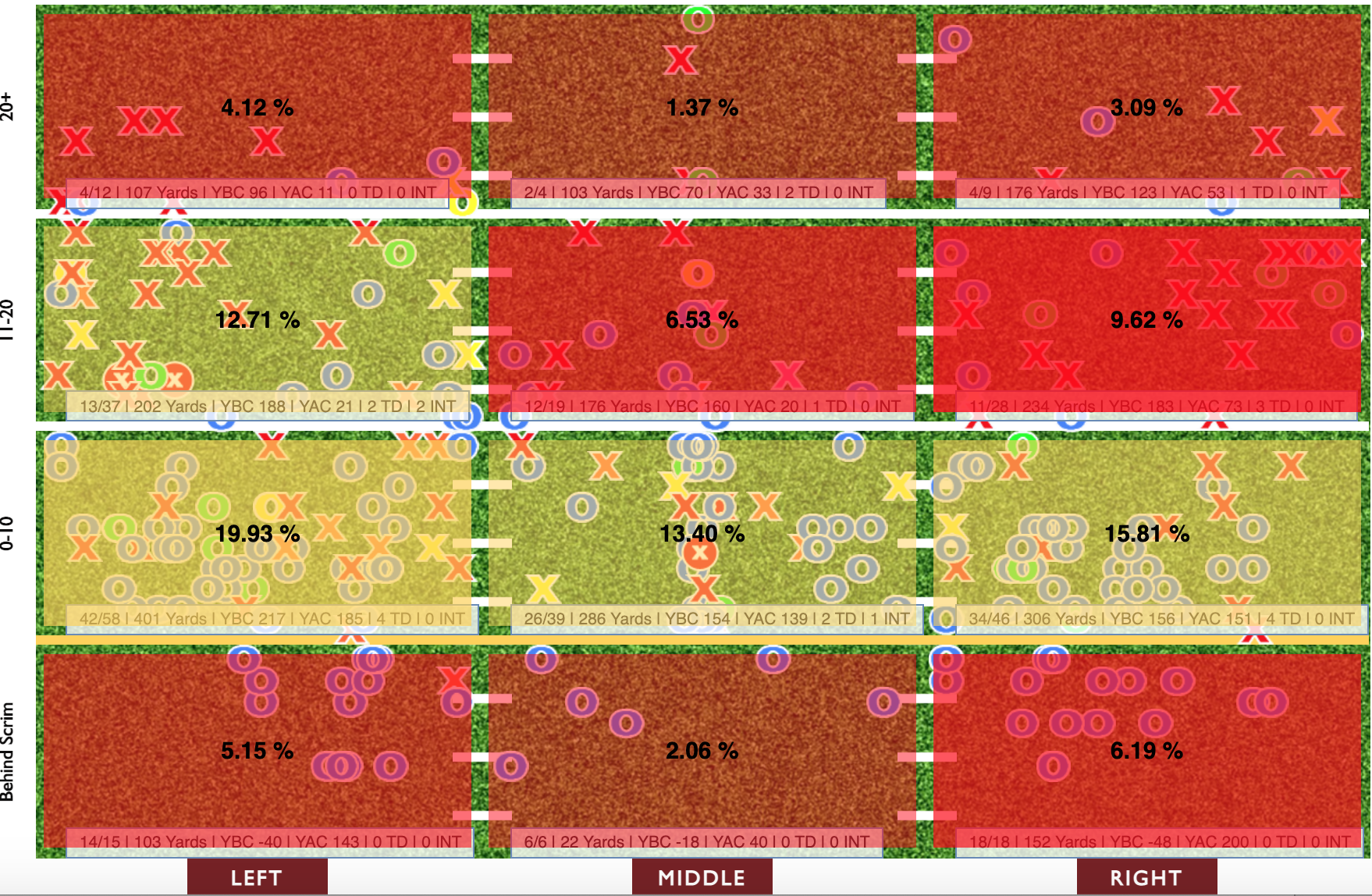
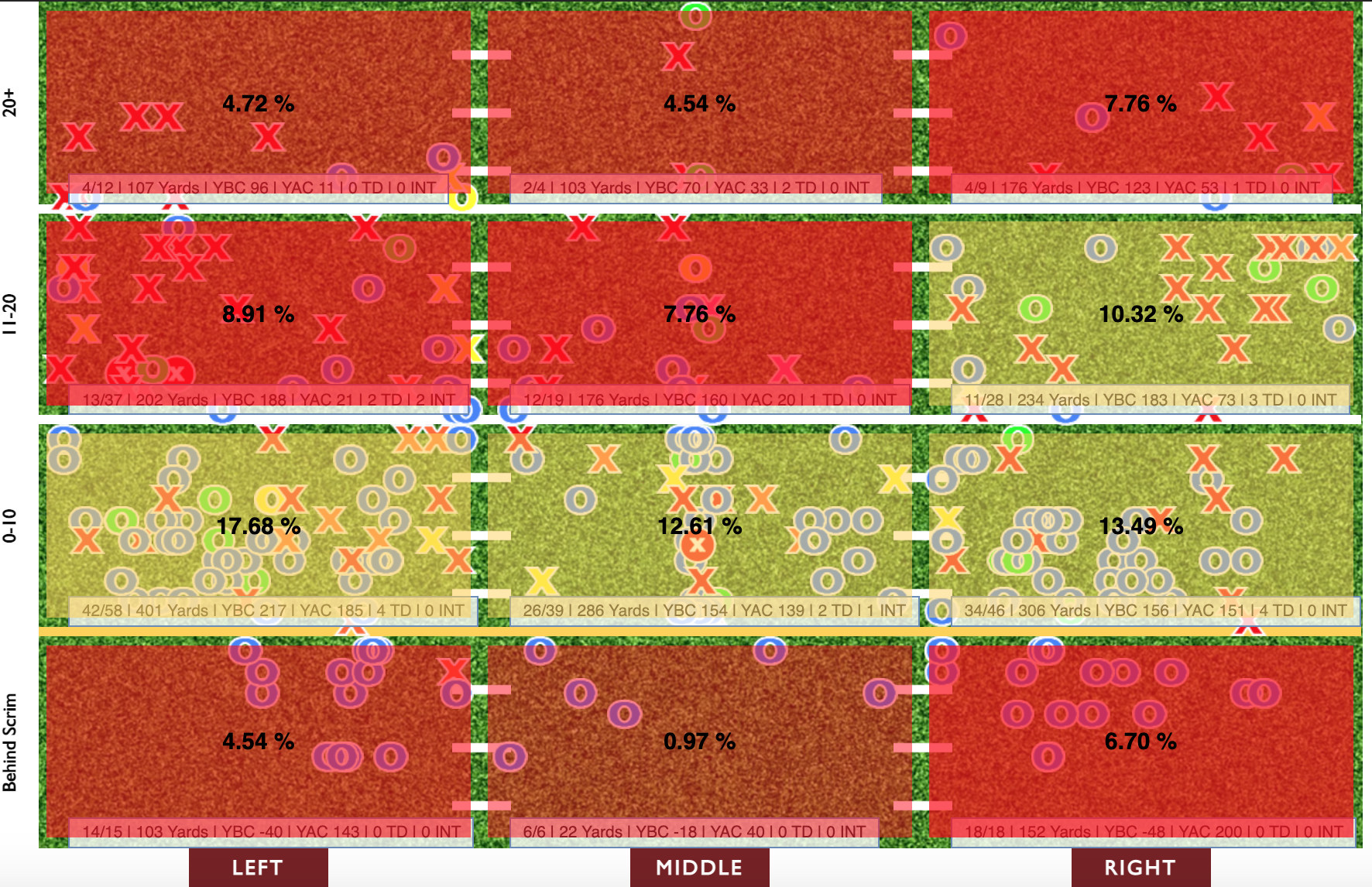
Kellen Mond's 2020 Target Heat Map Kellen Mond's 2020 Yard Heat Map
Entering the year, Mond presented the conference’s highest passing floor. Since he leaned on screen and RPO throws less than the other top returners, he presented the clearest representation of his true self in the dropback game. But with no real burners and predictable short routes, Mond’s environment made it hard for him to shine. Only four other conference passers tested tight windows as much as Mond’s 27.5% clip. At least both his raw Accuracy% and Depth Adjusted Accuracy% in tight window situations ranked as the SEC’s 2nd-best this past season as did his rate of turnover-worthy throws. He logged only two interceptable contested targets all season. Despite only playing in four games, Georgia’s JT Daniels logged more deep pass attempts (27) than Mond (25). Only freshmen Ken Seals and Will Rogers donned lower such rates than his 8.39% clip within the SEC. With so many bang-bang attempts, his Interceptable Pass Rate worsened each year despite the eroding verticality in TAMU’s offense. While luck was on his side, that’s not the best look considering his career Passing Success Rate finished under 50% against Power5 opponents.
Again, all that spells a pretty mixed bag. Exiting the season, analysts and scouts thought they had a pretty good read on Mond. But the Aggie tossed five 20+ yard completions in the Senior Bowl and suddenly has folks pondering his upside (He only totaled 24 in 2020). With the rise of run-threat quarterbacks in recent years, Mond has the legs to keep defenses honest and potentially contribute on the ground. Plus, he’s logged a good amount of experience evading SEC rushers during his time in College Station. That paired with the ability to deliver downfield strikes is a skill set most teams are hangrily craving. That said for a mobile guy, Mond plays rather stiff. On the move or in the pocket, the ball is right at his chin with both elbows flexed. This is sound technically speaking, but the end result appears as if he has a steel rod for a spine. This rigidity doesn’t mess with his lower body’s ability to stay fluid, but sometimes it can be a little inconsistent up top, which creates errancy on occasion. In addition to his Interceptable Pass Rate souring over his college career, Mond has logged 17 fumbles with five of them coming with him as a passer. Still, Mond’s coaching staff didn’t sugar coat his development and overly went out of their way to make him operate as a pro-style passer. The Aggie probably could have put up preferable stats with more screens or RPOs to take some downs off his plate, but he’s more prepared to latch on with an offense day one thanks to TAMU’s tendency to dropback.
Feleipe Franks

Feleipe Franks will be viewed as a flyer candidate by many. With coaching swaps, injuries, and venue changes, there’s not a whole bunch of stability across his resume. Moreover, Franks predominantly has donned a herky-jerk playing style as a college passer. During his days at Florida, he had a bad habit of holding onto the ball too long while being skittish in the pocket. Due to his weariness to let it rip, he logged a good amount of pressured attempts as a Gator. He was overly a “see it, throw it” passer early on, and often had to be goaded to take a shot. Only about an eighth of his passes traveled beyond 20 yards with 60% failing to crack ten in 2018. The process was certainly frustrating, but his dropback results were at least serviceable. This M.O. more or less carried over to his brief stint in 2020. No SEC passer sported a higher average time to throw on dropbacks or a higher overall Pressure Rate. He threw one less interception in three games than he had the year before before his season was lost to a gruesome injury. Though Franks’ efficiency and accuracy figures improved, Kyle Trask was getting results and winning games. Into the transfer portal he went, and ultimately Franks landed at Arkansas to lead Kendal Briles’ first SEC offense.
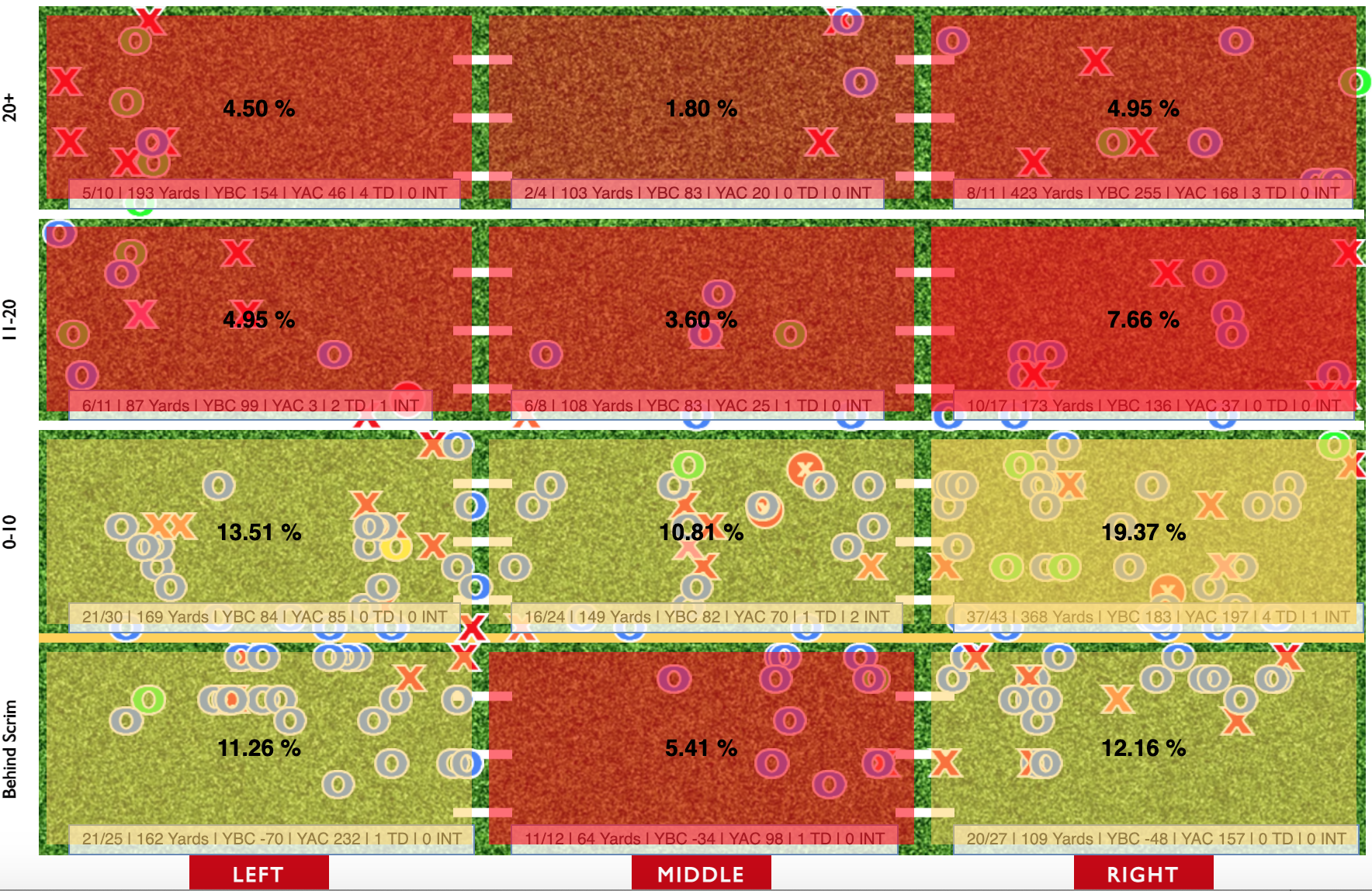
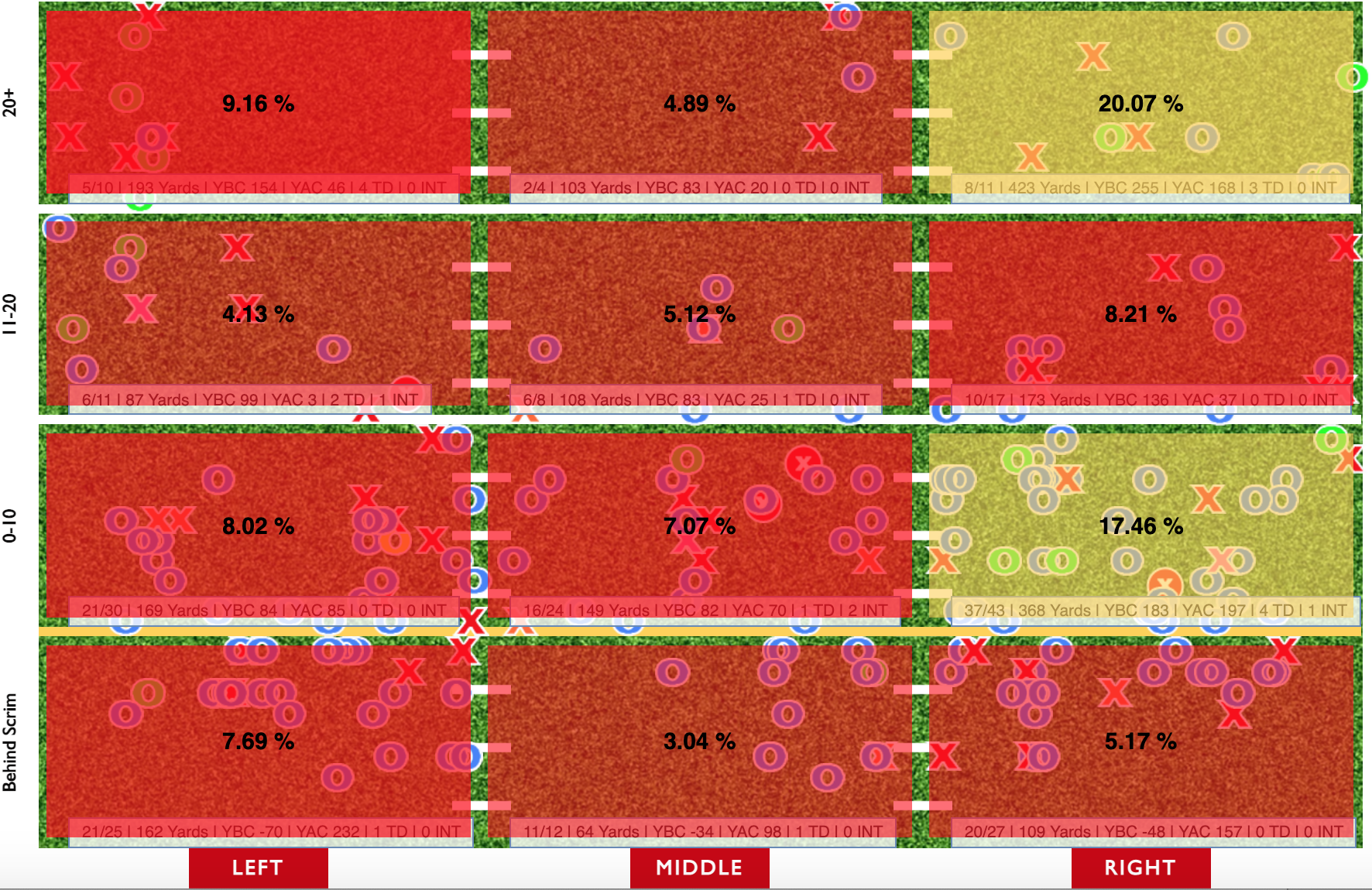
Feleipe Franks 2020 Target Heat Map Feleipe Franks 2020 Yard Heat Map
Franks’ past timidness from the pocket incentivized Arkansas coaches to lean into tactics that heightened his efforts as a facilitator and to limit his time behind a rather poo-poo bunch of pass protectors. Over a third of the Razorbacks’ plays were RPOs, and 34.5% of Franks’ total targets were directed towards route tags on those designs. No other SECer owned a clip in the 30’s. When tacking on his screen attempts, 41.2% of Franks’ passes occurred outside of the dropback game, which was the most in the conference by 9%. Though the Hog undeniably showed flashes of his old self, he was noticeably more tenacious, decisive, and effective. The scheme might have been rudimentary with bountiful slants, screens and short stuff, but Franks looked much more comfortable running an offense even if Arkansas rocked the SEC’s 2nd-highest Pressure Rate at 34.6%. The emphasis on patterns closer to the line certainly allowed Franks to pad his numbers. His raw Accuracy% was only bested by McCorkle. But while his Deep Pass Rate fell into the SEC’s bottom6, no conference quarterback topped his Deep Accuracy% of 64% (Kyle Trask was the next closest at just under 49%). Though the offense had its intricacies, it’s probably nothing like Franks will be asked to orchestrate at the next level. But you’d have to be a fool not to explore someone with his size with that level of precision.
His ball placement skills will buoy his general profile entering the draft. The knock on QBs 6’6 or taller is that their extra length makes their mechanics more erratic and unrefined, which can lead to maddening incompletions and inexcusable interceptions. While Franks appears to be turkey-tapping that trend with the best Depth Adjusted Accuracy% the SEC had to offer in 2020, it’s only fair to wonder if the simplified scheme and easy throws aided in skewing the figures. The jury is still out if he can function consistently in the dropback game, and scouts are probably worried he’ll need quite a bit of nurturing on that front. Developmental projects used to be the norm for this position group, but professional teams are becoming increasingly inpatient on sitting prospective passers. Franks’ NFL learning curve could be steep, but he still has envious physical tools that can take care of business at the next level.
Setting our “Floor”
Again, glancing at a passer's overall production doesn't necessarily reflect how they operated or what aspects helped elevate their outputs. Two passers could be asked to complete the same RPO read, but one could be gifted a potential first round pick while the other is dumping it off to a future salesperson. One passer could be more apt at playing backyard ball and extending plays outside of structure and make up for his lack of passing acumen. The point is, there are plenty of aspects to the game that can make evaluating a true passer's ability more murky.
While play versus pressure might set a quarterback's ceiling, play from pristine pockets often sets one’s floor. You want a high floor. Because after all, if you cannot produce when everything goes as designed consistently, when exactly can you? Being able to make a play when a design breaks down will always be a desirable trait, but that ability rarely reflects a passer’s down-to-down trajectory. Since unpressured attempts present far less variables, and hence excuses, they are better reflections of one’s down-to-down floor. Plus, they are more common. The average SEC passer logged a 23% Pressure Rate this past season. Last time I checked, a quarter is much less than three-fourths.
Like pressures, RPOs and screen snaps are omitted from this parameter. Since RPOs are modern day triple options, their usage depends on micro situations; and again, not every team fancies them the same. These throws hardly help project a passer’s ability to operate from the pocket. Screens as de facto extensions of the run game, make the passer’s decision for him. Either way, production on these snaps are mostly outside of the QB’s control. Any schmo could slide in and execute those concepts. In order for a passer to standout, or at least show he’s worth investing in, his bar dropback attempts from pristine pockets has to be decent.

Mac Jones

His four hardest defensive opponents might’ve been able to affect his accuracy with duress, but Mac Jones’ passing floor justifies his first round projection. He’s built to TCOB within structure. Despite missing out on a 65% Success Rate and double-digit Explosive Pass Rate on screen+RPOs, the Tider’s passing prowess remained rock steady. His results from 2019 kinda fudge his awesome numbers from last year, but Jones was lethal in this context. I mean, his gaudy 10:1 TD-to-INT ratio should speak volumes. Sure his Completion%, Accuracy%, and Interceptable Pass Rate took dings with less short stuff. But, more downfield throws begat a better Explosive Pass Rate, First Down+TD Rate and Y/A. Jones’ Success Rate and Uncatchable Pass Rate even improved compared to his overall figures. Often granted the green light to go deep, no other QB in our sample topped his 13.15 ADOT or 17.0 Y/C. This, of course, was often facilitated by the Tide’s aforementioned affinity for play action. Just under 40% of Jones’ attempts in this parameter used that tactic with a third gaining at least 20 yards. Over 62% of Mac’s clean+dropback play fakes generated either a fresh set of downs or a score.
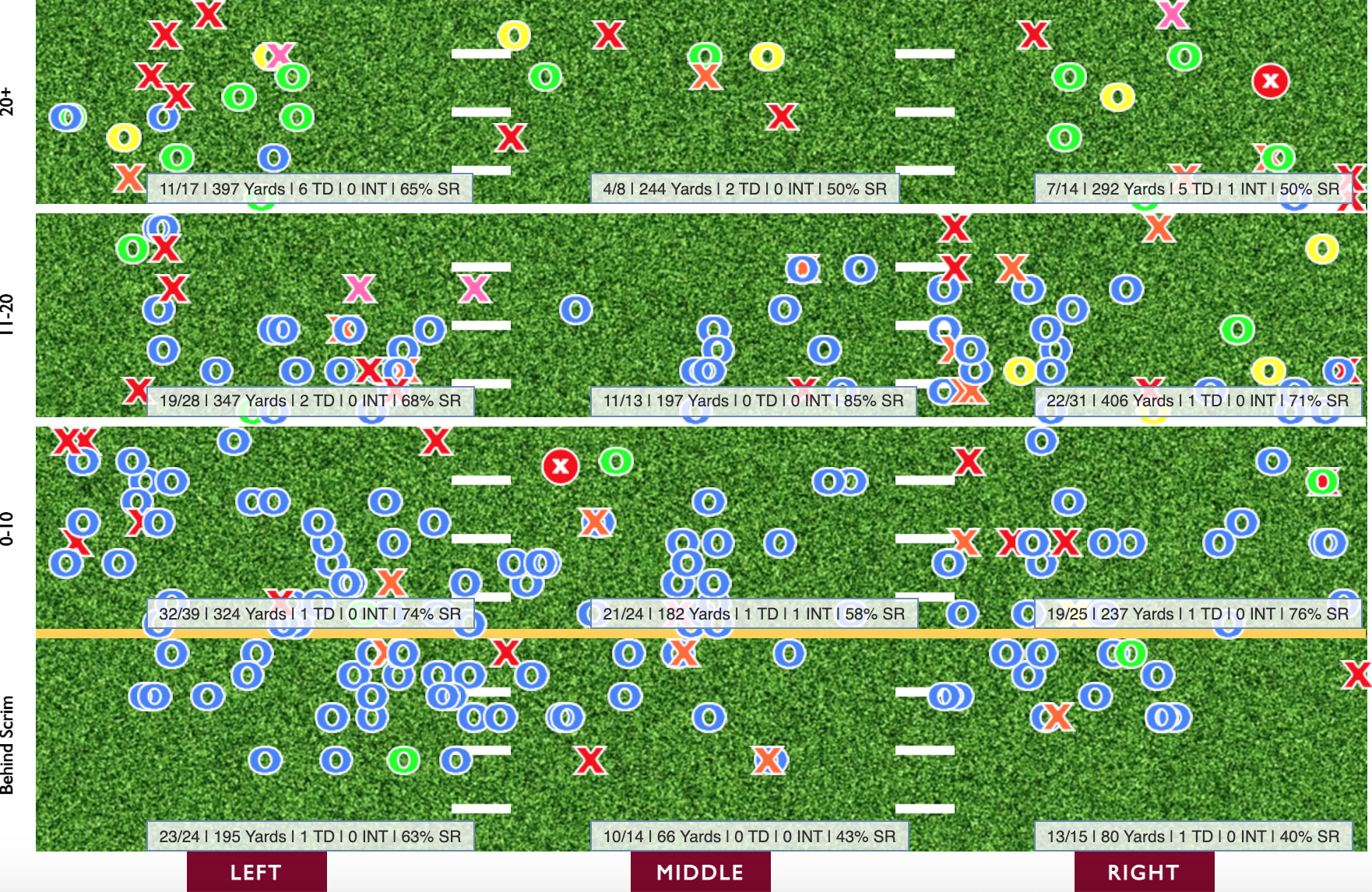
Mac Jones' 2020 clean+dropback Pass Chart
Play action or no, Mac’s deep ball placement was good, not great. Both his raw Deep Accuracy and Depth Adjusted Accuracy barely cracked the conference’s top5 this past season as each hovered around 47%. For a reference point, his figures are very close to Joe Burrow’s from 2019 (Arm strength was commonly the Bayou Bengal’s bugaboo entering last year’s draft, and he finished near the bottom of the NFL in Deep Accuracy% as a rookie). But like Cool Joe, Jones’ elite midrange figures remain his biggest selling point. On clean+intermediate targets the last two years, the Tider’s Success Rate and Depth Adjusted Accuracy finished in the 70’s.
Kyle Trask

Kyle Trask’s passing the last two seasons wasn’t a fluke according to his floor metrics. Both his Completion% and Accuracy% stayed in the mid-60’s, he connected on more explosive throws, and rocked the best two-year Success Rate in our sample. Though his clean+dropback numbers against Power5 opponents in 2019 were a bit worrisome, Trask’s performance this past season helped his figures improve across the board. All three of Trask’s ball placement figures in these spots bested his overall marks, which fueled his spectacular encore. In 2020, his Interception Rate was cut in half, his Y/A increased almost four yards, his Explosive Pass Rate improved by eight percentage points, and both Trask’s Uncatchable and Interceptable Pass Rates dipped into the single-digits. That said, his prominent flaw was further worsened from clean+dropback situations. Along with the worst two-year Depth Adjusted Accuracy% of our four prospective passers, his 8.64% Interceptable Pass Rate screams Trask won’t survive at the next level unless that’s fixed ASAP. Though it’s nice his clip worked itself under 10%, his stat from 2020 still fell comfortably into the danger zone. The fact his INTA% is 5x more than his INT% should illustrate how fortunate Trask has been avoiding turnovers with his knack for delivering contested throws.
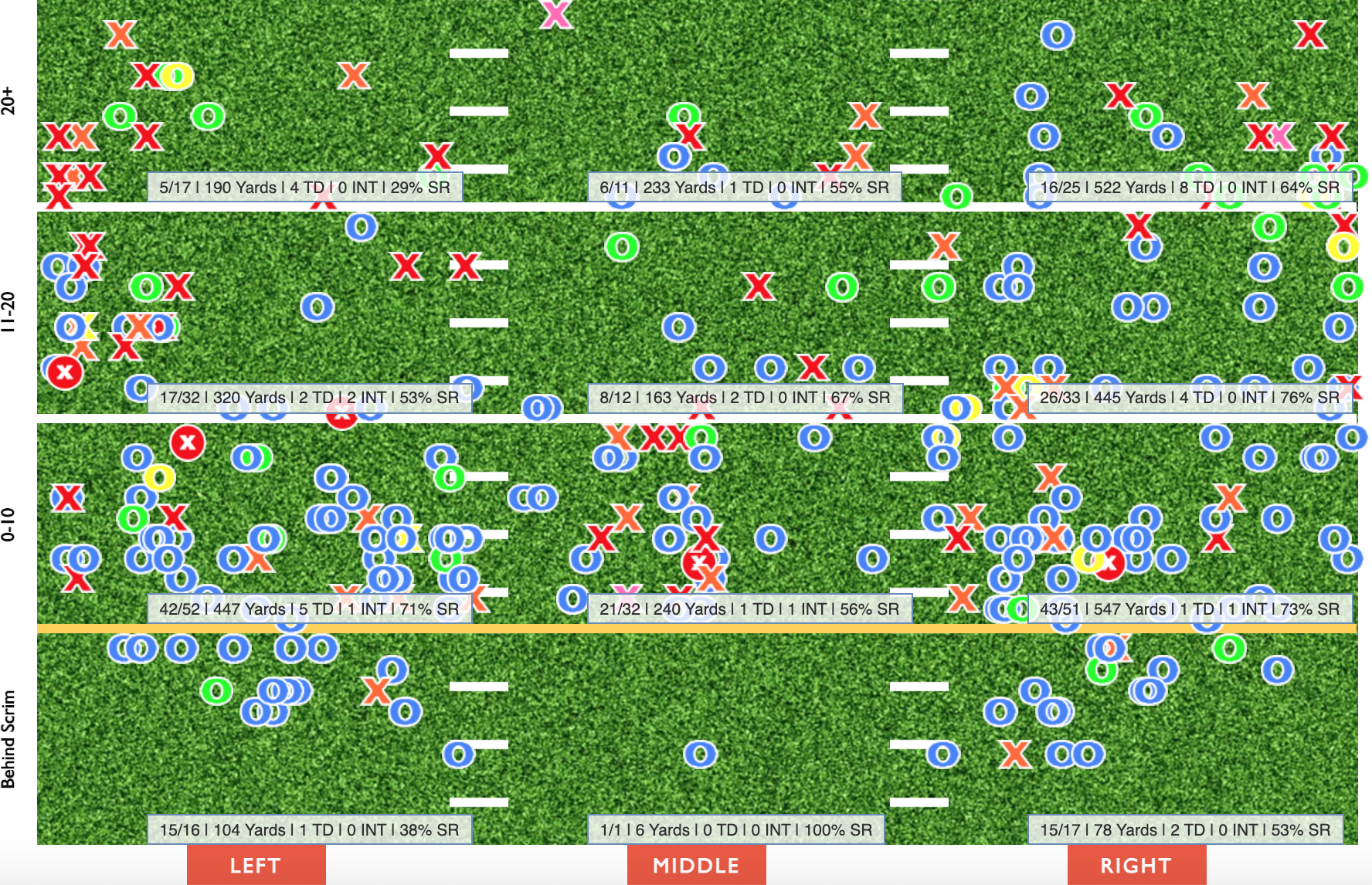
Kyle Trask's 2020 clean+dropback Pass Chart
The offense’s inconsistent run game played a part in the periodic stints of nickel and diming, but Trask certainly benefited from his scheme here. On throws beyond the line of scrimmage but less than 11 yards downfield, Trask rocked a top5 Accuracy%; but no conference QB topped his 70% Success Rate, 9.22 Y/A, or 10.8% Explosive Catch Rate this past season. Only five SECers donned a lower Air Yard Makeup on these throws than his 43.7% clip. While dissenters will note that level of production outside of his control in the dropback game this past season, they’ll also pick apart Trask’s one-year increase in deep precision. Trask has always been at least an average midrange passer, and he further increased his capacity in that department in 2020. But he was unquestionably a cellar-dweller on throws beyond 20+ yards in his first season of extended action in Gainesville. Less than a quarter of these attempts were deemed accurate, and his clean+dropback Deep Completion% finished at 29.6%. Last fall, both clips equaled 50.9%. That’s a massive uptick. As nice as reaching that plateau was, that kind of variance can’t be ignored when trying to gauge Trask’s long-term appeal.
Kellen Mond

Though Mac Jones and Kyle Trask each saw their screen+RPO Rates shrink year-over-year, Kellen Mond has consistently been one of the most-featured conference passers on true dropbacks. Back-to-back years, his such clip has topped 86% — only the Mississippi State’s two Air Raiders and Mizzou’s Conner Bazelak donned a higher mark than his 87.6% clip from 2020. With those facets carrying less weight across Mond’s profile than anyone else’s in our sample, his floor metrics resembled his overall figures more than the other dudes. But by eliminating 175 pressured attempts over the last two seasons, Mond’s passing bar was heightened even if his profile remains more muted than a silent picture. Though he saw improvement this past season operating TAMU’s secondary facet, his two-year Y/A, Y/C, Completion%, Accuracy%, First Down+TD Rate, Uncatchable Pass Rate, and Success Rate are the lowest floor metrics of our four prospective passers. Considering his average depth of target on clean+dropback situations fell inside the conference’s bottom5 each of the past two seasons, Mond’s Interception and Interceptable Pass Rates worsening along with the uninspiring returns should be a major concern moving forward.
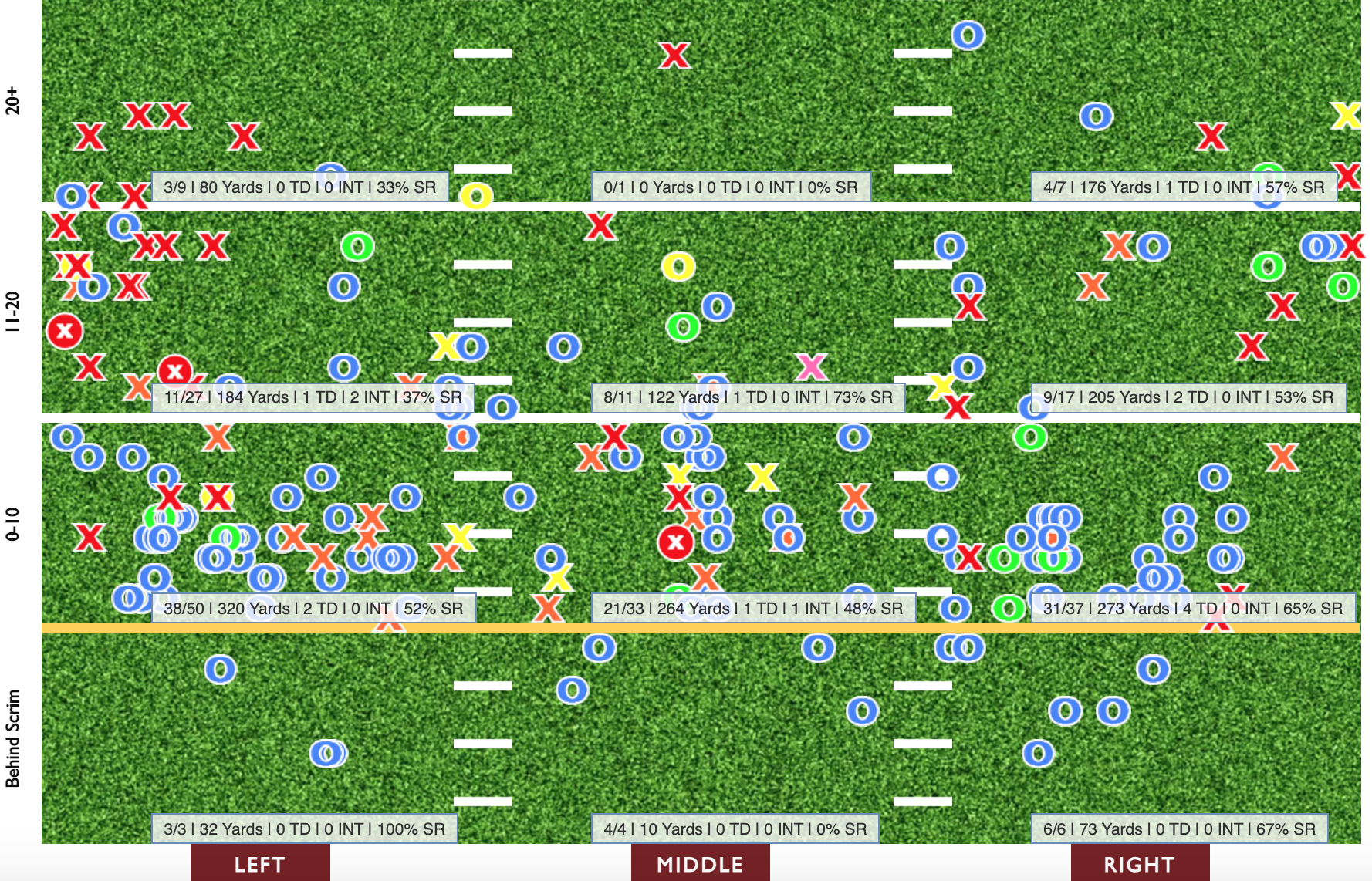
Kellen Mond's 2020 clean+dropback Pass Chart
Plus, folks will have hangups on his shortcomings targeting beyond ten yards downfield. Mond was far from a liability, but he failed to standout in any way with his intermediate and deep targets. I mean, check out his “death spot” from this past fall on his passer chart. Including all ten-plus yard throws from the left numbers outward, the Aggie only completed 7/36 attempts for 1 TD and 3 INTs. To reiterate, most of Mond’s damage came on short, underneath throws in structure. This allowed him to seized relatively easy completions and find moderate situational success. Both his Depth Adjusted Accuracy% and Success Rate cracked 50% the last two seasons on clean+dropback attempts. So at least, he’s got that going for him. And with the aforementioned team speed being on the wrong side of the conference average, Mond’s zip was commonly put to the test in tight windows. Along with his natural traits, this characteristic is probably one of his best selling points. In our parameter, no SECer topped his ball placement figures on contested attempts in 2019, and he finished top3 in Success Rate. While his marks failed to replicate themselves from the year prior, Mond still finished inside the conference’s top5 in both Accuracy% and Depth Adjusted Accuracy% on such throws this past season.
Feleipe Franks

Within structure, Feleipe Franks’ displayed nice floor metrics especially thanks to Kendal Briles’ influence. From clean+dropback situations, he maintained a Completion% in the 70’s back-to-back years, improved his Accuracy% each season, set a career high-Explosive Pass Rate and Accuracy%, and sliced his Uncatchable Pass Rate in half year-over-year. His 2020 11.47 Y/A just missed out on topping Kyle Trask, and his two-year 5.77% Interceptable Pass Rate in these spots was the lowest of any of our four QBs. Though Franks’ midrange figures finished behind Mac Jones’ within the SEC, his short and deep Depth Adjusted Accuracy% led the conference. Franks has rocked at least a 64% DAA% and a 52% Success Rate in clean+dropback situations since 2019. While you can crap on his somewhat risk-averse style of play, Franks was unequivocally efficient through the air within structure.
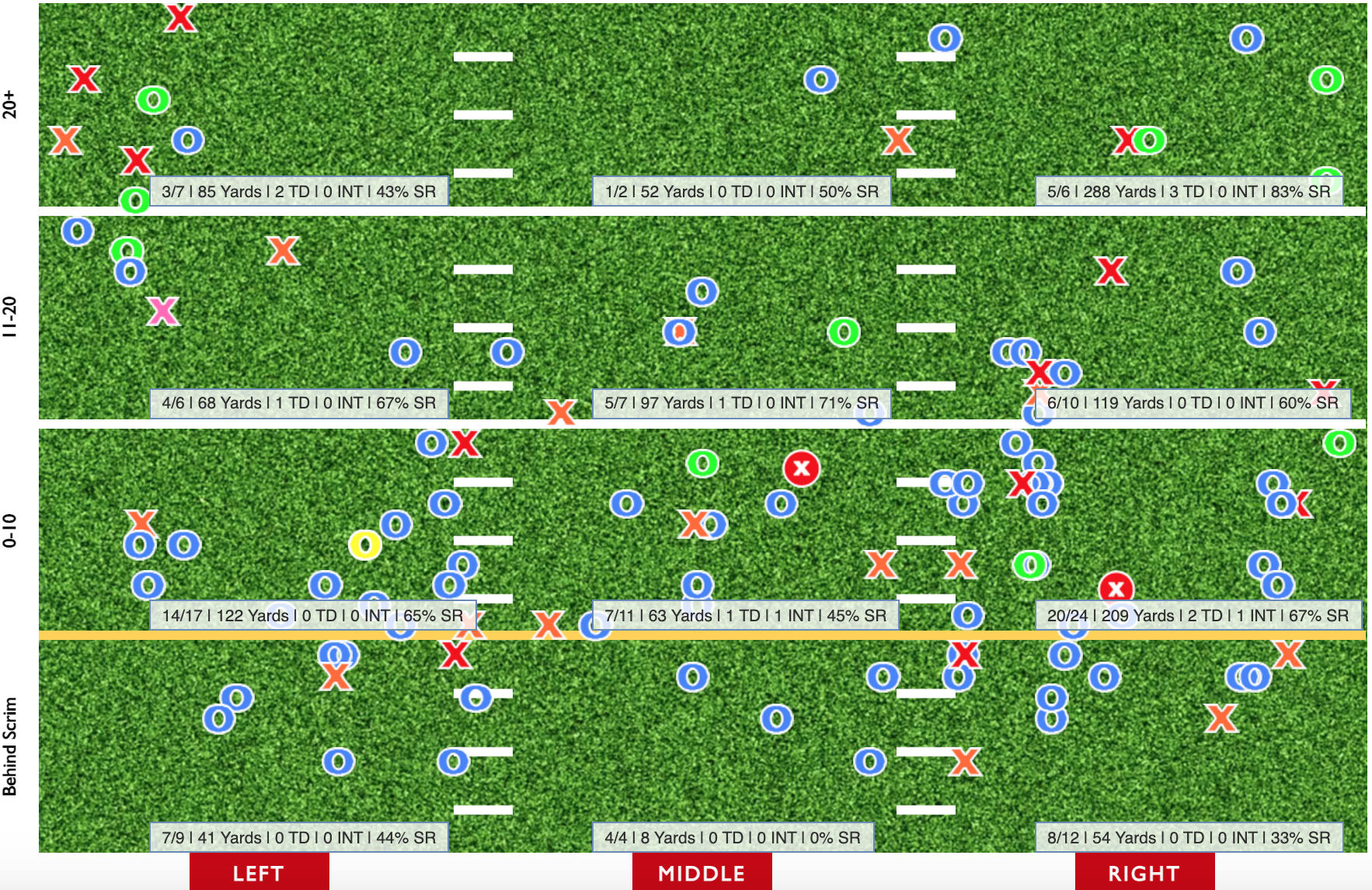
Feleipe Franks' 2020 clean+dropback Pass Chart
Still, analysts will be torn on his upside based on his past reliance on aspects outside of the dropback game. Remember his screen+RPO Rate trumped the next SECer by nine percentage points this past fall. Franks has only logged 104 attempts that met our parameter the past two years against Power5 opponents; his 87 from 2020 accounted for less than half of Kellen Mond’s total. Plus, the plurality of those snaps featured heavy play action. Including all dropbacks, Franks 41.5% PA Rate was only topped by Matt Corral within the conference. Mac Jones, JT Daniels, and Tennessee’s passers were the only other SECers that averaged more blockers/such attempt. This scheme aggressively presented Franks situations to win and deliver accurate passes. Despite donning more downfield gusto, there’s no doubt Arkansas’ operation helped goad more gold out of him. But unfortunately, no NFL offense runs the Baylor-spread full-time. Sure, he showed some success finding guys on pro concepts; but Franks’ development will likely take longer than the others despite projecting sterling ball placement.
Taking it one step further
Judging our passers through the clean+dropback lens told us quite a bit. Mac Jones’ stats remained robust, Kyle Trask’s tendency to toss turnover-worthy passes stained his profile, Kellen Mond’s methodical style of play helped author his overly meh resume, and Feleipe Franks’ accuracy showed up on all levels of the field despite commanding a simple scheme. Within structure without the threat of defenders, each passer experienced gains in their result-based metrics and accuracy figures.
But in order to get the best representation of out passers’ true throwing ability, we need to set one more little, extra parameter: omit play action attempts. Within the SEC the past few years, play action has coaxed more aggressive tendencies that generally results in an increase in ADOT, Y/A, and Explosive Pass Rate at the expense of stuff like Accuracy%, Uncatchable and Interceptable Pass Rate. Though a team doesn’t need a good — or even elite — run game in order for this tactic to work, having one certainly helps maximize the whole shebang. Moreover, a constant run threat eventually alters the backend coverages defenses can call, which prevents them from dictating the action. Along with the natural deceptive ability to create an open receiver, play action passes are generally scheme-driven rather than a product of one’s passing ability. So in order to account for that element and the tactic’s effect at producing volatile results, let’s see what happened to our QBs’ floors when taking out play fakes from clean+dropback snaps.

Mac Jones

Let’s start with the bad news before switching gears to something more positive. Jones was a worse version of himself without play action. His two-year Y/A, Y/C, Completion%, Accuracy%, TD Rate, Interceptable Pass Rate, Uncatchable Pass Rate, Explosive Pass Rate, and Success Rate all soured on straight clean+dropback attempts compared to his overall marks. He’s the only one of our passers to experience a dip in the latter while logging the largest drops in Completion% (-7.14%), TD Rate (-1.86%), and Explosive Pass Rate (-3.9%). Behind dynamic deception, sometimes Jones didn’t have to do too much in order for his bottom line to benefit. How many times can you think of Crimson Tider housing a bubble screen or securing a splash gain via a slant in recent years? Now for the glass-half-full angle: Jones’ passing floor still remains high. Half of his passes resulted in either a fresh set of downs or a score, both his Completion and Accuracy% finished in the high 60’s, and generated a gain of at least 20 yards on one out of every eight such attempts. Exactly 59% of his throws ten-plus yards downfield were deemed as accuracy. Though it did shrink some, no one is going to shove away a 58.5% Success Rate in this context or a 9.62 Y/A especially when the most recent showing generated respective clips of 66.4% and 10.7.
Kyle Trask

Trask was magnificent on straight clean+dropback attempts. Two-thirds of these passes worked situationally, and he was the only QB in our sample to experience gains in TD Rate, Y/C, and Explosive Pass Rate compared to his overall figures in the two-year window. None of our three other passers matched his 1.18 yard and 12.8 percentage point improvement in Y/A or Success Rate, respectively. With those boosts, both stand to be the best the SEC has to offer for April’s Draft in this context. There weren’t many negatives to Trask’s game in these spots other than a slight dip in his Completion% and still having issues with the whole ‘throwing the ball near defenders’ thing. Every twelfth pass had turnover potential, which is consistent with what his floor metrics told us. Now, his Interception Rate improved in these spots. But, that is judging him on his results and not his process. NFL defenders won’t be as kind as the “amateurs” Trask is used to dealing with in terms of letting him skirt with an INT Rate under 2%. That said, he has the accuracy, decision-making, and confidence to hold his own at the level level if those dangerous passes can be curbed.
Kellen Mond

Mond was typically his most aggressive self on these snaps, but that didn’t mean TAMU’s modest aerial attack saw an uptick in potency. The Aggie’s 12.55 ADOT, which was over three yards more than his overall figure, finished as the highest amongst our four passers in this context. With more downfield tries, he was slightly more prone to turnover-worthy passes per his two-year sample. This past fall, Mond logged an 8.23% Interceptable Pass Rate that was even worse than the heat-seeker Kyle Trask himself. But outside of that, folks have to like the way he’s trending. Nearly two-thirds of his throws ten-plus yards downfield were on the money, his overall Uncatchable Pass Rate was sliced in half, and Mond managed to rock at least a 50% Success Rate. While his normal mundane M.O. overly targeted short, he sported a 14.1 ADOT. Mond has gotten better for three straight years with his precision. And in these spots, he’s rocked a raw Accuracy% in the low 70’s last season. Though the short stuff appeared to be the catalyst for his sturdy metrics, Mond’s improvement in the dropback game within structure makes him a safe and respectable mid-round draft candidate even if the scheme he played in failed to produce a lot of fireworks.
Feleipe Franks

Despite his background, Franks could be a gem at the next level. Whoever drafts this kid better be a believer in the Millsap Doctrine. For the uninitiated, this is a theory from the world of the hardwood named for NBAer Paul Millsap that follows the notion if a player posts efficient rate-based stats in limited minutes consistently those figures should carry over with increased volume. Simply, Franks has been elite targeting ten-plus yards downfield in these spots, but his sample size is one the small side. Franks was the least-utilized of our passers in this context. Captain Obvious wanted me to remind you all in case you forgot about the aforementioned notes about his style of play and reliance on screen+RPO attempts to round out his bottom line. Because of that, these findings can be susceptible to variance. Plus when Franks isn’t comfortable with his pattern, he can be a Checkdown Charlie. As wonderful as his Completion and Accuracy% project to be, his 5.80 ADOT is over 1.8 yards lower than his overall clip. Someone will talk themselves into drafting the Razorback due to his athleticism and tantalizing traits, but no one will give him an extended chance if he never tests opponents downfield with his talents.
Stats might be for losers, but you’d have to be a straight dumbass to ignore these figures when evaluating the threshold of these passers at the next level.