2021 Draft Stuff: What's the Catch with the SECers?
2021 Draft Stuff: What's the Catch with the SECers?
While the quarterbacks are getting most of the headlines and driving the draft intrigue, this is a pretty darn good wide receiver class. And wouldn’t you know it, the SEC projects to own a lot of real estate atop most team’s draft boards with its pass catchers. Seven are top50 prospects. In addition to Florida’s tight end clearly being the premium at that position, Mel Kiper’s top6 receivers all hail from the SEC.
Boasting the likes of Ja’Marr Chase, DeVonta Smith, Kyle Pitts, and Jaylen Waddle, the SEC also presents worthy prospects such as Kadarius Toney, Elijah Moore, and Terrace Marshall Jr.. Plus, you have later options like Josh Palmer, Shi Smith, Seth Williams, Anthony Swartz, Jhamon Ausbon, and Osirus Mitchell. No question, this conference has delivered tantalizing pass catching prospects for 2021. Since these guys have got game, plenty of folks have preferred to zero in on their positives. Personally, I’d rather look at these SECers through a lens examining their most challenging moments instead of writing a rose-scented sendoff.
Catching a wide-open pass or in the comfort of the offensive design hardly helps receivers stand out. Well...those plays often result in nice bumps to the stat sheet. But in terms of unearthing traits, those receptions don’t tell us much. After all, most receivers should be able to snatch accurate balls. On the other hand, seeing how they perform when the pass isn’t quite on target, in traffic or tight windows, or deep downfield certainly helps a receiver separate himself from the pack (and show quarterbacks he’s trustworthy).
Before we pick apart these receivers one by one, let's gloss over the class on these "extra" attempts from the last two seasons. I should mention, there is some bleed over between these stats. Some deep targets are inaccurate. Some inaccurate targets are also contested. Some contested targets occur deep downfield. You get the idea. Still when you’re trying to determine a dude’s impact as a pass catcher, seeing him consistently win or provide value in difficult spots should put evaluators at ease. For the sake of clarity, all uncatchable attempts have been omitted. A few poor souls were more prone to logging those kinds of targets, which really hurt their bottom lines.
Inaccurate
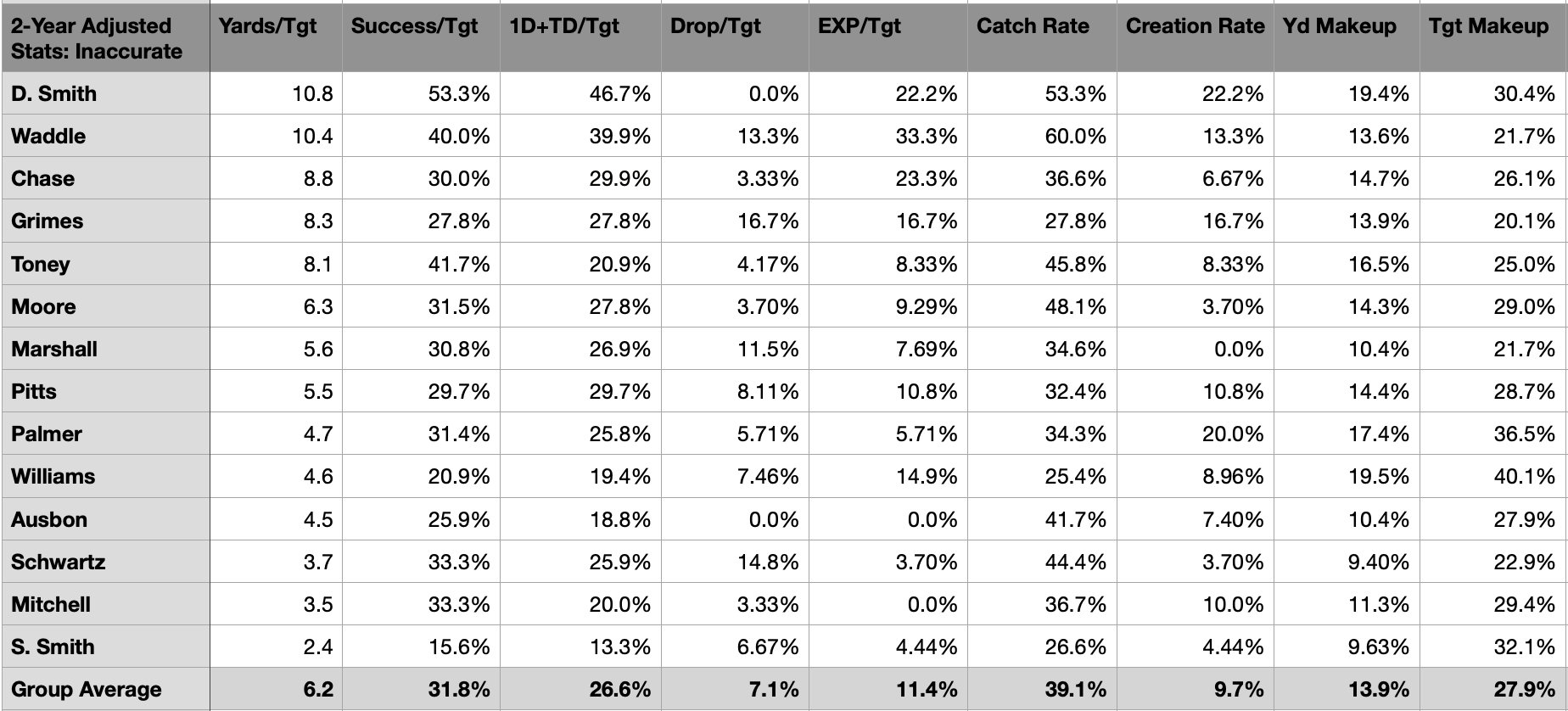
As a passer, it’s always nice to know your favorite target can adjust to a throw just in case the weather is windy, pressure affects your precision, or it’s just one of your off days. Plus, that element surely helps take the load off a quarterback’s shoulders. Trying to be perfect on every play can create stress, which tends to lead to bad things on the gridiron.
The average SEC prospect experienced an inaccurate, yet catchable, target on about every fourth attempt. Think of it as a display of competent catch radius, excellent hand-eye coordination, and ability to adapt on the fly. While evaluators like the practical upside it provides for a team’s passer, analytics people like them because these connections typically extend drives and help erase an offense’s miscues. Turning an expected incomplete pass into a fresh set of downs or better is football’s equivalent to a Midas Touch.
Contested
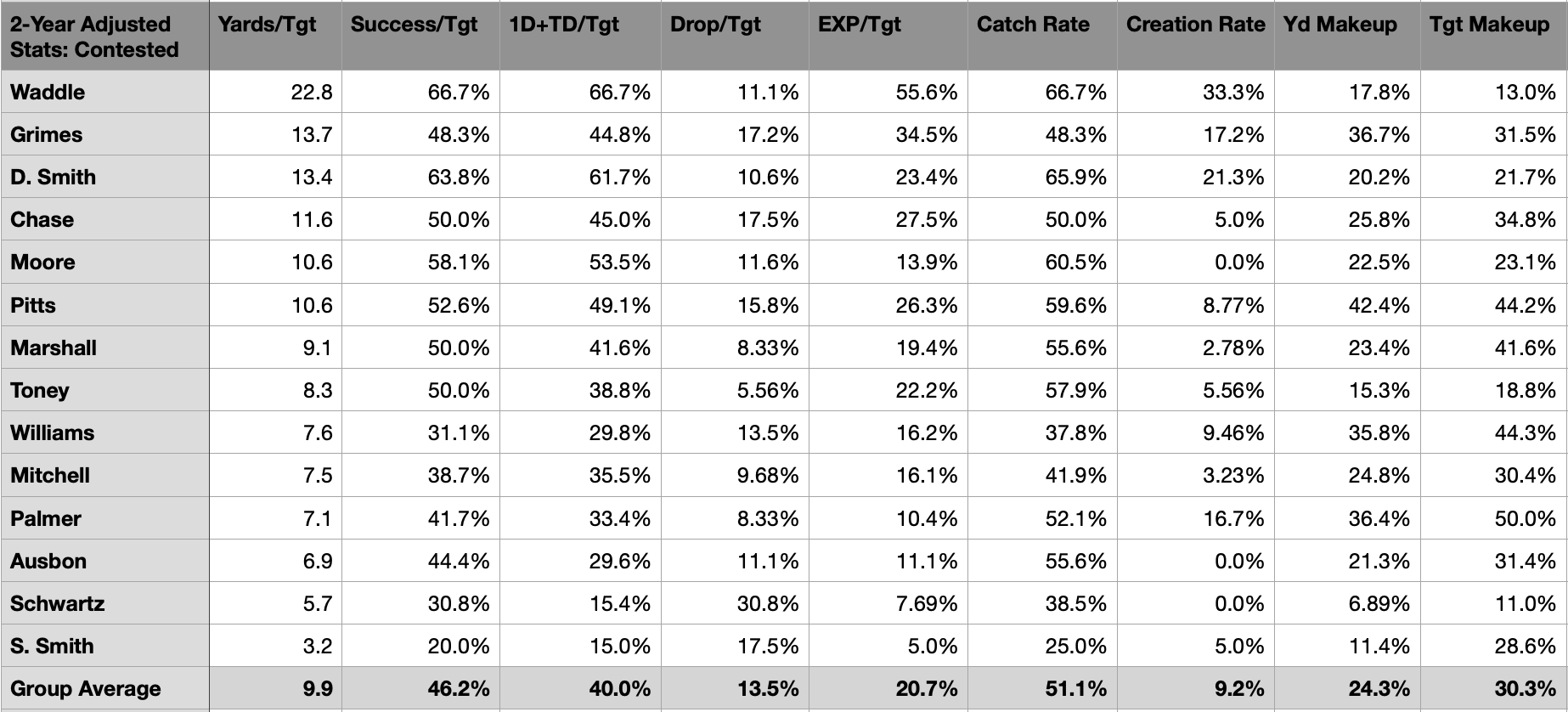
Sometimes a pass can be on the money, but a defender will do his damnedest to make sure a receiver winds up empty-handed. While rules are helping pass games open up and generate more cushion for completions, football is a contact sport at the end of the day. Knowing a receiver can deal with these elements consistently is another notch in the ole utility belt. Sure, there won’t always be a defender draped on their back or smacking their wrist at a high point. But when it’s crunch time, having dependable hands in contested spots if often vital to wins and losses.
The average SEC prospect saw a contested/tight window target on 30% of his chances. But thanks to some strong grips, over half of these targets the last two years were caught. With presumably less separation in the pros, those figures will likely head opposite directions. None of these SECers can afford to play soft, but being victorious in these battles unquestionably can help one find a niche.
Deep
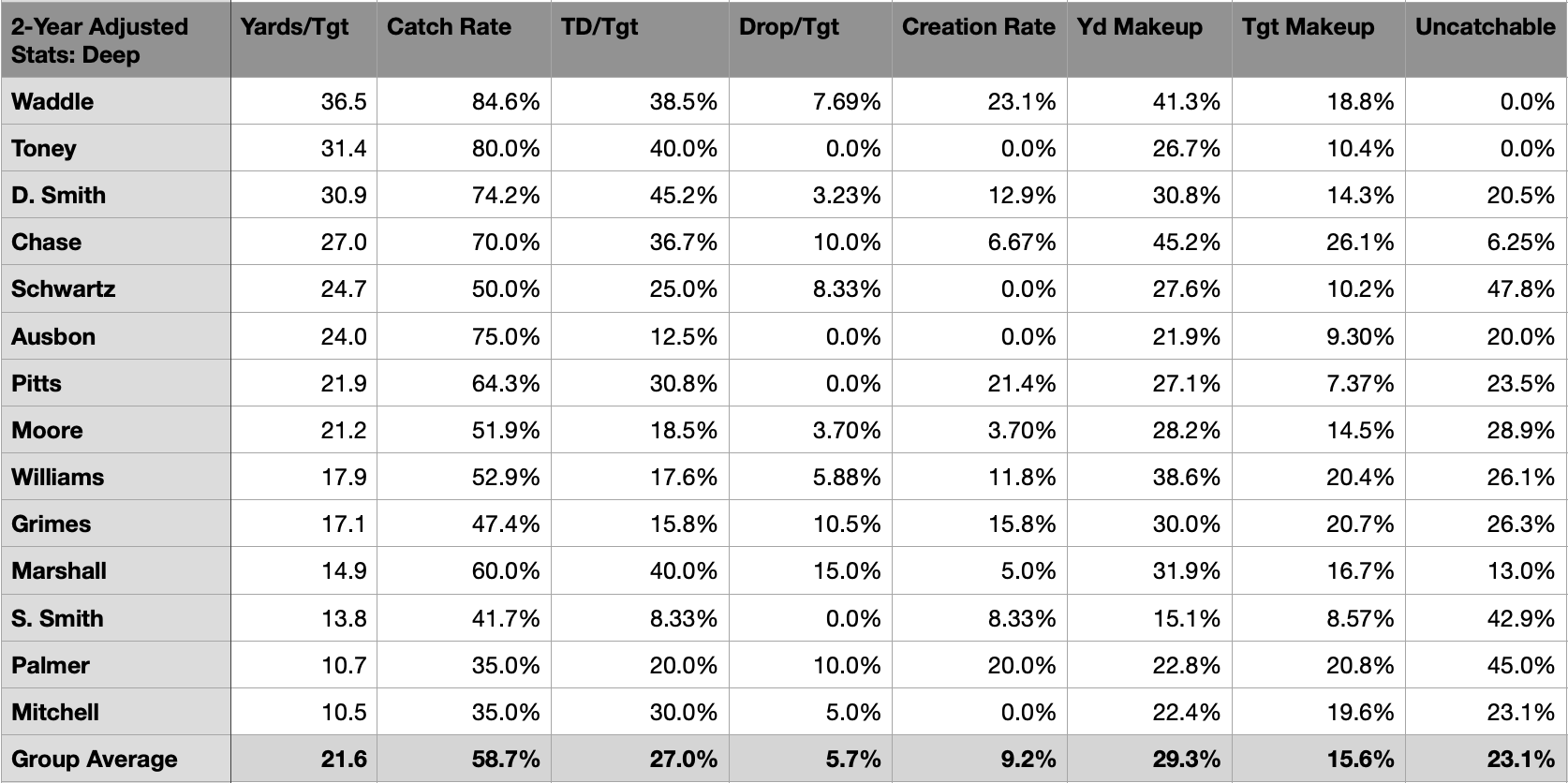
What’s the old saying? Chicks dig the long ball? Well, shit — who doesn’t. Deep throws get butts out of seats, provide the most bang, and can swing games instantly. Though there are different methods and avenues to unlock downfield bombs, a play caller has to know his receiver is capable of corralling these valuable attempts.
Either due to size, speed, savvy or any combination thereof, ten of our 14 SECers hauled in over half of their deep targets the last two seasons. Plus, the group was more likely to generate a touchdown than log an uncatchable target.
Ja'Marr Chase:
Measurables: 6'0, 201 lbs, 30.75'' arms, 9.625" hands


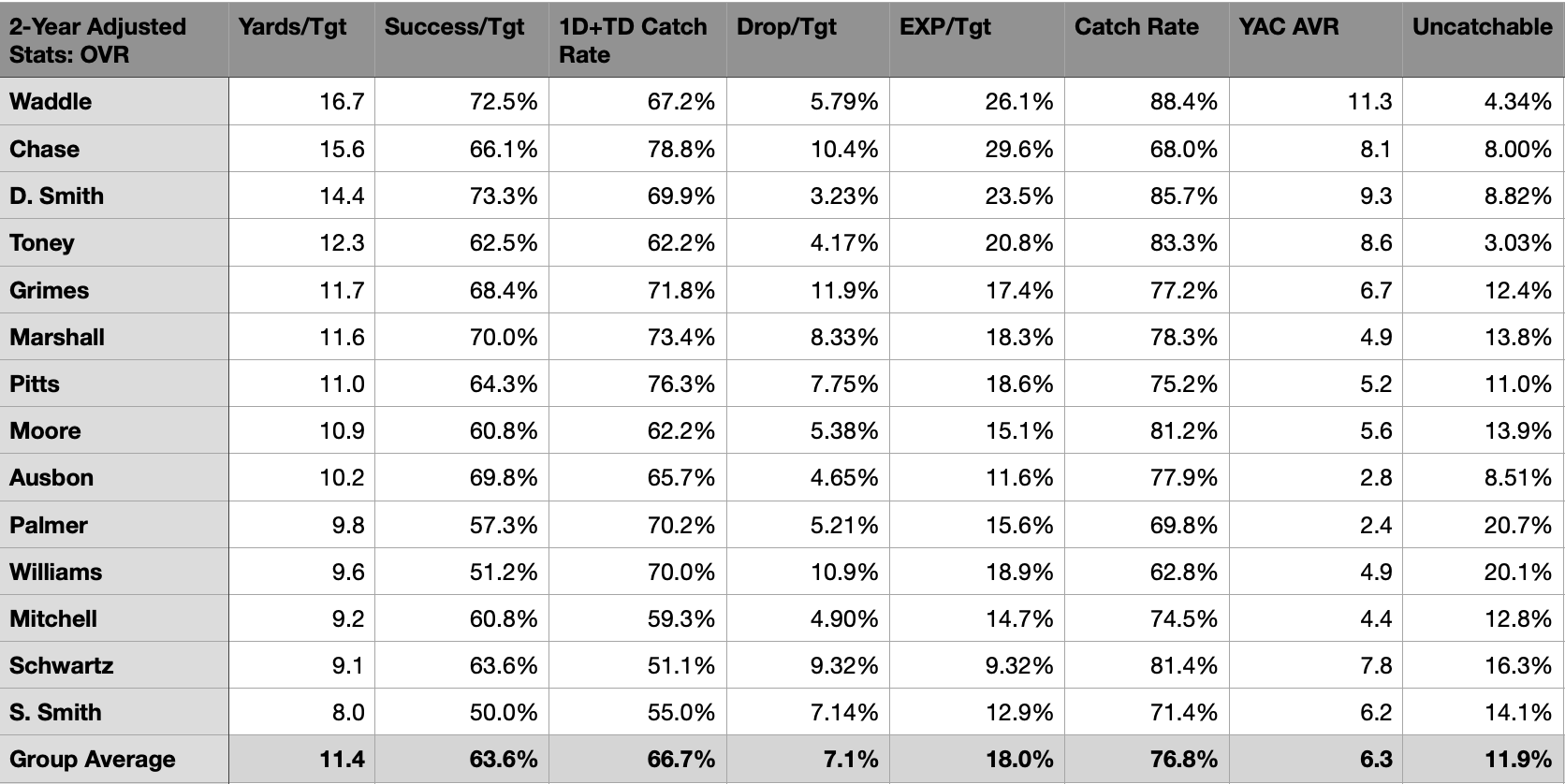
Ja'Marr Chase's breakout 2019 season was so spectacular that he didn't even need to log a single rep last fall in order to be many people's WR1 entering the draft. As the SEC's pass catching king that season, he was one of the conference's most explosive receivers and posted the top First Down+TD Rate. When adjusting that stat to a per catch basis, his big play potential is clear. In our parameter, no other SECer can challenge his 78.8% clip. And, his 15.6 yard/target further reflects his potency.
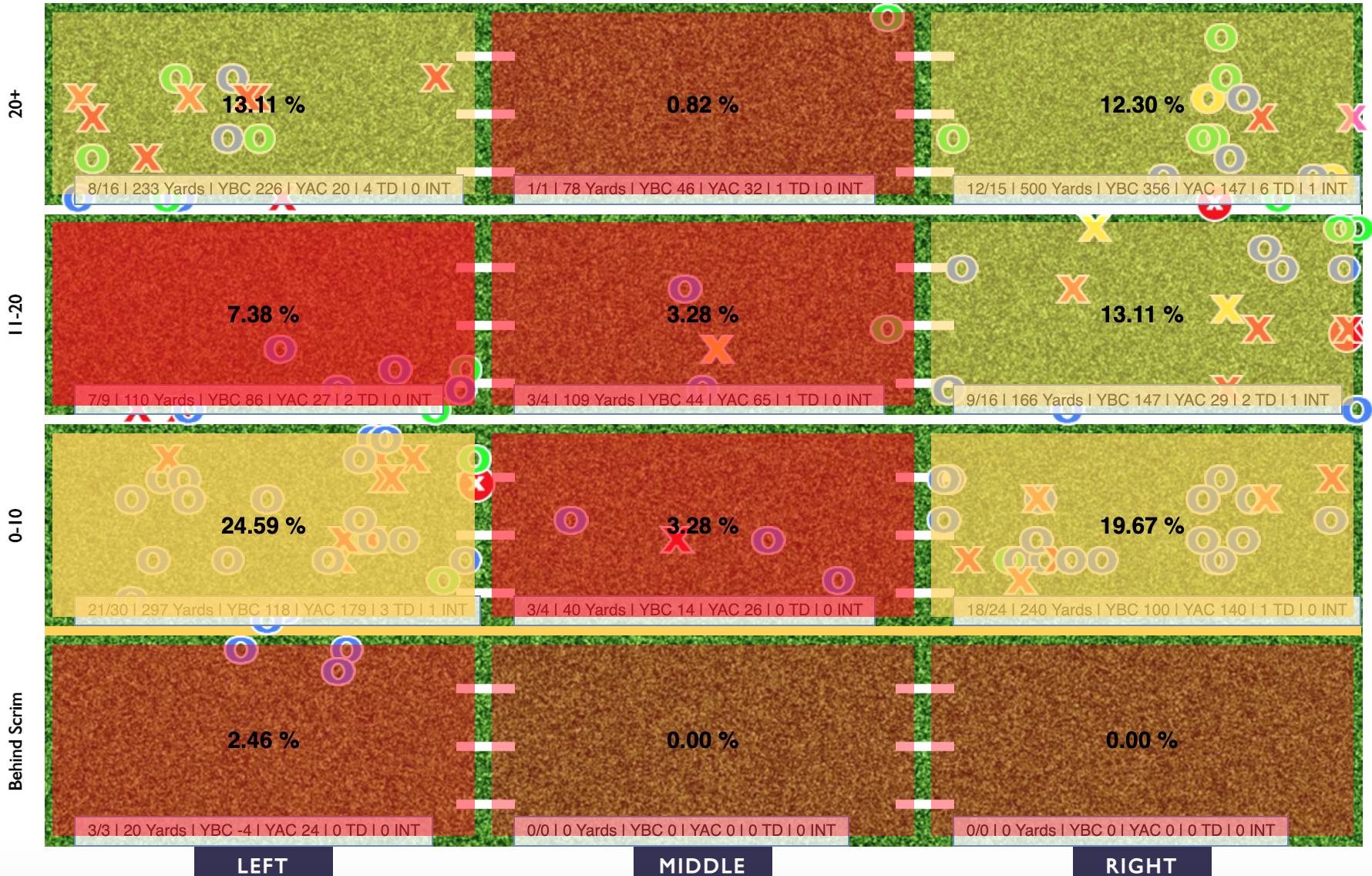

Chase is in the mold of a true X-receiver that can anchor a team's vertical route tree. Outside of slants, the plurality of his top targeted routes worked north and south in a straight line. Deep balls composed over a quarter of his targets and 45% of his yards. Chase's 26.1% makeup of the former is five percent more than the next SECer in line. Both his Deep Catch Rate and TD Rate stand as the 5th-best in the group, which seems unsatisfactory on the surface. As the top weapon on most people's draft boards, you'd probably expect him to at least be top3 among his peers. That said, those sturdy metrics paired with his heavy volume undeniably strengthen his outlook. Despite sitting out 2020, he only logged one less deep target than DeVonta Smith in our sample. With the increased degree of difficulty frequently working deep, however, his overall 68.0% adjusted Catch Rate is the 2nd-lowest in the group. Plus, his 10.4% Drop Rate falls into the bottom3. That's not the best look considering his Creation Rate -- or instances of going above and beyond the average receiver to make a play -- easily fell below our average. While a bonafide playmaker in the bayou, Chase's such rate failed to reach the good side of our group's mean in all three contexts.


Ample deep throws presented plenty of contested chances. Over a third of his catchable attempts in 2019 met that criteria. Though Chase certainly is speedy, he runs routes like a determined bulldog. This "confrontational" style lead to stalled releases, reduced cushion, and wasted reps on occasion; but the Tiger caught half of his contested chances of all which resulted in situational success. In addition to that, Chase also sits inside the top5 among our SECers in contested First Down+TD Rate and yards/target. The prevalence of these attempts in addition to owning the group's 3rd-lowest arm length should be something to monitor moving forward. Only Anthony Schwartz enters the draft with a worse contested Drop Rate.
Over a quarter of the Tiger's targets were off the mark. Having Joe Burrow ensured Chase didn't have to see an unmanageable amount of inaccurate targets no matter how vertically-oriented his route tree was. Like most of his metrics, that aforementioned style buoyed his Explosive Catch Rate and yards/target in addition to generating an above-average 1D+TD Rate on inaccurate targets. But, his Catch Rate and Success Rate were subpar. Though Chase certainly can make the occasional play adjusting to a downfield target, the stats say he has plenty of ground to make up in that department.
No prospect enters the draft with a perfect profile. Haters certainly can focus on his drops, blah play when a pass is off-target, and not playing a down in over a year. That said, the LSU product checks a lot of boxes. Everyone is out for that next great deep threat, and Chase's physical route running paired with his potency across all kinds of his targets solidifies his projected upside. Not everyone can hang onto tight window targets or exhibit prowess as a deep threat consistently. In a bang-bang game, receivers that can win those battles will always be a highly-sought asset. Keeping up his chesty appearances, the Bayou Bengal broke a tackle on every fourth reception on average. Per Pro Football Focus, that places him in the 93rd percentile of all pass catchers since 2014.
Jaylen Waddle:
Measurables: 5'91/2, 180 lbs, 30.375" arms, 9.125" hands


For three seasons, Jaylen Waddle has been a statistical sensation. Though overshadowed by teammates, hindered by an inconsistent workload, and injury truncating his 2020 campaign, the Alabama dynamo consistently produced elite efficiency metrics. His yards/target twice led the conference during his tenure in Tuscaloosa, his Success Rate never finished lower than 2nd, and his Explosive Catch Rate never finished lower than 4th. In case you forgot, the SEC has produced a good amount of quality pass catchers as of late and the Tider was arguably the best of the bunch. Per Pro Football Focus, Waddle's yards/route and yards after catch average are the best in the entire draft class. His clip of the latter from the last two years is the only figure in our sample to reach double digits.
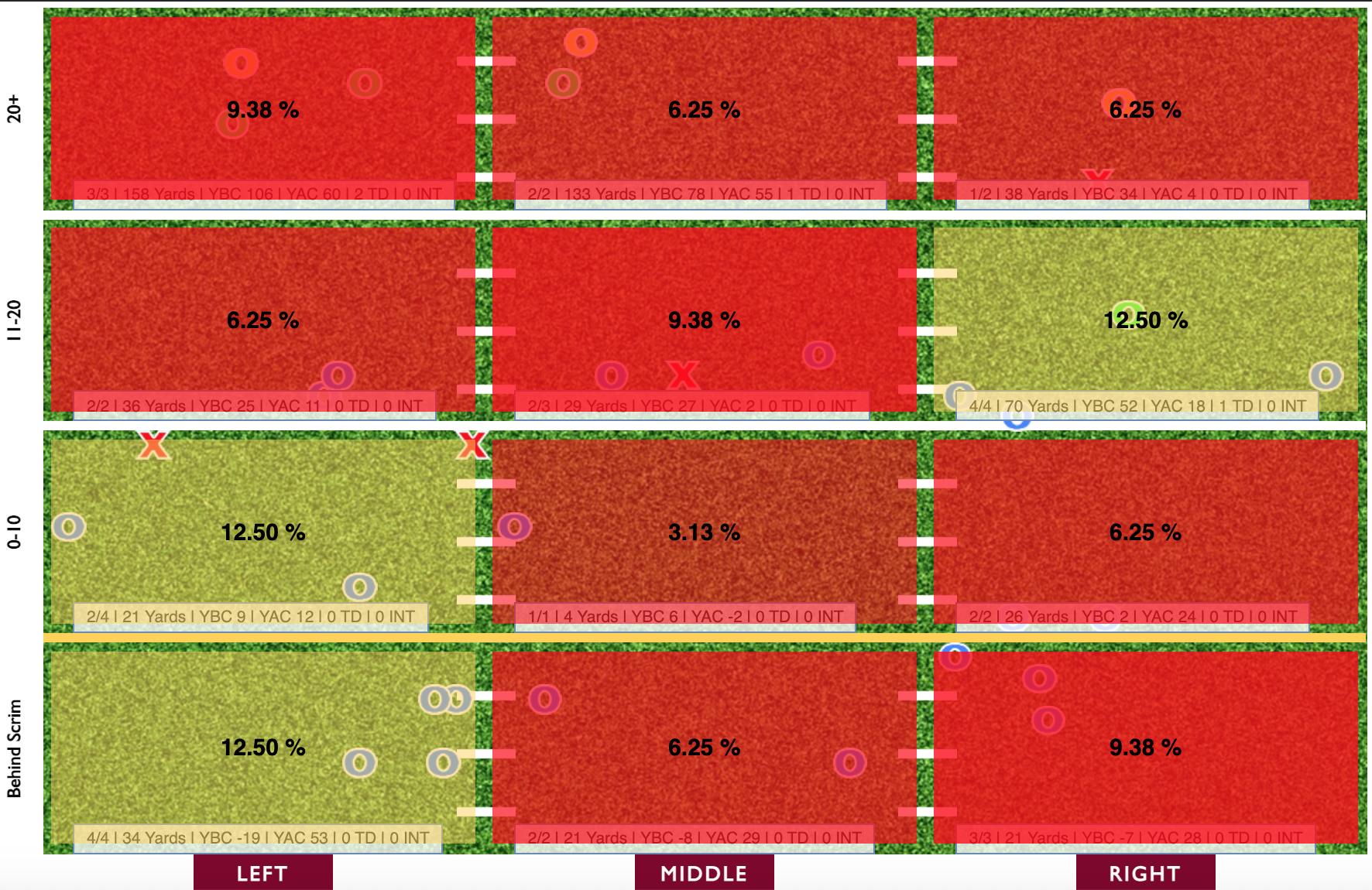
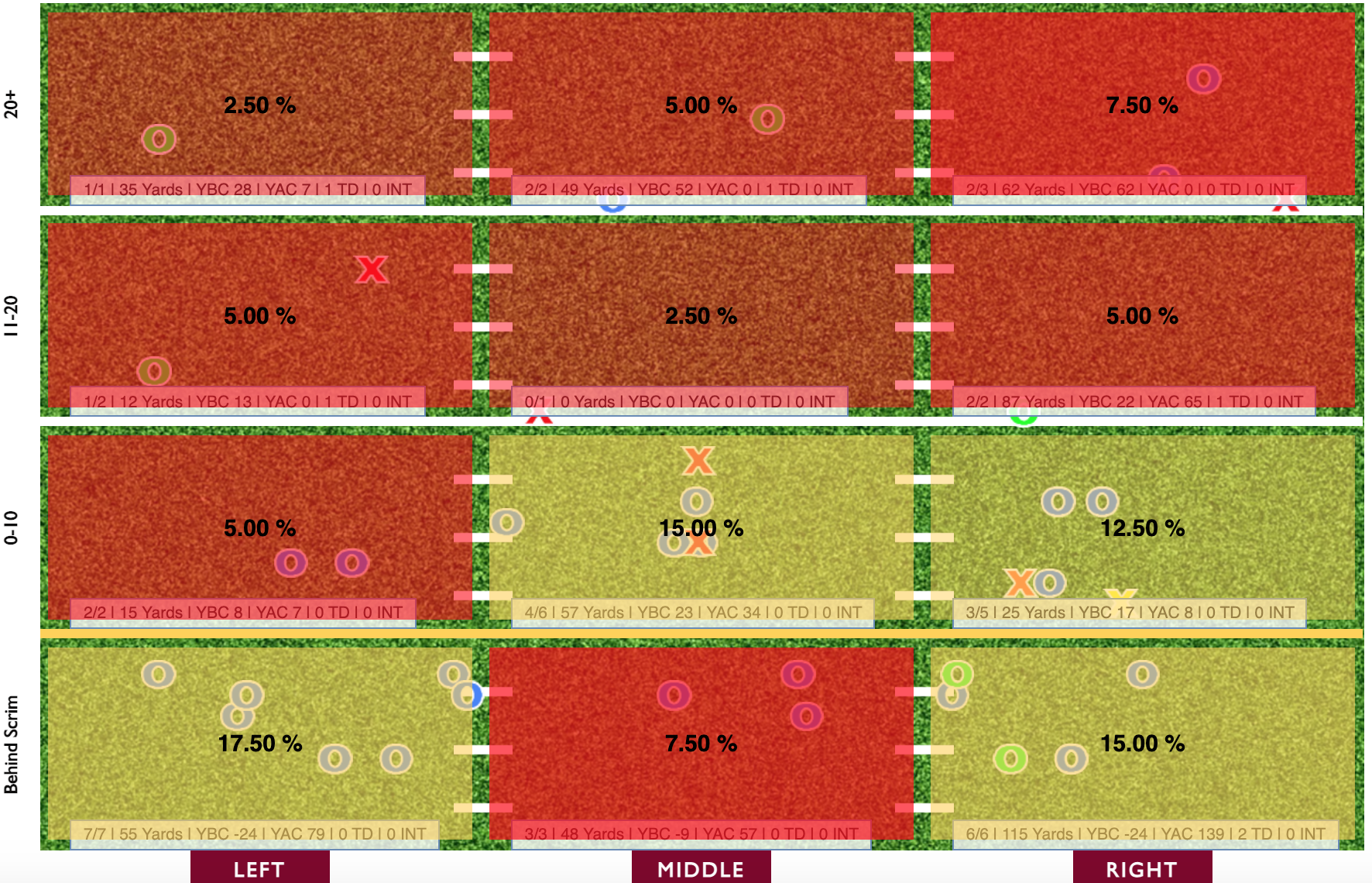
Waddle's 2020 Target Heat Map/Top Targeted Routes Waddle's 2019 Target Heat MapTop Targeted Routes


Steve Sarkisian was fickle in utilizing Waddle. Never the play caller to do something too often, the former Alabama offensive coordinator heavily leaned into the Tider's versatility to maximize his desire to keep defenses off-balanced. With blazing speed and dangerous homerun ability that forced opponents to always keep an eye on him, Waddle was frequently used as a gadget player via motions, outlet screens, and general eye candy. As a route runner, his jets make him a tricky receiver to defender on deep crosses and fluid horizontal paths, which is why he commonly was deployed in that manner. While his most targeted routes have remained steady the last two years, his average depth of target has be volatile. Despite logging a 5.9 ADOT in 2019, Waddle ventured downfield much more often before his injury this past season. Over a fifth of his 2020 targets occurred with him at least 20 yards past the line of scrimmage.
Though the volume was iffy, Waddle's deep receiving was anything but. The past two seasons, the Tider hauled in 11/13 such chances with three "creations". His respective rates of 84.6% and 23.1% on deep targets are tops amongst our SECers. If we wanted to include his most prolific season as far as the traditional stats are concerned, Waddle caught 20/23 deep attempts. These victories fueled much of his efficiencies littering his bottom line. You can think of him as a lightning-quick return man or spry outlet on the perimeter; but Waddle is unquestionably a talented ball tracker despite his unassuming frame.


Waddle's mettle transferred over to his contested targets. But like his deep attempts, he didn't log too many of these opportunities by volume. In fact the last two seasons, Waddle only commanded nine such chances. Small sample or not, his numbers overly remained the best in the conference. The Tider's speed and Alabama's stressful scheme tended to get him open, which is one of the reasons his 4.34% Uncatchable Target Rate is one of the lowest in the group. For what it's worth, his contested targets generally were all deep attempts.
With relatively little contests and a good amount of outlet receptions, Alabama's passers hardly had trouble delivering Waddle accurate balls. Only Trevon Grimes rocks a lower makeup of catchable targets that were inaccurate over the last two seasons. But when a wayward toss came his way, Waddle bested most of his peers. Though his teammate shined in this context and trumped most of his metrics on off-target attempts, no SECer sported a preferable Catch Rate or Explosive Catch Rate.
In a conference with plenty of x-factors, Waddle has been my favorite by a wide margin. Consistently popping not only on tape but also in charting, he has been an easy prospect to support. Admittedly, to back a player will his "lack of experience" and untested sample size is a huge risk. But others in his corner will unequivocally be touting the Millsap Doctrine. This is a theory from the world of the hardwood that acts on the principle if a player posts efficient stats consistently in limited stints those stats will remain stable with increased usage. While a low-usage resume is prone to fraudulence and volatility, the Tider's speed, play making, and shear talent are palpable. No doubt he'll be attacked due to his size, wonky production, and injury recovery; but if the draft is about upside, this likely slot or off-ball firecracker can make a lot of people look stupid for passing up his talents.
DeVonta Smith:
Measurables: 6'2, 166 lbs, 31.125" arms, 9.25" hands


DeVonta Smith's Heisman season should speak for itself. Despite the award increasingly becoming a quarterback-only honor, the Slim Reaper delivered plausibly the most dominant season ever by a college wideout. Along with his gaudy volume stats from this past season, Smith's 73.3% Success Rate over the past two seasons trumps all other prospective SECers when taking out uncatchable attempts. By a rate basis, he wasn't particularly hindered by those kinds of throws. But surprisingly, Smith was on the receiving end of copious off-target opportunities. Despite Tua Tagovailoa and Mac Jones notably being two of the most precise passers to come through the conference lately, 30.4% of the Tider's catchable targets the past two seasons were inaccurate. Only Seth Williams, Josh Palmer, and Shi Smith can lament about worse clips.
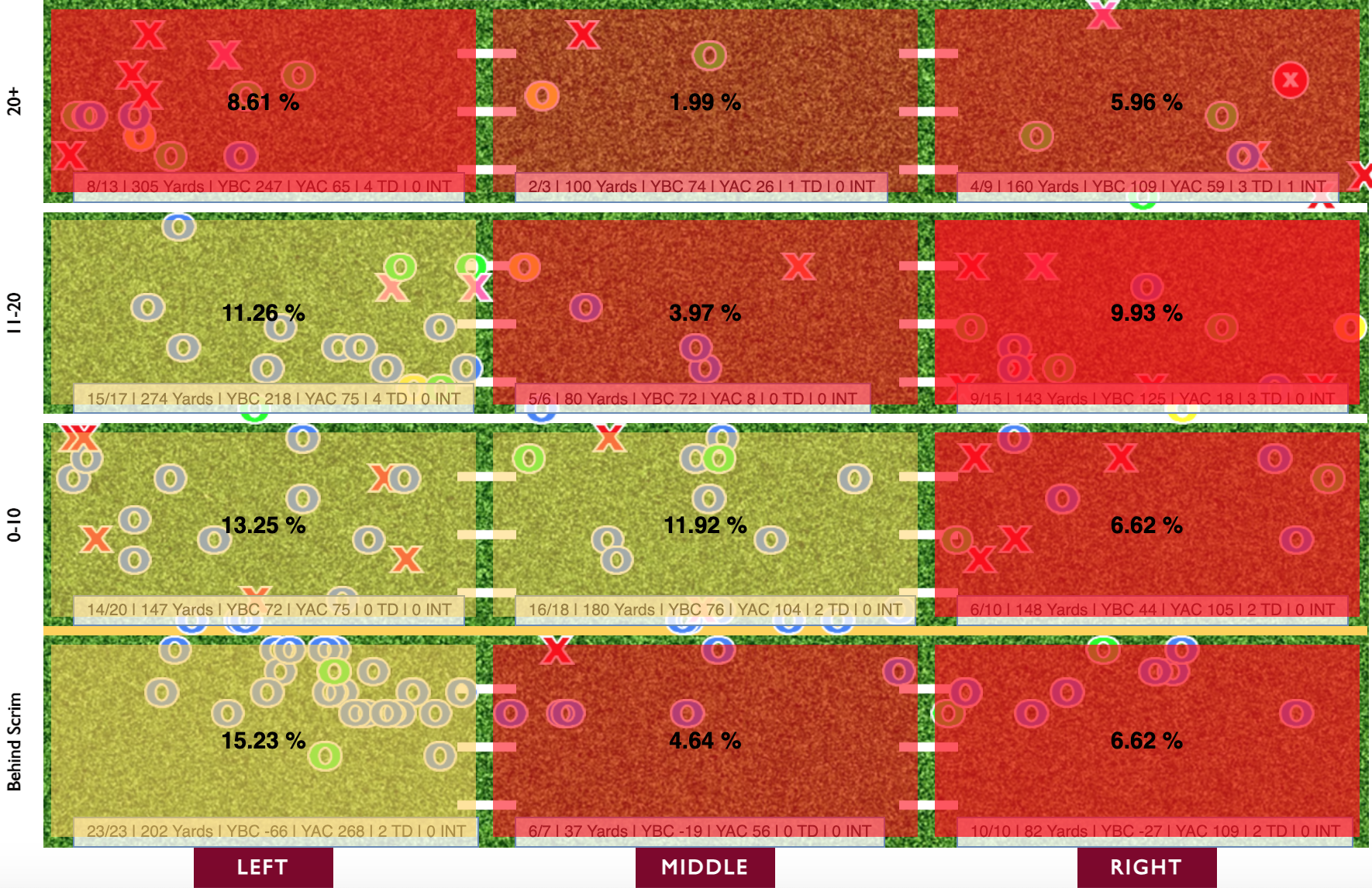
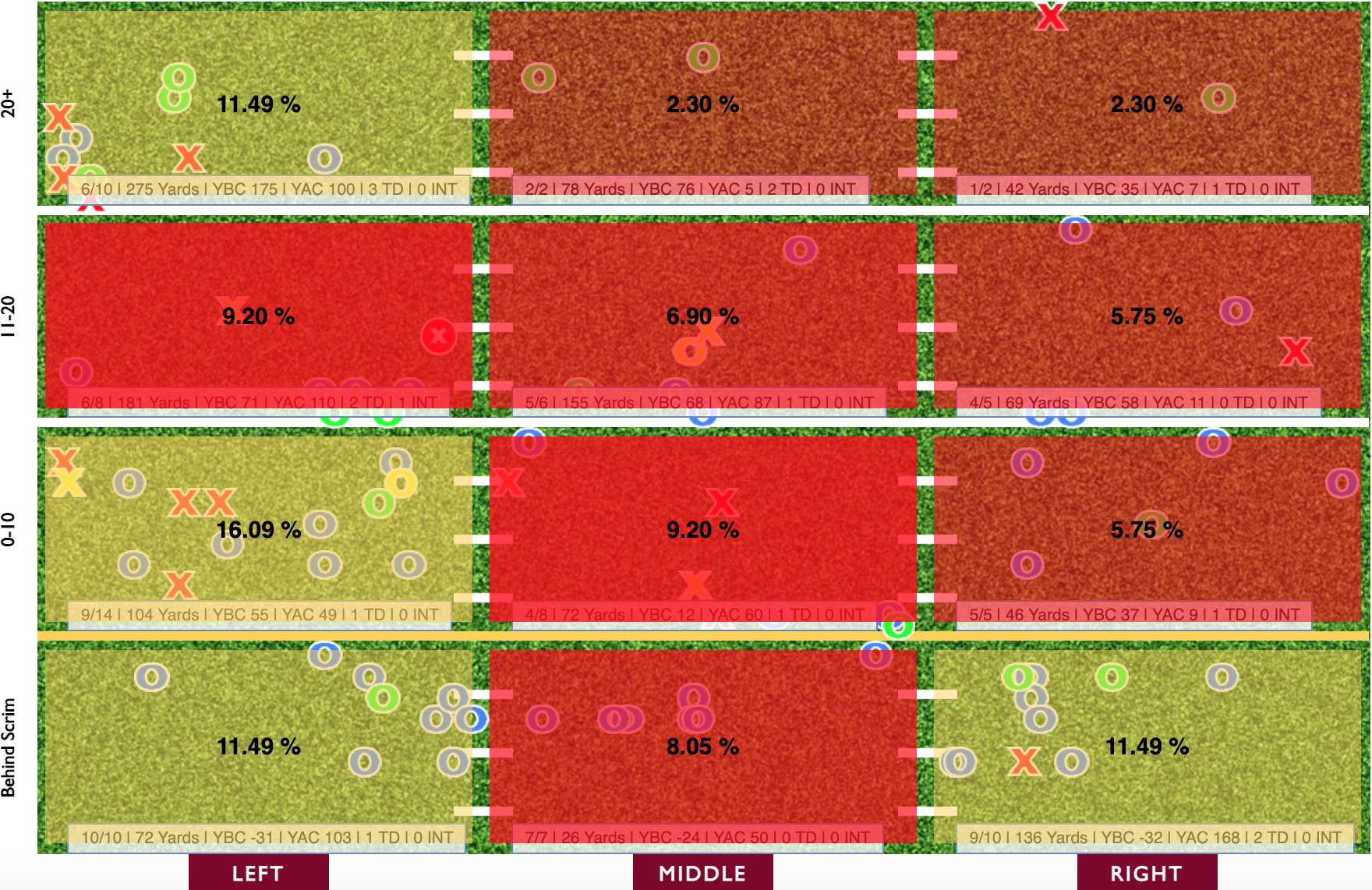
Smith's 2020 Target Heat Map/Top Targeted Routes Smith's 2019 Target Heat Map/Top Targeted Routes


Smith is viewed as a slight scarecrow running routes. But, don't kid yourself, he's no pushover especially on targets that require a bit of an adjustment. While most pass catchers would whither away under those conditions, Smith did the unthinkable and set the conference's curve. On off-target chances, Smith's exemplary skills were on full display. His such 10.8 yards/target and 53.3% Success Rate top all other SECers. Teammate Jaylen Waddle was the only other peer to earn a double-digit Y/T, but no one else managed to turn half of their catches into successful plays. Plus, Smith's First Down+Touchdown Rate and Creation Rate earned the group's gold medal. All the while, the sure-handed Heisman turned in a perfect Drop Rate fielding these attempts since 2019.
Like Waddle, Sark tweaked where Smith was targeted in 2020 compared to 2019. He saw less targets behind the line of scrimmage -- even though he was undeniably the Tide's primary RPO outlet after the Tennessee game -- in lieu of more intermediate opportunities. Despite reshuffling some of his top routes within his own personal rankings, slants, outlet screens, and vertical stems consistently littered his profile. Sure, he was moved around the formation to prevent the defense from getting too comfortable with his offerings. But, Smith generally operated from the left-outside receiver spot, typically saved for the main X-receiver. Smith's physicality will be one of the great draft debates as his unique measurements failed to present a fair comparison. No one with Smith's lanky frame has been able to sustain an exceptional career in the pros, but the Tider's tape and metrics are gladly aiming to buck expectations.


Alabama increased its desire to take the top off of opponents deep in 2020, but Smith was used prudently in that area of the field. Including uncatchable attempts, his Deep Target Rate cracked 16% each of the last two seasons; eight SECers command a higher adjusted clip ahead of the draft. Like you'd expect from a dude who was introduced to the country winning the national championship on a deep ball, coming through with homers was the norm with Smith. Since 2019, only Kardarius Toney and Waddle thwart his 30.6 yards/deep target. Of course, each has logged less than a baker's dozen attempts in our span. Elijah Moore is the only other conference pass catcher to tally more than Smith's 36 catchable deep targets. Along with logging four such creations against one drop, the Heisman's 45.2% TD Rate in these spots is the best the SEC has to offer. Though not the top figure in our group, Smith's 74.2% Deep Catch Rate is more than respectable and toppled the likes of Ja'Marr Chase and Kyle Pitts.
Though Smith was subject to abundant inaccurate attempts, his route running and savvy allowed him to avoid contested situations relative to the group's mean. Only Anthony Schwartz, Toney and Waddle experienced less tight window targets across our two-year sample. Either way, most of Smith's figures held firm in these spots. He placed top3 within the group in yards/target, Success Rate, First Down+TD Rate, and Creation Rate. But, his underwhelming physique seemingly was more inclined to be affected by defenders. Despite owning some of the most consistent hands in the sport, five of Smith's seven drops over the last two years occurred on contested attempts. No other catch type logged a Drop Rate over 3.3%, but these tries begat a clip in the double-digits. This shortcoming will probably lead the chorus for those who doubt he can stay afloat against bigger, stronger, faster defenders. Outside of that, however, his marks hardly present any red flags. That said, forced drops by physical coverage paired with his cagey comps present a cloud of doubt around an otherwise preeminent pass catching option.
Measurables: 6'6, 245 lbs, 33.5" arms, 10.625" hands


Before we dive in on the unicorn that is Kyle Pitts, I must admit: tight end is a position I preach to avoid drafting in the first round. Though I am a believer in its importance creating mismatches through the air as well as on the ground, recent history screams drafting a tight end early is a mistake. (First Round TEs Since 2009: Brandon Pettigrew, Jermaine Gresham, Kyle Rudolph, Tyler Eifert, Eric Ebron, OJ Howard, Evan Ingram, David Njoku, Hayden Hurst, Noah Fant, TJ Hockinsmith. Notable 2-4th rounders Since 2009: Jared Cook, Rob Gronkowski, Jimmy Graham, Zach Ertz, Travis Kelce, Jordan Reed, Hunter Henry, Austin Hooper, Jonnu Smith, Mark Andrews). Pitts physical prowess is challenging my stance due to his appreciable upside. With the modern wave of intimidating tight ends who can operate as in-line blockers, functional wide-outs, and downfield nightmares for linebackers and safeties, not every Y-man is cut out to fulfill that special role. So the ones that can fit that mold are all the more cherished. The past two years at Florida, Pitts accomplished all three; teasing feats yet to come. Only Ja'Marr Chase bests his adjusted 76.3% First Down+TD per catch percentage. Naturally with the largest measurements of the SECers, Pitts is well-accustomed to being tested in tight windows. While Josh Palmer and Seth Williams experienced a higher makeup of contested targets, none trumped Pitts' 42.4% yardage makeup in this context. No other player in the group topped a 37% clip.
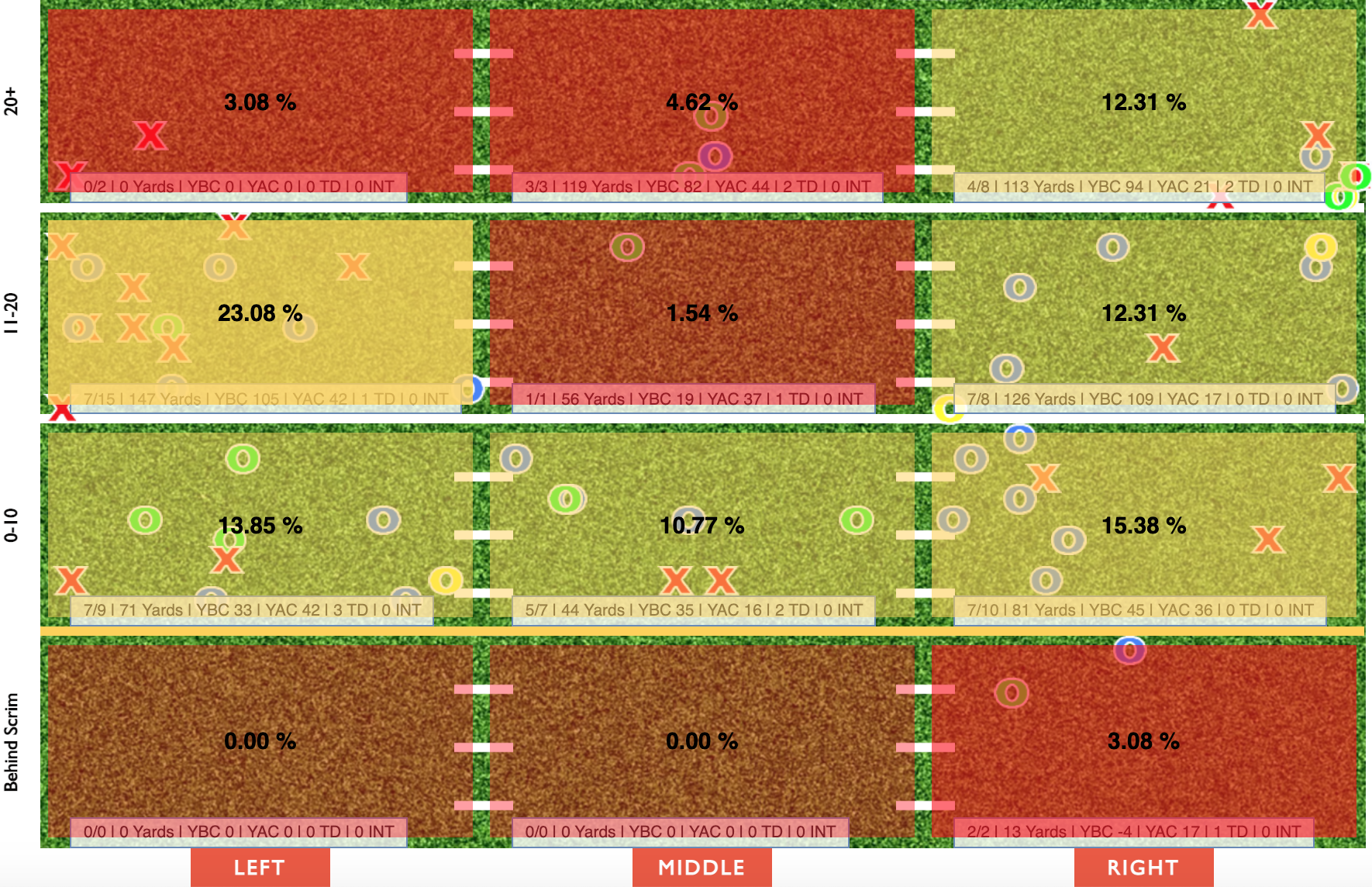
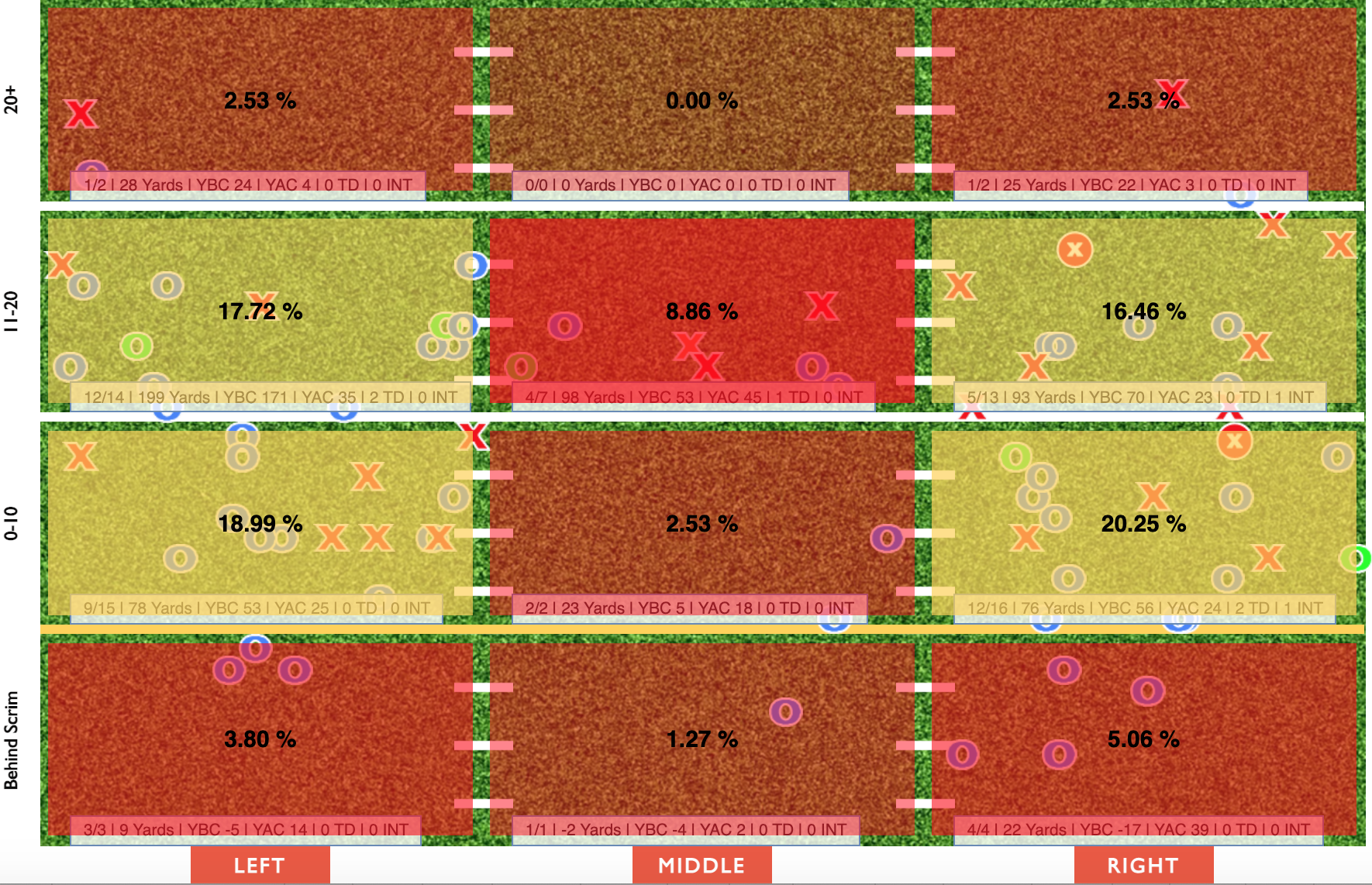
Pitt's 2020 Target Heat Map/Top Targeted Routes Pitt's 2019 Target Heat Map/Top Targeted Routes


With the ample contested targets, the Gator's overall profile looks a bit more muted in comparison to his peers. In fact, these snaps had such an effect on his bottom line that Pitts presents to be just an average pass catcher relative to the other SECers. It's not that Pitts was bad in these spots. But considering his illustrious perception of winning downfield duels, it's a shame he failed to crack the conference's top3 across the board on tight window targets in our sample (But remember a couple guys ahead of him logged considerably far less such snaps than this titan of a tight end). A below-average Drop and Creation Rate should also be a bit of a concern. His 15.8% clip of the former doubles his overall figure. Yet, Pitts still boasts metrics significantly preferable to the group mean in these spots and that's what's most important.
Florida's pass game was matchup oriented, and Dan Mullen loved using Pitts as a stressor all over the formation. Pitts has commonly been targeted on slants, corners, and capped verticals. Kyle Trask' trust in his tight end should be apparent due to the decent number of backshoulder fades from this past season. All in all, Pitts finished as the Gators' most productive pass catcher on the All Verts concept, which was a top2 look in their dropback game. Year-over-year, the former Swamp Dweller, saw his Deep Pass Rate quadruple. In 2019, roughly 53% of his targets occurred less than ten yards downfield. This past fall, that figure was much closer to 43%.


Pitts increased verticality in 2020 was well deserved. In our parameter, he beat the group's average yards/target, Deep Catch Rate, and TD Rate. While conventional wisdom told us a man of his stature should be well-suited to win jump balls and provide a large target for his passers, the Gator still had to go out, execute, and show he commands that skill-set. While not dropping a single deep target the last two years, only Jaylen Waddled topped his 21.4% Creation Rate on these attempts. While manufacturing these kinds of receptions came at an average clip in other instances, Pitts found no trouble flaunting his impressive catch radius on chances 20 or more yards downfield.
Again, Trask viewed Pitts in the highest light possible and wasn't afraid occasionally pressing his luck with his favorite target. While most cases resulted in trying to squeeze a throw into a tight window, plenty of others required our man in question to make a mid-air adjustment. But despite his imposing build, Pitt's physical traits consistently came up short helping the Gator haul in off-target opportunities. He bested the group mean in Creation Rate and First Down+TD Rate, but the rest of his metrics in these spots fell on the wrong side of average. Though Pitts logged an average amount of these throws relative to his peers, they undoubtedly stunk up his profile and brought a good deal of his numbers back down to earth. Considering a good amount of his upside anchors around his ability to erase wayward throws and make plays out of thin air, failing to positively stand out on inaccurate chances can't be totally ignored by evaluators. That said, Pitts won't be a top10 pick based on production and stats.
Kadarius Toney:
Measurables: 6'0, 193 lbs, 31.25" arms, 9.25" hands


Kadarius Toney is an average-sized receiver, but consistently plays above his means. He might be riding some restricted samples ala Jaylen Waddle, but the numbers like what this slot machine can dish out. Paired with the demigod Kyle Pitts certainly helped Toney maximize his matchups, but most people are unaware that most conference defenses opted to double the Mighty Mite instead of the do-it-all tight end. That should tell you have respected of a play maker he was within the SEC this past season. With his proclivity to whip underneath defenders in coverage, he presented a fairly nice target. Only three of his attempts since 2019 were uncatchable and his 4.17% Drop Rate only trailed DeVonta Smith's. Naturally with these pitch-and-catch tries beefing up his profile, Toney was given ample opportunities to tenderize and terrorize opponents with his YAC skills. Per PFF, no Power 5 wideout with 100-plus receptions over the past seven collegiate seasons (2014-20) has forced more missed tackles per reception than Toney (35.8%). Only the two Alabamers averaged a higher YAC than his 8.6 clip in our parameter.
Toney's 2020 Target Heap Map/Top Targeted Routes

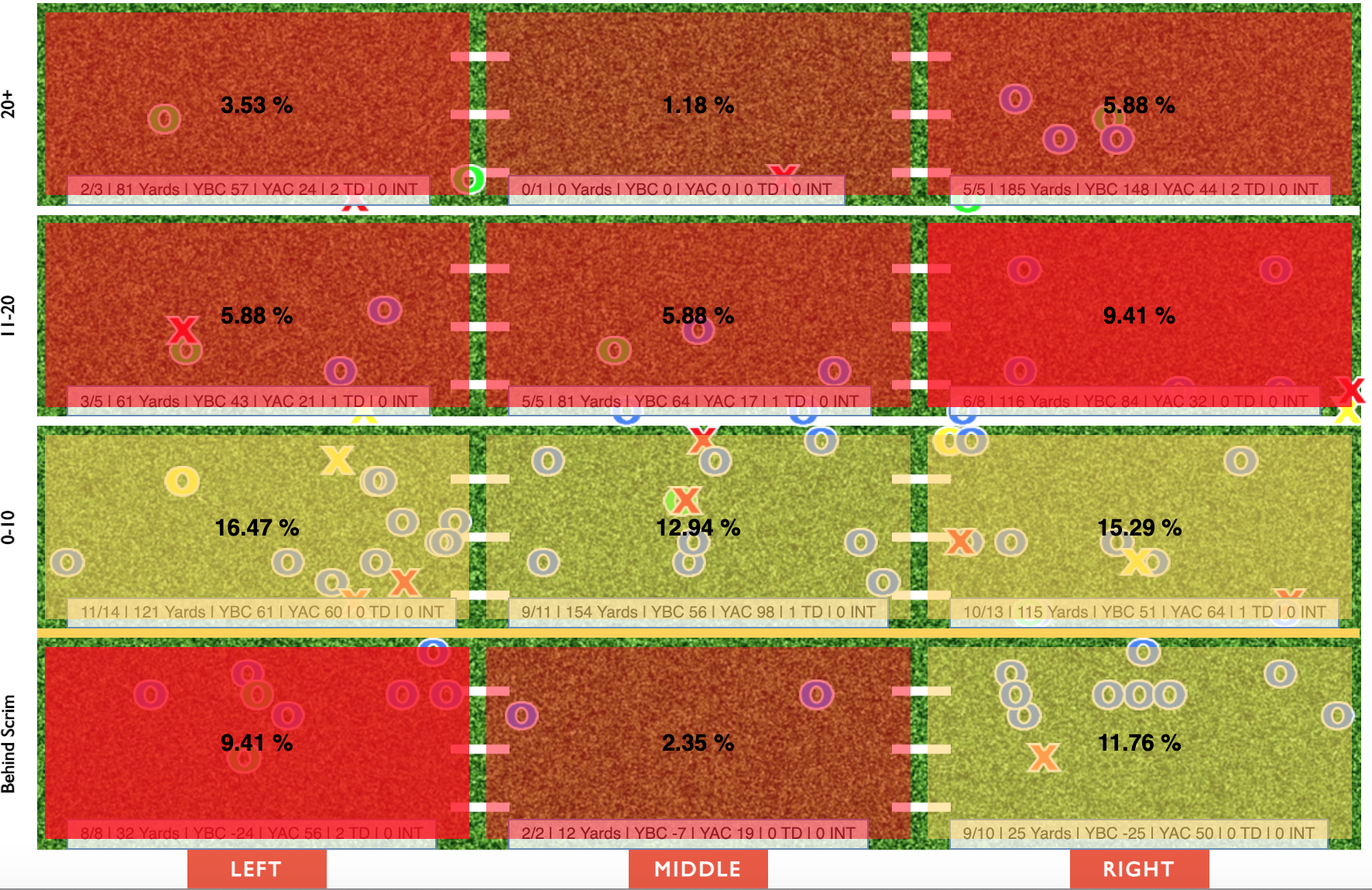
Prior to 2020, Toney was a textbook gadget back. He hardly ever ventured far downfield opting for screens, end arounds, and outlets. And while the Gator certainly improved his midrange and vertical offerings this past fall, grinders have noticed his route running isn't the sharpest despite his quick twitch and human joystick qualities. This perception in addition to his small sample as a "true receiver" have created a divide in war rooms. Some think his ball skills are worth the risk, and others would rather wait it out and see if he falls. Whichever camp you fall in, Toney's change-of-direction skills were accentuated on Florida's favorite pass concept: Hoss Slot Juke. For the laymen, this is a curl+seam combo (often from empty sets in the Gators' case) with the inner most receiver running a read-based multi-breaking "juke" route. On their favorite play, Toney was the team's most productive target by a considerable margin. Though his moved around the formation, his top route by year's end was the juke. In addition to the vertical stems commonly seen on the Hoss concept, Toney continued to see plenty of chances behind the line of scrimmage. Furthermore, almost two-thirds of his targets occurred less than ten yards downfield in 2020.
The Gator experienced about an average amount of inaccurate targets relative to his peers despite predominately roaming short. Modest stature be damned, Toney showed off nice hands when his targets were askew. He saw a noticeable dip in his potency and value catch metrics, but he still bested the mean in terms of finding success and logging a reception. Though challenging man to curb when he has positive inertia, he's a bit easier to contain when his rhythm is thrown off. Toney's overall 2020 YAC average on accurate passes was a whole yard higher than his clip on inaccurate targets.


This operation and Toney's burst allowed him to finish with the groups 3rd-lowest Contested Target Makeup. When he was throw the ball in tight spots, he performed admirably but failed to really stand out. With less cushion for Toney to get his boogie on and do what he does best, folks should be pleased he still managed to turn half of his catches into situational success and deliver splash gains when the defense tried to get physical. Plus, none of his peers sported a lower Drop Rate in these instances that his 5.56%.
Maximizing his opportunities in 2020 (the Gator only saw one deep throw in 2019), Toney's returns on targets 20+ yards downfield were among the best the SEC has to offer ahead of the draft. You can knock the lack of volume of these plays, but you cannot fuss about their bottom line. While not dropping an attempt or seeing an uncatchable deep ball the last two years, Toney finished top2 within the group in yards/target, Deep Catch Rate, and TD Rate.
While Toney's contested and deep catching figures are assuring, he only logged 14 and ten snaps, respectively, since 2019. No matter how much of a rascal he is with the ball in his hands, haters will zero in on his dependence for YAC-oriented designs. In their minds, no team should spend an early day pick on a receiver whose primarily productions came via screens. However, his backers will be adamant his efficiency isn't a mirage or product of a wonky sample; and his ability to consistently play bigger than his measurements will elevate his team at the next level. Toney's floor is fine due to his slippery style of play, but questions about his ceiling will fester if he remains chained close towards the line of scrimmage.
Elijah Moore:
Measurables: 5'91/2, 178 lbs, 30.125" arms, 9.375" hands


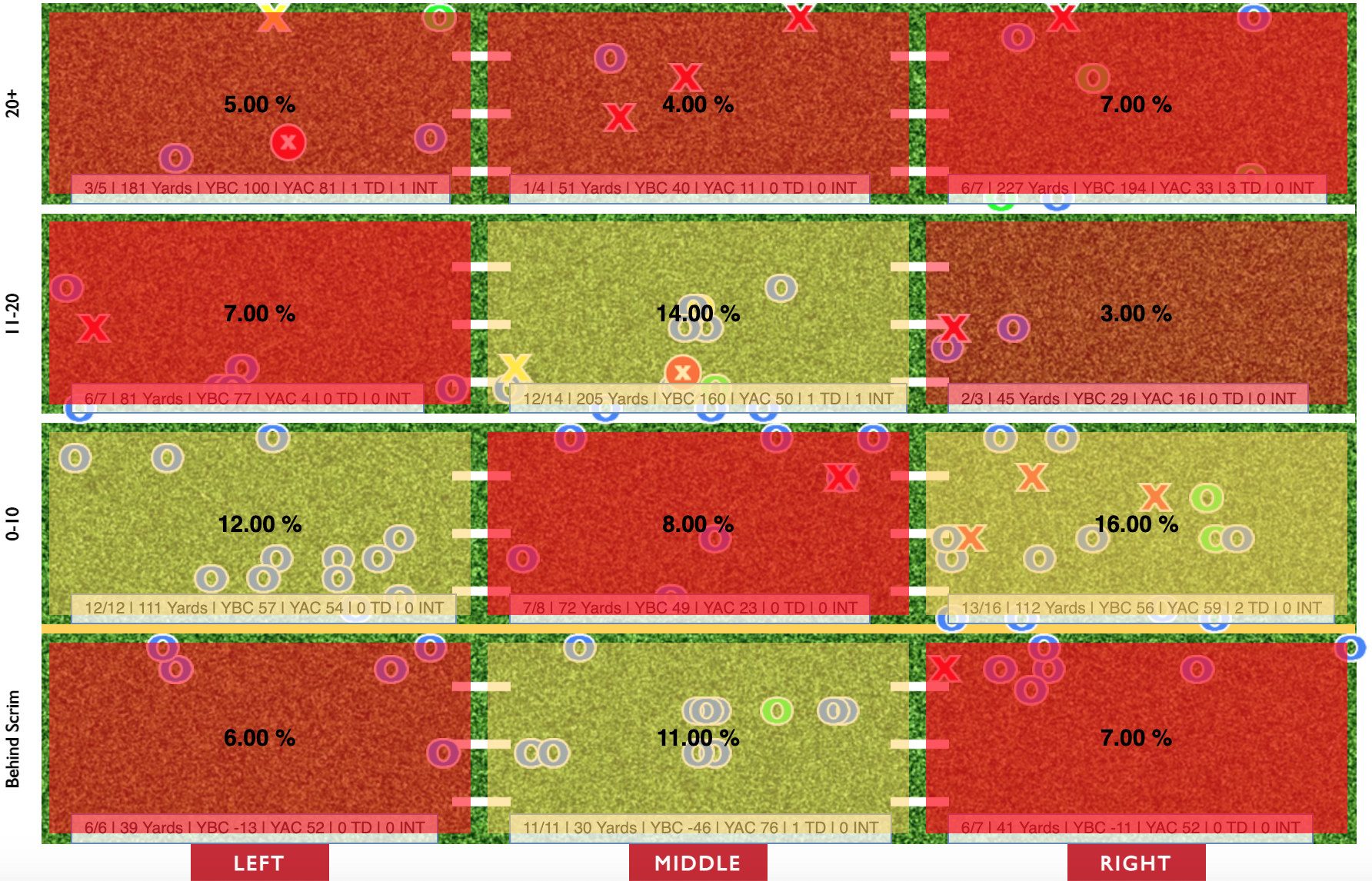
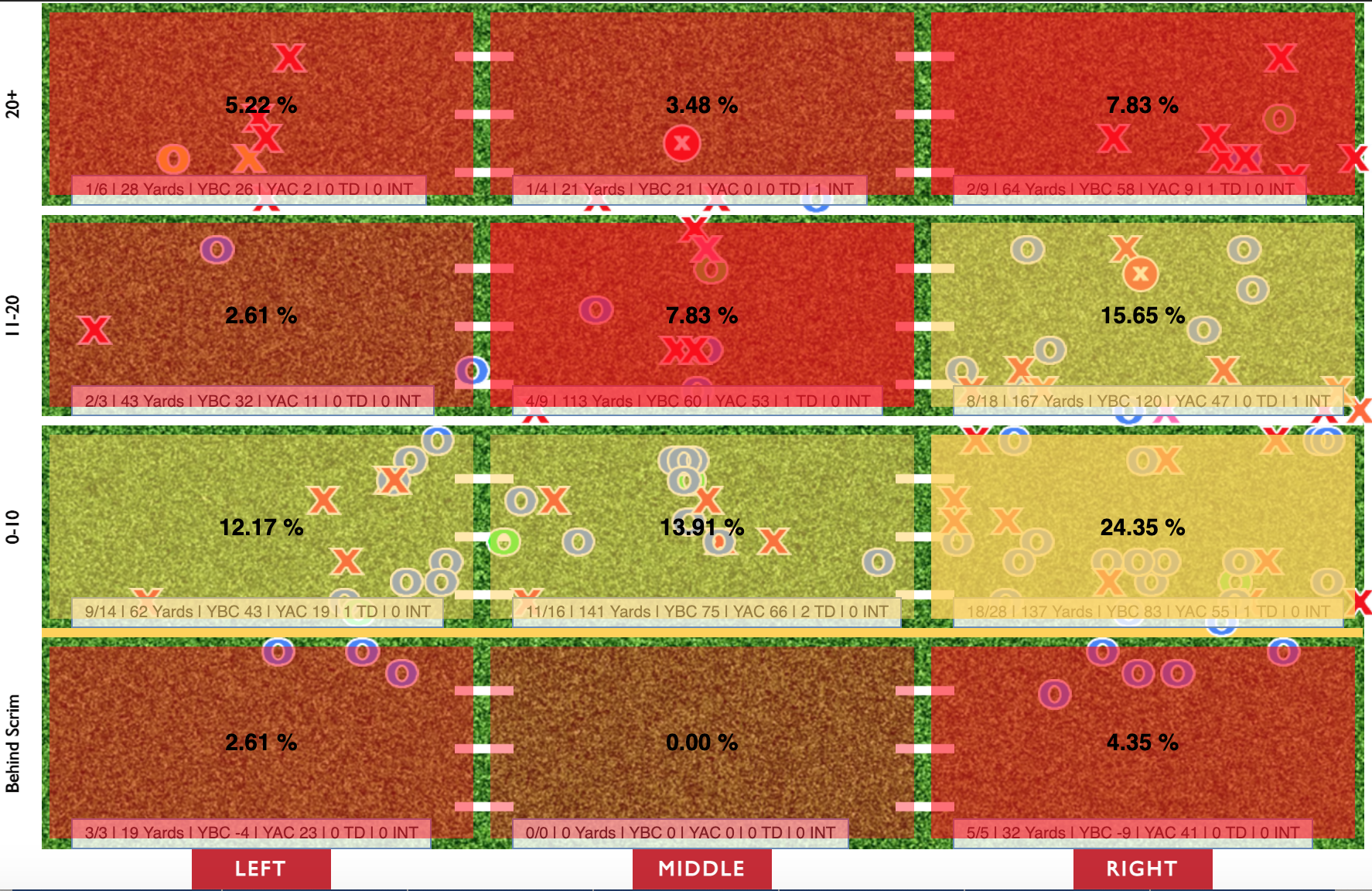
In a class where half the dudes are under 6'1, Elijah Moore's measureables are some of the lowest amongst his peers. Despite his small frame and the shortest arm length of our 14 receivers, the Rebel's hands are remarkably big for his size, which were put to good use compiling a bunch of catches. His mits are as large as or bigger than DeVonta Smith's, Kadarius Toney, Anthony Schwartz, and Trevon Grimes, all of whom have at least two inches of height on The Grover. But while his overall Catch Rate cracked our class's top5, Moore finished under the conference average in all of the remaining stat categories. Granted, his returns are far from disastrous. But considering his forgettable figure, it's only natural to wonder how productive Moore can be with those traits going against him versus the best defenders in the world.
Moore's 2020 Target Heat Map/Top Targeted Routes Moore's 2019 Target Heat Map/Top Targeted Routes
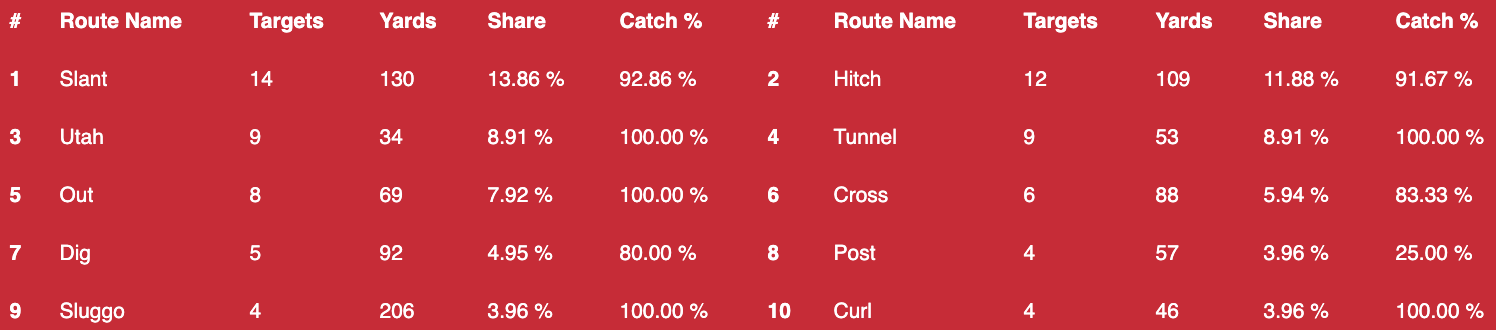
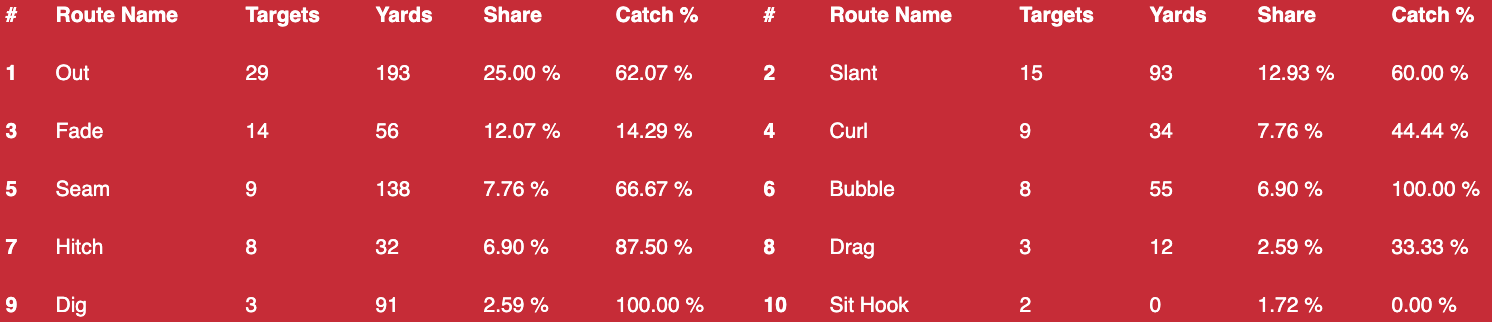
Despite being Ole Miss's go-to receiver for two seasons, Moore turned in a below-average Contested Target Makeup relative to his peers. Opponents just couldn't overly bother him no matter how narrow the Rebels' aerial intentions were telegraphed. Even though he might not have had to fight these battles as often as other SECers, Moore certainly displayed value for evaluators in these spots. He was one of three to not log a single "created" catch, but his meaty hooks did their thing helping the Rebel secure a top3 Catch Rate, Success Rate, and First Down+TD Rate within our group on contested targets.
Moore played in three separate offensive styles during his time in Oxford. First, Phil Longo's vertical pass attack+multiple run scheme helped Ole Miss boast some of the most prolific numbers around. Then, Rich Rodriguez tried to stir up some old magic with some spread-run tactics that involved dual quarterbacks while a sophisticated dropback game remained unprioritized. Finally, the Lane Train and the Baylor Spread came to town and delivered a balanced, yet aggressive assault. While his duties morphed, Moore consistently was a relied-upon slot receiver. In 2019, he was mostly an out-breaker as an option away from the congested areas of the field. Besides his 15 targeted slants, only one of his nine other most featured routes worked inward horizontally. That changed in 2020. In addition to "gimme" catches on tap passes, this staff deliberately aimed to exploit inside matchups with Moore. Roughly 37% of his targets occurred between the hashes compared to 25% under Rich Rod. Consequentially, the number of in-breaking route types among his most featured doubled year-over-year.


Moore soldiered a fair amount of inaccurate targets since 2019. His 29% such makeup was the 6th-highest in the group. But, practice makes perfect. Moore's 48.1% Catch Rate in his context only trails Alabama's dynamic duo. Considering his average depth of target on these chances the last two years have each topped 13 yards, that's a notable clip considering the degree of difficulty. Down-to-down, the rest of his stats on off-target throws are rather middling. Still, Moore's experience and competence snatching adrift attempts has him on many people's radars.
Going deep wasn't his calling card, but that didn't mean Moore was a dud in that department. Sure he delivered a suboptimal Deep Catch Rate, TD Rate, and Creation Rate. But, Moore was okay on a per target basis. Though he had some trouble whooping his man on this straight line vertical targets the Rebel is the SEC's reigning Duke of the Double Move. While catching all four sluggos, Moore finished with a 39.6 yards/target and 85.7% Catch Rate on all multi-break route targets, which led the conference this past fall. Moore's size might shy some folks away. His most ardent dissenters probably consider him nothing more than a slight possession receiver. At the very least, however, we know this cat can catch the rock. If a pass is within his reach, the odds are in his favor to come down with the catch. Even if there are concerns about his potency, Moore's savvy and sure-handedness make him an easy option for an offense needing a dependable inside receiver.
Terrace Marshall Jr.:
Measurables: 6'21/2 , 205 lbs, 32.75" arms, 9.5" hands


Among the potential first round receivers hailing from the SEC, Terrace Marshall enters with the best size albeit serviceable measurables. Though TMJ can bruise and cruise for some YAC, he's moreover a controlling set of hands that helps his offense gain yards on an up-and-down tree or with in-breakers towards the middle of the field. Blessed with accurate attempts on his more valuable routes, the Tiger low-key shined opposite Ja'Marr Chase in 2019 as one of the nation's most efficient wideouts. While being one of the SEC's most successful receivers down-to-down, he turned 13 red zone targets into ten scores. Things softened a bit in 2020. Including uncatchable attempts, his 69.7% overall Catching Success Rate dwindled to 52.1% this past fall. When engaged, Marshall was undeniably effective despite the rocky quarterback situation. But again, his metrics didn't finish with flying colors. Entering the draft, he presents a mediocre resume thanks LSU's offensive deterioration. Scouts are allowed to throw out those snaps to prevent them from skewing their perception on Marshall. But, I believe it's still worthwhile to see if a receiver can make plays when up against some adversity. Plus, the Tiger should hardly be considered a liability with a Success Rate and First Down+TD per catch percentage about seven points over the group's mean.
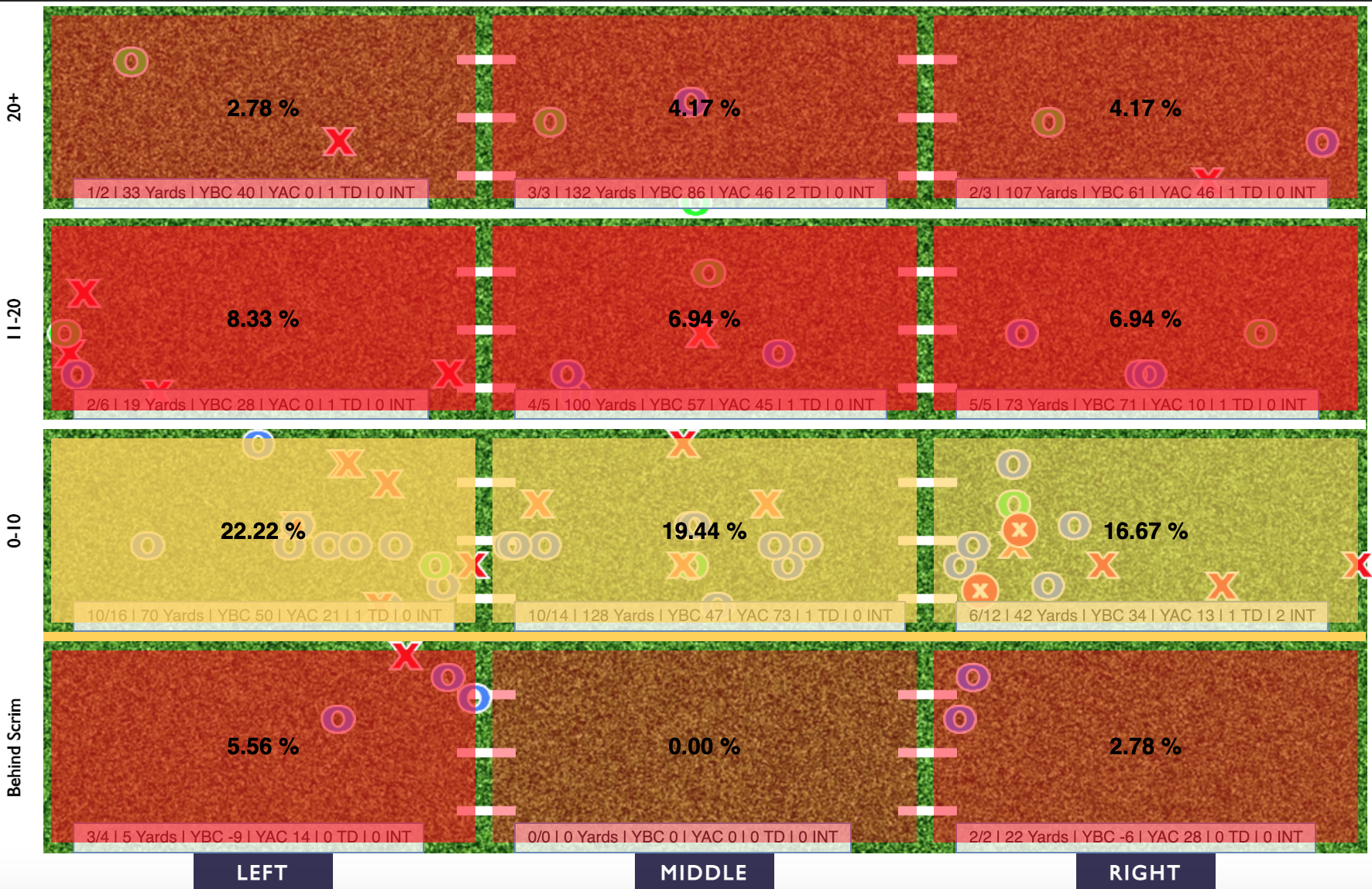
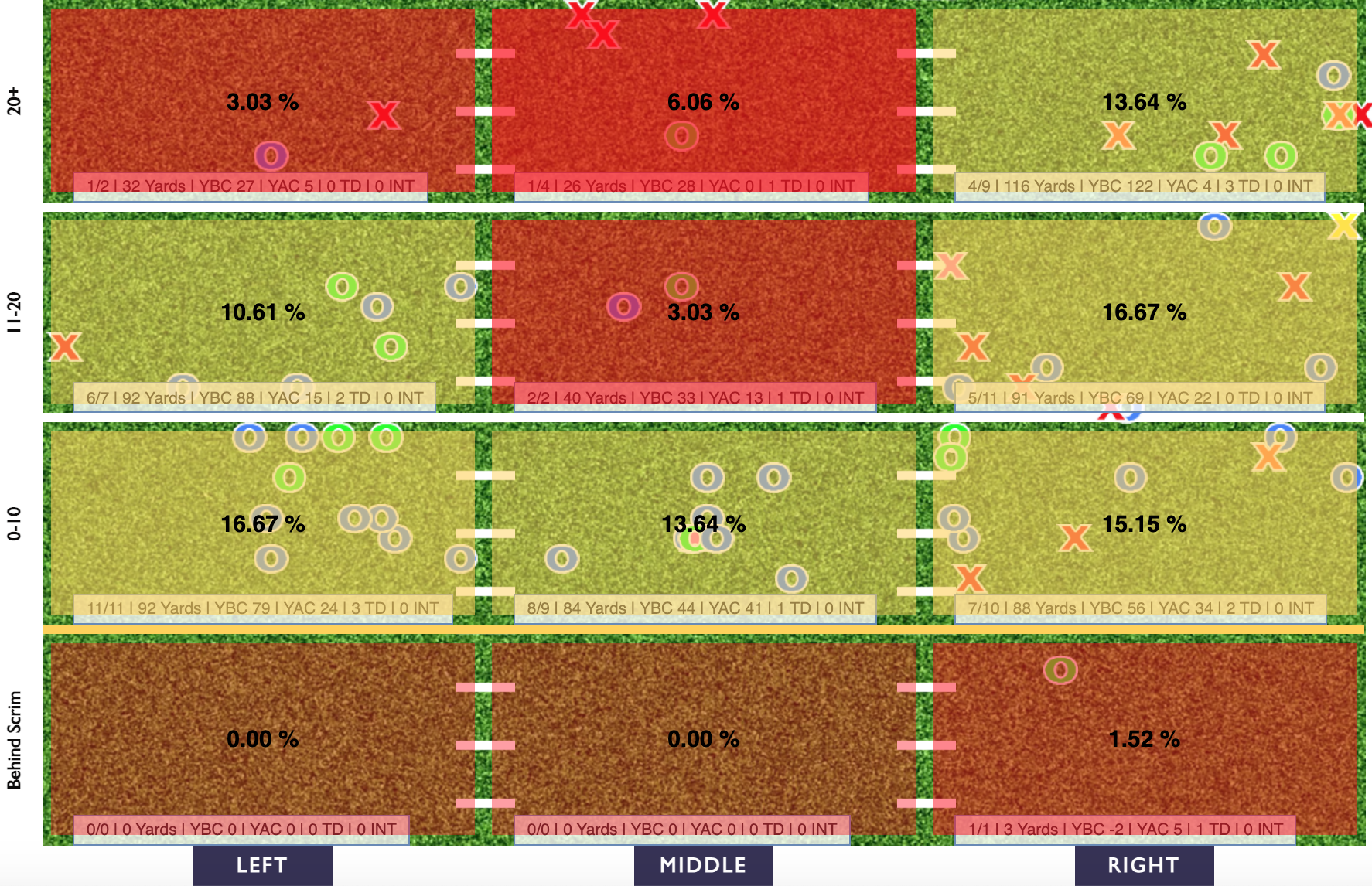
Marshall Jr.'s 2020 Target Heat Map/ Top Targeted Routes Marshall Jr.'s 2019 Target Heat Map/ Top Targeted Routes


As a burly receiver, he was no stranger to facing contested targets. Marshall's 41.6% Contested Target Makeup was the 4th-highest in the group. Though his target locations were reliant on the skillset of his passer, he frequently feasted with underneath patterns. After seeing 45.5% of his targets occur between 1-9 yards downfield in 2019, that figure shot up to over 53% last year. Despite the heavy lifting, TMJ shared the 2nd-lowest Drop Rate and finished on the good side of the conference average in Catch Rate, Success Rate and First Down+TD Rate. Though dependable, he never really displayed an aptitude for magic and creating a reception out of thin air. But considering the pluses from the other metrics, that drawback is a moot point.


Being blessed with precise passers resulted in Marshall rocking the 2nd-lowest Inaccurate Target Makeup in our parameter. And I do mean blessed because the Tiger was far from special in these spots. This was the only aspect where TMJ's Catch Rate finished below the group's respective mean. Plus his 11.5% Drop Rate fell into the bottom4. His size certainly provided wins in tight windows, but it couldn't help erase errant throws. While not ideal, his performances still weren't too far off from being overly lukewarm.
Without more context, Marshall's deep figures look a little off. Despite having an above-average Catch Rate his yards/deep is subpar by a considerable margin. As a gladiator, a good deal of his deep chances took place within striking distance. So while the air yards met our criteria, his final stats of course don't include yardage into the end zone. Our receiver in question was fantastic finishing off drives in this manner. Though you might have gotten that with his aforementioned red zone dominance from yesteryear, but only the Heisman sports a preferable Deep TD Rate to TMJ's 40% clip within the group. But his play wasn't all sunshine and lollipops on these throws. No SECer put up a worse Drop Rate the last two seasons on attempts 20 yards or more downfield. In fact, Marshall's 15.0% clip was nearly five points more than the next butterfingers in line all the while his Creation Rate remained anemic.
Marshall offers a clear competitive advantage with his physique. Plus, he's shown to boast a high floor as a pass catcher being a renown red zone threat. Outside of that, his game lacks pizzaz. When computing one's ceiling, failing to have a wow factor in addition to leaving plays on the field is an obvious ding to the equation. Still a 6'21/2 pugnacious pass catcher with a 4.3 forty in his back pocket will be hard to dismiss in a draft full of munchkins. Personally, I can't help shake the Cris Carter vibes I get from this guy.
Josh Palmer:
Measurables: 6'1, 210 lbs, 32.875" arms, 9.625" hands


By the traditional stats, Josh Palmer's plateaued bottom line isn't the kind of selling point you'd like to fall back on during draft season. Neither are his dull advanced stats. Almost exclusively operating as Tennessee's right, outside receiver (Z), Palmer's profile is riddled with difficult opportunities. Moreover, no SECer totaled a higher Uncatchable Pass Rate the last two seasons. A fifth of the Vol's tries were DOA. Even with the uncatchable attempts wiped away, his overall profile fails to pop. With the aforementioned wayward tosses, he wasn't granted ideal YAC chances. At least, Palmer posted an above-average Drop Rate and First Down+TD per catch percentage against the rest of his number being subpar. His operation was predominately up-and-down outside the numbers where he tried his best winning on an island.
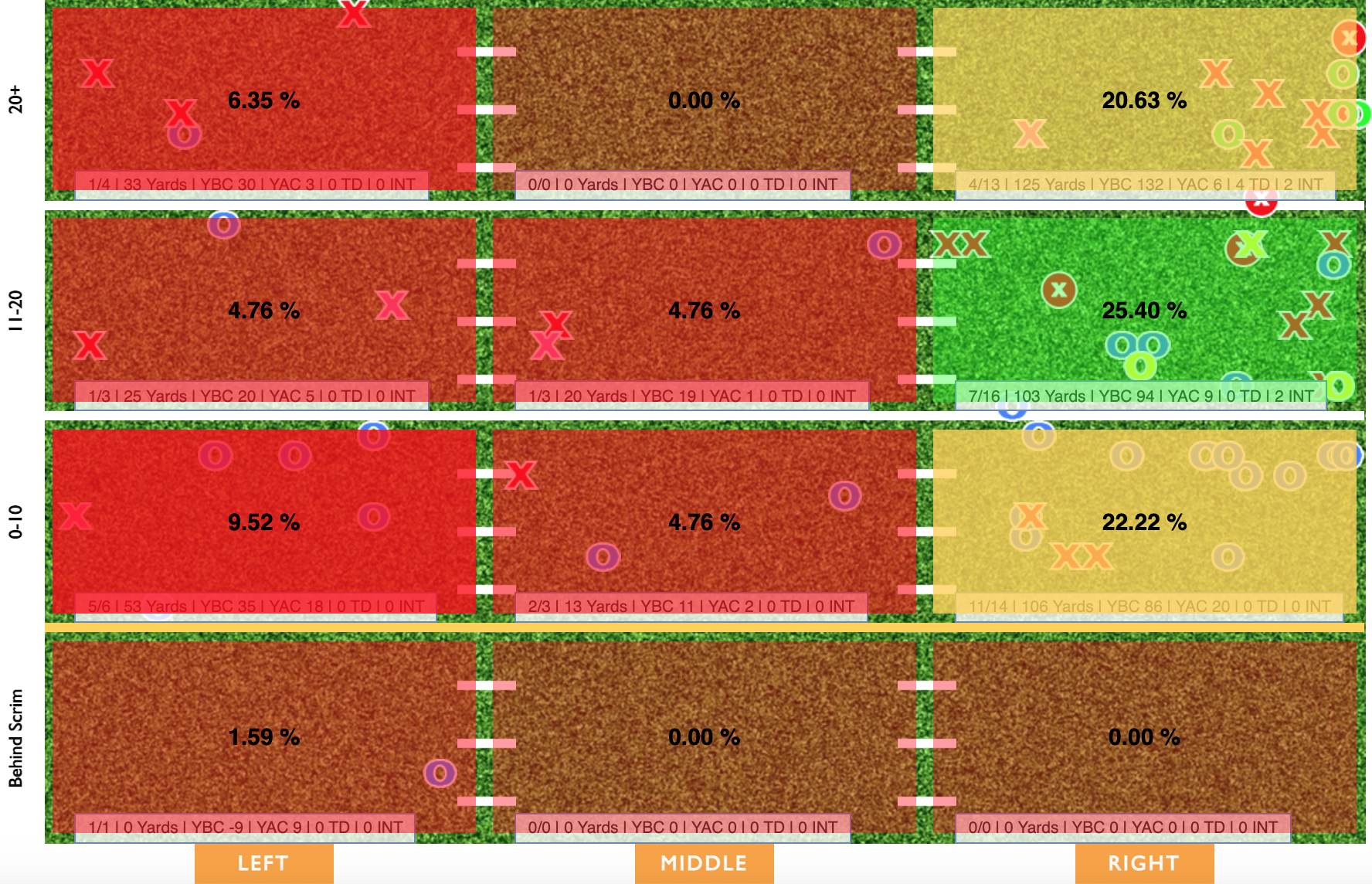
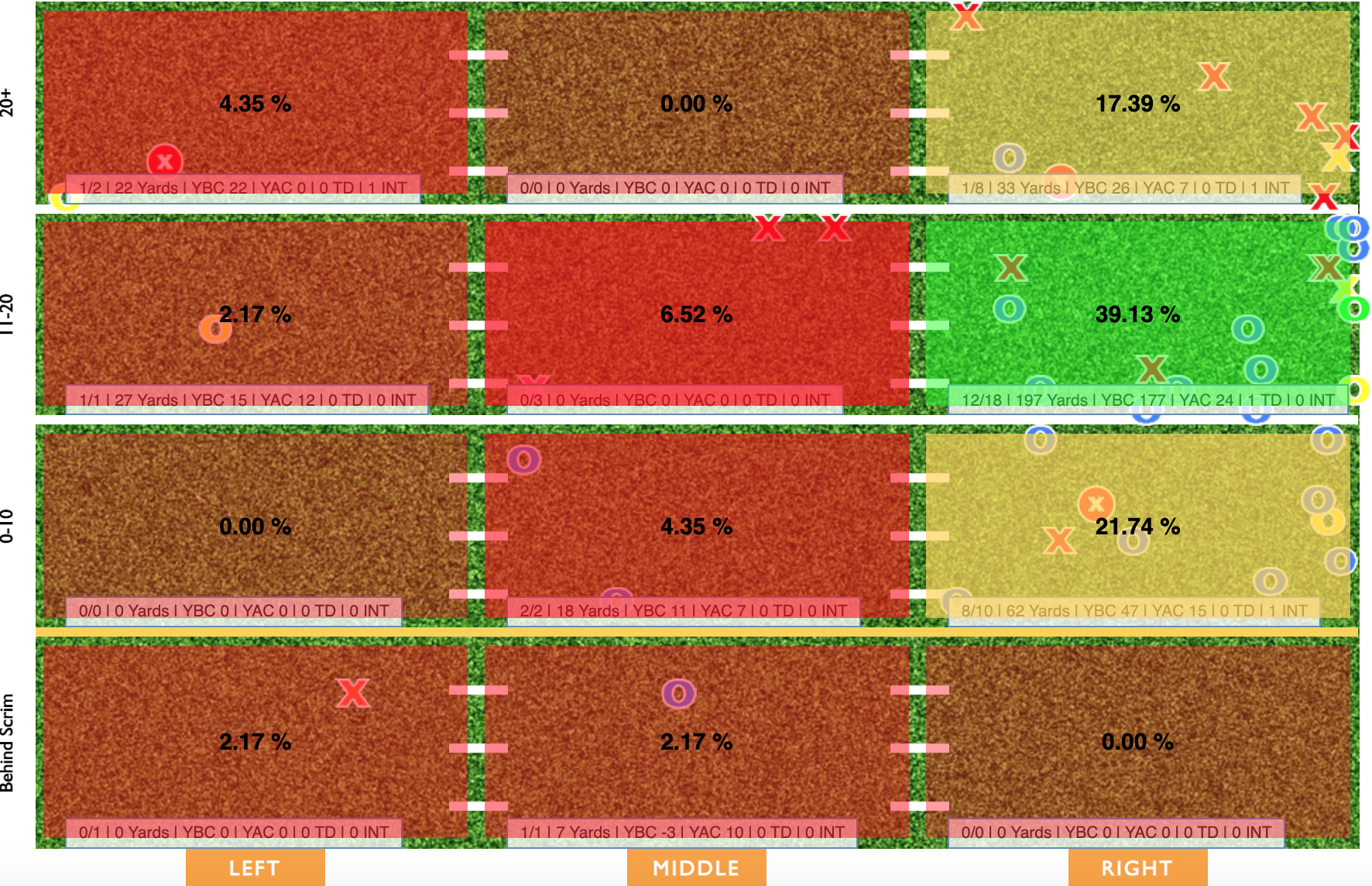
Palmer's 2020 Target Heat Map/Top Targeted Routes Palmer's 2019 Target Heat Map/Top Targeted Routes


To that point, his dexterity was frequently put to the test with defenders in his immediate vicinity. Tennessee's play callers opted to avoid gifting Palmer unchallenged completions as he only logged three catches behind the line of scrimmage since 2019. Exactly half of his attempts in our sample were contested; easily the highest clip in the group. His such yards/target, Success Rate, First Down+TD Rate, and Explosive Catch Rate were well below the conference mean. But his long arms came thru to the tune of of the 4th-best Creation Rate while hauling in over half of his attempts.


Besides being confronted with copious contested targets, Palmer had the misfortune of owning the 2nd-highest Inaccurate Target Makeup in the group. Situationally, he got by with middling returns. But, the Vol remained toothless in terms of potency despite his sensational Creation Rate that only trailed the Heisman's. Either way, it appears the All-Madden level difficulty got the better of Palmer. With so many "extra" chances, it's no mystery why his bottom line came in with unsatisfactory figures.
Though apt at winning midrange chances and walking tight ropes along the sideline, Palmer was a poor deep threat at Tennessee. Sure, his Creation Rate remained firm. But, he consistently fizzled rising above the futility of his situation. To reiterate, his passers did him zero favors tossing a combined 45% Uncatchable Target Rate in these spots. But even when Palmer could potentially make a stab at the pass, he only managed to corral 35% of these tries. No SECer in our sample enters the draft with a worse clip. And to further drive the point home, his 10.7 yards/deep target was more than half of the group's average.
Again, the majority of Palmer's routes worked a straight line. That simplicity coupled with his clear role attacking the right side of the formation don't exactly make the Vol a well-rounded prospect despite coming out as a senior. Considering there are additional concerns about his execution and colorless output make him a very risky prospect. No doubt his creation ability can't be coached, but how many of his toe taps would have counted at the next level. As spectacular as some of his past catches were, those will be hard achievements to maintain with below-average down-to-down projections.
Shi Smith:
Measurables: 5'91/2, 186 lbs, 31.875" arms, 9.5" hands


Shi Smith has a market for being a decent slot option after the early favorites are no longer on the board. Despite being one of the shortest SECers in the draft, his arm and hand measurables are superb for his stature. Plus, Smith noticeably has more meat on his bones than the other sub-6'0 receivers. His believers will be all in on those traits, because honestly, his stats are yelling from the top of their lungs that Smith lacks the value of a typical mid-round flyer. Smith was one of the more unfortunate pass catchers within the conference as of late. While logging the group's 3rd-highest overall Uncatchable Target Rate, only Seth Williams, Anthony Schwartz, and Josh Palmer logged a higher Inaccurate Target Makeup in our parameter. The bountiful bad chances obviously soured his output. Despite owning positive traits, they failed to neutralize the negatives around his environment at South Carolina. Even with uncatchable attempts taken out, his yards/target and Success Rate represent the group's floor. Plus, Smith's First Down+TD per catch percentage and Explosive Catch Rate fall inside the bottom3.
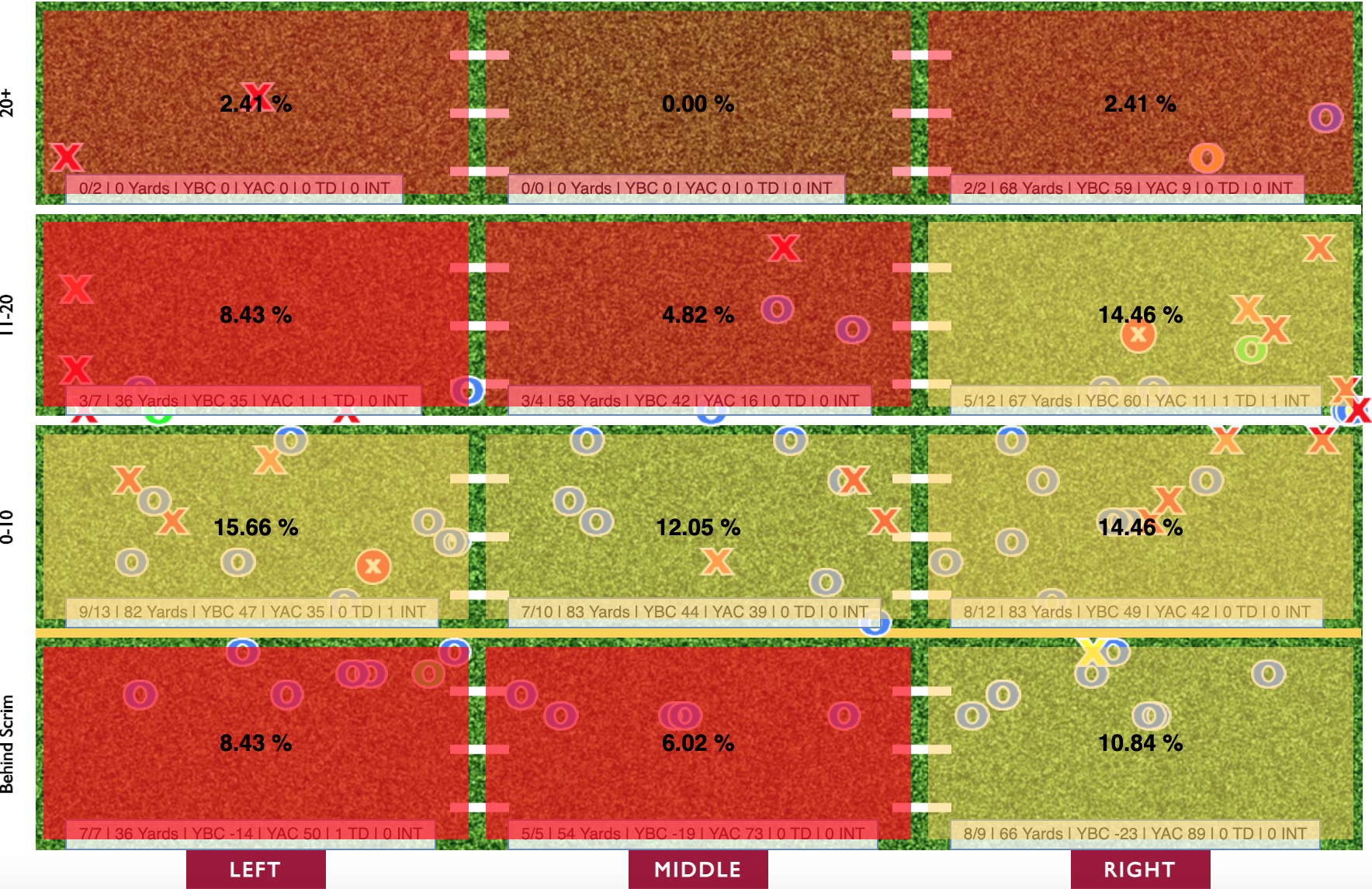
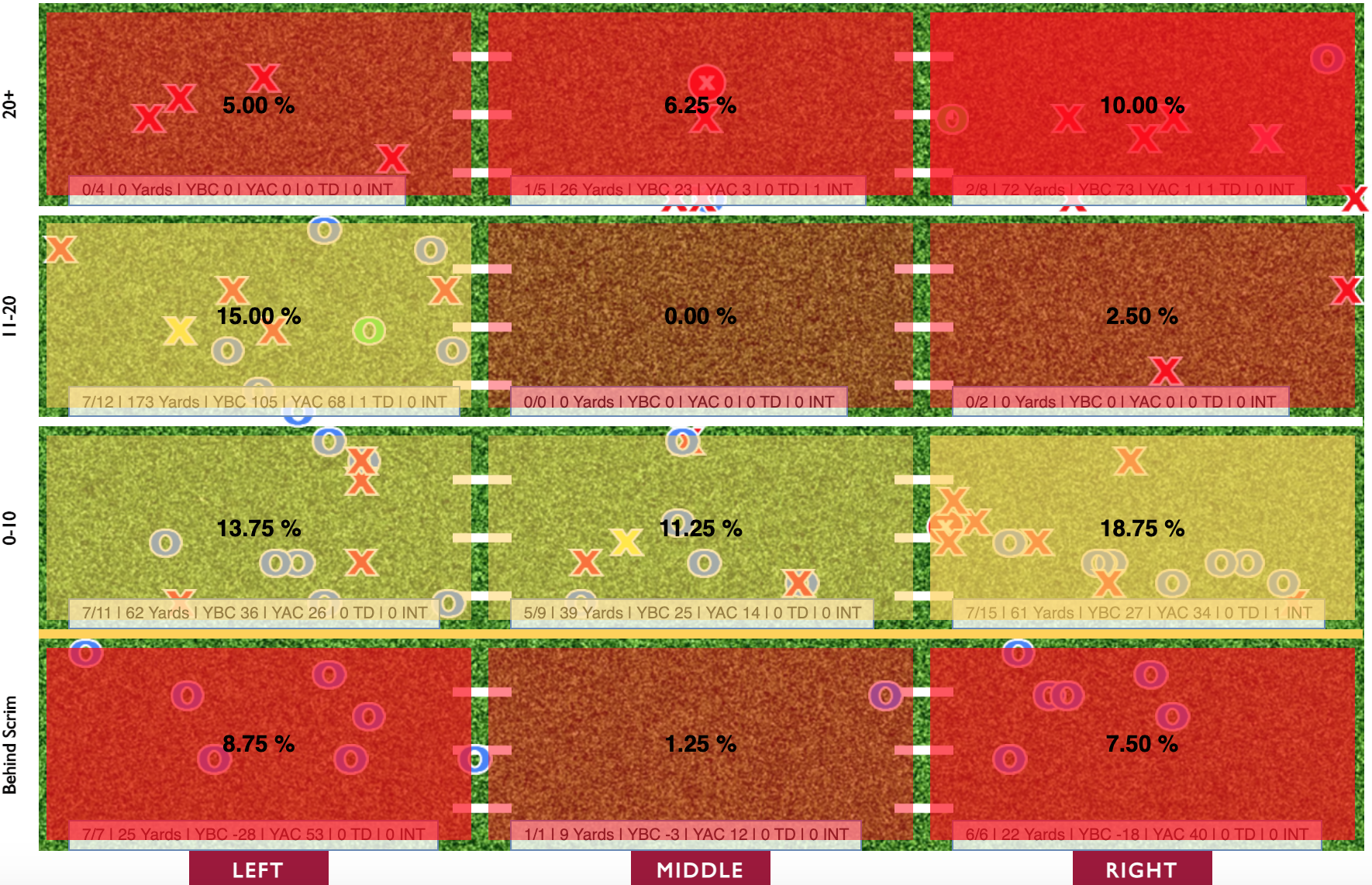
Smith's 2020 Target Heat Map/Top Targeted Routes Smith's 2019 Target Heat Map/Top Targeted Routes
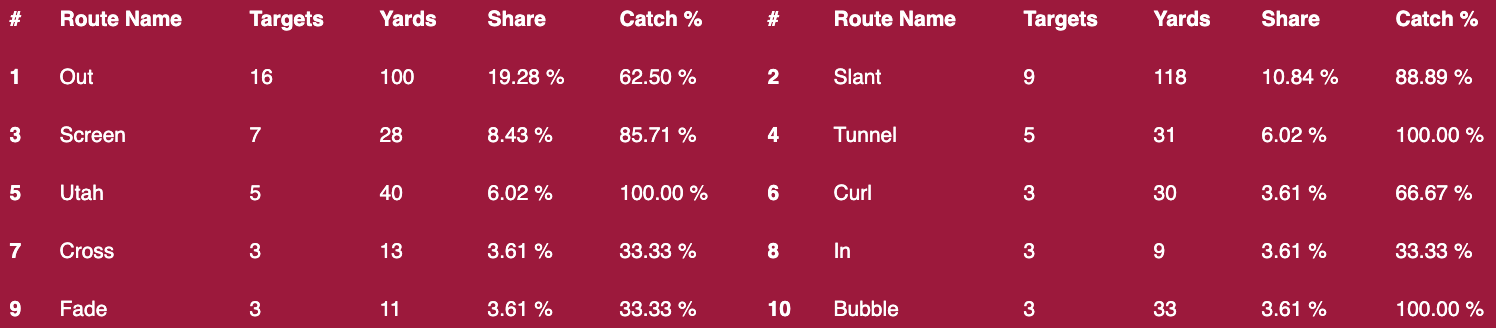
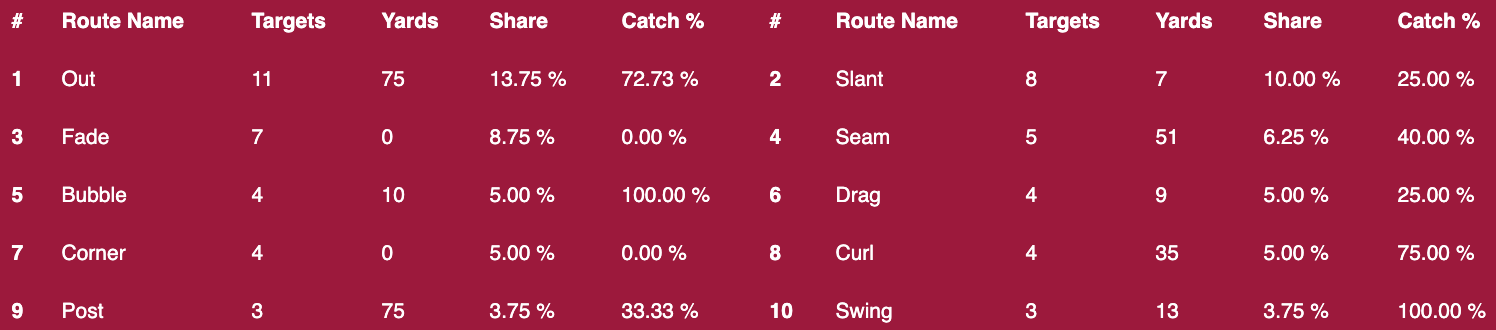
If you're a fan of his, you must hope Smith's figures were more a reflection on the Gamecocks' iffy passers and overly ineffective approach rather than his own shortcomings. No matter how you slice it, he was the worst the SEC has to offer corralling off-target chances. His such yards/target, Success Rate, and 1D+TD Rate looked up to the rest of the group. Despite the high makeup in terms of targets, no one logged a lower Inaccurate Yards Makeup than his 9.63% clip in our parameter. With this flunking performance and a high volume of inaccurate attempts, it's no wonder his overall profile is putrid relative to his peers. Time and time again, Smith failed to show he could provide value in these spots. Conventional wisdom might say, "No shit. He's 5'9. He isn't supposed to display the widest catch radius or elastic limbs." But it's a big hangup to back his upside considering the terrible returns manufacturing connections on off-target attempts.
In order to combat these errant throws, most of Smith's routes worked short. The last two years, outs, slants, and outlet screens composed his most featured routes. With his diminutive size and his quarterback's being less-than-ideal vertical passers, Smith rarely flaunted downfield catching ability. In 2019 when the Gamecocks were shoehorned by their toothless West Coast offense, over 60% of his targets occurred less than ten yards downfield. The year-over-year change in schematics allowed that mark to rise over 68% this past season. In return, Smith forged a mediocre YAC average. Of course when passes were inaccurate, that bright spot further dimmed. On his 52 accurate attempts this past year, his raw clip hit 6.8 yards. But on the 25 inaccurate ones, that dipped to 2.6.


Thanks to his frame and the Gamecocks' aforementioned dismal deep passing, almost 43% of his targets over 20 yards downfield the past two years were uncatchable. Only Schwartz could claim a worse clip within the group. Though he didn't log a drop in this area of the field, his resume remains dissatisfactory. With the 3rd-worst yards/deep target and Catch Rate, only Kyle Pitts saw a lower percentage of his attempts come off such throws than Smith. In 2020, he only sported four deep targets. No SECer finished with a smaller Deep Yard Makeup than his 15.1% clip.
Fancying underneath routes, Smith wasn't contested too much. But, he still had to brace for contact and flow through tight windows. Like the rest of his production, these snaps seldom were favorable for the Gamecocks. When contested, his Success Rate and Catch Rate was less than half the group's average. Not to mention his yards/target, First Down+TD Rate, and Explosive Target Rate were fractions of the conference's mean. All the while, his 17.5% Drop Rate was the 2nd-worst the SEC produced the last two seasons.
I say all this to be cautionary. With such volatile criteria in addition to his coupling to one of the SEC's least incendiary aerial attacks, there's no doubt this exercise wasn't fair to Smith. Still, the evidence is clear he probably isn't the receiver to make a play or deliver much value against adversity unless a target hits him square in the hands. For me, these inefficiencies are too much to overlook considering the depth of the rest of the class. But I'm sure someone is willing to relay the benefit of the doubt Smith's direction.
Seth Williams:
Measurables: 6'3, 211 lbs, 33.5" arms, 9.875" hands


From a physical standpoint, Seth Williams' appeal is clear. He's big and strong with nice measurables. Plus, he's in the mold of an old-school X-receiver who is fit to work opponents vertically and provide a nice stationary target outside the numbers. However from a production standpoint, being dealt plenty of poison pills made his analytics hard to swallow. While seeing one of the highest Uncatchable Target Rates within the group the last couple of years, no SECer can trump his numbing 40.1% Inaccurate Target Makeup. Though his frame is well-conditioned to operate under those conditions, the results came in under expectation. Sure, he provided value catches above the conference' mean. But, everything else fell on the wrong side of average. In fact, Williams' 51.2% adjusted Success Rate and 10.9% Drop Rate both sit in the bottom2 amongst our 14 pass catchers.
Williams' 2020 Target Heat Map/Top Targeted Routes Williams' 2019 Target Heat Map/Top Targeted Routes
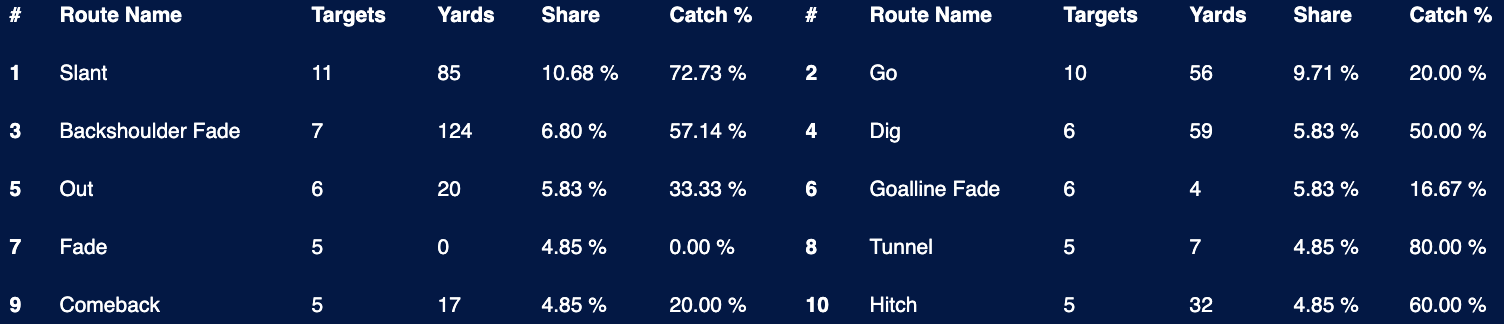
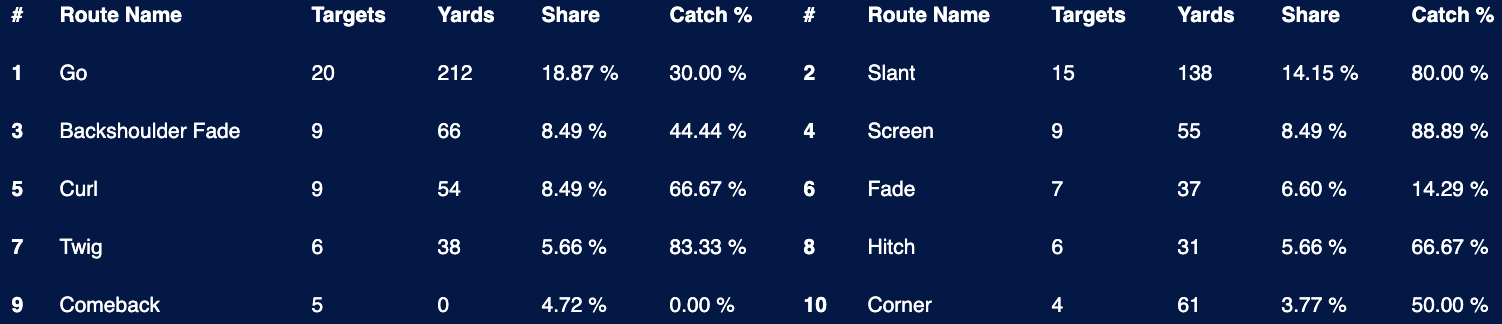
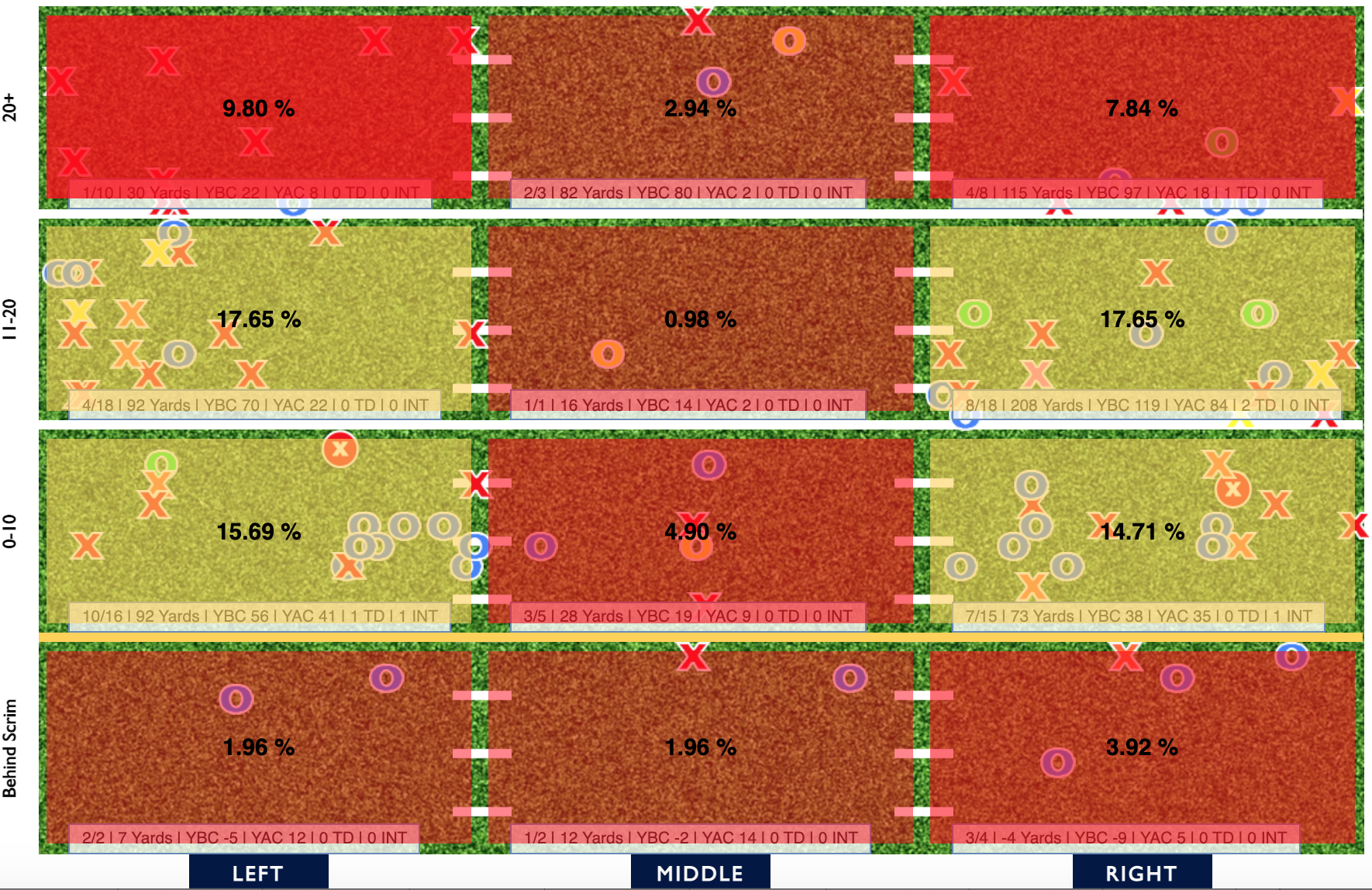
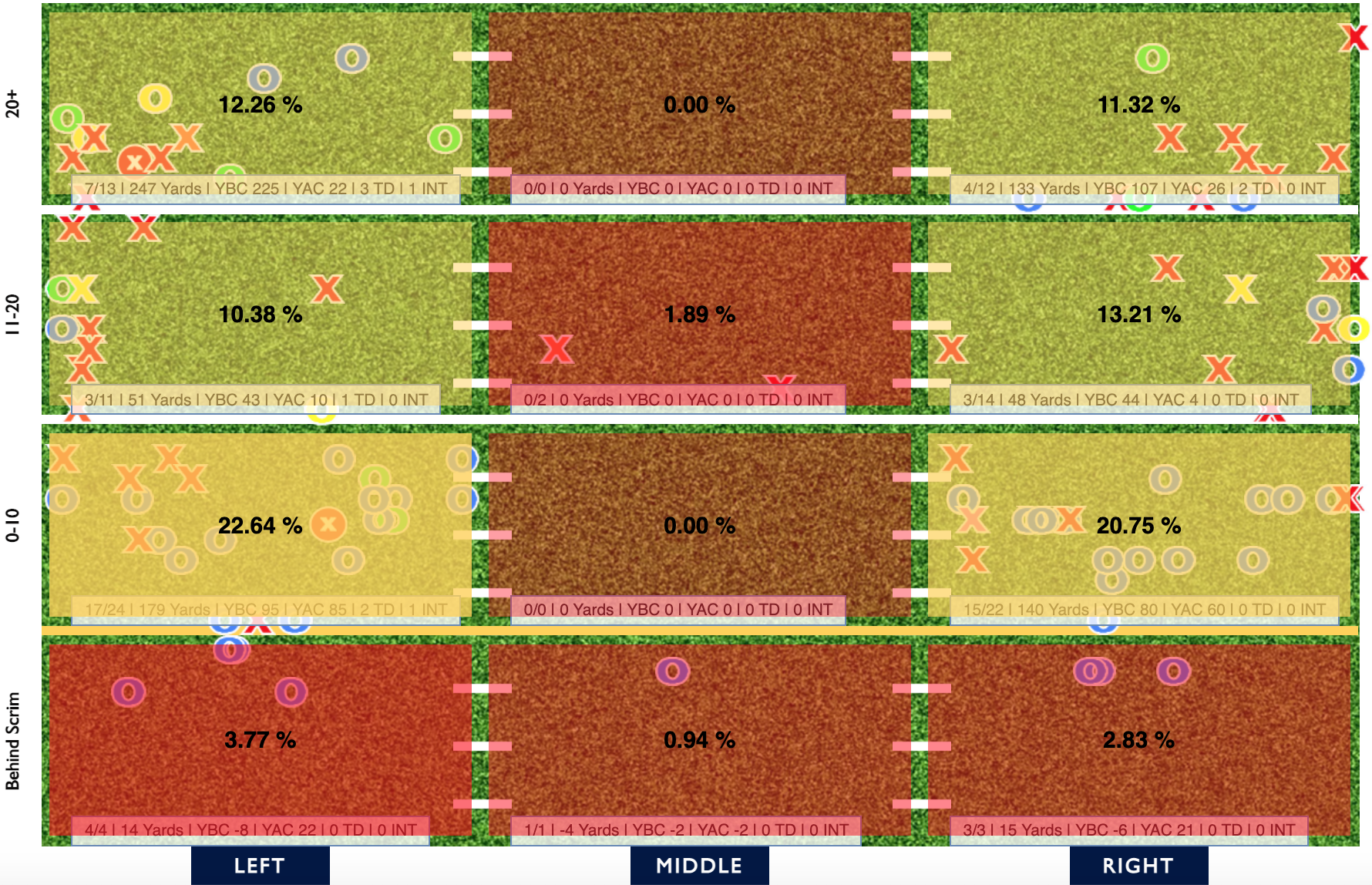
I hate to project Bo Nix's flaws as a dropback passer onto Williams', but it's very difficult to separate him from his unideal passing environment. No one else in the group saw a higher percentage of their yardage come from off-target passes. Outside of War Eagle's erraticism through the air, Williams' -- perhaps being cheeky -- mentioned to media members during draft preparation that Auburn's offense lacked a true route tree under Guz Malzahn. Not that a receiver of his size will be asked to be a buttery cutter from day one, but that hurts his projection. Alshon Jeffery created a nice career for himself operating as a big bodied vertical threat. But as we know, that style doesn't always age well. And considering Williams enters the league with poopy performances attempting to deal with off-target chances, some argue he could be a complete miss. Behind the SEC's worst Catch Rate off inaccurate throws the last two years, Williams also sits inside the bottom3 in Success Rate and First Down+TD Rate. Plus, his such Drop and Creation Rates finished below-average.
Each of the last two seasons, his top targeted routes have been go, slant, and backshoulder fade. You know, paths that allowed him to work his corner vertically or snatch the vacated yards underneath once they make their drops. Looking at his heat maps, you can make out the ample attempts outside the numbers and along the sideline beyond ten yards downfield. While Auburn's offense made no qualms flooding those areas, it was frequently one of the more averse scheme running men between the hashes. Williams has only logged 14 targets in those spots since 2019.
Bo Nix had a lot of faith in Williams' abilities to win contested targets. Like is ungodly Uncatchable and Inaccurate Target Rates, the Tiger's experienced one of the highest makeups of tight window offerings the SEC. Only Josh Palmer logged a bigger clip than Williams' 44.3% in our sample. But like most of his figures, his returns were inefficient. With his yards/target falling over two yards under the group's average in addition to his Success Rate, First Down+TD Rate, and Catch Rate looking up to the conference mean, it's apparent the task was too tall for the 6'3 wideout. No question better in this context when these contested throws were on target. Then again, all but one of his tight window drops since 2019 occurred on an accurate attempt. Can't blame Nix for those no matter how hard you try.


Off the group's 2nd-highest Deep Target Rate, Williams was okay but not anywhere close to the conference's top performers. These tries saw the Tiger's Drop and Creation Rates be their best selves. In terms of volume, the latter doubled the former in our parameter. Still based on what guys his size are ordinarily asked to do at the next level, his underwhelming returns will ensure Williams will be a mid-to-late round selection. Though every catch his freshman season resulted in either a first down or a score, that was far from the case in the scope of this analysis. I shouldn't have to remind you he's exiting a poor environment for sculpting future professional pass catchers. Williams is a hoss and isn't afraid to deal with less-than-ideal circumstances. But, that doesn't mean his abilities match his stature or confidence.
Anthony Schwartz:
Measurables: 6'0, 186 lbs, 31.5" arms, 9.375" hands


Anthony Schwartz is a difficult player to project. He's raw as a route runner, has plenty experience operating as an outlet or gadget player, is one of the fastest receivers entering the draft, and owns modest analytics. His measurables are nothing to dismiss but aren't singular in any way. Behind a short-to-long operation, Schwartz's speed was much more effective running away from opponents close to the line of scrimmage rather than threatening deep. The underneath completions were often his main source of production, which allowed him to find success at an average rate while being one of the strongest options after the catch in our group. Despite "sure-things" cluttering his sample, Schwartz's yards/target, Drop Rate, and Explosive Catch Rate all were subpar relative to his peers. His figure of the later was basically half of the conference's average. Though most of his chances resulted in catches, situational value didn't always follow suite.
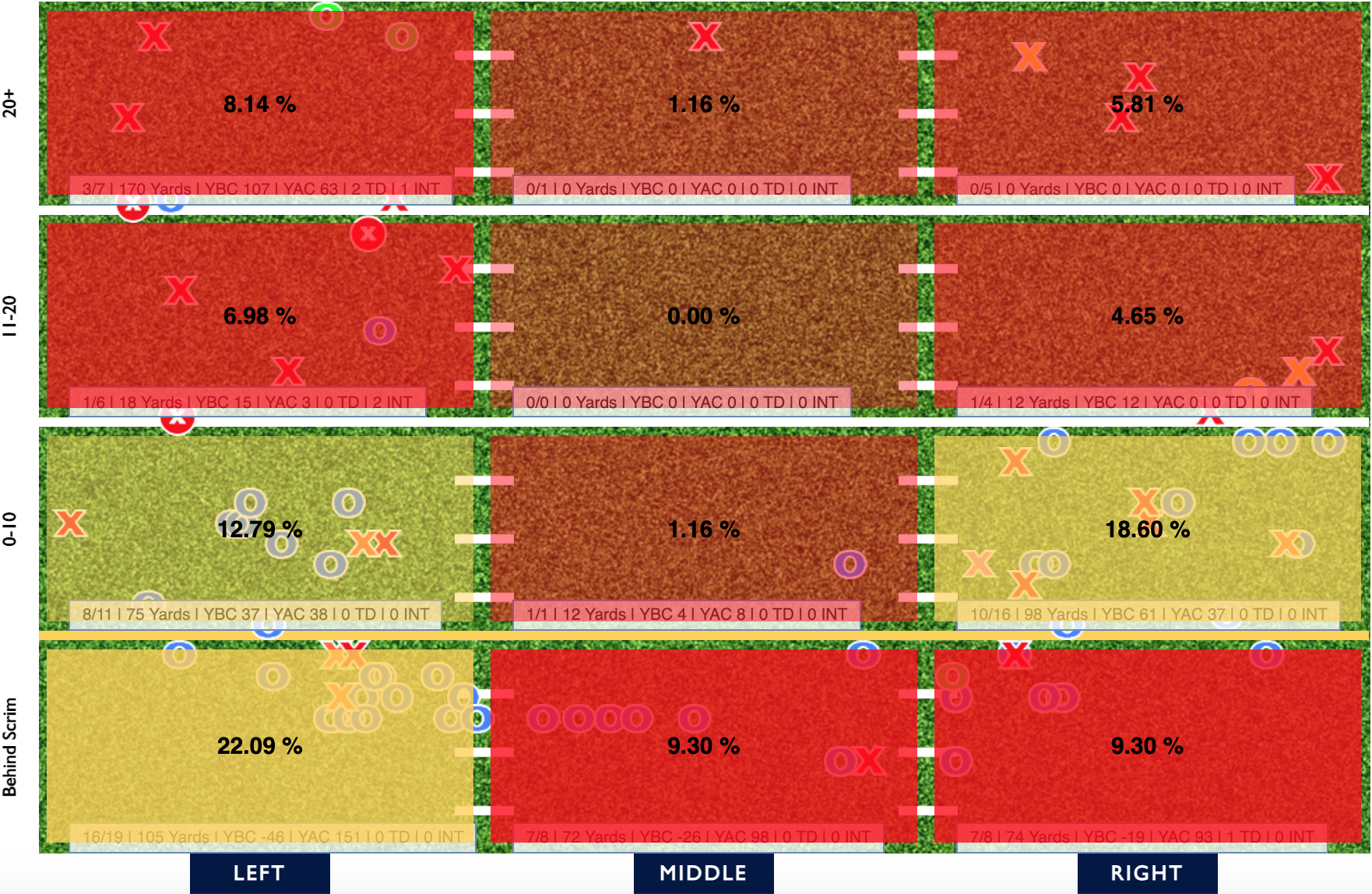
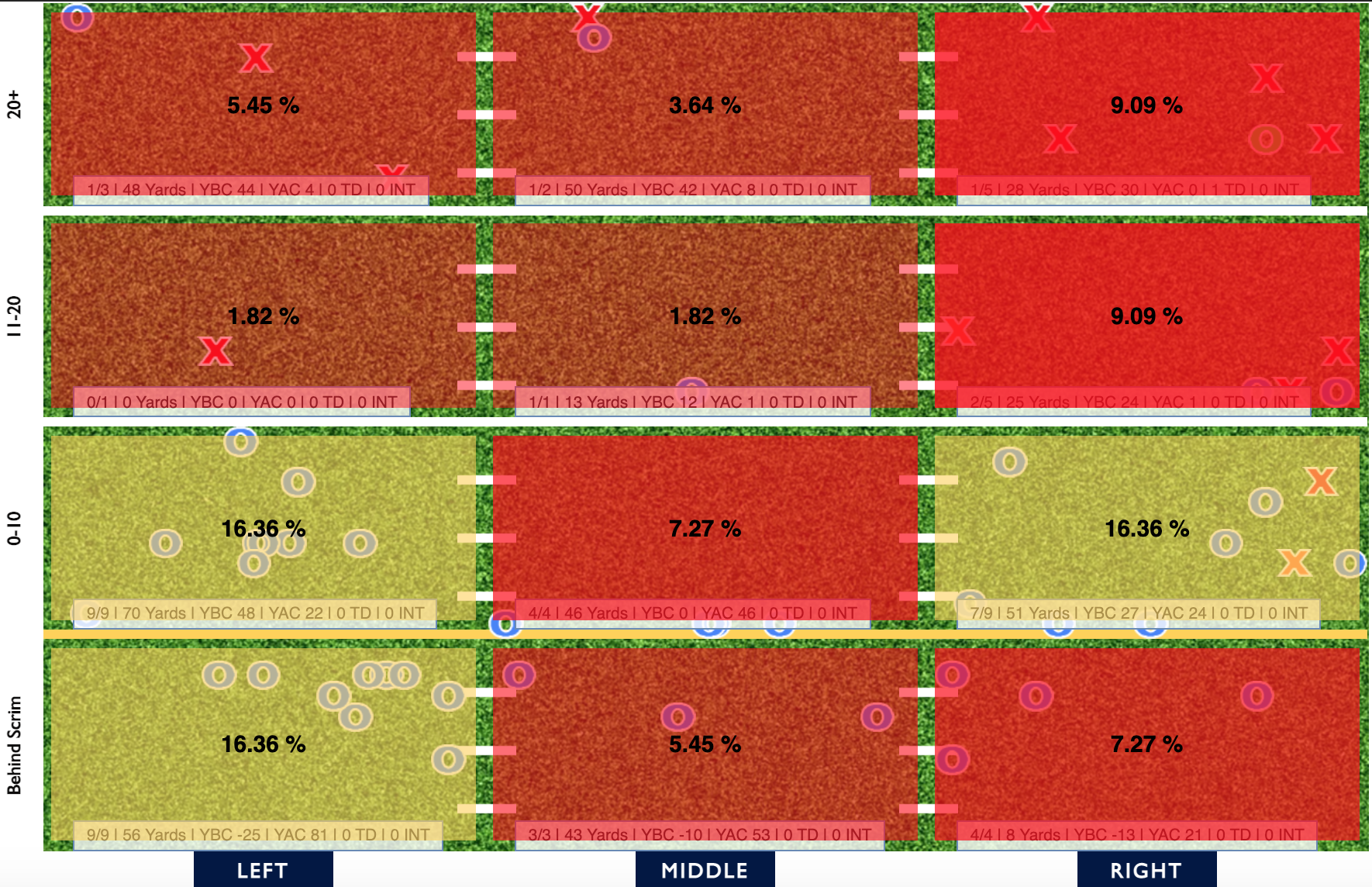
Schwartz's 2020 Target Heat Map/Top Targeted Routes Schwartz's 2019 Target Heat Map/Top Targeted Routes


Despite 29% and 40% of his targets coming behind the line of scrimmage the last two years, respectively, Schwartz still fielded a fair amount of off-target chances in our parameter. Though his dismal Drop Rate on inaccurate attempts is damning, our receiver in question at least was an average target in these spots in terms of Success Rate and Catch Rate. (On off-target throws, Schwartz' average depth of target practically doubled from his normal clip to well over 14 yards). Either way measuring his play, the Tiger simply did not display WAR metrics you'd hope to see in potential draftee. Though his 25.9% 1D+TD Rate was fair enough, his Creation Rate and yards/target were pretty colorless; both finished inside the group's bottom3.


Barely 10% of Schwartz targets the last two years occurred at least 20 yards downfield. Only three other group members can claim a lower clip. Despite his burst, he never quite put it all together functioning as a homerun threat. Part of that was due to the fact he was easily re-routed by stronger DBs, he lacked the proper brawn to battle, and Bo Nix struggled constantly with his ball placement at all areas of the field. Just about 48% of his deep attempts had no chance of being caught. No SECer sported a worse clip. Despite those wasted throws, failing to log a single creation, and the fact his Catch Rate and TD Rate off deep balls fell below the average, Schwartz managed to be on the receiving end of some true humdingers. As a result, his 24.7 yards/deep target cracked the top5 and was his only instance of that stat besting his peer's collective mean.
Perhaps because his coach's viewed the former track star as brittle or soft, Schwartz wasn't sent into the belly of the beast or asked to work in tight windows too often. With Seth Williams being the de-facto big body to deal with these circumstances, only 11% of Schwartz's targets were contested, which was the group's smallest clip. Plus, less than 7% of his yards the last two years have occurred off such throws; that mark is also represents the SECers' floor being the only figure in the single-digits. The reduced usage in tight windows was wise. Schwartz was easily his worst self judging by his relative output. In 2020 alone, the Tigers only mustered four yards off seven catchable contested targets. Good luck building on top of those metrics at the next level.
With his speed, someone will give Schwartz a chance. But, this off-ball prospect will come with a "buyers beware" warning considering his lack of added value off extra attempts. His jets helped him log a few nice end arounds and YAC plays, but rarely did they aid him creating separation or do much damage in the dropback game. At the very least, he could steal a few reps running screens. But considering his upside, it's hard to get too lustful for his breakaway ability considering the underwhelming lack of return as a college wideout.
Trevon Grimes:
Measurables: 6'4, 220 lbs, 31.375" arms, 9.375" hands


I view Trevon Grimes as a diamond in the rough, but I might be alone on that front. Traditionalists will surely knock his small arms and hands for his frame, deplorable Drop Rate, quiet 2020 season, and modest bottom line. And while I, too, expected more out of Grimes this past season, I am in his corner ahead of the draft. On the surface, he's clearly an above-average pass catcher compared to his conference contemporaries. In fact, his yards/target and Success Rate were top5 worthy.
In addition to his positive overall outlook, Grimes stood out in contested situations. Yes, his Drop Rate remained putrid and his Catch Rate finished under 50%. But every one of Grimes' receptions found situational success, most of which resulted in either a fresh set of downs or points. The Gator was also exceptional in these spots generating explosive gains and creating opportunities for himself. Only Jaylen Waddle trumped his 34.5% Explosive Pass Rate in this context. And it bears remembering, the Tider logged half the number of contested chances compared to Grimes. Plus, his such profile further strengthens knowing his 13.7 yards/target only trailed Waddle's. To round out his play making acumen, Grimes' 17.2% Creation Rate just about doubled the SECers' combined average. All the while, only teammate Kyle Pitts saw a higher makeup of his total yards come from tight window targets in this study.
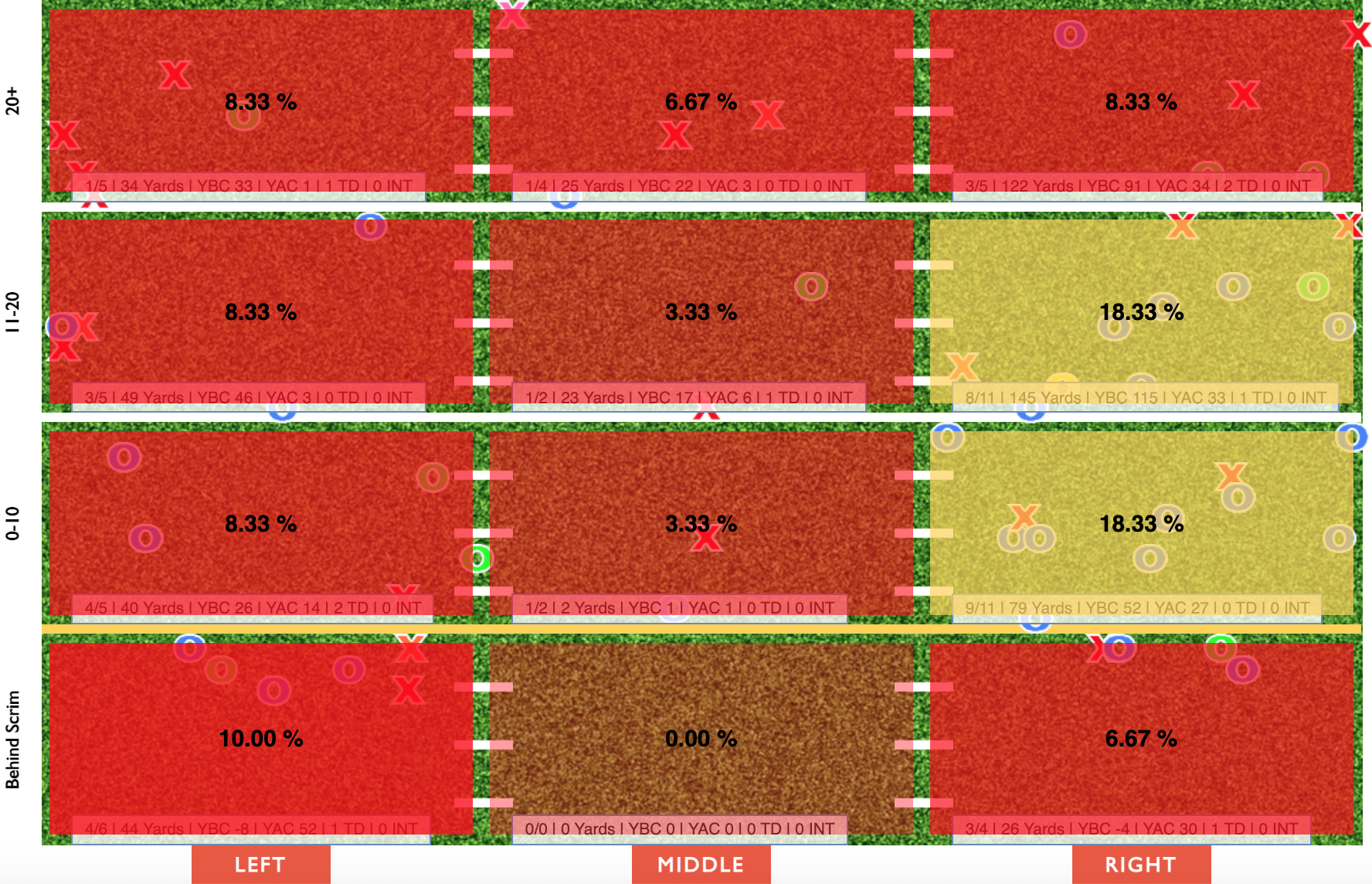
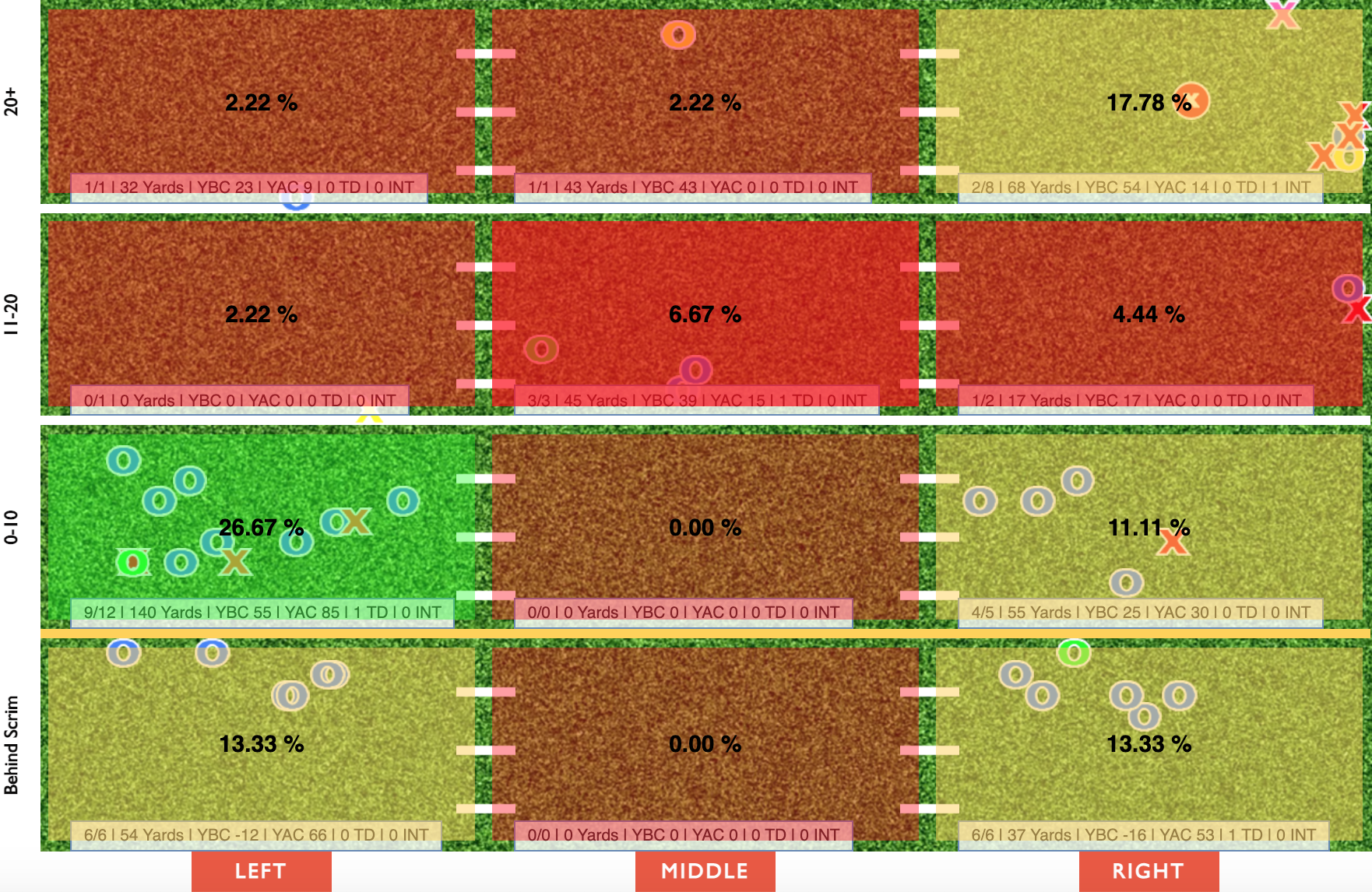
Grimes 2020 Target Heat Map/Top Targeted Routes Grimes 2019 Target Heat Map/Top Targeted Routes
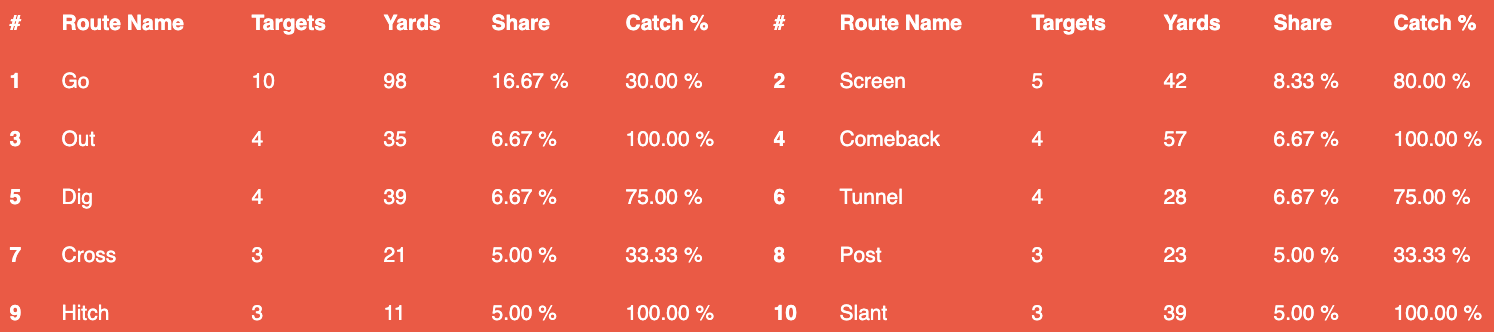
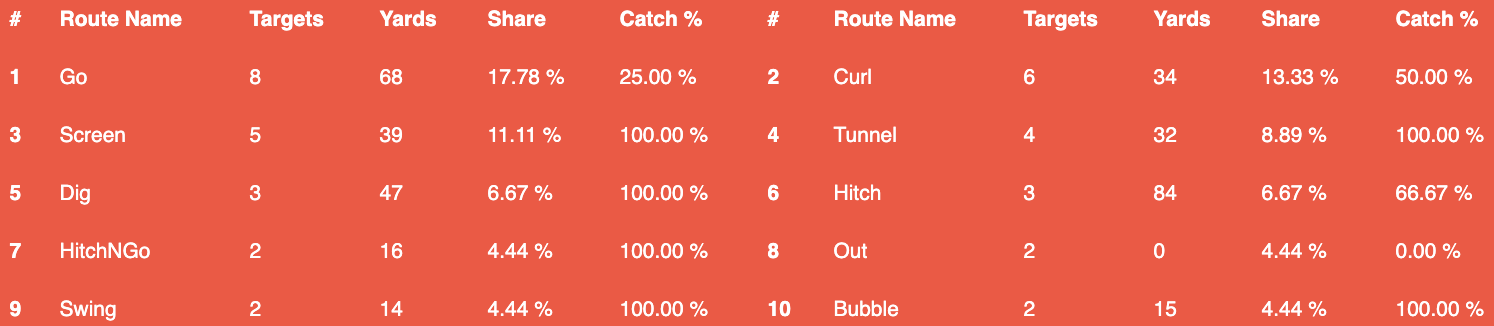
Grimes was one of the SEC's most efficient receivers in 2019. His heat map will show a pass catcher who feasted short, to the left as well as deep, to the right. With Van Jefferson, Josh Hammond, and Tyrie Cleveland in the mix, Grimes never had to soldier the load for his position group. And though he helped anchor Florida's efforts from the outside this past season, Pitts and Kadarious Toney wrestled away the spotlight. Grimes still had a good season, but it just wasn't as laudable as his previous campaign. With the Gators utilizing less RPOs and screens, Grimes saw his target makeup on throws behind the line of scrimmage shrink from 26% to 17%. He continued to move around the formation but saw a much more concerted effort working him from the Z-spot. Though it wasn't particularly the case in 2019, throws outside the right hash begat his best numbers ala a 74.2% Catch Rate (compared to 57.1% and 37.5% clip on attempts outside the left hash and towards the middle of the field).


Goes finished as Grimes most targeted route each of the last two seasons. As a result, over a fifth of his catchable attempts were directed deep. Only Ja'Marr Chase and Josh Palmer were targeted 20+ yards downfield more often across their samples than the Gator. But as you can notice from his disappointing Catch Rate hauling in goes, Grimes left a decent amount of plays on the field in these spots. Though his Creation Rate bested his double-digit Drop Rate, he fell below the group average in yards/deep target, Catch Rate, and TD Rate. All of them finished inside the bottom5.
Off-target chances were a mixed bag. Using his 6'4 frame, Grimes maintained his excellent ability to create opportunities and generate potent gains. Plus, his yards/target and First Down+TD Rate broke even. But while all of his catches resulted in success, both his Catch and Success Rates came in under expectation. Though three drops over two years on such chances doesn't sound like much worry, his 16.7% such Rate off inaccurate targets is a bottom5 mark in our sample.
Drops can be circumstantial and volatile. In no way are these plays strong predictors for future performances. Though Seth Williams consistently had butterfingers on the Plains, Grimes' miscues seemed less severe and were far less expected. Of the 11 he logged since 2019, nine came this past season with five coming on tight window targets. Haters will hone in on the plays he didn't make rather than his superb statline fielded contested throws. His size has him well-suited for that kind of role at the next level albeit his lukewarm returns working deep. Compared to the majority of the SECers expected to be available after Round2, Grimes favorably checks a lot of boxes.
Jhamon Ausbon:
Measurables: 6'2, 217 lbs, 32.375" arms, 9.875" hands


Opting out of 2020 has Jhamon Ausbon flying under the radar. For most, he's an afterthought who might be up as "Mr. Irrelevant". Among the SEC receivers, he boasts the biggest hand size. And, it shows being one of the best true possession receivers in the class. Operating in Texas A&M's methodical passing game begat few chances for big gainers. Most of his respective yards/target and First Down+TD Rates finished below the mean, but every single kind of his Catch Rates reached the good side of average. Moreover, after the catch opportunities seldom manifested off Jimbo Fisher's rigid patterns predominately working towards the teeth of the defense.
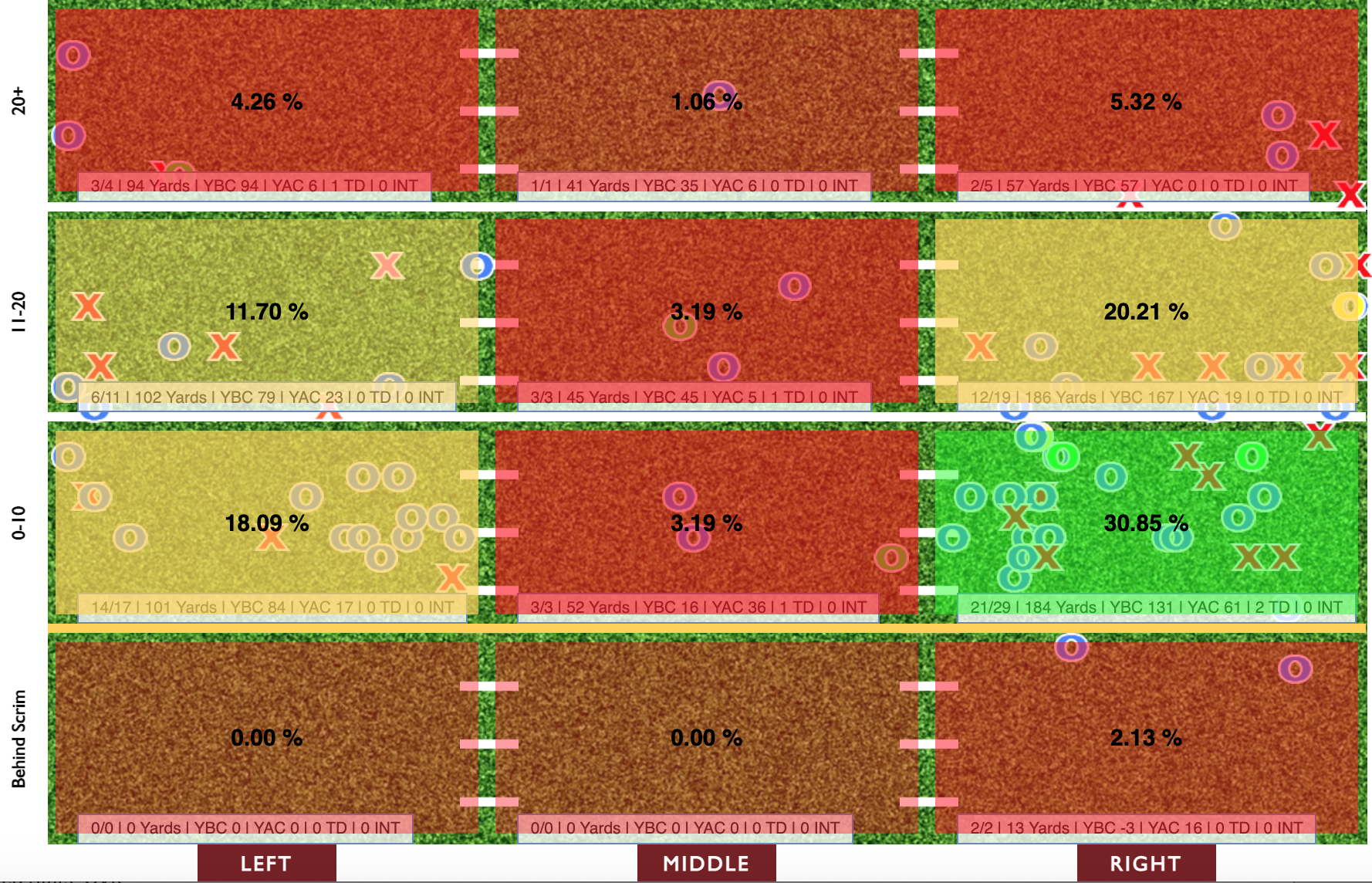
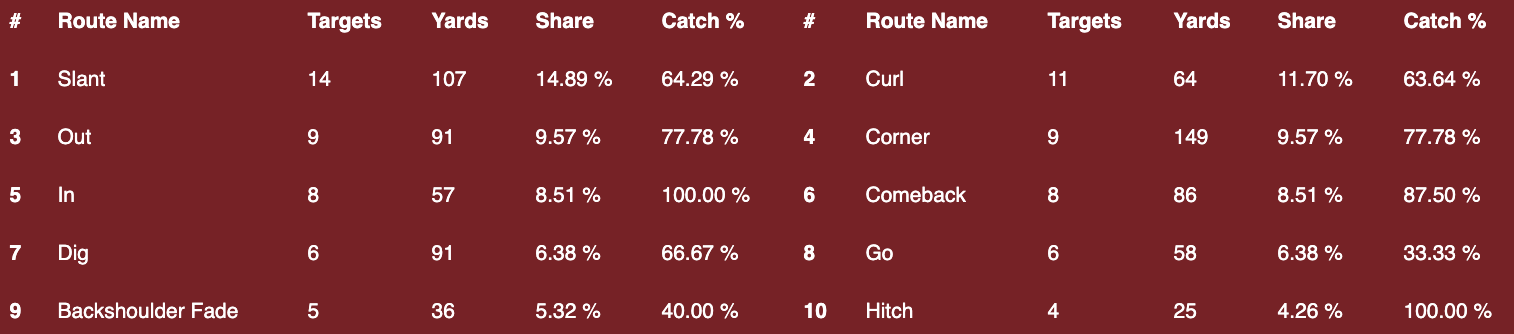
Slants and ins as well as stationary stills like curls, hitches, and comebacks were some of this top targeted routes. With only two attempts behind the line of scrimmage, more than half of his targets in 2019 traveled less than ten yards down field. If you look to screen right, you can see a whopping 31% went towards the short, right pocket. As a robust pass catcher, he's build to take contact. But despite being sure-handed on tight window targets, Ausbon didn't create a single reception for himself. It's a good thing Kellen Mond has been one of the SEC's top passers hitting contested throws. And again, Ausbon was quite good hanging onto those attempts.
Despite the ample in-breakers, very few of Ausbon's attempts occurred between the hashes. Similarly, the Aggie wasn't sent deep too often; he was targeted there even less. Excluding uncatchable targets, only Kyle Pitts and Shi Smith logged a lower Deep Makeup than his 9.30%. The volume was certainly lacking, but Ausbon made the most of his tries. Without dropping a single deep attempt in 2019, he hauled in six of his eight catchable targets.


Dealing with off-target balls was his weakest area. Exactly zero inaccurate targets birthed a gain of 20 or more yards and he comfortably finished below the group's average across the board with the exception of his Catch Rate. Like his deep attempts, Ausbon neglected to log a single drop. Again, you gotta love those hands.
Osirus Mitchell:
Measurables: 6'5, 206 lbs, N/A arms, N/A hands


If you made it this far, kudos. Not many stick around for Osirus Mitchell takes. He's lanky with some nice giddy-up but never quite established himself as a consistent threat. Paired with his nice length is a set of dependable hands. With one of the best overall Drop Rates in the group, his Catch Rate is close to the conference average. But in terms of value, his targets were less efficient than his peers.
The extra extension came in handy dealing with off-target throws, which Mitchell fielded at an above-average rate. His Success Rate and Creation Rate bested the mean with his First Down+TD Rate and Catch Rate being fairly respectable. But these catches seldom delivered potency. While failing to log a single 20+ yard gain off an inaccurate target the last two years, Mitchell's yards/target was almost three yards below the group's average.
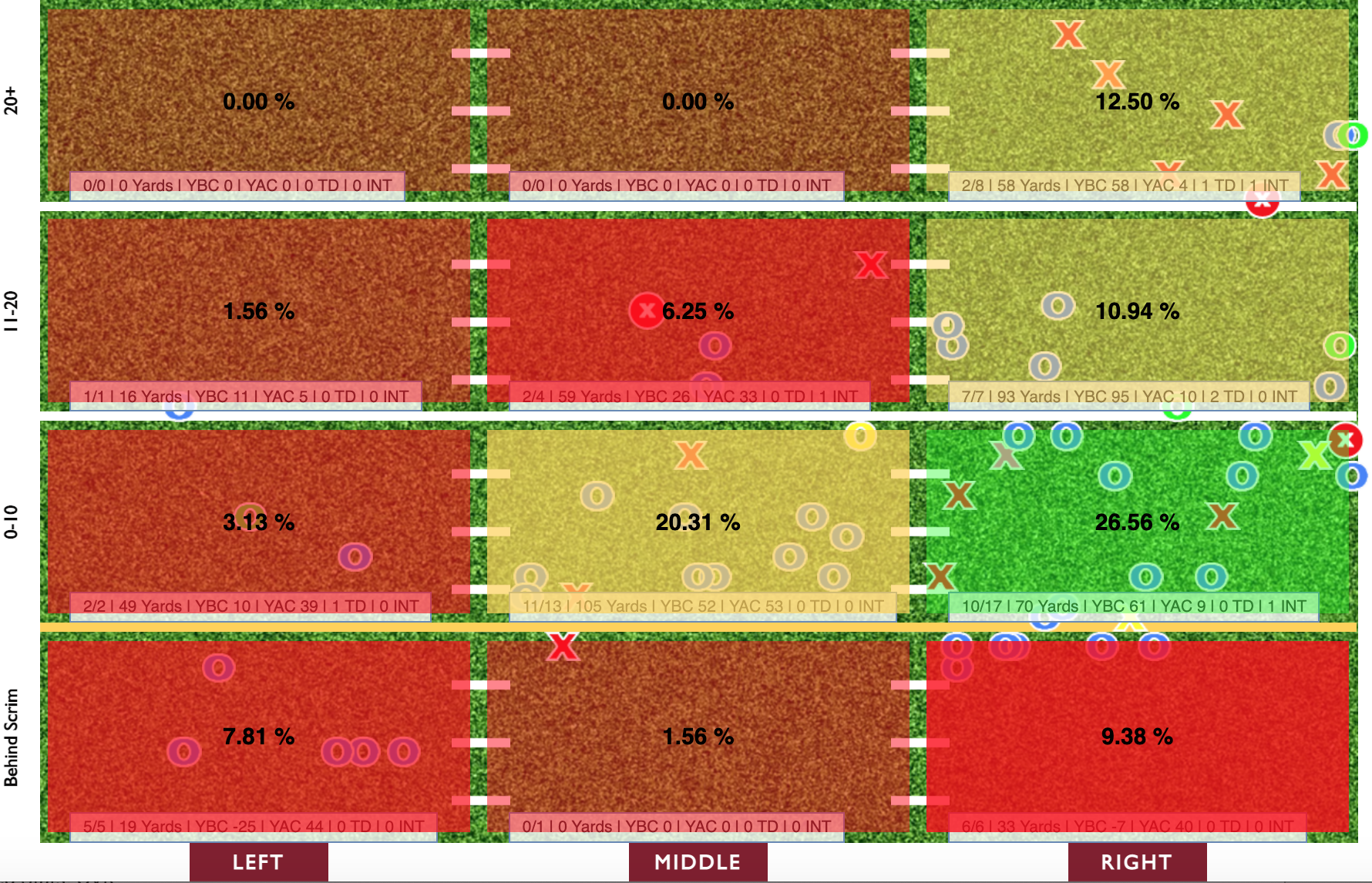
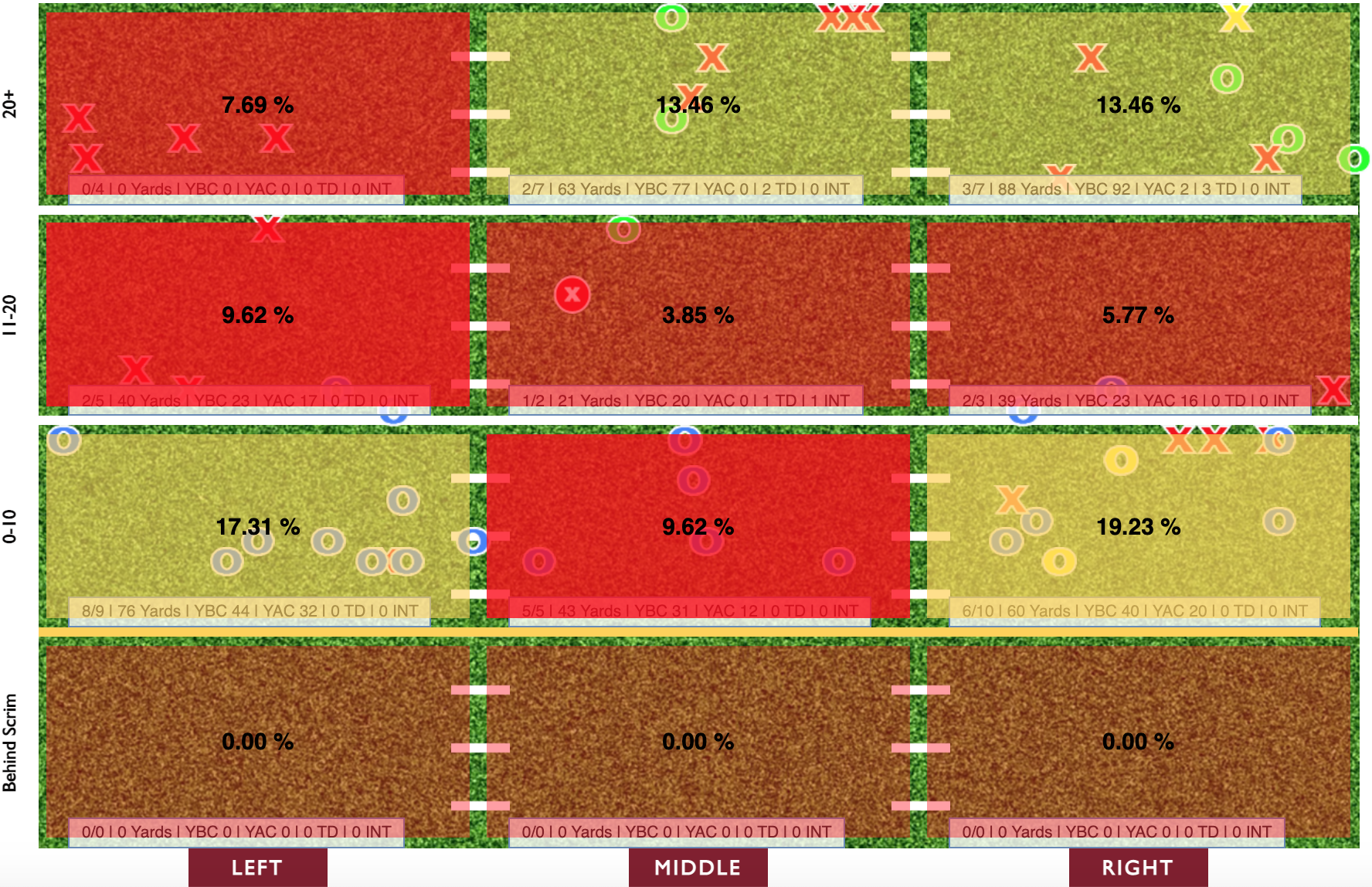


With Mike Leach coming to town, Mitchell's distribution was noticeably altered from 2019 to 2020. After being one of SEC's more vertically-oriented receivers in Joe Moorhead's last season, the ball control version of the Air Raid saw him run Mesh to death, anchor his efforts from the right side of the formation, and be featured in the screen game. Despite not logging a single attempt behind the line of scrimmage in 2019, the Bulldog totaled a dozen this past fall. Perhaps you noticed, Mitchell's two top targeted routes transformed from post and go to drag and screen. Though he's not the strongest route runner, evaluators have to like his displayed versatility considering his height. He's been asked to do far more than run work an up-and-down route tree.


Despite Mitchell's proclivity to be targeted deep, he wasn't the best receiver in those spots. His yards/deep target was less than half the group average and his Catch Rate finished 23 percentage points below the mean. All the while, he didn't muster a single creation reception. Granted, he has been dealth a few of the worst deep throwers the SEC has had to offer the past couple of seasons. But despite his frame, Mitchell just hasn't been able to rise to the occasion to make up for his quarterbacks' questionable abilities throwing downfield.
And when pestered by nearby defenders, Mitchell hardly played his size finishing subpar across the board. With one of the five lowest yards/target on contested targets, his such Success and Catch Rate ranked in the bottom4. Having experience operate under several offenses should do him well. Still, it's not like he mastered any role he was given. Having an upgrade at passer should raise his receiving floor some. But based on his returns relative to his peers, Mitchell's path on sustaining a decent NFL career is set up to be arduous.