2021 Vision: Previewing Florida
2021 Vision: Previewing Florida
With talking season winding down, preview season is among us! I'm sure this isn't the first preseason article you've viewed. You should know the drill by now with these bad boys. But if this is your first experience with StatCat, be ready to learn a thing or two about the Gators' passer, receiver room, ball carriers, OL, its most important stats to maintain and/or improve on both sides of the ball, and how Florida's schedule breaks down with help of ESPN's SP+ Rating!
Florida Passers

Traditionally, Dan Mullen’s offense has been a spread, run-first operation that enjoys teasing opponents with its quarterback’s mobility. Captain Obvious wanted me to remind you that Kyle Trask did not fit into that mold. Despite that and famously being a career backup, Darth Gator tweaked his approach, which resulted in Florida fielding one of the nation’s most prolific passing offenses. Behind Trask’s arm, the Gators reclaimed relevance, got back to winning ball games, and broke a lot of school records. Only Mac Jones accumulated more Expected Points Added in college football last year than Trask’s 228.5 figure.
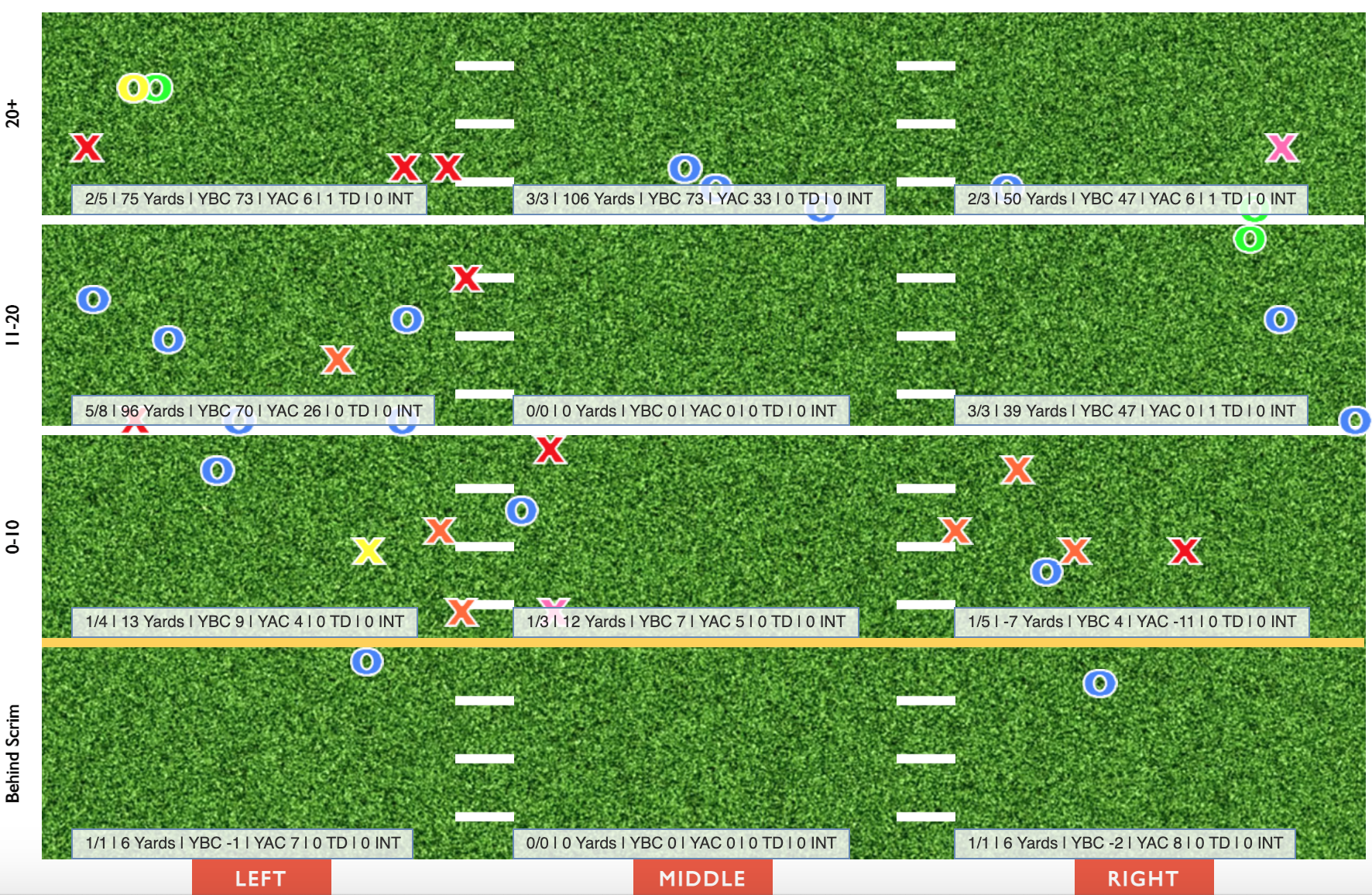
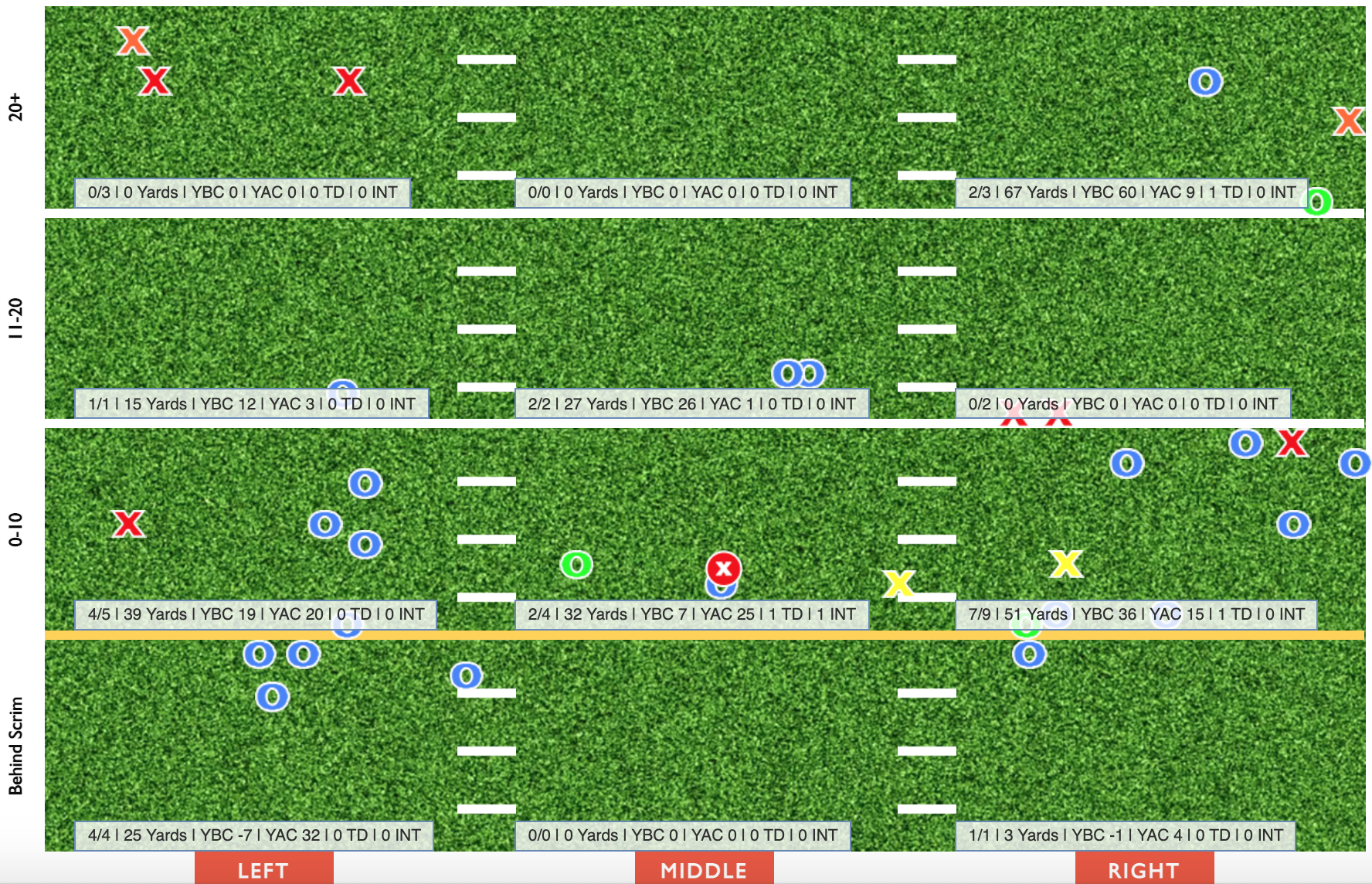
Though Mullen can stick to his claim he doesn't have a system, he certainly has staples he likes to lean on. Emory Jones should get him back into his old comfort zone as a play caller. While Trask himself was by no means a liability as a ball carrier, you don’t need me to tell you he was a lug of a rusher who possessed lackluster athleticism. That certainly isn’t an issue for Jones. The former-top5 QB prospect has been so dynamic as a runner that Mullen opted to take snaps away from one of the nation’s top passers in lieu of his legs. Among SECers with at least 28 designed carries last year, Jones finished top3 in Yards/Carry and Rushing Success Rate while commanding the league’s best First Down+TD Rate. He also rocked the conference’s highest yards after contact average among QBs with a 2.55 clip. Over the last two seasons, about a fifth of carries have gone for at least ten yards. Florida fans should be giddy with what he offers in this department especially considering Mullen’s creativity.
But while Jones can scoot and will draw a lot of eye balls with his rushing ability, he’s yet to prove he can function as a down-to-down passer. Even in packages specifically tailored to maximize his skill set, he’s been rather wishy-washy. Over the last two seasons, Jones’ overall Y/A, Success Rate, and Accuracy% finished under the conference mean. The latter was almost seven percentage points under 2020’s average while his career weighted Depth Adjusted Accuracy is under 40%. Bucking the Nick Fitzgerald comparisons will be tough. The former Mullen-QB played with a similar modus operandi whose best characteristics came via the ground. If you recall, the former Bulldog oozed efficiency as a rusher, but struggled mightily when asked to pass. In 2018 as Fitz logged the SEC’s 5th-most designed carries, he finished with a top3 Success Rate and top6 Yards/Carry. Through the air, however, he was dead last in Completion%, Accuracy%, and Depth Adjusted Accuracy% with the 2nd-worst Y/A, Success Rate, and First Down+TD Rate. For what it’s worth, that Mississippi State team went 8-5 and finished with the 8th-best offense in the SP+ (along with the top defense in college football). Despite being obviously efficient, the Bulldogs’ pathetic passing game handcuffed the final product. While not a perfect comparison, Jones should help Florida be pretty good assuming his ball carrying skills remain firm and his dropbacks continue to disappoint. If he figures out the latter, however, the Gators should be right in the thick of the conference title hunt.
Again, I have a good amount of faith Jones will offer value for this offense and that Mullen’s track record of knocking QBs into shape will continue. I do believe his final 2021 metrics will best his previous bottomlines. That said until Jones goes out an executes consistently through the air, I will maintain my muted overall expectations for him instead of blindly assuming he’ll work himself into being a top10 pick. After all, I wouldn’t be doing a good job an an objective observer by only focusing on the things he does well.
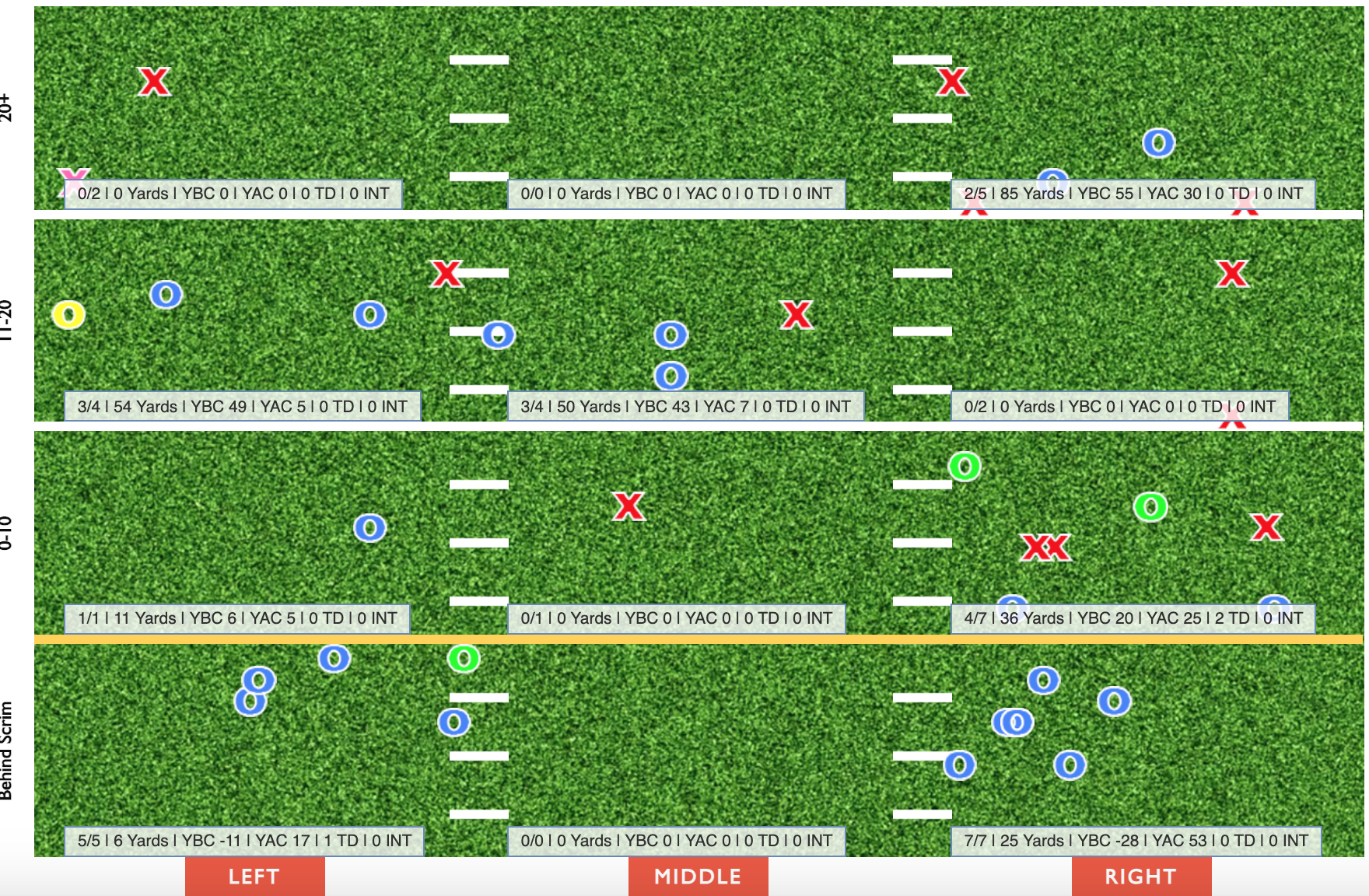
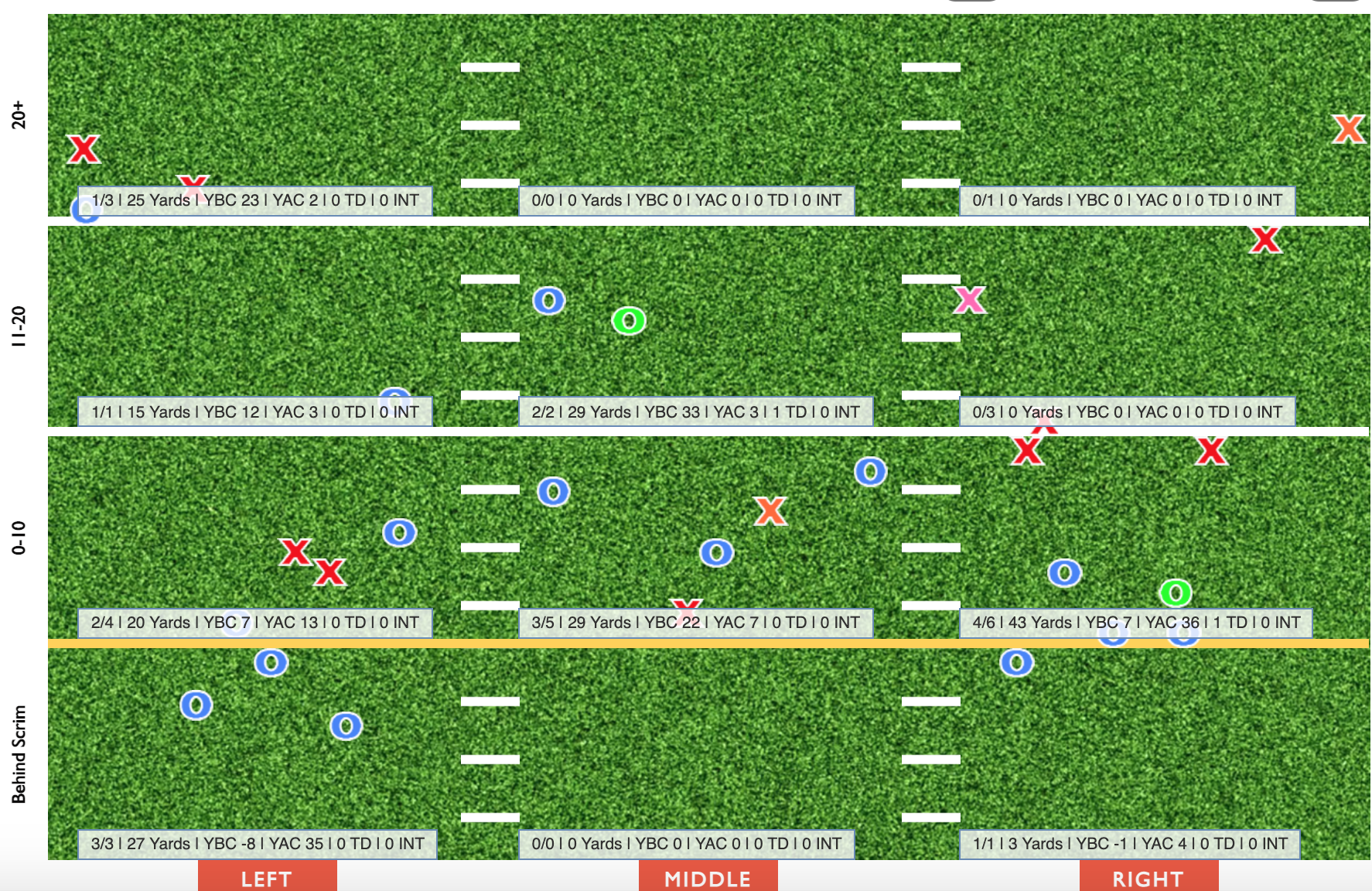
Emory Jones 2019 Pass Chart Emory Jones 2020 Pass Chart
Florida Rushers
With lots of passing game turnover, Dan Mullen hasn’t been shy proclaiming the depth and dependability of his running back room ahead of 2021. The Sultan of the Swamp might not be losing any sleep about his rushers, but the masses are left with some anxiety considering none of the Gators’ returning ball carriers — outside of Jones — stood out statistically or wowed with their advanced metrics. Perhaps underwhelming on the surface, Florida’s ground game was by no means a liability like in 2019. Though the Gators finished inside the bottom4 within the SEC in Explosive Run Rate, the team’s yards before contact average improved by over half a yard. The extra room up front also allowed both their Rushing Success Rate and Run Havoc Rate to enhance by double-digits.
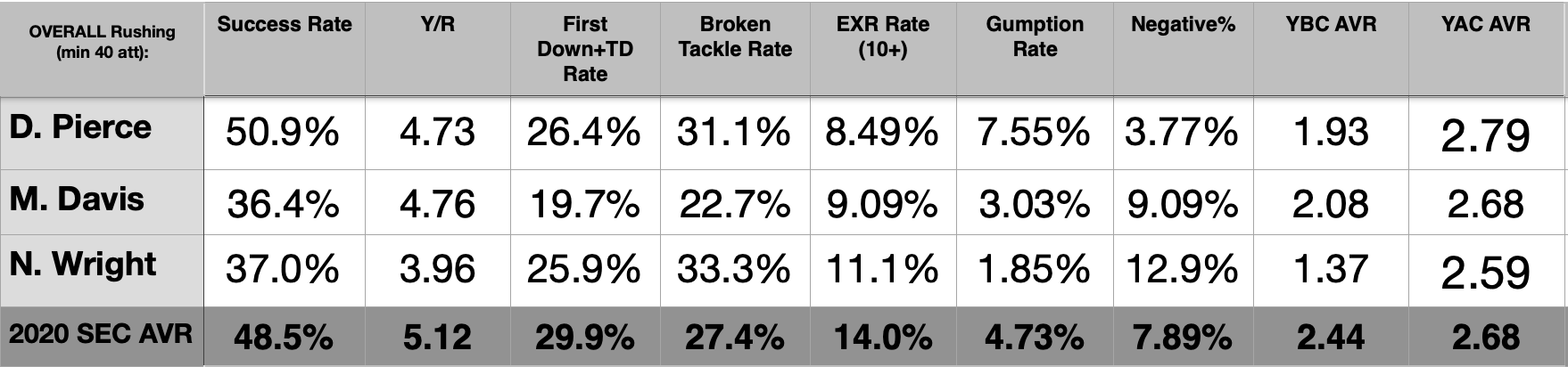
As the most productive ball carrier in 2020, Dameon Pierce is presumed to remain as the Gators’ RB1. With a sturdy build, he often functions as this offense's battering ram. For the second-straight year, he logged a team-best yards after contact average. Plus, his 31.1% Broken Tackle Rate cracked the SEC’s top10 last year. Might apparently made the difference as his 50.9% Success Rate also finished beyond that threshold and trumped Florida’s other running backs by over 13 percentage points. Pierce accomplished such despite ranking 23rd within the conference in YBC average with a 1.93 figure. While fine down-to-down, his rate of delivering a fresh set of downs, a score, or an explosive carry finished under the SEC mean. His 8.49% clip of the latter actually landed inside the bottom4 amongst conference qualifiers. Like you might suspect as a bruiser, he shined in short yardage situations. With three yards or less to gain, Pierce captured a top5 Success Rate, a top8 YAC average, and top10 Broken Tackle Rate. Despite being hit in the backfield on a seventh of this carries, the Gator fell forward each time and prevented logging a single negative try in this context. Only Brian Robinson has a preferable goal-to-go First Down+TD Rate amongst conference backs for this fall. But on other red zone carries or when behind the chains, Pierce’s low-ceiling running was in full effect as a less than a third of these tries ended in success.
The more versatile Malik Davis was the lesser option as a ball carrier. Though his overall efficiency increased from 2019, absolutely no one is jumping up and down about a 36.4% Success Rate, 22.7% Broken Tackle Rate, and 28.8% First Down+TD Rate. Davis’ cumulative resume has a massive negative opportunity cost. Considering Mullen’s adaptability with his X’s and O’s to aggressively avoid failed efforts, it will be interesting to monitor whether or not Darth Gator keeps his cool around Davis’ output. Though he was Florida’s most flawed rusher, he returns as the Gators leading pass catcher with the 2nd-most yards. Over half of his receptions resulted in a first down; only Najee Harris could make such a claim within the SEC last season as far as running backs go. Amongst all returners, his 10.2 Yards/Target is the conference’s 6th-best and more than double his Y/C figure. With an uptick in QB runs on the horizon, Davis’ run blocking and receiving ability might tip the scales in favor of sustained reps. But, his place in the rotation isn’t as firm as Pierce’s thanks to his poor production as a ball carrier.
If Davis continues to waste carries, Nay’Quan Wright should shoot up the depth chart. His blah 3.96 Y/C will scare plenty away, but his 33.3% Broken Tackle Rate was the highest mark from a Florida running back since 2018. With a depilating 1.37 yards before contact average, only LSU’s Chris Curry suffered from less room to run per carry within the conference. By fire and fight, however, over 65% of Wright’s yards came after contact as a seventh of his runs experienced defensive engagement behind the line of scrimmage. With such adversity and a subpar YAC average, his result-based stats overly stunk. That said, he still topped Davis in both Success and First Down+TD Rate. Wright appears to be the more formidable runner even if there are doubts about his ability to bring about efficiency. Moreover, his receiving numbers are sound. While Davis has some slight edges, the sophomore bested his Catching Success Rate by nine points. Thanks to catching all 19 of his chances, his 11.5 Yards/Target only trailed Kyle Pitts on the team last year. Either way, Mullen should have comfort in his group’s receiving ability out of the backfield.
Beyond the main three-man rotation, Lorenzo Linguard and Demarkus Bowman will be lying in the wake anxious for an opportunity. With both being former five-stars by 247 Sports, the buzz surrounding those two ball carriers is justified. But since neither have logged much collegiate experience, your guess is as good as mine as to whether or not either makes much of an impact this fall. While I won’t bother to set any expectations regarding Linguard’s or Bowman’s rushing acumens, I certainly won’t stop any Florida fan who wants to buy in their hype.
Florida Catchers
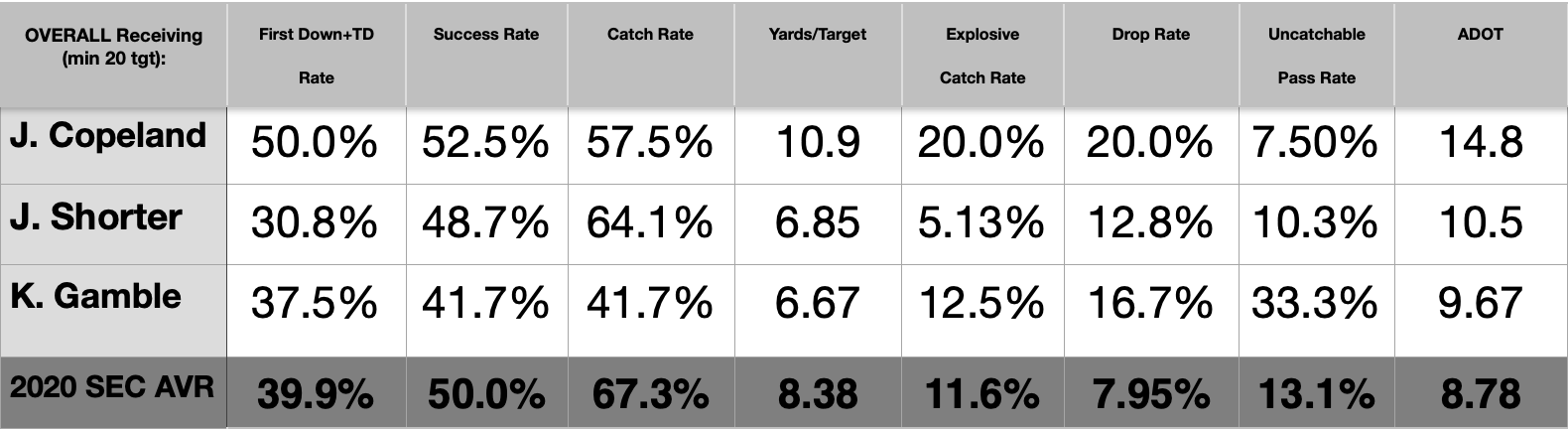
Jacob Copeland’s volume figures surely won’t draw much fanfare nor will a raw 57.5% Catch Rate. And even though Mullen has a track record of spreading the wealth around, he is a player StatCat really likes to make an impact ahead of 2021. Only Ole Miss’s Braylon Sanders and Dontario Drummond rock higher Deep Target Makeups than Copeland’s 30% clip amongst SEC returners. No doubt the high degree of difficulty on his attempts altered his opportunities. Yet, his 58.3% Deep Catch Rate is 3rd-highest once again only trailing the two Rebels. Of his 435 total yards, 231 (53%) came via the deep ball. Other than that, he benefitted from Kyle Trask’s passing savvy in the midrange game. Behind seeing zero uncatchable attempts between 11-20 yards, he shares the 3rd-best intermediate Catch Rate with the 8th-best Yards/Target. However, drops were a problem. There’s no ignoring that gaudy 20% such clip of his. So, that’s something to monitor. Though a happenstance that can be random, some dudes can never conquer a case of the butterfingers. Granted, the rest of his optimism rides in the assumption that Jones will exhibit better downfield accuracy than he has previously shown in his spot snaps. Trask was typically on-point, and more wasted chances naturally will hurt a target’s numbers. But as Florida’s primary receiver, Copeland will strive to flip the field. Plus, there’s a great chance he’ll line up at difference spots all over the formation rather than being landlocked to the far right. Mullen will be searching to create prudent matchups with Copeland’s verticality all over. StatCat anticipates opponents will load the box in anticipation of Florida’s Q-run game or otherwise, which will lead them susceptible to falling victim to the Gator’s skillset.
Jacob Copeland's 2020 Target Chart Justin Shorter's 2020 Target Chart
Justin Shorter ventured downfield on occasion, but he was primarily targeted short. Over 62% of his attempts occurred 10 yards inward. His most thrown-to routes reflect that style. Slant, Tunnel, Screen, Drag, and Curl were the only ones that received over four attempts. Despite the prevalence to work short, he still suffered from a double-digit Drop Rate and Uncatchable Target Rate. Behind the miscues and conservative usage, no Gator receiver with at least 20 chances logged a lower Yards/Target or Success Rate; the latter being the only Florida figure under 50%. His 5.13 Explosive Catch Rate was also a team-low. As the old guy on the team, there needs to be further urgency to make a bigger difference on the field. Being more efficient with his deep chances is a start. But if he’s to be this offense’s new factor after the catch, he’s got to generate a better such average his 4.8 clip during his first year in SEC play. Moreover, padding stats against Vanderbilt doesn’t help his sales pitch. Against one of the worst defenses around, Shorter amassed a fifth of his catches and over a third of his total yards. Though he’s due for a bigger role with less mouths to feed through the air, Shorter isn’t one for StatCat to buy ahead of 2021.
As the tertiary options, Trent Whittemore, Xzavier Henderson, and Rick Wells will duke it out for snaps. All received under 20 targets last year, so take their stats with a grain of salt. With Toney leaving an immediate need for an inside receiver, Whittemore seemingly fits the bill to fill that vacancy. Sure, logging only a dozen chances is not much substance to formulate much of a take. But two-thirds of his opportunities wound up in situational success. And, his Yards/Target reached the double-digits. As a smooth operator, StatCat believes he’s the best suited to slide into the slot and pick on box defenders. If Mullen wants to keep riding the Hoss Juke pattern, Whittemore should be the guy to start at H. Super senior Rick Wells can’t be ruled out getting snaps there either. But along with his lack of career volume, his 61.6% Depth Adjusted Catch Rate is the 2nd-lowest on the team. Henderson will likely provide depth on the outside. He was maligned by a 39% Uncatchable Pass Rate, which limited him to a sub-7.0 Yards/Target and 45% Success Rate on his limited sample. His up-and-down route tree with plenty of vertical stems is also culpable in his meh sophomore showing. The whole offensive operation will have an entirely different focus. So, perhaps these jacks find better efficiency once the master makes a few tweaks to his scheme.
No one man can replace someone akin to the titan of a tight end that is Kyle Pitts. So, the Gators are hoping to double team it with Kemore Gamble and Keon Zipperer. No, neither will be able to flex out wide, destroy jabronis in man coverage, or give off vibes of a demigod. But, that doesn’t mean this duo can’t be effective college football Y-men. No matter how you slice it, Gamble wasn’t an efficient target last year. While it’s easy to be empathetic toward the 2nd-highest Uncatchable Target Rate from an SEC TE with at least 16 attempts, sporting the position group’s worst Drop Rate (19.1%) is pretty inexcusable. All in all, both his Success and Catch Rates finished ranked in the 30’s among all conference pass catchers. His 7.00 Yards/Target, 38.1% First Down+TD Rate, and 48.8% Depth Adjusted Catch Rate all rank in the bottom3 amongst his peers. Thanks to being on the receiving end of a couple of big plays, Zipperer turned in a better bottomline. Though he wasn’t immune from drops himself, his 60% Success Rate only trailed Toney and Pitts on the team. If given permission, he could be used downfield like the latter. Seam, curl, and corner were his three most targeted routes; so there’s evidence Mullen thinks his traits are pretty good attacking single-high coverages.
Glancing at Florida’s Offensive Line
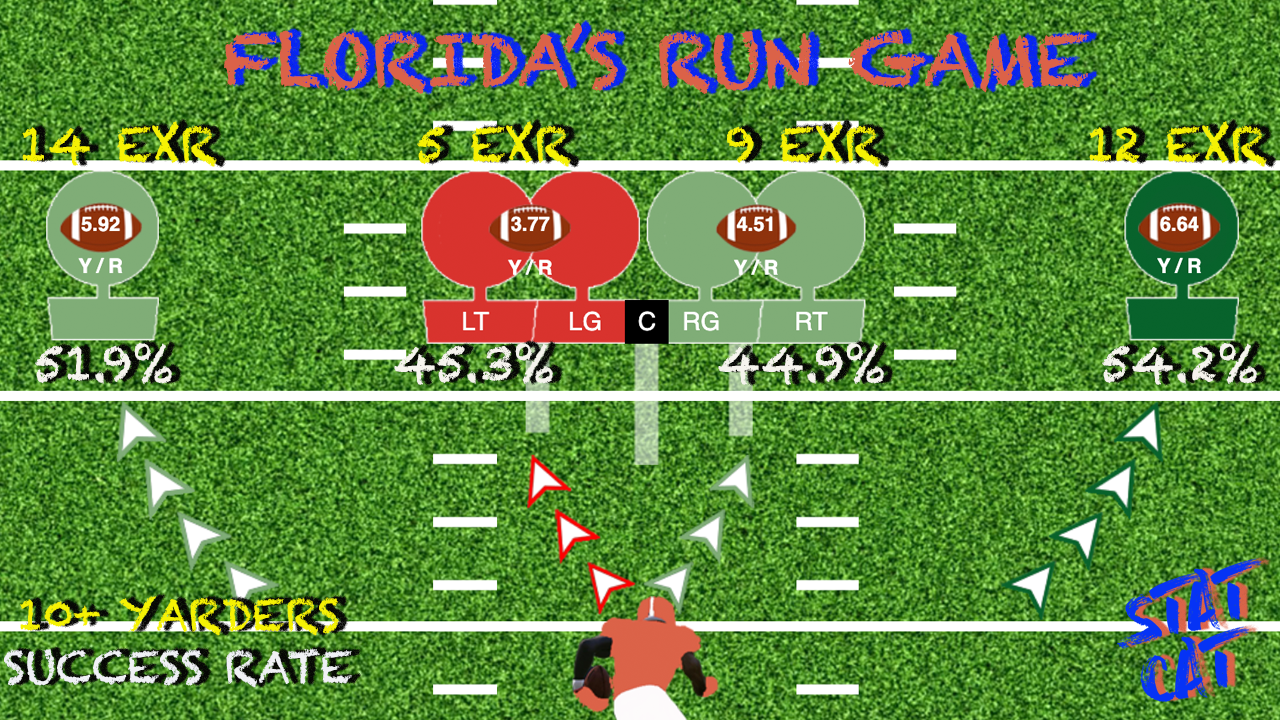
Florida’s offensive line was serviceable in 2020. Year-over-year against SEC foes in meaningful minutes, the Gators’ rush yards before contact average increased by over half a yard, Pressure Rate dropped about six percentage points, and Run Havoc Rate improved ten points. But while situational success came much easier than in 2019, the Swamp Dwellers were basically flat in Yards/Carry and Explosive Run Rate. Despite the improvement carving cushion, Florida’s 2.07 YBC clip still ranked inside the conference’s bottom4, which undoubtedly affected their ball carriers. Moving forward, increased Q-runs could inflate the Gators’ YBC average. Jones’ burst can turn any bit of daylight into an untouched big gainer. But at the end of the day, if this position group can’t widen holes consistently, Florida’s aspirations of repeating of SEC East Champ will weaken tremendously. The Gators’ improvement limiting havoc was a good start, but StatCat is challenging this OL to finish above the conference average in YBC. That might not sound like much, but they haven’t accomplished that feat in three years. In terms of pass protection, Florida should more or less deliver an average product like last year. And Jones’ escapability could actually see their top4 4.07% Sack Rate shrink even further. But admittedly, that’s a bit of wishful thinking.
Generally speaking, the Gators’ left side is much further along and the stronger portion of their front. With Stone Forsythe now in the pros, Richard Gouraige will slide over and be the Gators’ left bookend. If the position change didn’t signify it already, he’s their premier option in pass pro. Evan White looks to settle in at left guard after previously bouncing around at a few spots. Because of that, don’t be entirely surprised if he has to be a plug-and-play option elsewhere if the early returns suck or the injury bug strikes; particularly at center. Presumed starting center Stewart Reese has never started a game there. And with his past experience at guard and lackluster run blocking returns, White seems like the safer option to replace Brett Heggie. But, the pairing of Gouraige and White might be too tempting to go that route. Former-four star Josh Braun has the inside track to win the right guard spot, and Jean DeLance will round out the line at right tackle. Despite Braun’s inexperience and DeLance’s past sputters, there’s real optimism they can aid this ground game. For what it’s worth, the Gators averaged 2.68 YBC on rightward runs compared to 1.77 on leftward carries in 2020.
Key Offensive Metrics in SEC Play
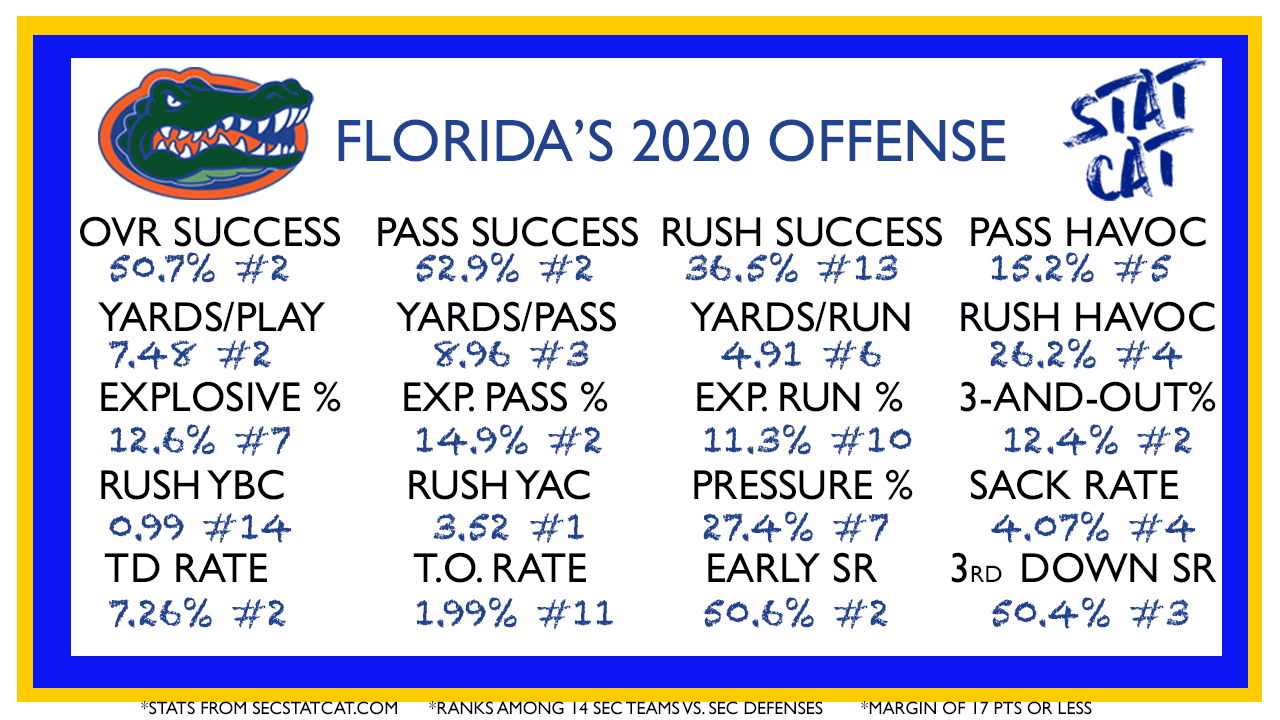
By land and air, Emory Jones will be the focal point for the Gators’ offense. As dynamic as he’s been as a rusher, managing his workload and preventing unnecessary hits will be a bit of a challenge to ensure he isn’t too banged up to pass. Though there are no sure things in the game of football, most are banking on Mullen maximizing Jones’ skillset. With the presumption he’ll boost this run game’s bottom line, this unit needs to focus a considerable amount of effort into logging a comparable Passing Success Rate. No one is demanding the Gators finish runner-up within the SEC in that respect; but I think striving for a clip over 50% is achievable and would create a significant advantage for this offense. Every conference team that has logged a Success Rate in both facets over that threshold the last few years has won double-digit games. If Florida accomplishes that, there’s a good chance they’re back in Atlanta. Balance with his tools could potentially fold any defense. But, Jones has to grow as a downfield passer and prove he has stamina to shoulder to load. If his “floor” is akin to former Mullen QB Nick Fitzgerald — who was a fine ball carrier but never came together as competent passer — the Gators simply won’t be as good; and in all likelihood, out of contention.
With the gears shifting back towards the run game, Florida naturally needs to do a better job paving paths and thriving in the trenches. The easiest way to enhance a rush attack is to consistently provide ball carriers will clear avenues without obstacles. And since Mullen returned to the Swamp, the Gators have finished below the conference average in rush yards before contact each year. Salt in the wound, they’ve placed no better than 11th in SEC play in that respect. While Jones is likely to experience a healthy YBC clip thanks to scheme, his speed, and an inherent numbers advantages, the OL has to help out their backs; especially to start a set of downs. There, Florida’s three-headed backfield averaged a paltry 1.73 yards before contact in meaningful minutes. Jones appears to be quite the difference-maker but he can’t beat opponents by himself. This line has to enable other people to contribute to the attack. And as a tack-on, this offense certainly could work on curbing turnovers. With a figure just under 2%, the Gators have sat inside the SEC’s bottom4 the last two years. Now obviously when your TD rate is 3.5x better in comparison, that sting cools considerably. Still with the roster changeup, this new group has yet to show it has the firepower to consistently negate giveaways. Plus, it’s never a great idea to grant your opponents extra drives.
Key Defensive Metrics in SEC Play
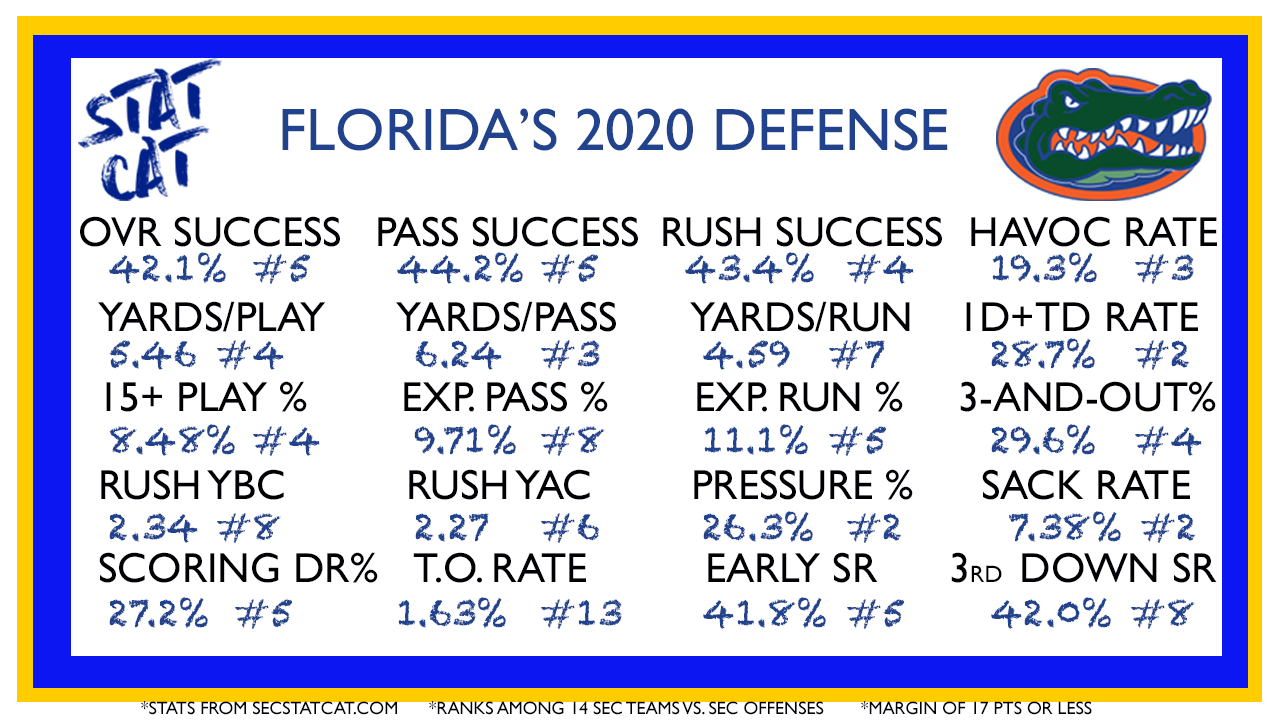
As an offensive guy, I generally gloss over defensive previews. Not that I don’t think individual defensive players aren’t valuable or dislike a blindside sack or athletic INT every once in awhile, but I typically treat that side of the ball as a collective unit. As only one guy, I can only track so much, yanno? You won’t get many fun defensive nuggets from me. That said, Todd Grantham’s style of defense is perfect for collect football. Much like a hungover junior stumbling into an exam cold, things might get a bit dizzy — at times, vomiting seems like an absolute certainty — and wild, crazy guesses will be made. More often than not, they’ll miss spectacularly. But a few haymakers and bingos inevitably make things interesting. At the end, the whole experience often seems like a distant blur; failure or triumph. For casual spectators looking on, it’s quite the treat; much less for those who have attached stakes in the outcome. Unfortunately for Florida fans, this defense was typically disappointing in 2020. The Gators finished among the conference’s top5 in many a metric, but they were overly closer to the SEC mean than elite territory. 3rd and Grantham was particularly average AF. But, his calculated approach bent on applying prudent pressure highlighted why his philosophy is worthwhile. In addition to the Gators’ overall Havoc Rate sporting the SEC’s bronze medal, Florida finished runner-up in league play with a 26.3% Pressure Rate and 7.38% Sack Rate.
No doubt, more consistency will be needed from this unit in 2021. But, Grantham will go down swinging, Maintaining high levels of havoc is almost a guarantee. Leaning into methods to manufacture disruption is a double-edged sword: it can birth blistering hits and takeaways or lead a guy well out of position. When the former don’t occur with great regularity, this approach is often picked apart. Year-over-year, Florida’s defense saw its Takeaway Rate shrink a percentage point going a top3 mark in SEC play to the 2nd-worst. With the Gators suboptimal ball control offensively last year, it’s easy to see how this team wound up with several losses albeit its mighty pass game. As long as Grantham is commanding the Swamp Dwellers defensive efforts, he needs to keep doing his thing. Since the majority of the Gators’ stats were relatively decent — including the almighty Explosive Play Rate — this braintrust needs to stay the course. Continue to focus on conjuring havoc as much as possible and lean into the odds that a number of snaps results in a turnover opportunity.
Glancing at Florida's Schedule
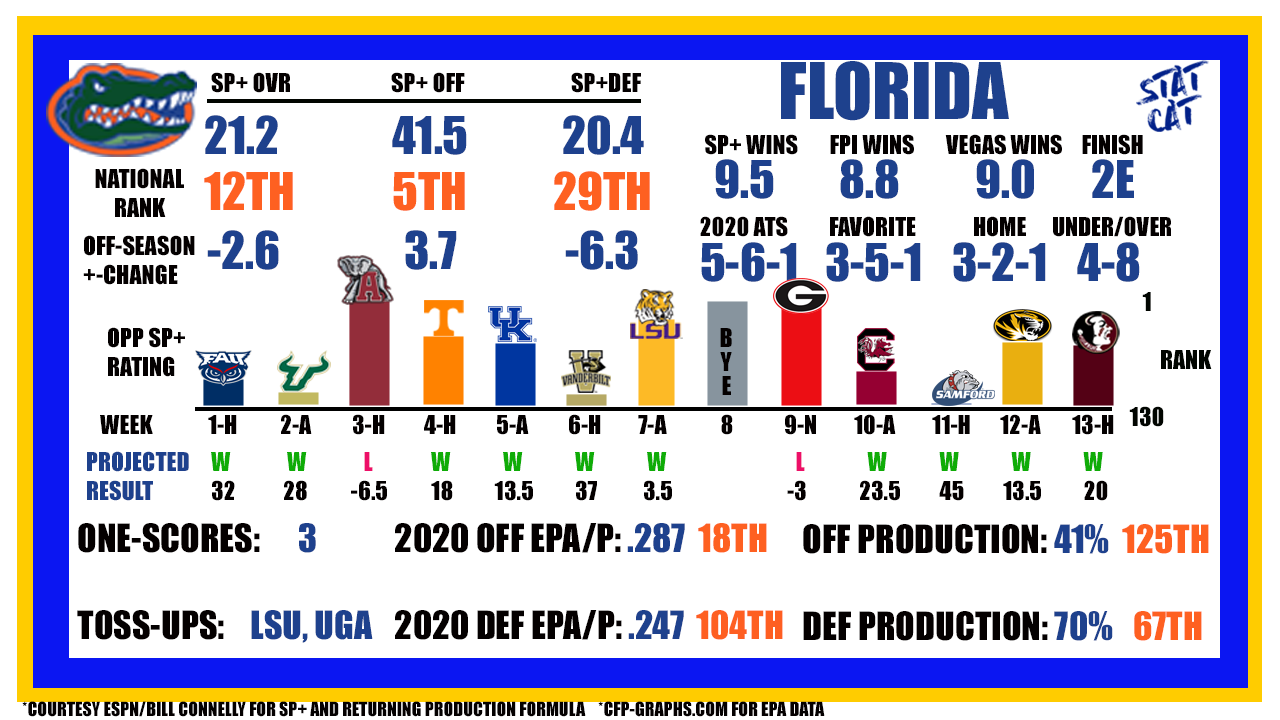
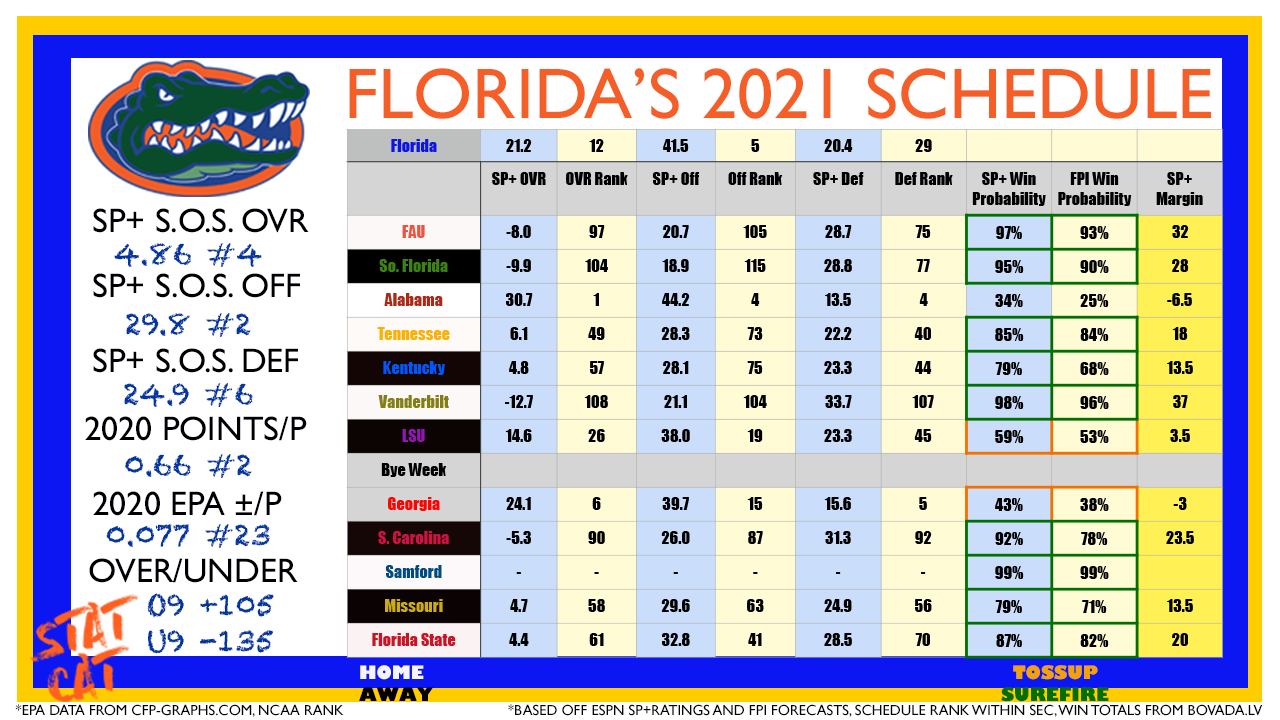
In the eyes of ESPN’s SP+, Florida is the SEC’s 3rd-best team and pegged to be the runner-up in the division. Like most years, the East is overly a two-team race between the Gators and Bulldogs. Thanks to a less challenging non-conference slate, Florida enters 2021 with the SEC’s 4th-easiest schedule while UGA hovers around the SEC mean. Per the SP+, the Gators play a team akin to 56th-ranked Virginia every week, which isn’t the most formidable group. But, the slate significantly favors its defense. Grantham’s bunch will face the conference’s 2nd-softest set of offenses. Even excluding FCS foe Samford, six of their opponents project to have an offense outside the Top70. So with continuity and that in the Gators’ corner, don’t be overly surprised to see an uptick in efficiency; especially considering their first two opponents are rated in the triple digits on that side of the ball. The SP+ forecasts Florida to win by double-digits in all but three games; I’m sure you can guess which three. Since Dan Mullen has hauled the Gators back to relevance, it’s only prudent to measure this team against the other big boys of the conference. The schedule favors Florida in terms of difficulty, but also well-distributes the Gators’ workload. Before each circled game on the calendar, Florida will either have a soft opponent or an off-week. Knock on wood, this team should be fresh and ready to rock in each of those contests. And against since each is forecasted to be settled by less than a score, any edge could decide those matchups.
Vegas set Florida’s under/over win total at 9, which is the exact number of games the Gators are favored to win by at least two tuddies. Along with naturally affecting the their standing within the SEC, Florida’s contests against the conference’s elite will hinge whether or not this team bests expectations. The bar is pretty low all else considered. Assuming they handle the rest of their opponents, the Gators need to only beat one of Alabama, LSU, or Georgia to hit their over. But, that’s easier said than done considering those adversaries’ pedigrees. The SP+ is more bullish on Florida’s chances to beat one of those three; particularly thanks to its favoritism towards the Gators prospects in Death Valley. Entering the season, they’re currently expected prevail by about a field goal. ESPN’s Football Power Index, however, is confident that total can be topped. Thanks to giving UK and LSU a higher probability to upset Florida than the SP+, their cumulative view is more pessimistic — even if they beat the Cats and Tigers in over two-thirds and half of their simulations, respectively. Though things might get interesting during Bryce Young’s first SEC road start, Alabama is projected to win by about a touchdown. Either way, that game will be a great litmus test for the Gators’ 2021 upside. In the World’s Largest Outdoor Cocktail Party, the Gators will enter a field goal underdog with neither metric liking their chances. Squaring up against the nation’s top defense is bound to have some drawbacks. But by that point in the season, Florida could be coasting and lighting up scoreboards. If you think Mullen can guide his guys to at least one notable win without slipping up to the likes of Kentucky, Tennessee, Missouri or Florida State, the Gators are an easy buy ahead of 2021.