2021 Vision: Previewing Georgia
2021 Vision: Previewing Georgia
With talking season winding down, preview season is among us! I'm sure this isn't the first preseason article you've viewed. You should know the drill by now with these bad boys. But if this is your first experience with StatCat, be ready to learn a thing or two about the Bulldogs' passer, receiver room, ball carriers, OL, its most important stats to maintain and/or improve on both sides of the ball, and how Georgia's schedule breaks down with help of ESPN's SP+ Rating!
Georgia Passers

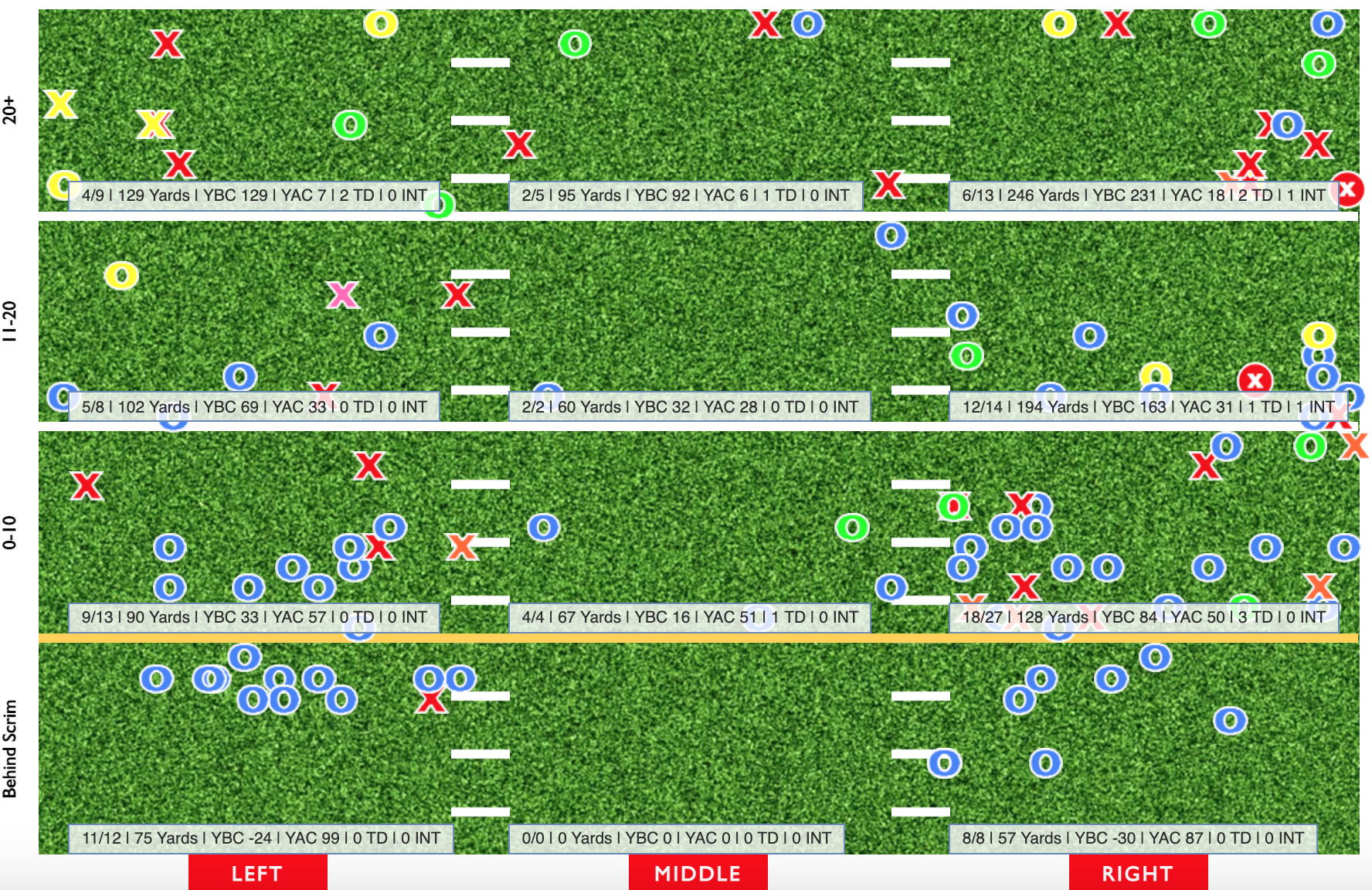
The hype around JT Daniels is understandable. He’s a former five-star prospect, noticeably helped decrease Georgia’s uncatchable attempts through the air, and closed the 2020 season as one of the most potent passers in college football. I mean when one rocks a league’s highest average depth of target, Explosive Pass Rate, and Yards/Attempt, most folks don’t need further supporting evidence to jump onto that passer's bandwagon. It certainly doesn’t hurt that his Expected Points Added/attempt and First Down+TD Rate from last year holds the SEC’s silver medal ahead of this fall. Though it wasn’t a well-kept secret Todd Monken wanted to test secondaries deep upon landing the offensive coordinator gig in Athens, how Daniels fit within that scheme was a grand mystery. At USC, the West Coaster was rather cliche. Forgive the overused buzz words, but he overly dinked and dunked, took what the defense gave him, and had to be goaded to try folks deep. Scouting him, I didn’t think much of his downfield abilities. He projected a below-average Depth Adjusted Accuracy figure and his 9.47% Interceptable Pass Rate against his hardest opponents was well into the danger zone. Moreover, Pro Football Focus slapped him with a repugnant -0.41 wins above average, which was good for 129th in the country in 2018. Not to mention he was rehabbing a torn ACL. But as aforementioned, the new environment completely reworked his modus operandi, and worthwhile results boosted his bottomline.
Daniels process metrics, however, hint he may have been blessed by fortune and/or his supporting cast more so than turning the corner as a passer. Already worried about how his downfield precision and aversion putting the ball into harm’s way, the vertically-oriented style of play begat a bottom3 Depth Adjusted Accuracy% and below-average Interceptable Pass Rate within the SEC last year. Sure, the Bulldogs wasted less chances through the air and Daniels gave his guys more frequent opportunities than D’Wan Mathis and Stetson Bennett. But beyond 20 yards downfield, only Vanderbilt freshman Ken Seals donned a worse such Accuracy% than JTD’s 22.2% clip. If you are planning on honing in on a tactic a lot, I’d recommend not sucking at it. Behind the volume and underwhelming ball placement, this flaw easily affected Daniels’ overall profile negatively.
When evaluating his passing floor — ie attempts from clean+dropback conditions where QBs have no excuses but to go out and play pitch and catch — his extremes intensified and further insinuate JTD might be a bit of an imposter. Only South Carolina freshman Luke Doty saw his such Accuracy% drop by a higher figure while no SECer’s Depth Adjusted clip deteriorated as much as his 4.4 percentage point decrease. In this context, no returning conference passer put up a number as low of his 32.9% clip. But without screens and RPOs bringing down his potency, a remarkable 50% of his attempts resulted in either a first down or a score, nearly a quarter gained at least 20 yards, and his clean+dropback Y/A birthed a cool 12.5 mark, all of which stand to be the SEC’s best ahead of 2021. But thanks to his flimsy process, I am left uneasy especially considering 10.5% of these tries had turnover-worthy potential. While Daniels should put up sturdy traditional stats to fuel his Heisman buzz, I won’t sign-off on his credentials until his overall downfield ball placement climbs out from the conference’s gutter.
JT Daniels' 2020 Pass Chart
Georgia Rushers
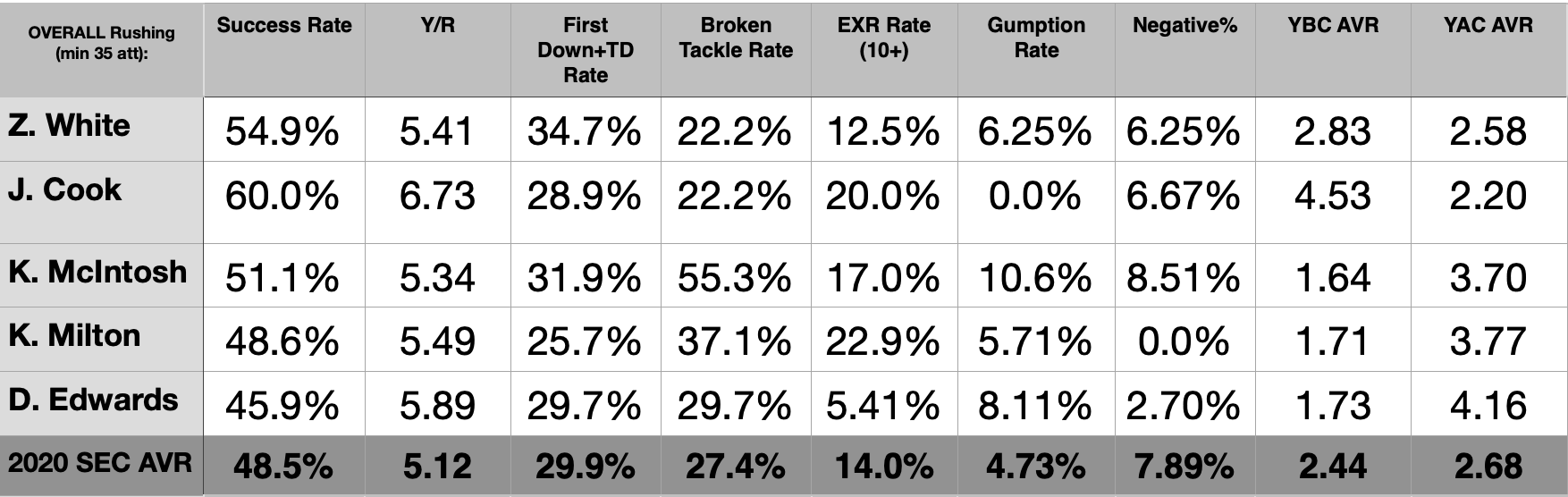
Georgia has the deepest running back rotation in the SEC. All five returners logged at least 35 attempts and a 5.4 Y/C and compliment each other well. Behind the SEC’s 2nd-highest yards before contact average against conference foes in meaningful minutes, only Alabama’s ball carriers finished with a higher collective Success Rate than UGA’s 52.8% while their Explosive Run Rate finished 4th. Having a handful of capable rushers with varying skill sets certainly creates stress for opponents and allows the Dawgs to keep their legs fresh with a healthy snap share.
Let’s begin with Georgia’s RB1, Zamir White. As the workhorse, he posted the team’s best volume numbers and a very respectable 54.9% Success Rate and 34.9% First Down+TD Rate; both figures finished top4 within the conference last year. But his stable metrics and ability to shine in certain situations hint White might be the Bulldogs most muted option. Of the five rushers, White ranks fourth or worse in Yards/Carry, YAC average, Broken Tackle Rate, and Explosive Run Rate. While his floor appears to be decent, his ceiling doesn’t appear to be too lofty. Particularly considering his stable metrics like YAC average and Broken Tackle Rate ranked no better than 17th within the SEC last year, White isn’t elite. But, that blah play can be attributed to his so-so showings to start a set of downs. Along with less than half of his runs resulting in success, his such First Down+TD Rate, Broken Tackle Rate, and Explosive Run Rate finished in the 20's. Moreover, a sixth of his runs experienced contact behind the line of scrimmage with a tenth resulting in a loss.
Inversely, White earned his mettle in short yardage situations and later downs. With three yards or less to gain, Zeus helped produce a shockingly good 83.9% Success Rate, 7.39 Y/C, and 22.6% Explosive Run Rate that all lead the SEC ahead of 2021. Obviously awesome, those metrics benefited from a robust 4.58 yards before contact average. (It’s pretty damn easy to get the job done in those situations when you average an extra yard and a half past the sticks before defensive contact!). But to White’s credit, he didn’t log a single negative try despite being hit in the backfield on a tenth of these tries. Meanwhile, two-thirds of his 3rd down attempts ended in success while leading the conference with a 6.0 Y/C. Running determined, White's Broken Tackle Rates in both spots were at least 33%.
Though White functions in a straightforward manner, James Cook has typically operated as a gadget back posting varying degrees of success. With his natural burst, hitting the edge and capitalizing on flat-footed defenders has been a great source of splash runs. In fact, a fifth of his carries the last two seasons have gained at least ten yards. This spry style of play is maximized by attacking space and not necessarily out to bruise bodies in the box. Ipso facto, Cook’s YAC average and Broken Tackle Rate were the worst on the team. As the flash to White’s bash, his potency shined through via his 6.8 Y/C and the 3rd-best Expected Points Added/attempt amongst SEC returners. No doubt leading the Dawgs in Yards/Target played a part in that calculation viewing him favorably. And though White was the short yardage specialist, Cook’s sizzled when behind the chains. In these spots, no SECer bested his Success Rate, First Down+TD Rate, or Explosive Run Rate. Plus, his Broken Tackle Rate was top10 worthy. Cook also posted a good output on first downs. Those runs especially inflated his bottomline and allowed his 60.0% Success Rate to lead the team. But with a less-domineering running style, his returns are highly volatile and can turn on a dime. Just a short year a go, he was UGA's least successful rusher down-to-down.
Georgia’s three remaining ball carriers in Kenny McIntosh, Daijun Edwards, and Kendall Milton all exhibit fantastic stable metrics worthy of continued touches. All three were hindered with a rush yards before contact average under 1.73 yards but finished among the SEC’s top6 in YAC average among dudes with at least 40 carries last year. Only TAMU’s Devon Achane and UK’s Chris Rodriguez averaged a higher figure than Edwards 4.16 mark. Hammering home the trio’s tenacious running style, each finished with an above-average Broken Tackle Rate within the conference; McIntosh’s 55.3% clip and Milton’s 37.1% clip rank 1st and 6th, respectively ahead of this fall.
McIntosh was the most tried of the tertiary options and saw a high concentration of his attempts occur on first downs where he typically was his best self. Along with logging a top3 Success Rate, he commands the SEC’s 2nd-best First Down+TD Rate, Explosive Run Rate, and YAC average. Moreover, his laudable overall Broken Tackle Rate was heavily influenced by his sterling 64.3% clip to start a set of downs. Milton was also commonly utilized in these spots. Only three SECers composed a higher first down makeup than his 63% figure. Like McIntosh, he overly impressed. Though his First Down+TD Rate was forgettable, he sits inside the SEC’s top5 ahead of this fall in such Broken Tackle, Explosive Run Rate and YAC average. The plurality of Edwards reps also took place on firsts, but his premier output occurred on second downs. Averaging 8.5 Y/C — with 5.5 coming after contact — he compiled five of his 11 broken tackles, a 50% First Down+TD Rate and 71.4% Success Rate.
With White plugging and chugging while being stalwart in short yardage, Cook changing games with his big play ability, McIntosh and Milton often imposing their wills to keep the Bulldogs ahead of the chains, and Edwards apt at pushing the pile, there’s no denying the well-rounded skill and versatility of Georgia’s running back corp. With all the moving parts, finding the right recipe on balancing touches could prove to be a bit of a challenge for Monken. Either way if things fail to materialize, it won’t be because of this group’s lack of collective talent.
Georgia Catchers
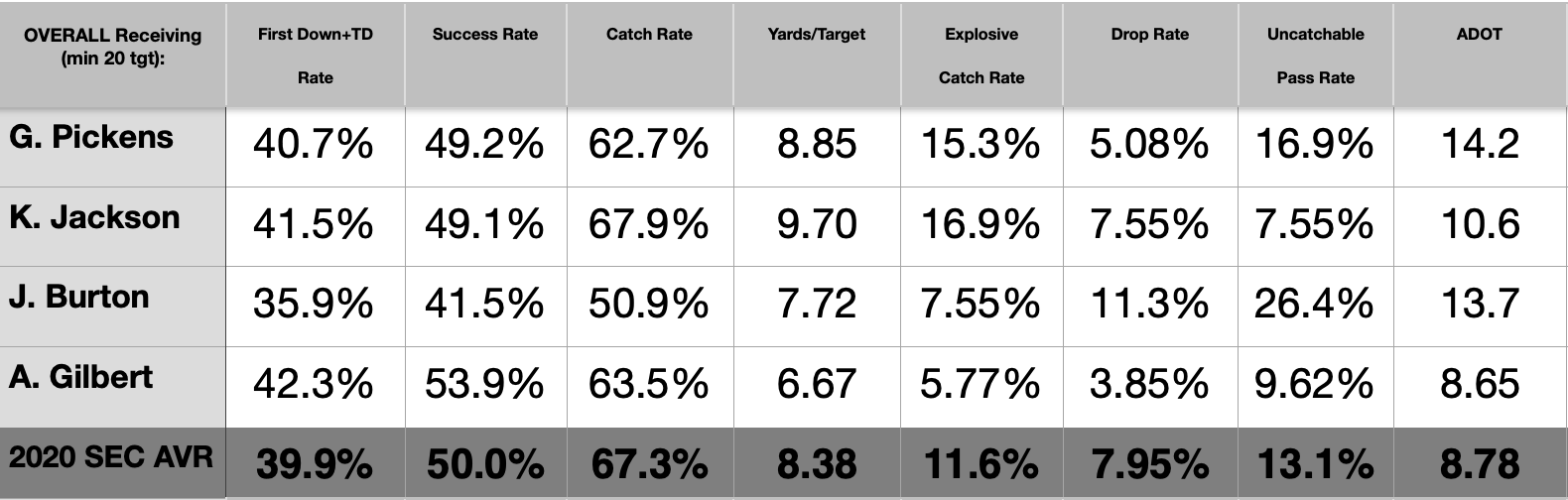
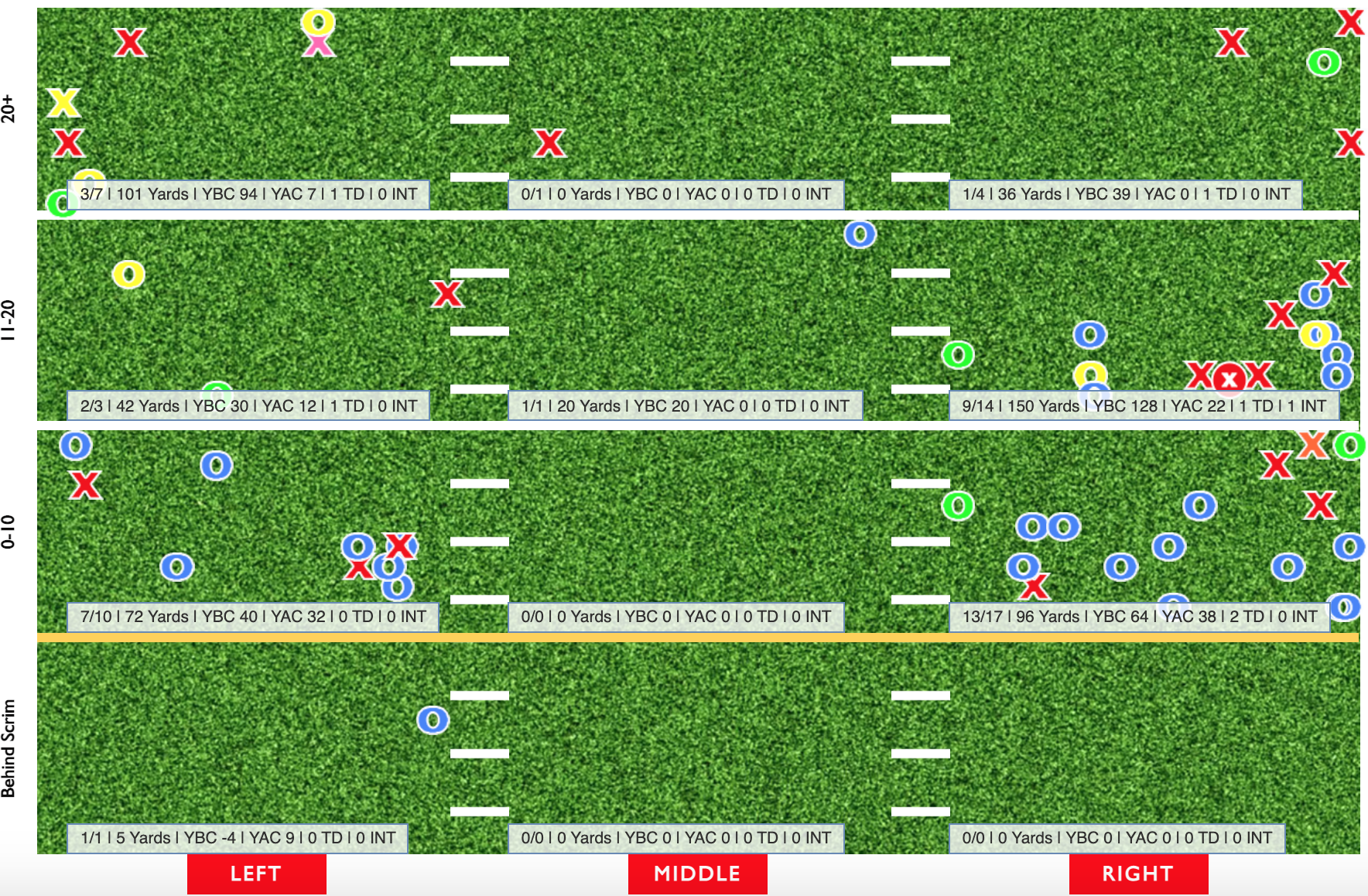
Though the odds he hits the field this year are slim, I feel obligated to discuss George Pickens to kick off this section. As a big body built to win battles outside the numbers and deep downfield, he has been this offense’s most productive receiver the last two years. Though he was hindered by uncatchable attempts early on, the Bulldog closed the season as well as anyone once JTD was slinging passes. By year’s end, Pickens finished with a team-high 49.2% Success Rate, the lowest Drop Rate amongst the receivers, and an SEC-best 10.2% Creation Rate. His eleven career such “creations” are among the most in the SEC. Moreover, Pickens’ value was further flaunted on his 3rd down production. Though usually volatile situations, he’s been among the conference’s elite in that context the last two seasons. Amongst returners, his 64.3% Success Rate and 100% Depth Adjusted Catch Rate from 2020 hold gold medals while his 11.1 Yards/Target and 30% TD Rate are both top3-worthy. Don’t say his loss won’t be impactful.
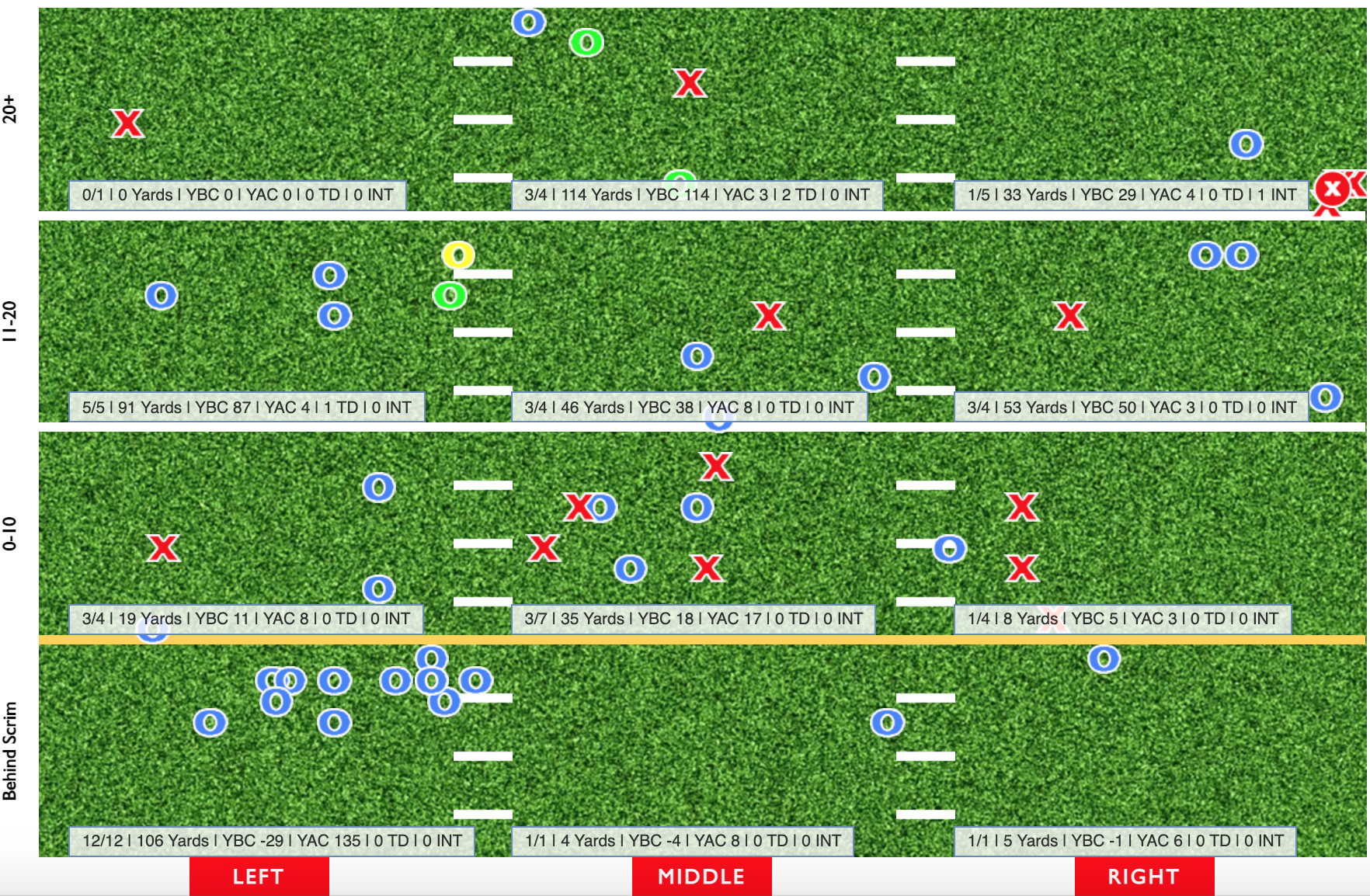
George Pickens 2020 Target Chart Kearis Jackson 2020 Target Chart
Though still rehabbing, Kearis Jackson should remain this team's main inside receiver. No doubt, some of his stats were padded by over a quarter of his targets coming behind the line of scrimmage, but he stands to be one of this conference’s premier midrange targets for this fall. Benefitting from zero uncatchable intermediate attempts, he spots the 2nd-best Catch Rate, 3rd-best Creation Rate, and 4th-best Yards/Target. Plus, he didn’t drop a single such target. And as good as Pickens’ was on the money down, Jackson was the best the SEC has to offer. Two-thirds of his 3rd down chances were successful while his Explosive Catch Rate, Depth Adjusted Catch Rate, and Yards/Target were runner-up. However, down-to-down, Jackson was relatively average within this conference. With an increased role ahead, finding more consistency is a dire must. I have no doubt his volume numbers will look fine, but there’s no guarantee his advanced metrics will improve significantly.
If last year is any indication, Jermaine Burton will operate as UGA’s zealous deep threat. Of course, the Mississippi State game was his demo reel for such a role. Outside of that glowing performance, most of his 2020 season was rather forgettable. But that style of play is a double-edged sword. While it brings about big plays, potency, and highlights, it also entails a high degree of difficulty, inefficiency, and wasted downs. Over a quarter of his attempts were deemed uncatchable last year. Only South Carolina’s Jalen Brooks can lament from a higher clip than his 26.4% figure. That paired with a double-digit drop rate was a bad recipe for success. Overall, his 7.72 Yards/Target, 41.5% Success Rate, and 7.55% Explosive Catch Rate fail to get the blood pumping. But if he can field a higher quality of targets, his bottom line is bound to improve. Georgia will still fixate on taking shots, so it’s just a matter of how effective he and his QB can be in that respect. Not that he won’t work in other areas of the field, but explosiveness will be needed with Pickens’ on the mend.
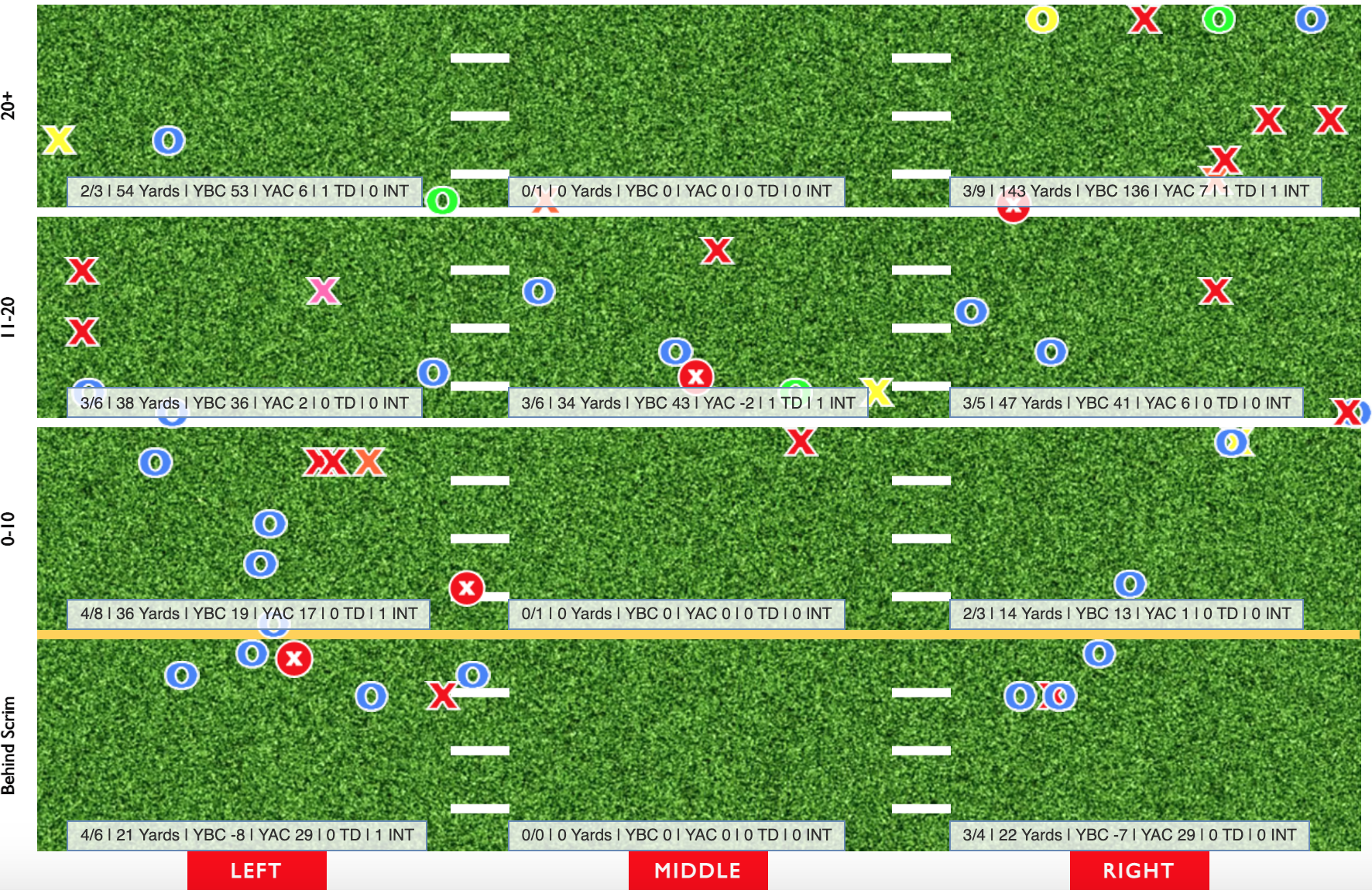
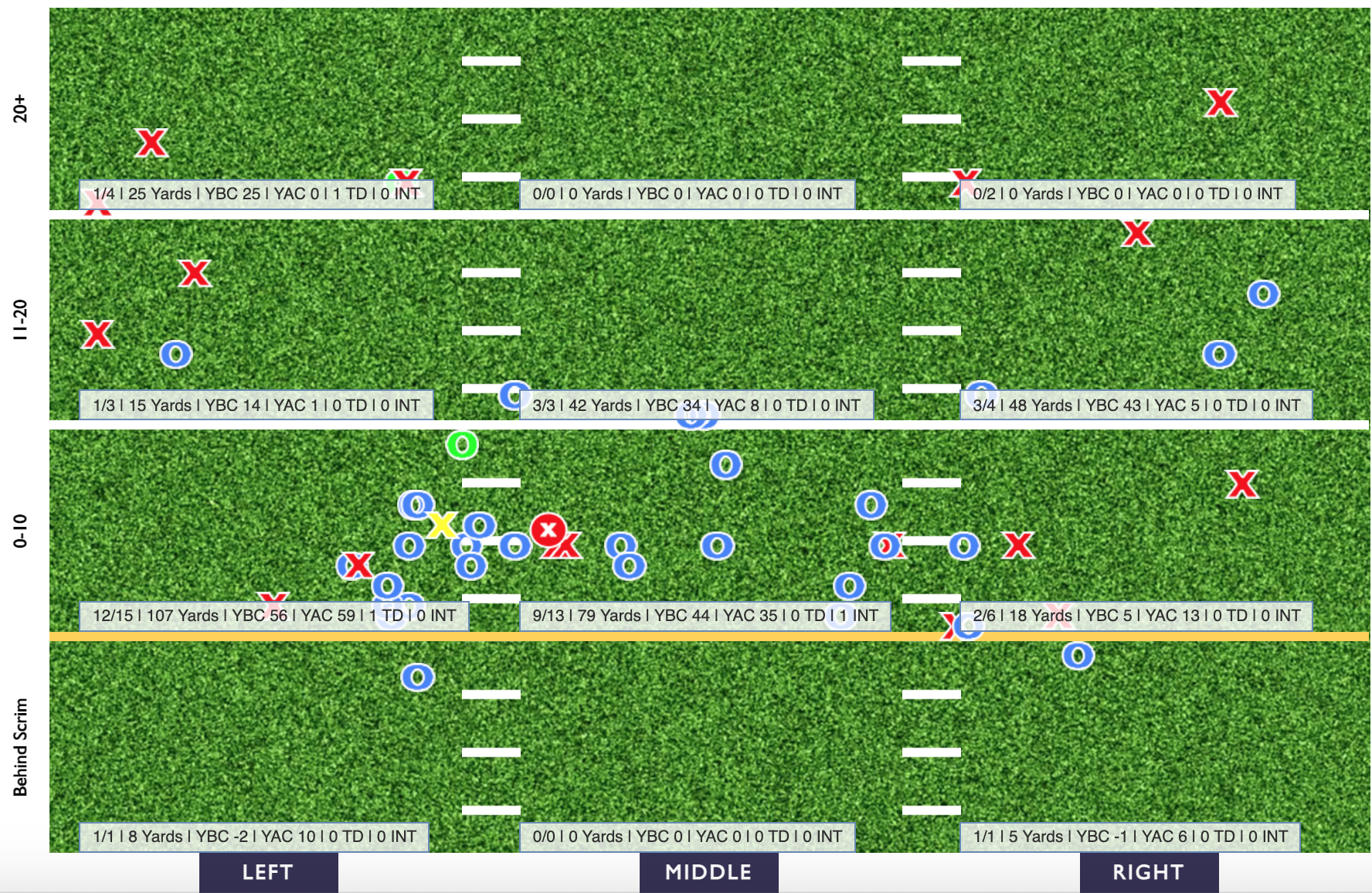
Jermaine Burton's 2020 Target Chart Arik Gilbert's 2020 Target Chart
Don’t worry; I didn’t forget about Arik Gilbert. Pickens, Jackson, and Burton each received about 55 targets last year. StatCat thinks it's a safe bet he cracks that threshold in 2021. Though he overly operated short, as a safety valve, as an additional pass blocker at LSU, he should function as a down-the-seam threat for the Dawgs. About 70% of his targets occurred less than ten yards downfield, which can be considered boring by some. Seeing how Kyle Pitts blossomed moving around the formation and attacking defenses at all levels of the field surely played a part in his aspirations to change things up. Monken’s vertical scheme and the rest of UGA’s supporting cast of course won out in the end. Listed as a receiver, his mass could conceivably function from the X-spot in place of Pickens. If his billing as a game-changer is true, that’s the place for him to prove it; win on an island, snag back shoulders, and anchor most pass patterns. But practically, he’s likely line up at different spots. Size and fluidity are rare combos, so lengths Monken and Co. go to maximize this matchup creator should take many forms. I mean, imagine him and Jackson both in the slot in 2x2; or him and Darnell Washington in a wing set; or him from a nub. Monken has quite the toy to play with. The change in scenery should do wonders for his bottomline. Far from dismissible, Gilbert finished with the 5th-best Success and Catch Rate in addition to the 4th-best First Down+TD Rate amongst returning conference tight ends.
While it remains to be seen if Gilbert will be asked his hand in the dirt, Darnell Washington and John Fitzpatrick should be the primary tight ends. Washington is full of potential — he’s 6’7, a former five-star, and nimble enough to run routes downfield — but in his limited targets, his down-to-down stats stunk. Thanks to seeing five uncatchable attempts across his 17 targets, he was limited to a 29.4% Success Rate. But looking on the bright side, all of his successful catches resulted in either a first down or a score, and his 9.76 Yards/Target is the 3rd-best among SEC tight ends returning for this fall. Assuming he naturally progresses and gets more comfortable testing secondaries in year 2, Georgia could have an abundance of riches at pass catcher. Though a much more muted option, Fitz can also be counted on for an occasional outlet. That said, he’ll typically function as a de facto sixth lineman for most of this snaps.
Marcus Rosemy-Jacksaint, Arian Smith, (and if he can go) Dom Blaylock are candidates to round out the rotation. With such small sample sizes, forecasting their impacts would be a complete waste of time. In lieu of generic filler and coach talk, let’s move on.
Glancing at Georgia’s Offensive Line
Monken and Matt Luke are seemingly molding UGA’s front into a sleeker product. From 2019 to the group that started the Peach Bowl, the average starter’s weight is down ten pounds. The days of this offense leaning on the old school “we’re bigger and stronger than you so we don’t have to do anything too cute schematically” are over. Excluding pin-pull techniques you frequently see on Toss Sweeps, UGA pulled at least one lineman on a mere 25 plays from 2018-19 — or 1.4% of its offensive snaps. Last year, however, the Dawgs logged 32 such designs (roughly a 5% Play Share). Though sound, the emphasis on cultivating a more versatile bunch of blockers has stunted the trajectory of this position group. Thanks to a rough spring, UGA’s offensive line is undergoing some scrutiny. Despite returning three starters, the losses of two key interior offensive lineman in Trey Hill and Ben Cleveland have thrusted Georgia’s pawns into slight disarray. The old idiom of “only being as strong as one's weakest link” often rings true with these big boys. No one is really doubting the individual talent stacked across the Dawgs’ front, but there’s been a constant chorus of dudes “not being on the same page”, “lacking chemistry”, or needing to “take a leap”. Based on these stumbles, crowning UGA among the nation’s top offense seems trigger-happy at best and completely irresponsible at worst.
If Georgia’s heavy early down run script faces constant premature contact or its vertical passing game suffers from duress, there’s no way this unit meets its buzz-worthy hype or contends for a national title. The bar might be high; but again, the majority of the guys who helped produce those figures are back in the fold. Though far from a given to replicate, the Dawgs grew their average rush yards before contact figure by 0.7, maintained a top3 Run Havoc Rate around 23%, and turned in a top5 Pressure Rate against SEC foes in meaningful minutes. Plus, the blocking stability saw UGA’s Rushing Success Rate increase nearly eight percentage points for the SEC’s silver medal. So while healthy pessimism lingers around UGA’s line, hope remains these guys can make an about-face and field a formidable front. Luke is bound to shuffle guys around until a serviceable rotation sticks. Xavier Truss and Jamaree Salyer could hold down the left side. There’s also a possibility the Dawgs run back their 2020 lineup with Salyer at tackle and Justin Shaffer at guard, but the former’s surgery recovery could prevent him from trotting out with the ones. If he or Truss ultimately don’t win the left bookend spot, perhaps true freshman, five-star, and top8 prospect Amarius Mims (6’7, 330) enters the chat. If he isn’t on the sinister side, Shaffer will replace Cleveland with Warren McClendon being the unit’s rock on the right. Tate Ratledge is also a candidate to monitor for that guard spot should Shaffer align on the opposite side of center. Speaking of center, Warren Ericson looks to have that spot on lock after decent showings to close out 2020.
Key Offensive Metrics in SEC Play
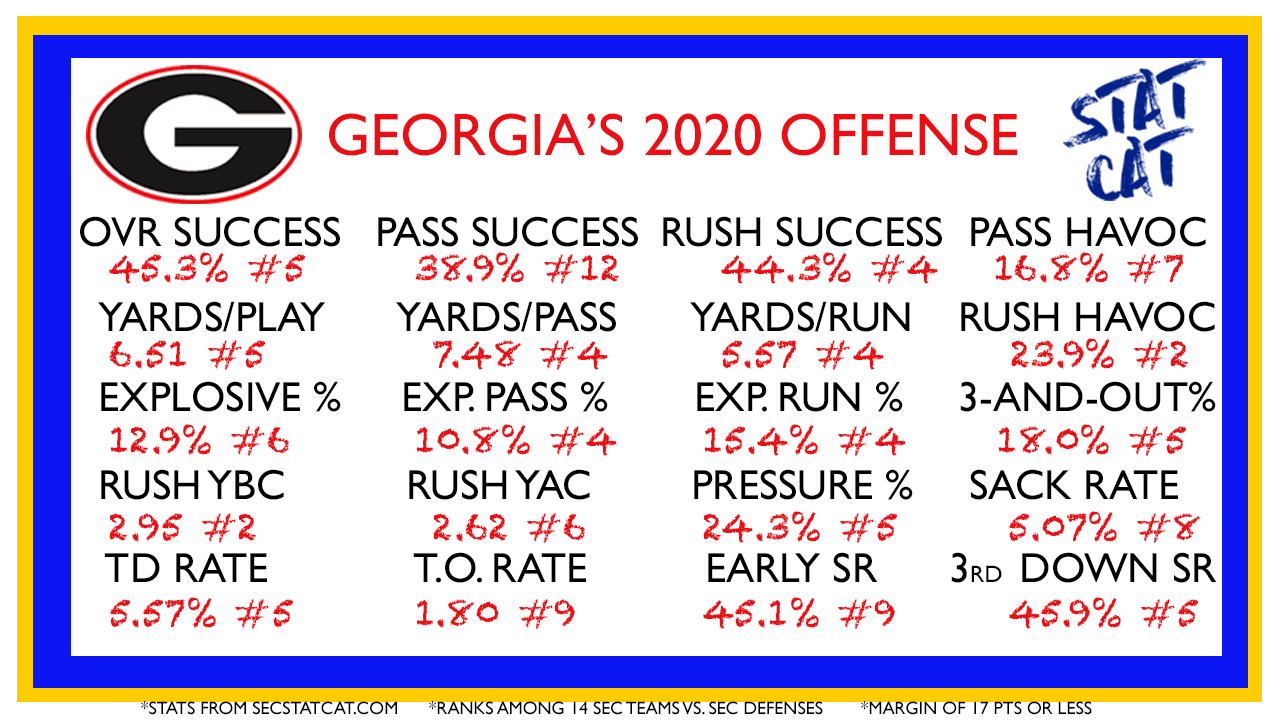
Assuming this bunch wants to continue leaning into its vertical passing game, Georgia will aggressively seek explosive plays through the air. All three of UGA’s passers last year logged three of the SEC’s four highest average depths of target, and JT Daniels’ 22.5% Deep Pass Rate was the conference’s highest mark by over five percentage points. During his stint as a starter, the team’s Explosive Pass Rate clocked in at 15.5% and only trailed the national champions. Glancing at their profile graphic, you can see that is substantially better than the offense’s cumulative year-long figure. Likewise, the Dawgs’ down-to-down Passing Success Rate also held an edge by a similar margin during this span. Most assume the ground game will remain this offense’s bedrock, but there’s a reason JTD is one of the most popular Heisman bets entering the season. Small sample size or no, replicating that competent, threatening passing product — beyond the lame “can’t go broke taking a profit” philosophy that previously plagued this offense — should be a heavy emphasis. Besides the sexy bottomline and rousing highlights the deep passing game often bestows, it’s the simplest avenue to snatching aforementioned splash gains through the air. Though it can be somewhat counterintuitive to pass up consistency for potency, no element has had a higher correction to victory in SEC play the last few years than winning the big play battle; not turnovers, winning time of possession, or scoring more in the middle8. Since 2018, 63% of conference teams that log more such plays than their opponents came out on top. No doubt, Monkey is well-aware of that happenstance.
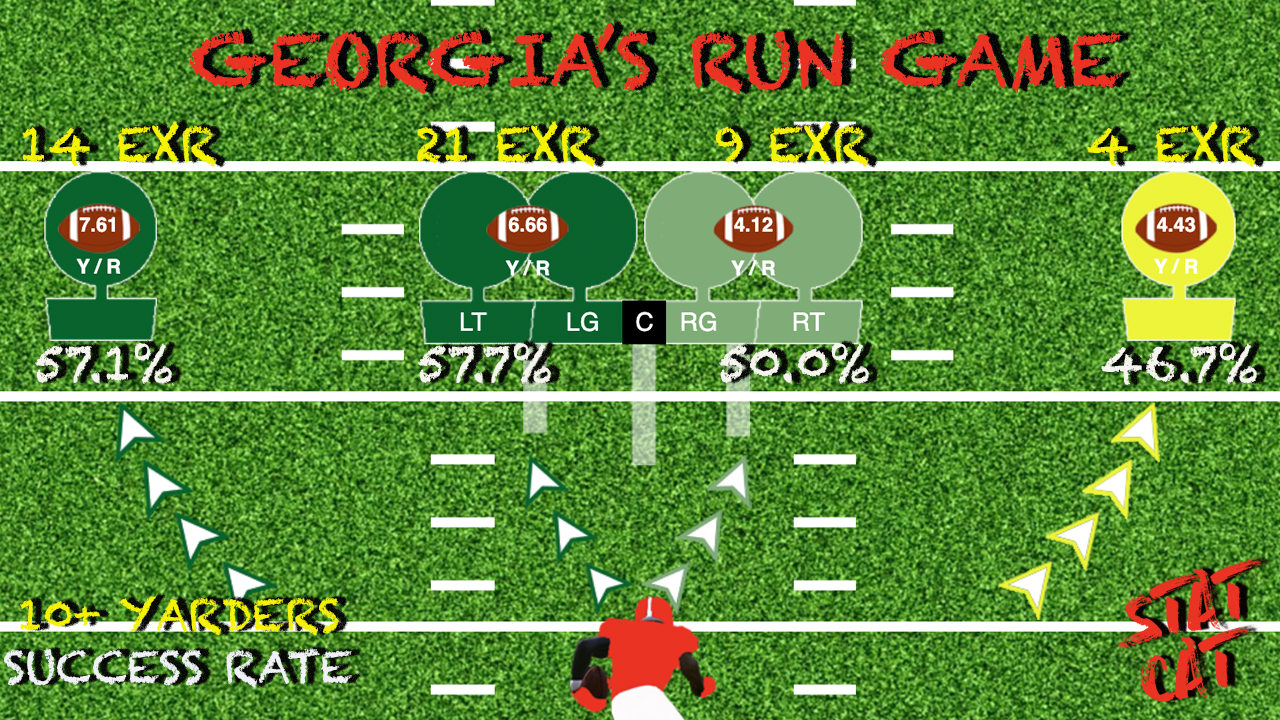
While boosting its clip through the air should be an area of opportunity for this group, the run game still needs to do its part generating explosive gains. The best methodology to ensure those chances occur more frequently is to maintain is sturdy run blocking upfront. While rocking the conference’s silver medal in rush yards before contact, Georgia’s line provided ample cushion for the Dawgs’ talented backs to do damage. Their Run Havoc Rate also finished runner-up in league play, and UGA dons a top4 Explosive Run Rate and Yards/Carry despite placing 6th in YAC average. Though an overly strong output all year long, this ground game elevated its execution once JTD was slinging the pill. With a greater passing threat, defenses were less keen on curbing Georgia’s ball carriers, which resulted in the Bulldogs leading the conference with a 3.17 YBC and 6.14 Yards/Carry down the stretch. Plus, over a fifth of UGA’s carries over its final four games went for at least ten yards. Obviously if these returns are replicated, Georgia will be in a fantastic spot in its quest to quench its championship thirst. Though losing some interior lineman will diminish their line’s cohesiveness ahead of 2021, the talented Dawgs should continue pushing folks around to create chunk runs; especially if opponents cannot dedicate adequate resources to the box for fear of a possible downfield shot.
Key Defensive Metrics in SEC Play
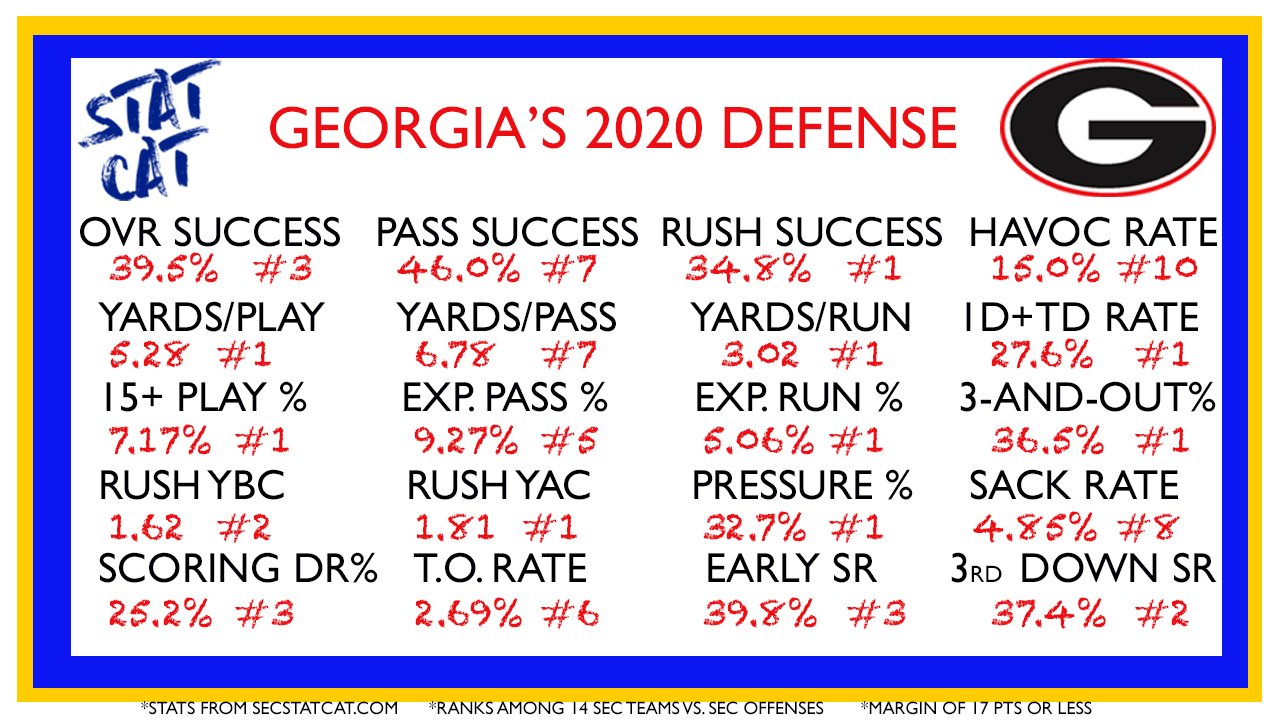
As an offensive guy, I generally gloss over defensive previews. Not that I don’t think individual defensive players aren’t valuable or dislike a blindside sack or athletic INT every once in awhile, but I typically treat that side of the ball as a collective unit. As only one guy, I can only track so much, yanno? You won’t get many fun defensive nuggets from me. That said, Georgia has been the nation’s top defense in the eyes of ESPN’s SP+ each of the last two seasons. Returning a handful of starters and nabbing two quality transfers at cornerback, the Dawgs are squarely back in the mix to protect their crown as the college football’s most dominant defense. Still with the recent renaissance from conference offenses, UGA wasn’t immune from stumbling a bit on the statsheet year-over-year. Their Overall Success Rate, First Down+TD Rate, Yards/Play, Havoc Rate, and Scoring Drive Rate all dipped in SEC play. Despite the slight downturns, this unit earned its stripes overly being elite against the run for the second-straight year. Limiting opponents to a miserly 1.62 yards before contact average, the Dawgs produced the conference’s lowest Yards/Carry, Explosive Run Rate, and Rushing Success Rate. Sound fits and terrific tackling limited foes to the best YAC average by an SEC defense since 2018. Often putting the adversaries behind the chains and swiftly getting them off the field, none of their contemporaries could champion such a robust 3-and-Out Rate in league play.
While clogging run lanes might continue being the Dawgs’ forte, their pass defense could stand to improve. The last two seasons in league play, the Dawgs have turned mediocre Passing Success Rates and an Explosive Pass Rates outside the SEC’s top4. Behind averaging about a yards and a half more per pass year-over-year, UGA’s clip of the former climbed about five percentage points. Considering the weight the pass game holds these days, Kirby and Co. simply need to be better. Plus, it’s not like this defense has been otherworldly delivering sacks and drive-killing plays. Sound techniques or no, UGA’s Sack Rate has comfortably finished in the back half of the SEC the last two years. Again, this group has a lot of talent and one of the best minds directing traffic on that side of the ball. The additions of Tyreke Smith and Derion Kendrick to the secondary should notably shore up their efforts. Though plenty are talking about this defense finishing with laudable metrics, this unit must boost its bottomline from back to front in order to be the driver of the discourse or main topic of conversation.
Glancing at Georgia’s Schedule
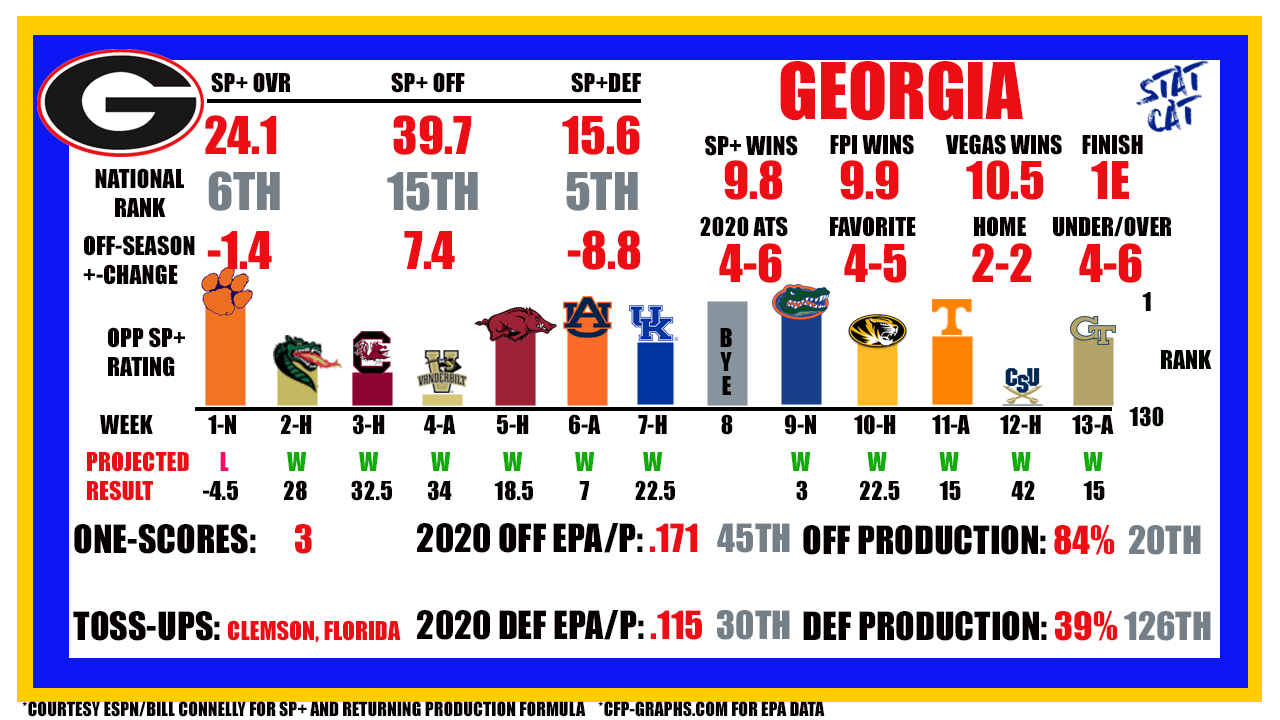
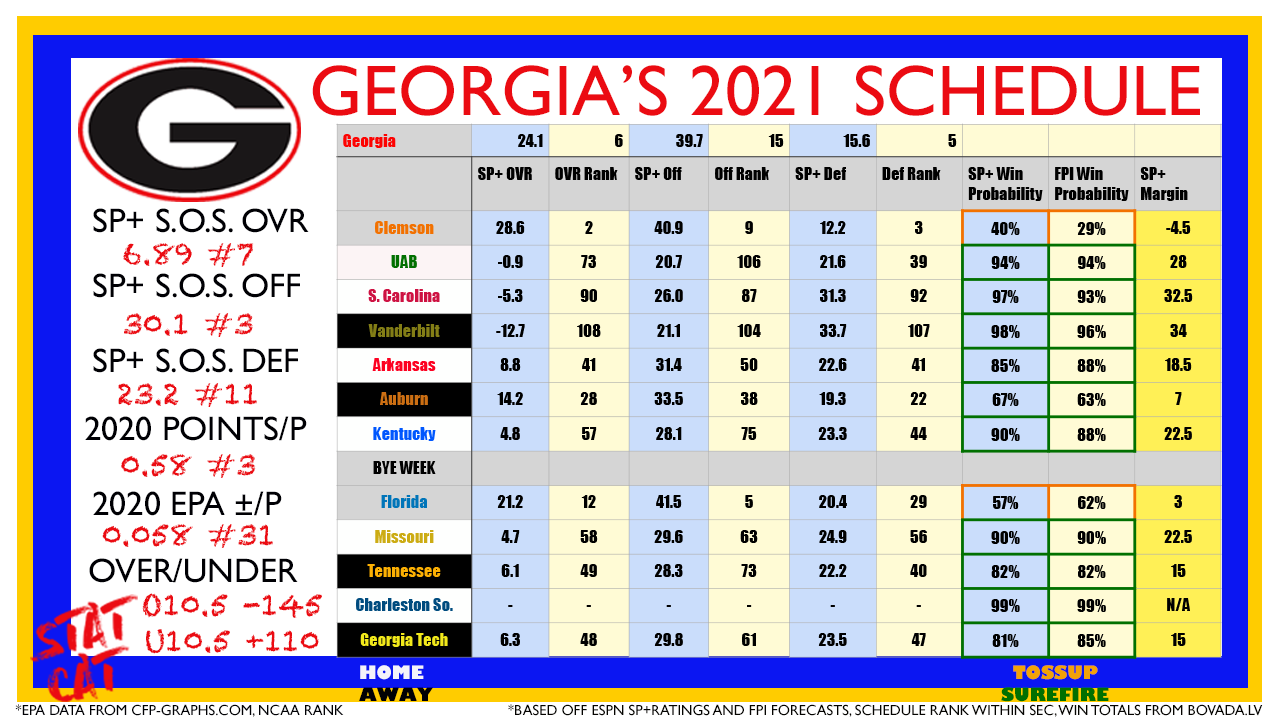
In the eyes of the SP+, Georgia has a relatively average slate compared to other SECers. That said, their schedule skews heavily into favoring their top5 defense. Only Florida and Kentucky are set to face a less challenging set of offenses. UGA only plays a pair of top25 units all season. On the other hand, the offense that improved seven points year-over-year in that metric’s eyes will be put to the test against the conference’s 4th-hardest defensive lineup. Still all else considered, Georgia faces as many top10 defenses as ones ranked in back third of the country. As you might suspect with the Bulldogs’ background, the SP+ likes their chances to be victorious in all of their conference games and represent the SEC East in Atlanta. Georgia is expected to win by over two touchdowns in nine of its contests. Since it is one of the nation’s elite programs the last half decade, UGA is often judged against the sport’s other big dogs. While a face-off with top-ranked Alabama might be looming, Georgia has to deal with No. 2 Clemson to start the year. Despite the Tigers being favored by less than a TD, both ESPN’s Football Power Index and the SP+ hate UGA’s upset odds; primary because UGA’s 15th ranked offense appears outmatched by Clemson’s top3 defense. Still, that doesn’t mean the Dawgs can be overly dismissed.
Again, they’ll be favored to come out on top in their two forecasted one-score conference games. Though Auburn should be dealt with rather easily if last year’s game was any indication, you can never overlook a conference road game in the heart of the schedule; especially one with a margin of a TD. That said, the SP+ and ESPN’s Football Power Index favors UGA in over two-thirds of that matchup’s simulations. Likewise, divisional nemesis Florida is only a field goal underdog in Jacksonville following the bye week and certainly will put up a nasty fight. In those trials, both metrics still clearly like UGA. But, the results were much closer to an even split. Despite liking the Bulldogs’ prospects in close games, the SP+ and FPI forecast this team to win ten games. With their over/under win total set at 10.5, the numbers hint the under should be hammered. Plus, the currently value is on that side of the line (+110, -145). The Dawgs could be a hard team to bet against thanks to a vertical passing game, sturdy ground game and tenacious defense. But, sometimes being a hater can pay.