2021 Vision: Previewing Kentucky
2021 Vision: Previewing Kentucky
With talking season winding down, preview season is among us! I'm sure this isn't the first preseason article you've viewed. You should know the drill by now with these bad boys. But if this is your first experience with StatCat, be ready to learn a thing or two about the Wildcats' QB options, receiver room, ball carriers, OL, its most important stats to maintain and/or improve on both sides of the ball, and how Kentucky's schedule breaks down with help of ESPN's SP+ Rating!
Kentucky's Passers
I’m not going to sugarcoat this: UK’s quarterback situation is one of the worst in the conference. As is, you certainly could make a case Big Blue’s QB room is as precarious as any other power5 offense. After all when your three options are a twiggy three-star, a glorified wildcat quarterback, and a dude who literally had to go to a biochemist to learn how the throw the ball in a less-crappy fashion, envy isn’t the first feeling that comes to mind. Neither option is incredibly experienced nor possesses a slam dunk case to win the job.
While its easy for any blue-blooded Kentucky fan to dwell in sorrow and wallow in the surrounding pessimism, incoming play caller Liam Coen should at the very least have the position group put up better year-over-year returns. I mean at this point, the Cats don’t have the much room to move backwards; the only place to go is up. UK doesn’t have to jump from first to worst in order for big things to happen in Lexington this fall. But zeroing-in on value plays and maintaining passing competence will go a long way in rejuvenating this offense. All off-season, the BBN has been hammered with the phrase “a better marriage between the run and pass”. While the Cats have been one of the nation’s most run-first attacks, they didn’t always use that fact to their advantage. While I don’t expect the Cats to have a 50/50 run/pass split this fall, suckering in defenses should be far more noticeable trait in this scheme. The ground game will still be the primary way to move the ball, but Coen will have his aerial assault primed to aggressively compliment UK’s ball carriers with play action, bootlegs, and eye candy. All of those said tactics were used under the SEC-average under Eddie Gran’s watch, but the ex-LA Rams staffer is determined to keep opponents in the dark.
The other blessing is that Coen doesn’t have to mold his play calling to fit anyone’s individual skill set and can call each passer similarly. While Beau Allen might not be as fluid as a runner than the other two, he isn’t exactly a statue back there. Moreover, Jared Goff was a child of the Air Raid and of the typical “pocket passer” mold and still found efficiency in this scheme to the point where he helped get his squad to the Super Bowl. Plus, Goff’s production wasn’t an outlier. Wide zone-based offenses have made many a mediocre quarterback function admirably as a secondary facet. And based on the popularity of the scheme, loads more are bound to see their returns improve as a result. Whoever wins the QB1 gig certainly could be the next success story on that front.
Though he missed this spring finishing up some course work at Penn State, Will Levis is many people’s pick to trot out with the ones. As the most “veteran” option --despite only logging 102 career pass attempts -- his resume simply has less concerns than UK’s other two options. Yes, his career Completion% falls under 60%, both of his 2020 Passing and Rushing Success Rates failed to crack the dependable 50% plateau, and Levis dons a mellow 6.3 Yards/Attempt. But compared to Allen and Joey Gatewood, all said metrics have the respective edge. But again, I am far from sold on what he has to offer. While you can spin his mechanical “treatment” into a positive that he’s always looking to get better, going to those extremes in order to fix problems throwing the ball says a whole lot of where he was as a natural passer.
Allen and Gatewood had an edge being around this spring. After the mess of last year’s off-season, no doubt being around teammates and leaning the new offense first-hand aided in their learning curve. But with neither truly exciting or winning over Coen both have seemingly fallen behind Levis in the discussion. The Lexington Catholic product appears to have the longest shot to win the job. He might end up a worthwhile passer one day, but Allen needs to get stronger, develop poise, and polish up his precision before he’s ready to see the field. At this point, the 6’1 slinger has a low release point and struggles to zip the ball vertically. That’s okay. Not every youngster is equipped to immediately makes a splash.
Gatewood’s stagnation, however, should be a bit concerning. Despite exiting the 2018 recruiting cycle as 247 Sports’ top athlete in the class, the former four-star hasn’t come close to reaching that threshold on Saturdays. Though he looks like a prototypical passer one would design in a lab — tall, broad shoulders, mobile, strong — the ex-Auburn Tiger still hasn’t quite figured out the whole throwing the football thing. Both his Depth Adjusted Accuracy and Uncatchable Pass Rates looked up to Terry Wilson’s last year, which is pretty damning. Plus, it’s not like his rushing returns have lived up to his lustrous billing either. Coen spoke highly of him in the spring. Plus, Stoops was complimentary of his seemingly improved downfield accuracy at this year's media days. But, coaches say a lot of needlessly congratulatory stuff this time of year. If the staff was indeed being candid on Gatewood’s prospects and acumen, the BBN should be bright-eyed. At the very least, a strong competition prevents Levis from winning the job by default, which is a good thing for the Cats both in the short and long term.
Kentucky's Rushers

Returning the nation’s (and in turn the SEC’s) most efficient ball carrier should justify Kentucky's desire to stick with a run-oriented approach. No returning running back ahead of 2021 tops Chris Rodriguez’s Expected Points Added/run, Pro Football Focus Rushing Grade, Success Rate, or First Down+TD Rate in college football. His two clips of the latter were each the highest respective clips the SEC has seen since StatCat started tracking every offensive snap in 2018. But, the C-Rod wasn’t just following his blocking and running towards green grass. In addition to logging the conference’s highest Yards/Carry among dudes with at least 50 touches last year, he’s topped the SEC back-to-back seasons in YAC average when facing conference opponents. This has come despite placing outside the SEC’s top15 in rush yards before contact average each year at UK. Though his tackle breaking dipped, Rodriguez's zeal kept burning. No SECer commanded a lower Negative Run Rate or a preferable Gumption Conversion Rate than his 2.52% and 57.1% clips, respectively. The latter measures instances where contact behind the line of scrimmage occurs but a positive gain is logged. And for what it’s worth, his career Broken Tackle Rate against SEC defenses is a commendable 37%.
As the SEC’s most dedicated short yardage specialist (24.4% Attempt Makeup with three yards or less to gain) and bronze-medal earner in 3rd down makeup (15.2%), both of Rodriguez’s respective Success Rates are the SEC’s runner up for this fall. Considering his high usage and underwhelming stable metrics in these spots, however, dissenters will point to his environment as the primary factor for his awesome output rather than his personal abilities to elevate his teammates. In both contexts, C-Rod’s rush yards before contact average is the 3rd-best amongst returners while his YAC average and Broken Tackle Rate finished outside of the conference’s top11 in 2020. More or less, this middling running persisted inside the redzone. Sure, Rodriguez’s 46.7% TD Rate on goal-to-go carries was admirable, but his overall resume in that area of the field was rather flimsy. But it’s important to appraise short yardage, redzone, and 3rd down situations for what they are: valuable spots full of variables and volatile conditions. Though great at allowing ball carriers chances to exhibit performance over expectation, these snaps are lousy at forecasting one’s down-to-down baseline unlike a more standardized situation like 1st and 10. The results were great; but his stable metrics in unstable circumstances hint he and the Cats’ rushing attack could take a big step back in these areas if blocking falters or Rodriguez fails to boost his forcefulness.
Still, there are plenty of reasons to be infatuated based on Rodriguez’s lofty showings to start a set of downs and when placed behind the chains. On first downs, which are the most common and stabilized situation in the game, his Success Rate, Y/C, YAC Average, and First Down+TD Rate were top3 worthy within the SEC while his such Broken Tackle Rate and Explosive Run Rate both sit inside the conference’s top6 for 2021. His cumulative profile on these attempts truly is unmatched among his conference contemporaries. In fact, his 68% Success Rate is nearly eight percentage points more than the next closest conference qualifier. And since these tries are quite good at predicting future output, the BBN should be giddy his role is about to get maximized. Plus when disadvantaged by down and distance, C-Rod sits inside the SEC’s top5 for this fall in such Success Rate, the top2 in Broken Tackle Rate and Gumption Rate, and holds the premier Y/C and YAC average.
Stylistically, UK’s offense will shift towards an outside zone-based approach. Though no conference running back saw a higher concentration of their carries occur off zone schemes last year, Rodriguez failed to log a single OZ try in 2020 by StatCat’s charting. His elite numbers in this context were exclusively off inside zones. Like his overall profile would suggest, C-Rod sports the SEC’s best Success Rate, First Down+TD Rate, Y/C, and YAC average. And for good measure his Broken Tackle Rate cracks the top10 for this fall. Despite his high per carry clip, he didn’t produce a crazy rate of splash runs. Only about an eight of his zone tries gained at least ten yards, which is a below average clip in these neck of the woods. Rodriguez's style points aren’t necessarily formidable because of that; explosive gains win ball games. But don't dismiss his effectiveness. Furthermore, don’t call him a zone specialist, folks! Yes, only 17% of his carries came off power stuff, but his such profile in this was just as illustrious as his zone counterpart, which emphasizes C-Rod's versatility. On gap schemes, Rodriguez’s Success Rate still reached 65%, averaged over four yards after contact, and rocked a 50% Gumption Conversion Rate. But, he increased his potency. Behind a 45% Broken Tackle Rate, which was the SEC’s premier figure on such designs in 2020, a fifth of his runs went for ten yards or more. Though he's far from a perfect prospect, Rodriguez is one of the most undervalued and underrated rushers around. Again despite his dazzling efficiencies, the SEC media as a whole views him to be no better than the conference's 5th-best back.
Kavosiey Smoke will be the flash and dash to C-Rod’s bash and mash. The 2021 All-SEC Name Team member logged pretty inefficient returns in a season where he battled injuries. So in lieu of blitzing you with supporting figures on how he disappointed, let's focus on what he can offer this offense moving forward. With his burst being a key trait to his game, over a fifth of his career runs directed outside the tackles have resulted in an explosive carry. That’s a pretty neat stat to have in your back pocket when an off tackle-ladened scheme comes to town. Though swift, Smoke’s stable metrics in his Broken Tackle Rate and YAC average failed to add any other excitement towards his resume. Still as is, he’s a piece that’s buzz-worthy considering his characteristics. JuTahn McClain and Travis Tisdale’s past performances aren’t really of note. Plus, the judging them on that small sample would be irresponsible. But, one or both should function as a tertiary option. Either as change-up options, passing outlets, or occasional motion threats, the Cats have to find ways to continuously stressing opponents especially when Rodriguez isn’t doing his thing.
Kentucky's Catchers
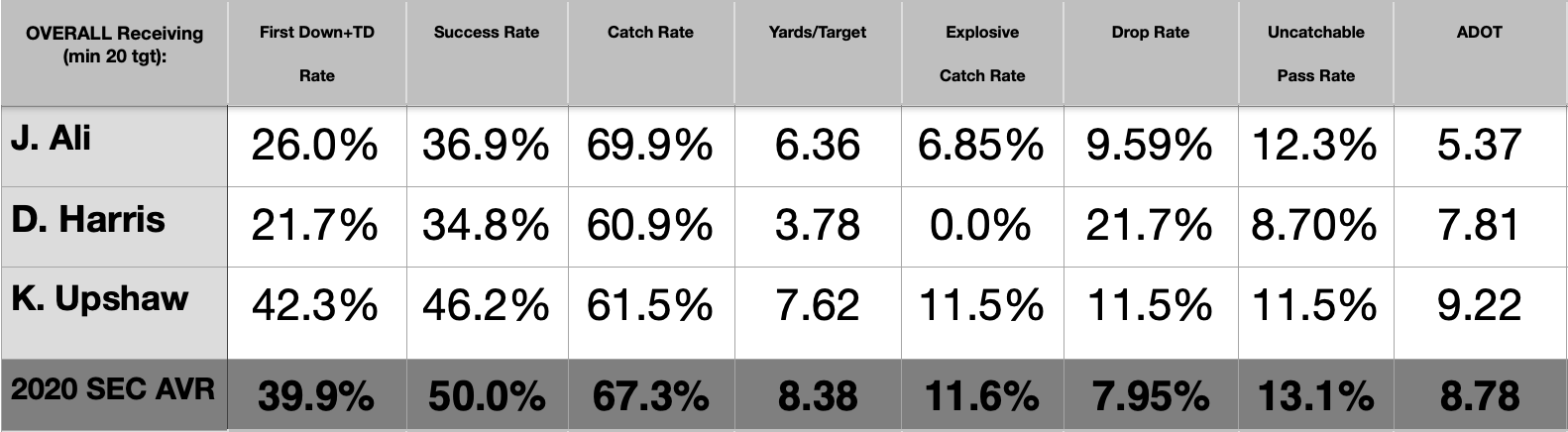
Since 2018, UK hasn’t fielded a single pass catcher with at least a 50% Success Rate (min 20 targets). Again, many issues maligned Kentucky’s aerial efforts, but there’s no getting around the lack of pizzaz from this position group. We know the QB play hasn’t bee the best as of late, but the number one factor in boosting a passer’s efficiency is surrounding them with a good cast. UK’s past offensive staff failed to get the right guys to muster any bit of worthwhile production. Josh Ali, The only receiver that was overly worth a damn last year (and the only returning Wildcat to log over 25 targets) was terribly inefficient. Benefactor of a tunnel scheme, only the Heisman DeVonta Smith saw a higher percentage of his team’s targets. But his 37.9% Success Rate and 6.36 Yards/Target were the 3rd-worst and 6th-worst, respectively, amongst SEC receivers in 2020. With no other recourse, opponents clearly had no trouble keying in on Ali and further stifling Kentucky’s offense. Outside of his 7.5 YAC average, which were highlight by his SEC-leading usage on Utah/tap passes, none of his previous career metrics are notable. But, Ali’s trait as a guy with enough giddy-up for defense to worry about cannot be overlooked; especially when a new speedster comes to town.
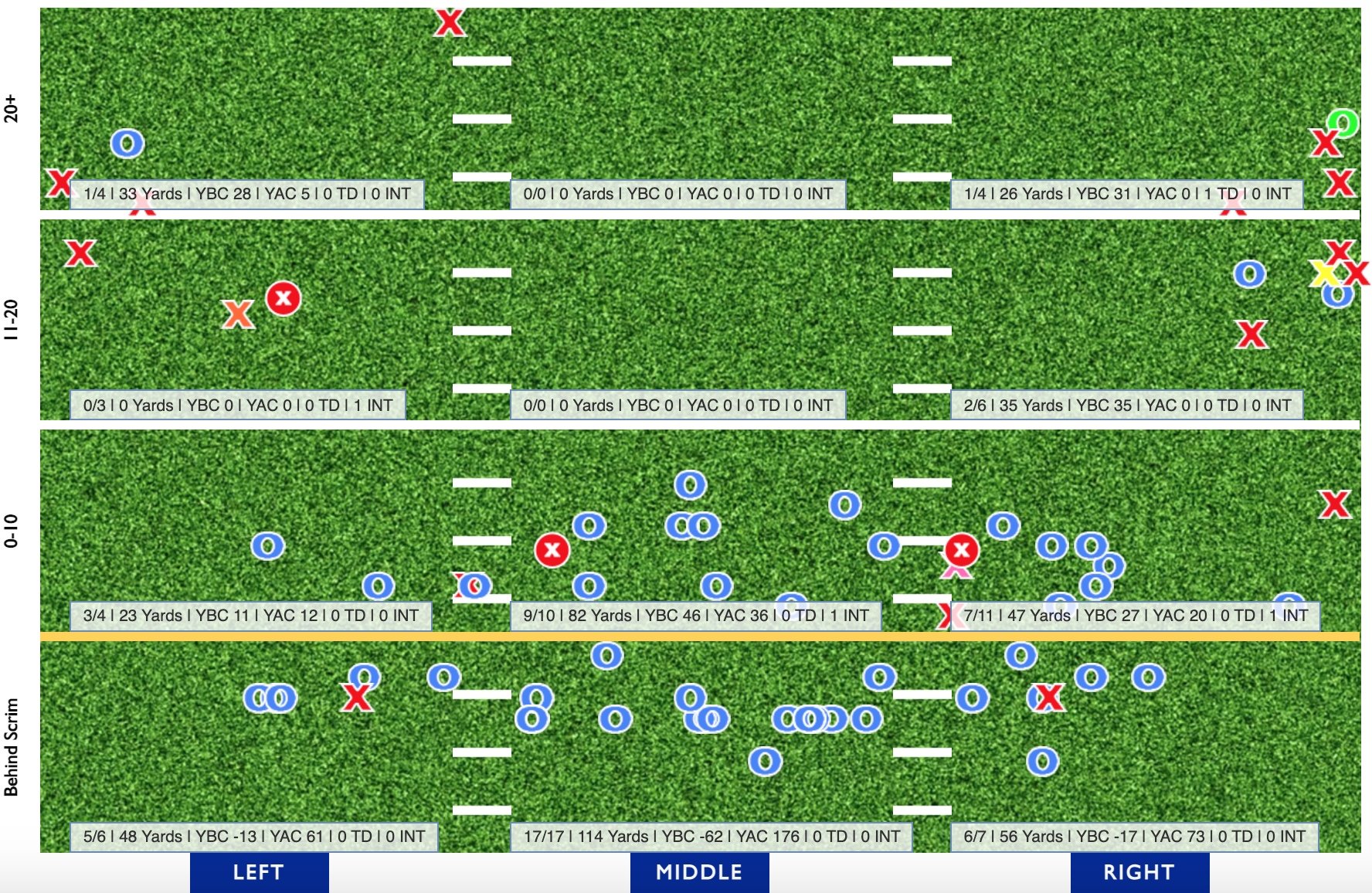
Josh Ali's 2020 Target Chart
Wan’Dale Robinson’s transfer reconfigures this entire unit. If this is the first time you are reading about his athletic ability, you’ve been missing out. Though his traditional stats are sturdy, they hardly pop off the page. Like Ali, his hype is fueled by his skillset and athletic upside. Moreover, he doubles UK’s number of at-the-snap motion threats, YAC weapons, and factor backs. The Cats now have a formula they haven’t had since 2016: a wide receiver tandem apt at winning one-on-one with their speed and making plays after the catch. Kentucky fans should have fond memories of Stephen Johnson’s deep posts from that year. Along with a strong run game, Many of those patterns were triggered by a safety collapsing to help out with one of the quicksters only to be burnt overtop by the other. The end result was UK’s best passing result since 2008. With a new scheme built off the marriage between the run and the pass, healthy play action, and plenty of deception tactics, Robinson and Ali could be the new Badet and Johnson. If you don’t have a raging Cats Boner after reading that, I don’t know what to tell you. Whether on opposite sides of the formation or aligned next to one another, UK will have loads of opportunities for effective hi-low patterns like Yankee Shots, Shallow, Mills, Double Posts, Cross, and Dagger. Off the new base outside zone play, Liam Coen would be wise to bum a few of those said looks from reigning national champion Alabama off play action.

Though Ali lined up all over the formation last year, most of his snaps occurred from the slot. Moving forward, Robinson will be the main man inside. Presumably because of his size and to keep his motion-eligibility in tact, Ali will kick over to flanker. If the goal is to make Robinson UK’s version of Cooper Kupp, UK will utilize condensed sets, rubs, and routes across and behind the formation to thwart tight coverage. And if the defense becomes to fixated on his antics, Ali can make them pay downfield.
Kentucky has like a half dozen dudes who could wind up as its tertiary receiver. Before getting hurt this spring, Clevan Thomas seemed like a good bet to be that guy; ditto for Keaton Upshaw. If one wanted to use last year as a barometer, sophomore DeMarcus Harris received the most volume of the outstanding options. But across his 23 opportunities, he generated the team’s worst Success Rate and Yards/Target in 2020. Granted, a new scheme should make those figures moot. But, those sour returns should open the door for further completion within this position group. Isaiah Epps has been long talked about as a potential deep threat, but has never amassed more than eight catches in a season. If speed is this braintrust’s emphasis, however, that alone might extend his playing time. Michael Drennen has high hopes as a youngster and former-four star. He’s likely to help UK’s depth on the inside as an additional avenue to pick on box defenders. Other dark horse candidates to round out the Wildcats’ ranks include Louisvillian Tae Tae Crumes and four-star freshman Lexingtonian Dekel Crowdus.
I’m sure UK’s original plan was to deploy a good amount of 12 personnel to maximize Ali’s and Robinson’s matchup opportunities against base defenses. Plus, I know folks in Lexington were excited to see how the 6’6 Upshaw would perform in a more sophisticated receiving role. But his untimely injury nixed that plan. Nothing against Justin Rigg, but he’s just not cutout for working the seam or testing secondaries every down. He can still offer this offense an underneath outlet, but he’s likely to operate more as a de facto sixth offensive lineman most of the time. Maybe Brendon Bates or Jordan Dingle provide a pass catching spark, but StatCat is dubious. To help provide more receiving depth, Izaiah Cummings has shifted over and very well could fill the vacancy left by Upshaw. The Rams scheme has generated value from its Y-men aerially; but with the current talent level at its disposal, Coen might just be inclined to limit his usage of two-tight end sets.
Glancing at Kentucky’s Offensive Line
Controlling the edge will be a major emphasis in the new Outside Zone scheme, which means the Cats will be asking their big boys to move more laterally than the previous operation. Former South Carolina OL coach Eric Wolford is the man tasked to ensure that mission statement comes to fruition. Of course since he’s being handed the reigns to one of the conference’s top fronts, expectations are high the Big Blue Wall remains this offense's foundation. Though overly specialized maulers, the group has been among Pro Football Focus’ highest graded units the last two years. Often embodying the passion and dependability of former sage John Schlarman, UK’s line has been its driving force, heart and soul, and most consistent offensive asset. After all, playing small behind stingy defense and a gritty ground game usually doesn’t end well unless a team has a formidable front that can win the trenches. The last two seasons against SEC opponents in meaningful minutes, UK finished inside the SEC’s top3 in rush yards before contact, Run Havoc Rate, and Yards/Carry. Year-over-year, the Cats largely traded in potency for consistency. Though the Cats cracked the top5 in Success Rate in 2019, their 2020 clip was about seven points better. One of Wolford’s main challenges will be maintaining that dependability while attempting to goad more explosiveness from this run game. While there’s nothing wrong with getting six yards per carry, splash gains need to be aggressively sought. Explosive plays have a higher correlation to victories than winning the turnover battle within the conference as of late. Improving UK’s efforts in pass protection is also on his to do list. For the second straight year, UK finished inside the conference’s bottom5 in Sack Rate and remained not-to-strong preventing pressures. If Kentucky wants to flip the field through the air, this group needs to be more sound at maintaining clean pockets. No doubt those play action shots in the works will unequivocally work better if UK’s QB can stand tall and deliver a strike without duress.
Despite the talent, the Cats will undergo some shuffling upfront. Left to right, UK’s starters last year were Landon Young, Kenneth Horsey, Drake Jackson, Luke Fortner, and Darian Kinnard. Of course, Young and Jackson were drafted and are no longer around, which created openings at left tackle and center. Arguably the two most important cogs across a line, filling those roles are never ideal. But luckily for the Cats, they’ll be in great hands for both vacancies. Kinnard, who is an All-American and PFF’s highest graded returning SEC lineman, will flip bookends in a pursuit to prove he’s a capable pass blocker on the blindside. Former guard Fortner will slide over to the middle while Horsey is back in the saddle at left guard. Despite logging the majority of his reps on the left side, LSU-transfer Dare Rosenthal is thought to be UK’s preference at right tackle. Though the premise of having tackles swap sides and learn a new scheme seems risky, the gambit is worthwhile in order for this bunch to increase its ceiling. Putting one’s best lineman at LT has been a cliche move for years, but there’s a reason why that practice is followed. Plus, Rosenthal is long and athletic; perfect traits for a run-dominant tackle in a perimeter-oriented offense to possess. Jeremy Flax will round out the Cats at right guard. Slated to start at tackle prior to Rosenthal’s arrival, Flax had a strong spring that seemingly earned him a place among the Cats’ first five. If he or the former Tiger falter or can’t go, Brian Cox and Austin Dotson will be the next bricks in the wall.
Key Offensive Metrics in SEC Play
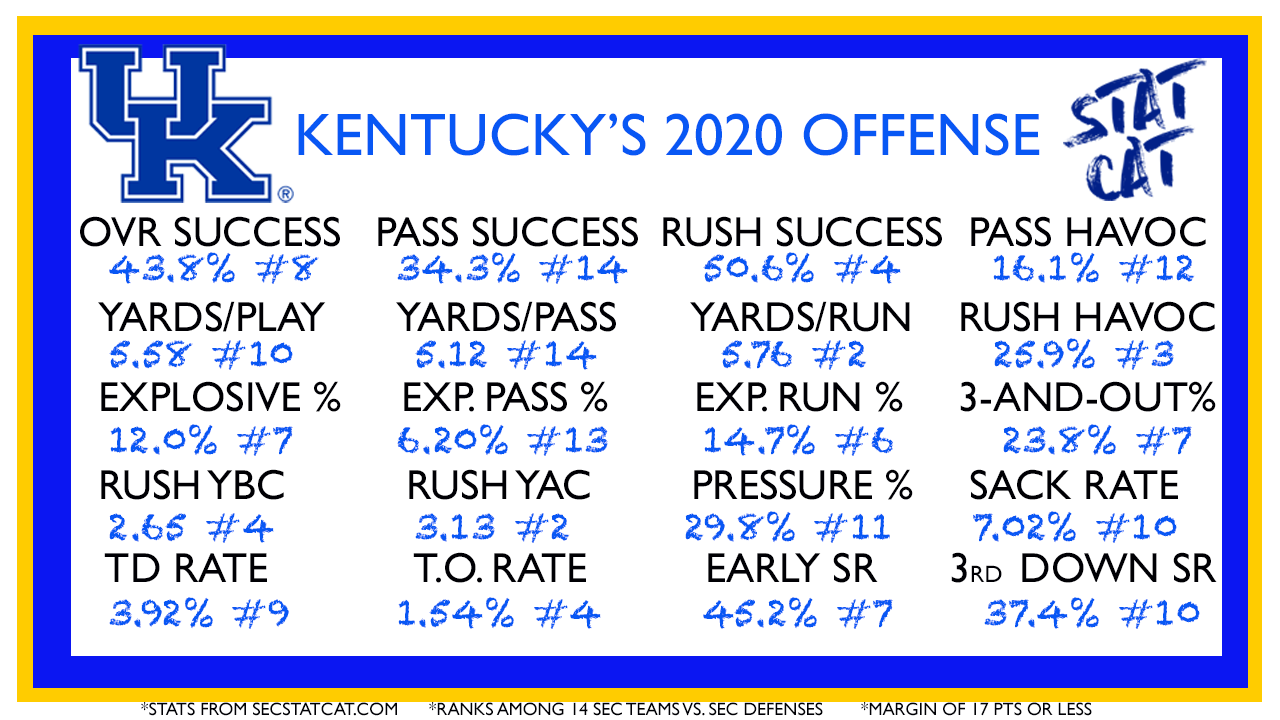
The single most important stat for this offense is obvious. Liam Coen might be bringing along a new scheme and approach, but the primary reason he was hired lies with his ability to enhance Kentucky’s passing product. Anyone who’s been paying attention to UK’s offense the last few years knows it was incredibly one-dimensional, predictable, and overly capped. Banking on a strong ground game with a decent defense got the Cats as far as they could go. Moving forward, balance and blended tactics will be core elements. Though the phrase of “keeping opponents guessing” is basic and a thing you read in a Dummie’s Guide to Football, that’s simply an aspect this offense has sorely lacked. Expect deception and movement on nearly every snap; especially play action. Despite UK’s run-heavy ways, its passers’ Play Action Rates were consistently under the conference mean. In fact entering last season, Terry Wilson’s career clip fell under 17%. A little innovation and schematic evolution could vault this offense into another echelon; possibly even dark horse territory for the SEC East crown. Granted, the bar is awfully low for Coen inheriting the SEC’s least efficient pass game. Even marginal improvement will be seen as a win. Still considering his arsenal of weapons, the Cats should strive to finish near the middle of the pack. If they can do better, that’s fantastic. But jumpstarting this dropback attack off of the conference floor should be paramount. Considering the “Shannahan” System’s recent track record maximize middling throwers, this offense is an easy buy-low candidate.
However, that’s assuming business as usual continues upfront. Most expect the Cats to maintain a top4 rush yards before contact and Run Success Rate in SEC play behind the Big Blue Wall and Chris Rodriguez. But while the probability of that pairing producing praise-worthy numbers is strong, the new offensive braintrust cannot take that as given. The switch to the perimeter-oriented scheme might take yield early faults, or Kentucky could hit the ground running. If this Cats find their groove from the get go, this group should aspire to be the conference’s most efficient ground game. After all, UK has looked considerably mighty despite folks knowing they were running basically every snap. Imagine the result once boxes clear out. Though there are new voices in the room, this run game can’t lose its past zeal. Since StatCat has been in existence, no SEC team has donned a top5 rush yards before contact and Rushing Success Rate three-straight years. UK will be the conference’s only qualifier for 2021 to attempt to set that prescient. Considering their collective pedigree, StatCat likes the Cats’ odds.
Key Defensive Metrics in SEC Play
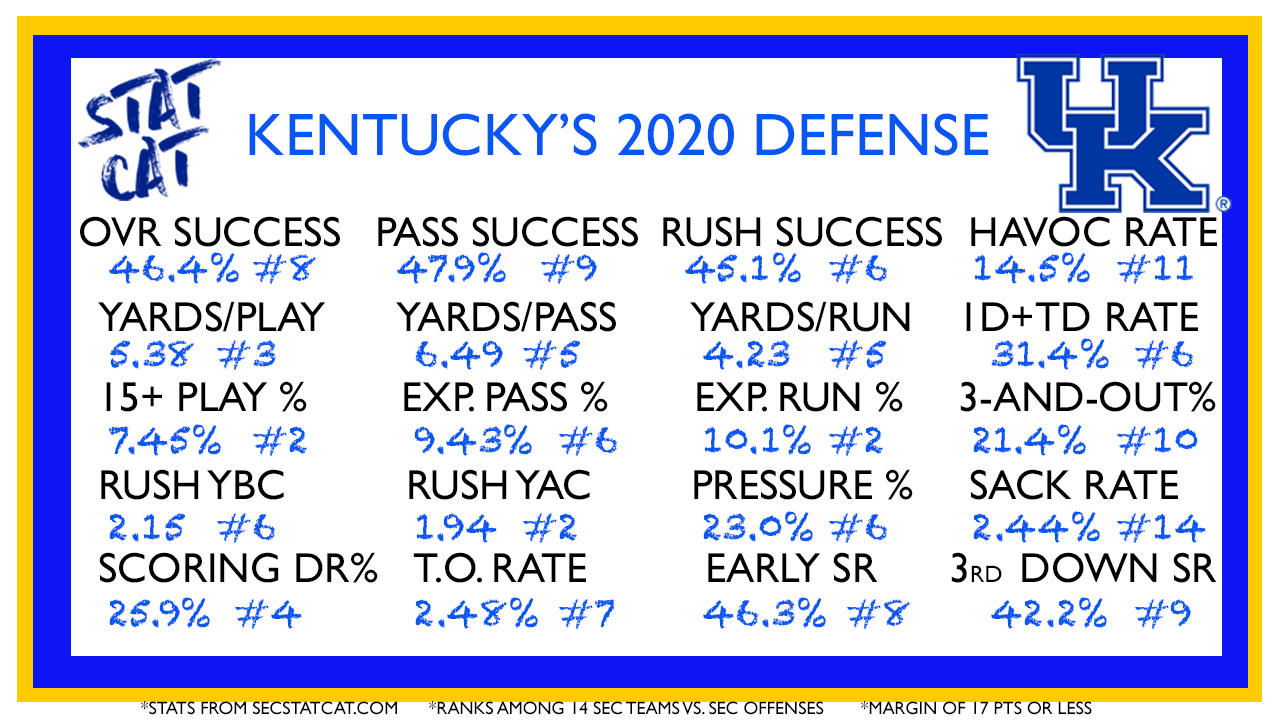
As an offensive guy, I generally gloss over defensive previews. Not that I don’t think individual defensive players aren’t valuable or dislike a blindside sack or athletic INT every once in awhile, but I typically treat that side of the ball as a collective unit. As only one guy, I can only track so much, yanno? You won’t get many fun defensive nuggets from me. That said, the traditional metrics like Kentucky’s defense much better than the advanced numbers. UK ranked in the top5 in Yards/Game and Yards/Play, and no SEC defense surrendered less yards though the air. By volume, they allowed the conference’s 3rd-lowest total of scoring drives with 37 and the 4th-lowest amount of explosive plays with 76. But their down-to-down Success Rate, 3rd Down Conversion Rate, First Down+TD Rate, Havoc Rate, and Turnover Rate were average at best in league play. Plus, the Cats’ 3-and-Out Rate fell into the conference’s bottom5. Stoops’ defenses tend to sit back and rally towards the line of scrimmage. In the past, it has yielded porous run defenses. But this past season the Cats corked big gainers on the ground as good as anyone in the SEC. While holding opponents to a YAC average under 2.0, only Georgia’s top-ranked defense was better stifling splash runs. Moreover, only the Dawgs had a preferable Run Missed Tackle Rate in meaningful minutes than UK’s 18.1% clip last year. With a handful of key departures including two trenchmen and corners, maintaining serviceable back-to-front execution could be difficult for Stoops' Troops.
While this blue collar staff will focus on sustaining the bright spots of yesteryear, Kentucky’s defense undeniably has to improve situationally. Though their ranking within the conference remained unchanged, UK’s Success Rate worsened almost six percentage points compared to its figure from 2019 vs SEC offenses. The Cats’ standing on the money down also soured by roughly the same amount, but dropped from the SEC’s 5th-best to 9th. Again Stoops’ defenses like to get most of their havoc out of their downs with backenders sitting in a shell. It’s set up to allow opponents to nickel and dime, and banks on them eventually making a crucial mistake. As the BBN can attest, when this defense isn’t creating takeaways it's often lifeless and bland. With the tight front/drop8 sensation taking over the sport, StatCat doubts Kentucky changes its philosophy in that regard. Without an emphasis to create havoc, turnovers will have to come by individual play and circumstance. And when the Cats find themselves on 3rd down, they must be advantageous and prevent logging extra plays and allowing opposing momentum to build. Though UK has as decent starting group, they still aren’t as deep as some of the blue bloods. Extended snaps and long drives simply hurt them more. Collectively, this group needs to execute better and aim for another top5 finish in league play. Sure, a stronger Sack Rate would go a long way to restore this defense’s fortitude on latter downs. But with all the personnel turnover, the Cats collectively need to make strides winning one-offs and getting its offense back on the field…unless the BBN would like to relive last year’s Missouri game over and over each week in 2021.
Glancing at Kentucky’s Schedule
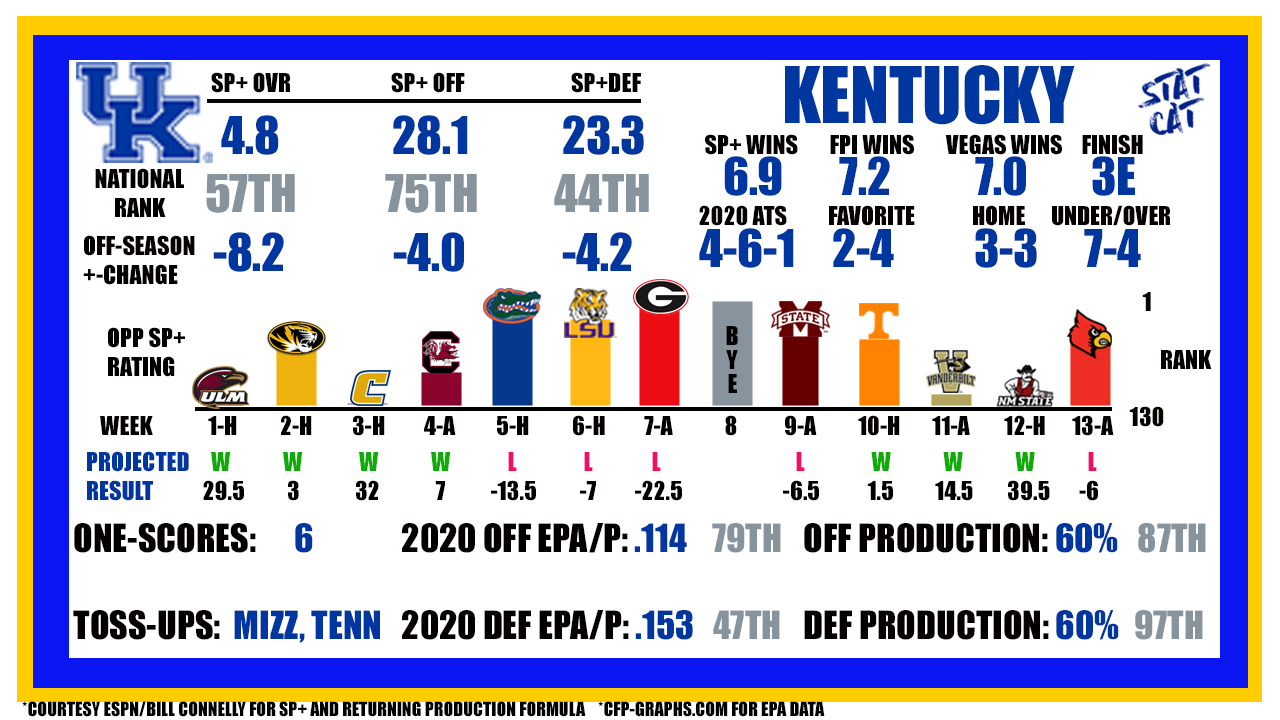
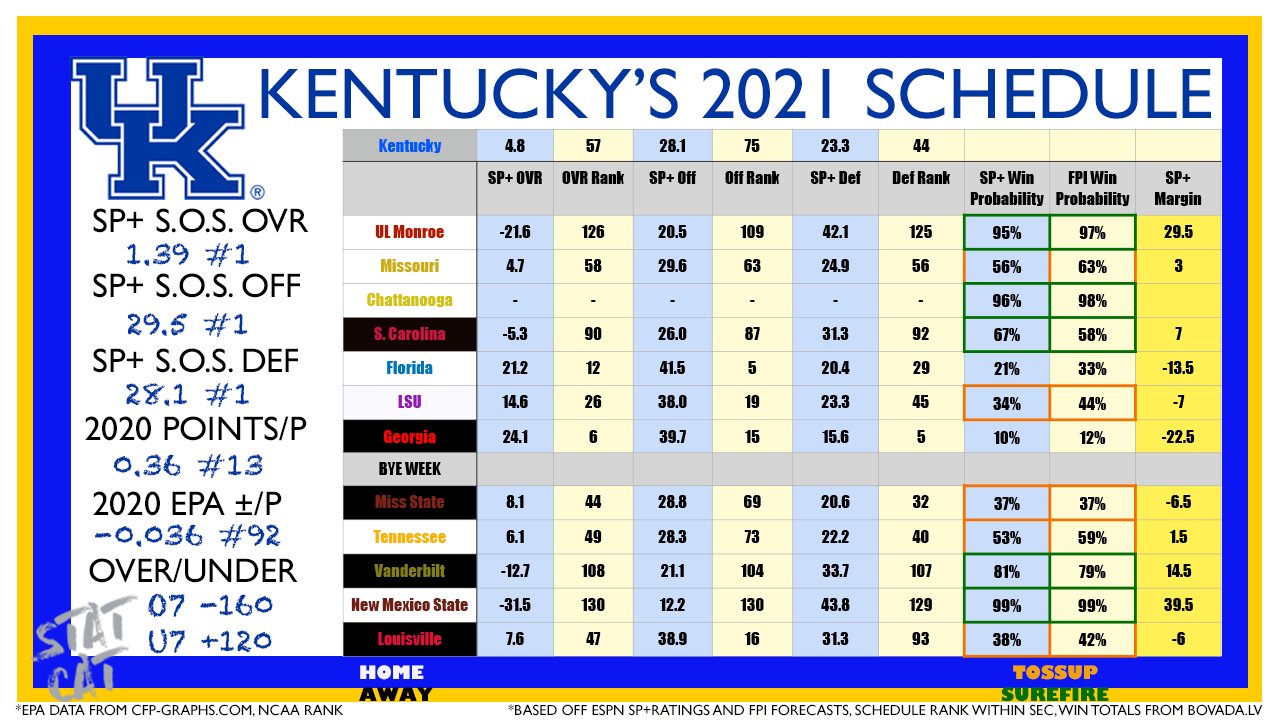
Outside of South Carolina and Tennessee, no SEC team regressed by a larger amount in ESPN’s SP+ Ratings than Kentucky. In that metric’s eyes, the Cats were eight points better as a team at the beginning of 2019 compared to now. Despite the downturn and murkiness surrounding a good portion of its roster, UK rocks a pure gift of a schedule. The Cats might play a good deal of snoozers; but if things break their way, this group could be on the cusp of a ten-win season. No SEC team plays an easier slate overall, offensively, or defensively. The average SP+ score of their opponents is 1.39 (a dead-ass average team will rock a rating of exactly 0). The next-closest SEC’s clip is Vanderbilt at 4.61; the SEC mean ahead of this fall is 7.34. The point, UK’s slate is in a class of its own in terms of cupcakedom within the conference. Excluding FCS foe Chattanooga, five of their opponents come into the season ranked 90th or worse; thank you, Mitch Barnhart. Outside of the divisional stalwarts in Georgia and Florida, none of the Cats’ opponents sit inside the Top25. Even with the SP+ score slippage, that metric along with ESPN’s Football Power Index projects Kentucky to win seven games. Advantageous bettors were quick to capitalize on the upside of this team’s prospects besting their (original) 6.5 under/over win total. Their figure has sense risen half a game to match their forecasts at 7. The fat exists on the head and tail of UK’s schedule. The meat, however, will dictate the Cats’ season.
Getting to eight wins and beyond is tricky, but it can be accomplished. Assuming the Cats win all of the games where they’re projected to win by at least a touchdown, that leaves a scenario of beating three of Missouri (a team with a 1-5 record vs UK the last six years), South Carolina (ditto), LSU, Mississippi State, Tennessee, and arch-rival Louisville. At this point in time, the SP+ is giving Kentucky the edge in only vs. Mizzou and the Vols. But either way, all of these matchups forecast a one-score margin. LSU will be traveling to Lexington after hosting Auburn and before Florida comes to town. The Kentucky trip could become a trap game of sorts. UK gets a chance to freshen up before traveling to Starkville after its bye week. And of course, the Cats are always motivated to head into the off-season on a high note after facing UofL. If the Cats sweep these games, they’ll be a dark horse for Atlanta. If they go o’fer, UK will likely don consecutive losing seasons for the first time since 2014-2015. Though the Cats have played the Gators close in recent years, the SP+ figures Florida wins by about two TDs. Meanwhile, Georgia is presumed to win by over three. Obviously with plenty of one-score margins on their slate, their season could break many different ways. But if you believe in UK discovering a passing game in addition to displaying its previous grit versus its tissue paper schedule, Big Blue is an easy team to buy ahead of September. If the Cats meet their expected outcome, Mark Stoops will be the first Kentucky coach to rock a career winning record commanding the Cats since Blanton Collier in 1962.