2021 Vision: Previewing Missouri
2021 Vision: Previewing Missouri
With talking season winding down, preview season is among us! I'm sure this isn't the first preseason article you've viewed. You should know the drill by now with these bad boys. But if this is your first experience with StatCat, be ready to learn a thing or two about the Tigers' QB1, receiver room, rushers, OL, its most important stats to maintain and/or improve on both sides of the ball, and how Missouri's schedule breaks down with help of ESPN's SP+ Rating!
Missouri's Passers

Conner Bazelak might not be college football's most sexy passer. But, make no mistake about it. His sound play was a major factor in the Tigers topping expectations in Eli Drinkwitz’s first year in Columbia. A good deal of spectators and scouts tend to gravitate towards the big arms and dazzling displays of athleticism; steady, average, game manager types no so much. However, something is to be said about avoiding negative plays. If you recall, sustaining drives and winning on 3rd down certainly helped Mizzou hang tough in a few ball games and steal some W’s. And of course, no one likes a QB who frequently gifts passes to defenses. Within the conference last year, he was rather mediocre as far as results go. That said amongst returners, he rocks a top5 Success Rate, Accuracy%, First Down+TD Rate, Uncatchable Pass Rate, Interceptable Pass Rate and Yards/Attempt. Operating in a nickel-and-diming fashion — barring a tricky look every once in awhile — Bazelak really didn’t stand out on the stat sheet, but he did finish top40 in the country in total Expected Points Added.
Looking at his passing floor — ie non-pressured, non-RPO/screens attempts— his modest modus operandi is further highlighted. Though his accuracy didn’t drastically improve, none of his contemporaries can command a lower Interceptable Pass Rate in this context. The Tiger’s conservative play is further hammered home by a bottom3 average depth of target. But despite working more horizontally than vertically, the sophomore undeniably delivered value. He enters 2021 with the SEC’s 2nd-best such Success Rate with the 3rd-best Uncatchable and First Down+TD Rate.
Since he’s not the quickest of foot, Bazelak isn’t too keen as an escape artist or playing backyard ball. Not that he can’t scoot on occasion, but no one is championing his play outside of structure. Like a lot of green passers, he frequently faltered in the face of pressure. Within the SEC last year, he finished bottom3 in in such Success Rate, Y/A, and Depth Adjusted Accuracy. Though normally pretty good at avoiding boo boos, Bazelak posted the 4th-worst Interceptable Pass Rate with an alarming 15.5% clip under duress. Captain Obvious wanted me to remind you that figure is well past the danger zone and should be a glaring concern. As nice as a foundation as Bazelak presents from perfect conditions, consistently folding in the face of adversity will handcuff this offense from entering the next echelon within the SEC.
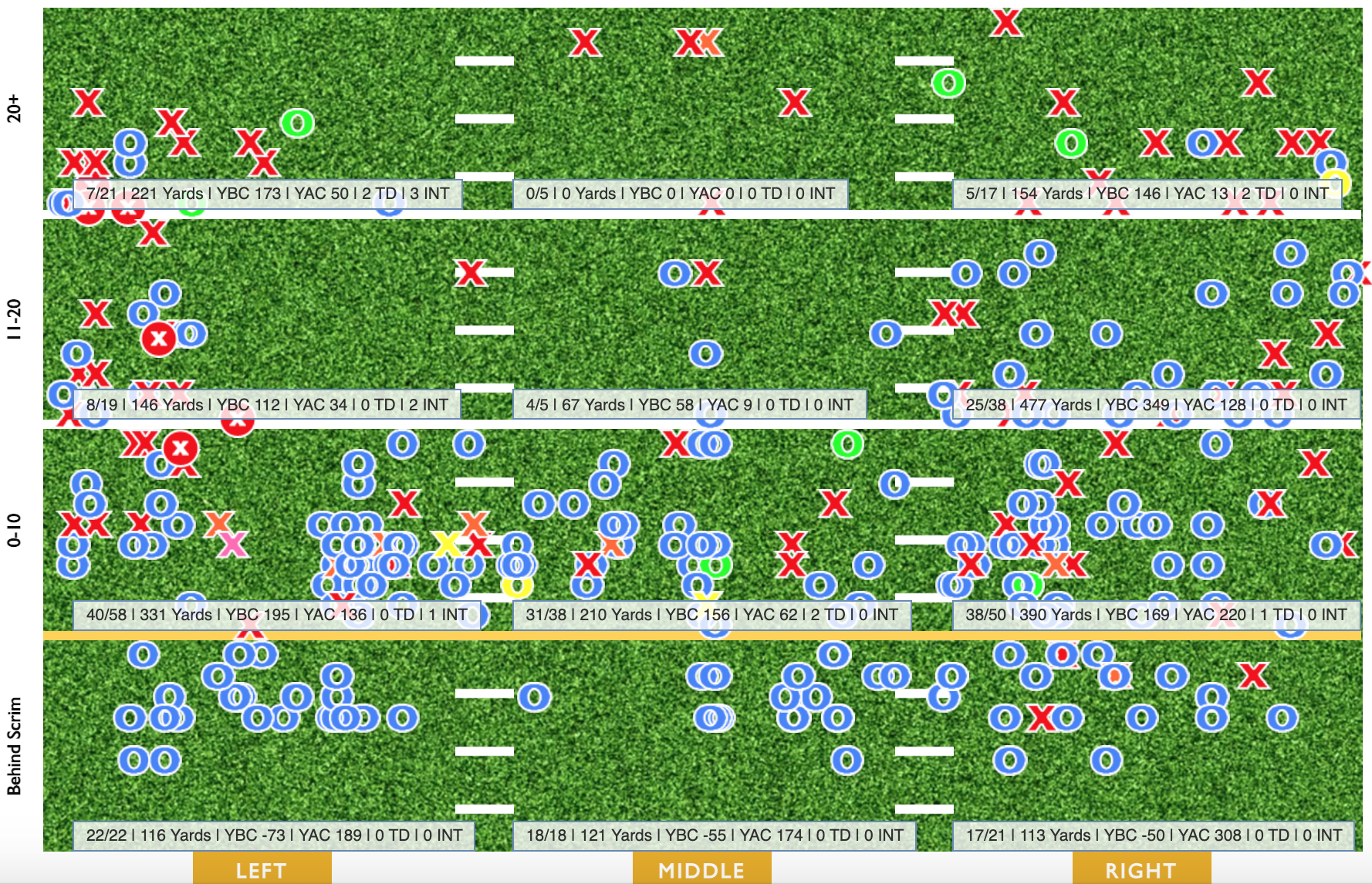
Moreover, the Tiger could sharpen his deep passing skills. Bazelak might be satisfied chugging along as a champion of Curl+Flats, but only a quarter of his 20+ yard attempts were on-target last year; almost just as many were deemed turnover-worthy. Meanwhile about a third of his bombs were duds and had no chance of being caught. Though Missouri didn't mind getting methodical, delivering more explosive gains unquestionably would provide more margin of error for this unit. By the way, he wasn’t the sharpest play action passer either. (These days a lot of deep balls and/or field flipping plays are manufactured with help of heavy play fakes).
Bazelak could be a dark horse All-SEC pick if he can improve upon his consistency, accuracy, and versatility on all snaps; not just ones where he’s operating from a bubble. Though still working out the kinks to his game, Bazelak’s first season as a starter presents reasons for optimism. His base and floor are fine. Not to mention, his supporting cast is more than decent. For what it's worth, he was Pro Football Focus' Honorable Mention selection for the All-SEC QBs. A good amount of folks are buying into his upside It’s just a matter of Drinkwitz and Co. finding ways to lift his passing ceiling without developing cracks or pitfalls in his foundation during renovations.
Bazelak's 2020 Pass Chart
Missouri's Rushers

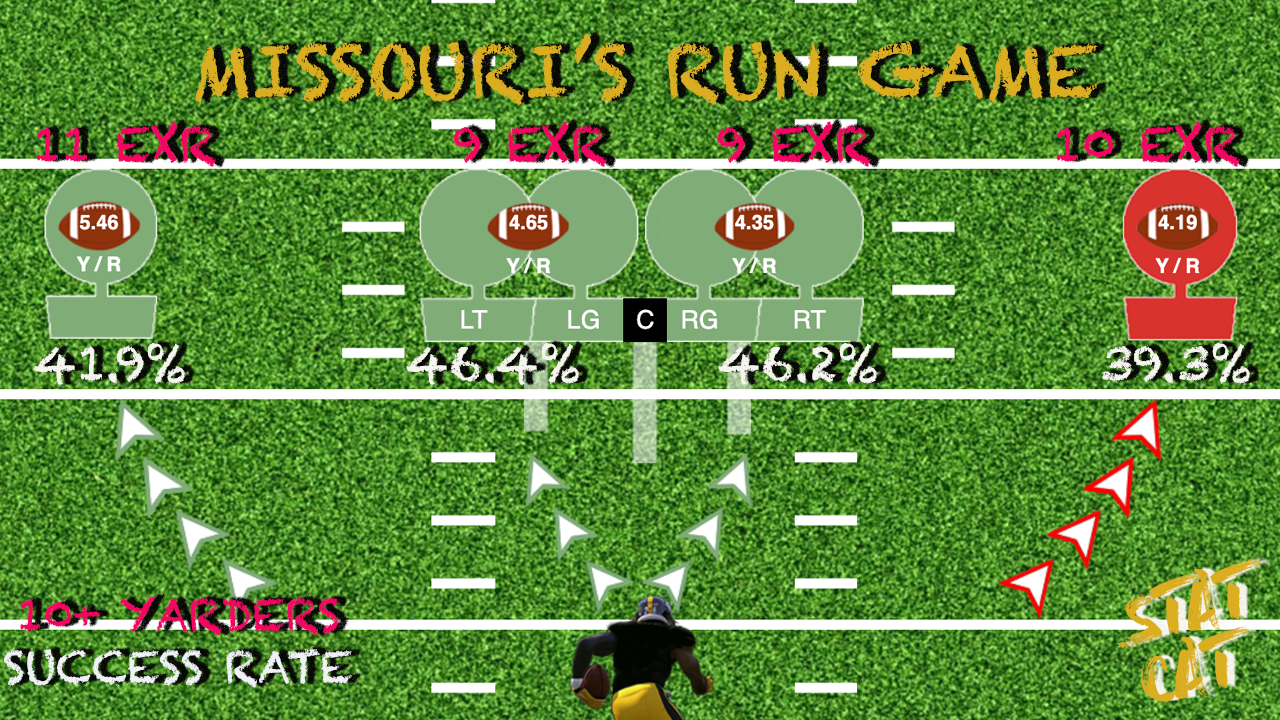
On the whole, the ground game saw nice year-over-year boosts against conference foes. Eli Drinkwitz has preached a consistent tune about establishing a serviceable offense line and how such helped the Tigers compete in 2020. Mizzou went from having the 3rd-worst rush yards before contact average to the top5 with a 2.63 clip, its Run Havoc Rate Allowed dipped ten percentage points, and its Rushing Success Rate increased double-digits against conference opponents in meaningful minutes. Outside of Florida, no other SEC offense experienced a higher uptick than the Tigers’ 11.7 clip year-over-year. Despite the improvement behind motions, triple options ,and the new scheme’s bread and butter off-tackle play, the end rushing result was still relatively mediocre within the conference. Other than their YBC clip, the Tigers run game failed to crack the conference’s top5 in any metric.
You could argue their former uninspiring bellcow was the root of their mediocrity. Let me just get this off my chest: I never thought much of Larry Rountree as a ball carrier. Over his tenure as the Tigers primary running back, he consistently failed to pop on his advanced stat sheet. Though okay running to space or following blockers, he was muted when things became difficult. Both his rush yards after contact average and his Broken Tackle Rate finished under the SEC average for three straight years. Mizzou fans know blocking hasn’t been at it upmost finest in recent years. But Rountree’s shortcoming shedding defenders and elevating his teammates simply made him less valuable. This past season despite finishing with an above-average yards before contact figure, he delivered a subpar Success Rate, Explosive Run Rate, and First Down+TD Rate. And the capper, no ball carrier accounted for a higher percentage of his team’s carries than Rountree’s 65.7% mark (FYI it bested the next clip by 7 percentage points).
I’m not sure why Tyler Badie was not as featured last year, but his style of play as a speedster looking to get around the edge seems well-suited for Drinkwitz’s OZ foundation. That said, it’s not like he boasted a booming bottomline across his 48 carries. His own returns were fairly manilla too. Plus, Badie’s stable metrics — things like YAC average, Broken Tackle Rate, and Gumption Rate that are used to see how a ball carrier manages adversity) — were forgettable. But when one bests a teammate in Explosive Run Rate while seeing half of his carries beat situational goals, some optimism is justified. Plus according to cfb-graphs.com, Badie’s 0.17 Expected Points Added/run is the SEC’s 6th best returning clip. And of course, that’s excluding the element he brings to Missouri’s pass game. His overall EPA/touch rises to just under 0.4 because of his playmaking skills in that facet.
Drinkwitz has experience finding production with “smaller” backs, but it’s fair to question how exactly Mizzou’s modus operandi gets altered on the ground compared to last year's approach. After all, the Tigers apparent beta back in Elijah Young has a very similar build to Badie. The positive could be seen as the Tigers maintaining consistency with their play calling. But a potential downside could be a double-edge sword of lacking a primary bruiser. Though Young's ten snaps produced very fine results, banking on such a sample size would be moronic. But since I know you’re curious, he broken six tackles and secured seven successful carries by StatCat’s charting. If — big IF — that hard running continues, this offense will be in a great spot especially if the run blocking upfront remains firm.
Simi Bakare and super senior Dawson Downing are the next most veteran options and could be options on designs run into the teeth of their defense. But there’s no reason to place high expectations on either to come in and light the world on fire. That said, both have pretty could size; and if their savvy progresses after another year under Drinkwitz tutelage, maybe one of them becomes an asset. Otherwise the tertiary ball carrier will be one the the two freshman. Taj Butts and BJ Harris have similar builds are are former-three stars. Certainly not too heralded on the national stage, an opportunity exists for a name to be made if one of them finds their footing.
Missouri's Catchers
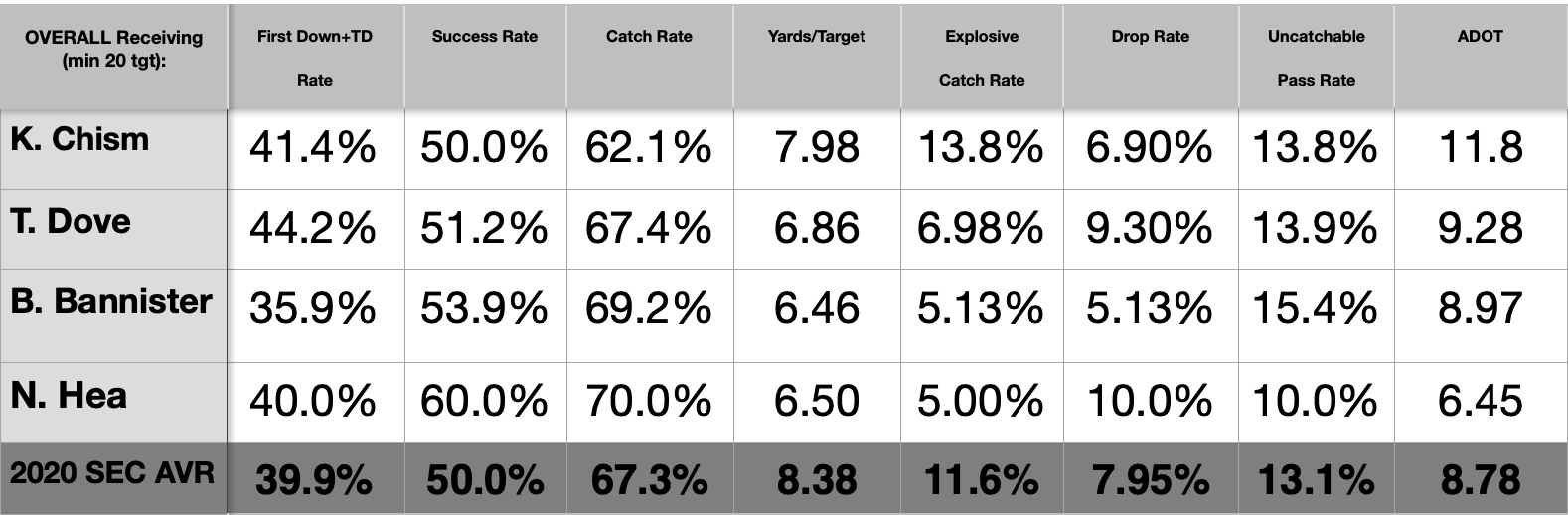
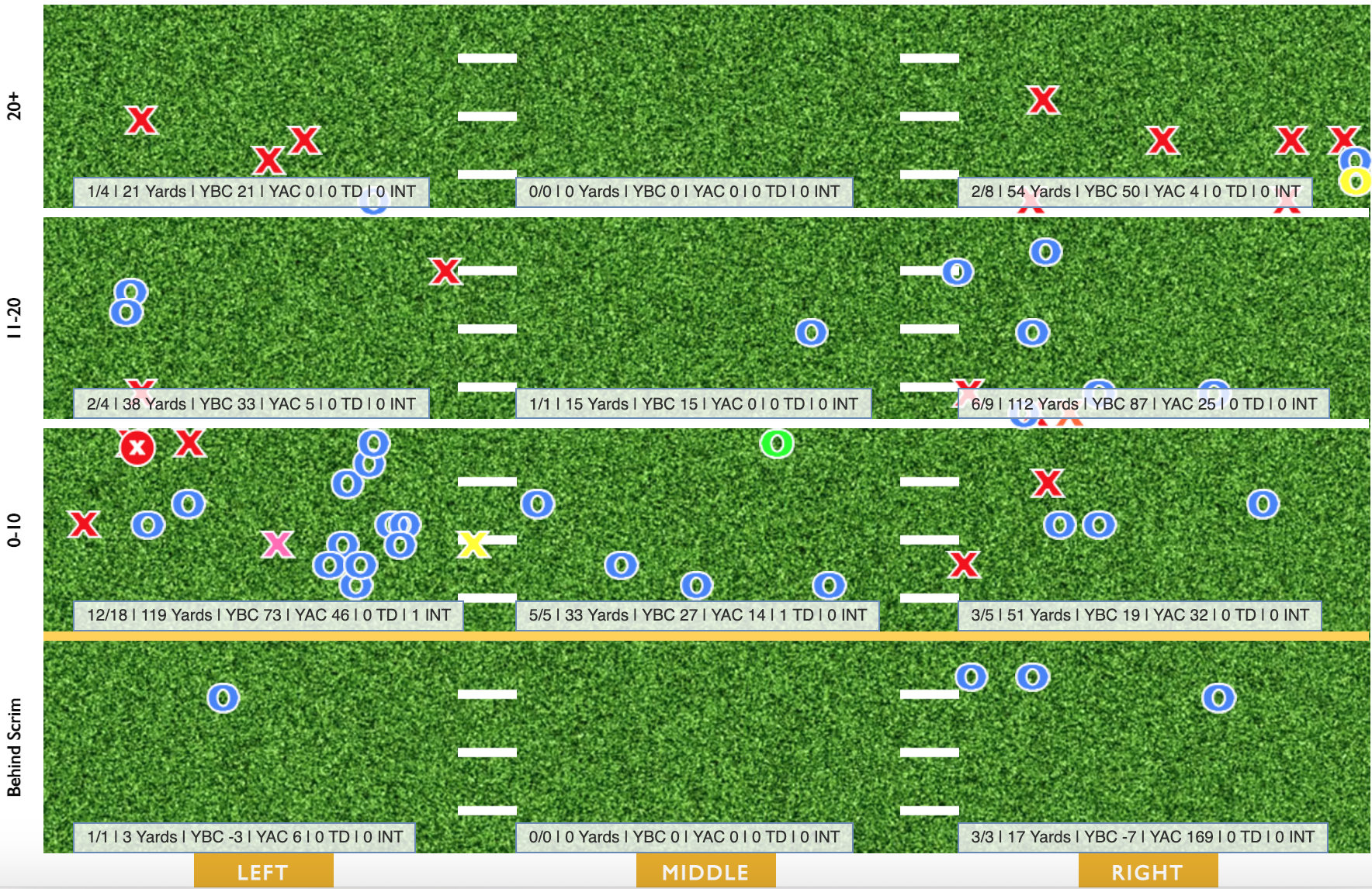
As the Tigers’ most voluminous receiver last year in terms of targets, catches, yards, first down, and explosive catches, Super senior Keke Chism looks to be Missouri’s primary option on the outside. That said, his resume is relatively humble. In addition to his volume figures failing to drum up much excitement, most of his advanced metrics were good not great. In fact his 50% Success Rate, 41.8% First Down+TD Rate, and 7.38 Yards/Target were pretty middle-of-the-road within the SEC last year. Since he only managed to haul in a quarter fo his deep attempts, Chism was relegated to doing damage short off Missouri’s horizontal spacing pass patters. On underneath routes like hitches, curls, drags, slants, and outs, the Tiger’s three aforementioned metrics all sit inside the SEC’s top5 for this year with none of his contemporaries trumping his 91.4% Depth Adjusted Catch Rate or 11.8 YAC average off such targets. In fact, because of his heroics running away from defenders in this context, Chism’s cumulative YAC clip of 8.65 is the SEC’s 2nd-best amongst non-running backs. He’s far from a sexy option for this offense, but that trait hints he has some playmaker genes in him. Mizzou will be hoping for increased potency and overall consistency. However, as long as at least half of his targets result in situational success, there’s no denying the short term value he provides this offense.
Keke Chism's 2020 Target Chart Tauskie Dove's 2020 Target Chart
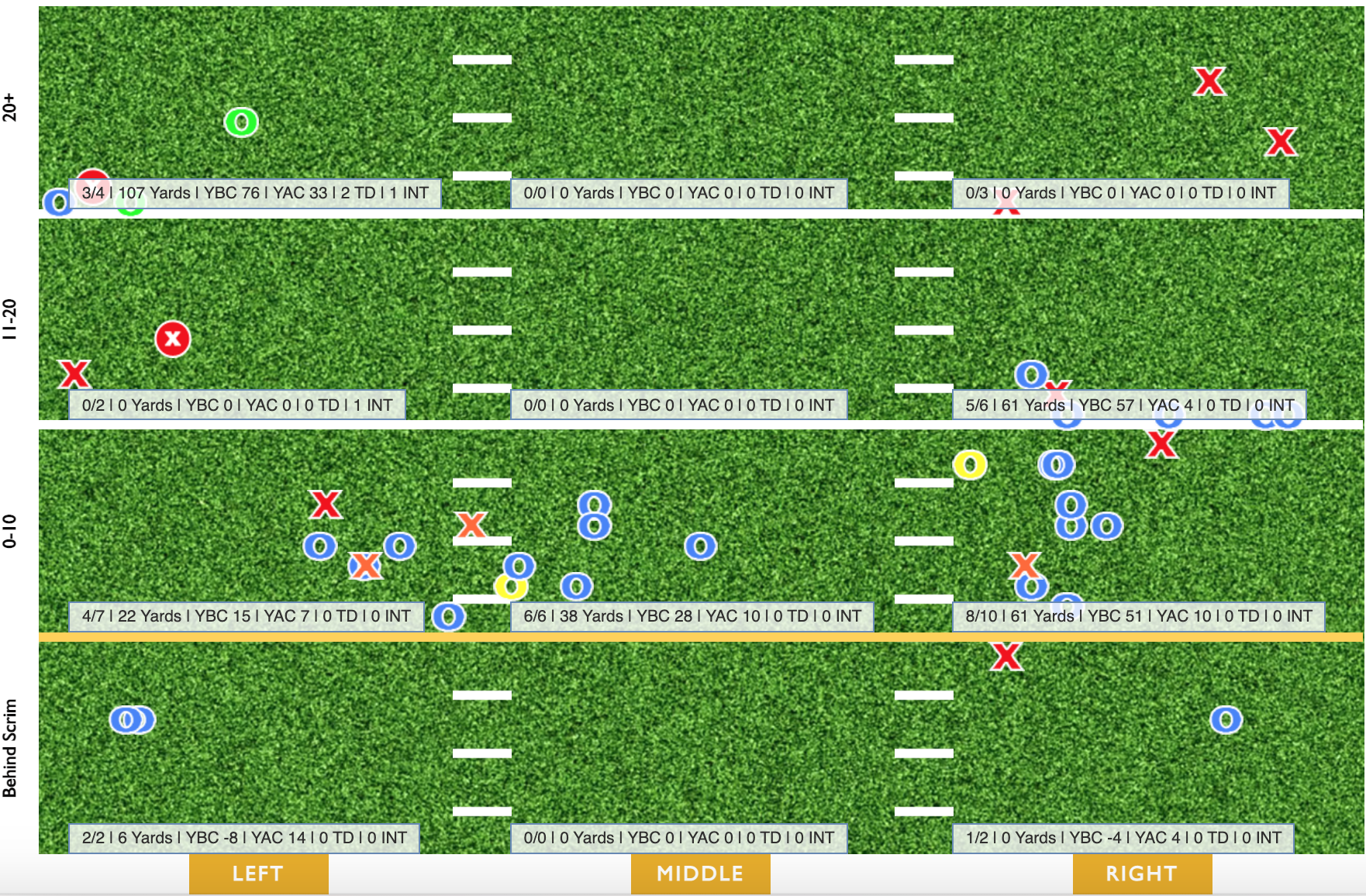
Tauskie Dove will join him out-wide. Though he operated in a similar fashion, his underneath patterns worked inside the numbers at a far greater frequency. Furthermore, of SECers with at least 20 targets at X/Z receiver, none produced a higher target or yard makeup than Dove’s 51.6% and 60.3% clips, respectively. Frequently led into the teeth of the defense, his adjusted Inaccurate and Contested Catch Rates both sit inside the conference’s top3 amongst qualifiers. In fact, his 42.9% First Down+TD Rate on straight-up tight window chances holds the SEC’s silver medal ahead of 2021. Overall, Dove’s 76.2% Depth Adjusted Catch Rate was a team-high as were his two “created” receptions. Because of Missouri’s methodical operation, his advanced metrics lack the same zing and pep of most of his teammates. But while he’s less dangerous after the catch than his contemporaries, that doesn’t mean Dove can't discover a boost to his bottomline behind more volume or enhanced efficiency in year 2 of the Drinkwitz Era.
Though Jalen Knox’s summer departure stung, the Tigers return of the the conference’s most reliable slot receivers in Barrett Bannister to hopefully provide some solace. Bannister is your basic, run-of-the-mill slot receiver. Saying with without saying it, he’s scrappy, savvy, and always seems to find himself open in the underbelly of coverages. While Chism’s target makeup certainly had a strong concentration on throws zero to ten yards downfield, fellow inside man Austin Williams was the only other SECer with at least 25 targets to see two-thirds of their chances occur in such spots besides Bannister. With a degree of difficulty set on junior varsity, he boasts Missouri’s best Catch Rate and Success Rate among their returning receivers. As the recipient to many pitch-and-catch attempts, he rarely provided an explosive gain; his 5.13% such clip was a team-low. Granted, he was overly a safety valve; but Bannister’s mitts delivered value on extra attempts. Excluded uncatchable balls, his adjusted Inaccurate and Contested Catch Rates rank first and fifth amongst returning SECers, respectively. Dependable and consistent, Bannister should be in store for the highest volume of his career.
But, newcomer Malik Cooper is bound to fight for snaps. Hell, some are already crowning the former four-star and Ohio State signee the jewel of this position group. To reiterate, Mizzou’s emphasis on the short passing game helped bring this offense stability but overly struggled to produce big gainers without the help of trickeration. Cooper’s burst should allow more natural patterns to attack secondaries downfield and be advantageous once they creep up to stop the Tigers’ patterns or curb the ground game. Standing under 5’9, maximizing his quickness against box defenders from the slot sounds like a good premise. Plus, his boogie will be unquestionably unleashed via at-the-snap motion tactics. Even as a decoy, he has the speed defenses can’t afford to ignore, which in turn should help other dudes become more threatening. As a nuisance, he’s likely to log a beaucoup amount of reps, but that doesn’t necessarily mean he’ll field a lot of targets. While there’s no question the braintrust will look to get him the ball in spots, StatCat is pessimistic this offense goes out of its way to shoehorn him opportunities. In addition to Cooper, fellow four-star JJ Hestor, Micah Wilson, and Jay Maclin also can’t be dismissed from making an impact for this bunch.
Mizzou’s tight end functioned as complimentary pieces in this scheme. Old man Daniel Parker Jr is one of the better blocking Y-men in the conference and Niko Hea logged Missouri’s best Success Rate at 60% last year. Combined, they hauled in over 70% of their chances, but each finished with a sub-7.0 Yards/Target. Despite some fun wrinkles involving these guys, they don’t seem to be difference makers who can rise above their scheme or perform as options against significant adversity through the air. Sure, Hea was on the receiving end of a couple of downfield chunk gains. But the duo combined to see over a third of their attempts come behind the line of scrimmage. Outside play action bootlegs or nifty RPO outlets, this position group doesn’t have too much upside for this season. If Coach Eli grows frustrating or continues to be underwhelmed, don’t count out Gavin McKay from offering a little more of a pass catching threat.
Glancing at Missouri’s Offensive Line
Though Missouri’s offense had some flashy tricks in Drinkwitz’s first campaign in Columbia, the Tigers certainly wouldn’t have beaten set expectations without a serviceable front five. Mizzou’s head coach stressed that notion this summer at media days. And if you felt his words were hollow in Hoover, Coach E’s actions rung out elevating his OL Coach Marcus Johnson to a new title (assistant head coach and run game coordinator). After inheriting a group that mustered the SEC’s 3rd-worst Run Havoc Rate and rush yard before contact average, Johnson helped birth a front that finished inside the SEC’s top half in those aforementioned metrics as well as Pressure and Sack Rate. Against SEC foes in meaningful minutes, none boasted a preferable clip of the latter than the Tigers’ 2.19% clip. With less obstructions, the ground game was a little more consistent and dependable. Behind less pressures, Mizzou’s young quarterback was able to distribute adequately. All in all, Pro Football Focus ranked this unit as the country’s 30th-best OL last year. Replacing the conference’s highest graded pass blocker in Larry Borom will be tough, but former right bookend Hyrin White should slide back in that spot assuming he’s battle-ready after missing extended time recovering from an injury. With his experience and the Tigers returning super senior Michael Maietti and redshirt senior Case Cook, Missouri’s right side of its front is undoubtedly its stronger portion. That said, it’s not like the left was an entire liability. Considering his net-positive play in 2020, Zeke Powell is presumed to hold down the left tackle spot. Though Xavier Delgado was the primary starter at left guard, Luke Griffin will push for snaps as that competition is more open than elsewhere on the line. But say one of the tackles dissatisfies, Javon Foster and Bobby Lawrence should be candidates to get spot reps or outright win a gig at bookend. For a program anxious to claw out of the conference’s cellar back to relevance, Drinkwitz and Co. can ill-afford stumbles upfront. So, Johnson needs to make sure he has the right OL recipe entering the season.
Key Offensive Metrics in SEC Play
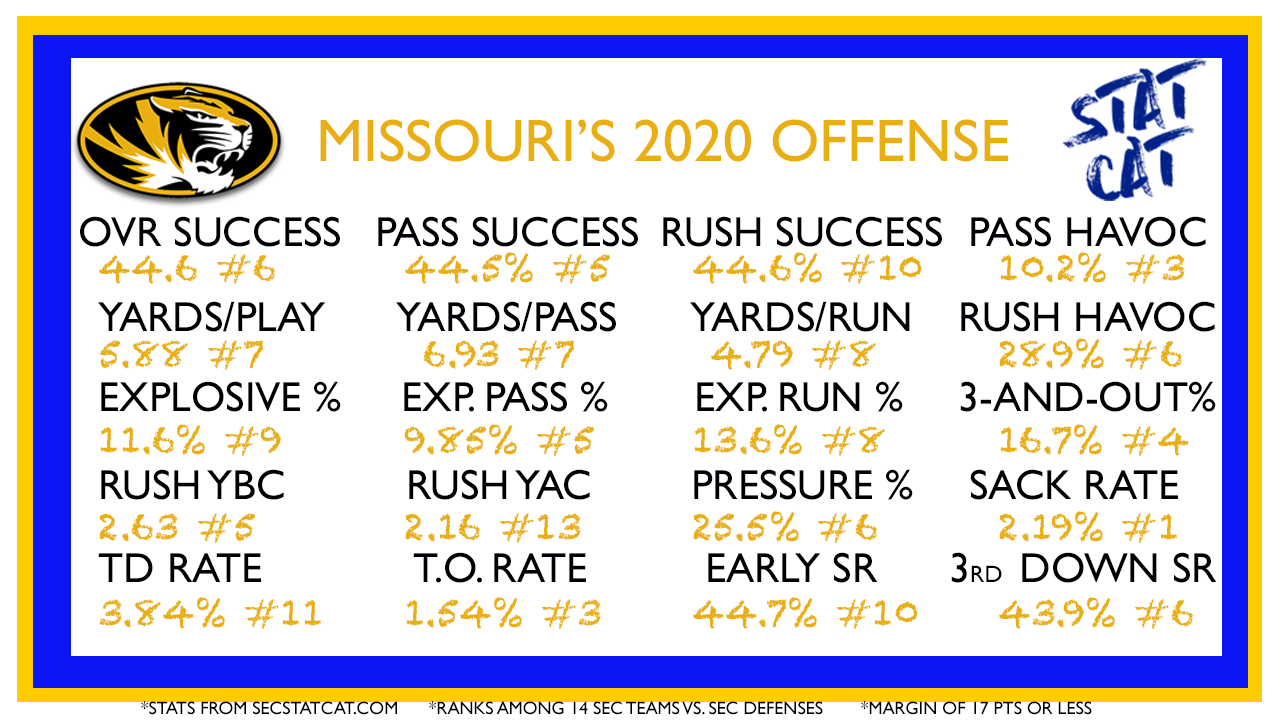
This time last year, the SP+ placed the Tigers in the triple digits. Oh boy what competent QB play, decent blocking, and a scheme with occasional razzmatazz can do for an offense! Call it the Drinkwitz Effect, the absence of Derek Dooley, or luck, but Missouri was one of the most improved conference offenses in league play. Their overall Success Rate climbed over nine points, their 3-and-Out Rate plummeted 13 points, and their rush yards before contact average climbed by nearly a yard. While the first two increases rank as the third highest year-over-year jumps within the SEC, the latter was the conference’s biggest uptick. All in all, Mizzou overly went from a bottom5 offense to a middling and serviceable unit. After having none of their 20 major metrics crack the conference’s top5 in 2019, seven reached that threshold this past season including its 2.63 YBC clip and SEC-best 2.19% Sack Rate. To reiterate on the OL section, establishing a healthy front was paramount for the new staff to lay its groundwork and compete. Behind more room to operate, the Tigers’ Rushing Success Rate and Yards/Carry improved by the 2nd-highest figures at 11.5 points and 0.9 yards, respectively. This summer, Drinkwitz has stressed the continued progress of his line. If the Tigers’ big boys play well, they’ll have a fair shot to win and potentially clip a few conference opponents.
Though Drinkwitz might want to keep playing small, this offense could buy itself some margin of error improving its capacity for big plays. While the Tigers’ 11.6% Explosive Play Rate ranked 9th, their 3.84% TD Rate was the SEC’s 4th-worst. The group was okay with chunk passes on occasion; but still less than a tenth of their dropbacks birthed a gain of at least 20 yards. Plodding ahead, logging a lot of snaps, and testing your 3rd down skills over and over is certainly one way to do it. But, it puts a lot of pressure on your offense to lurch forward and avoid wasting downs. Plus besides being aesthetically pleasing and a great ploy to get butts out of seats, explosive plays matter analytically. Drinkwitz is a smart fellow; so he ought to be aware of similar findings that the highest correlating factor the SEC wins the last three years has been the victor the big play battle. The team who logs more 20+ yard passes to 10+ yard runs has won 63% of games — more than turnovers, middle 8, and time of possession. With Bazelak progressing, Tyler Badie ready to be unleashed, and a few capable receivers back in the fold, perhaps Drinkwitz opens it up a bit more. Looking at his defense, however, he might just be inclined to grind out games by keeping his offense on the field.
Key Defensive Metrics in SEC Play
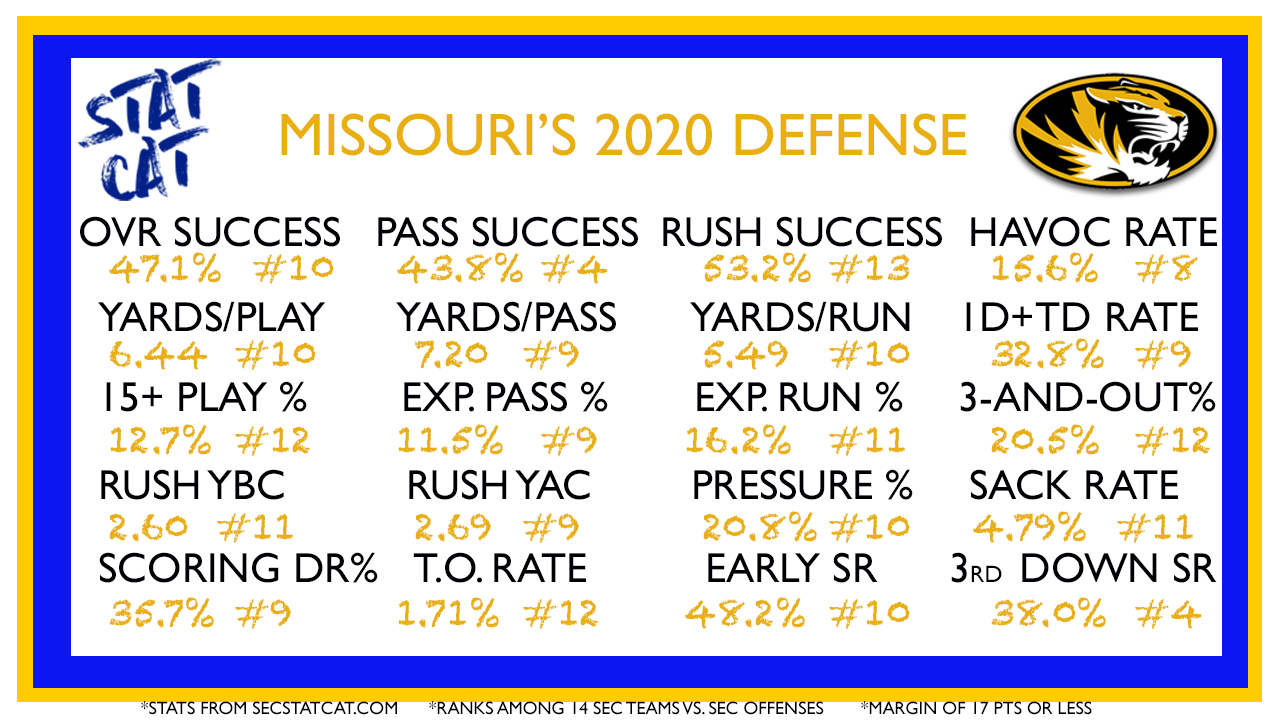
As an offensive guy, I generally gloss over defensive previews. Not that I don’t think individual defensive players aren’t valuable or dislike a blindside sack or athletic INT every once in awhile, but I typically treat that side of the ball as a collective unit. As only one guy, I can only track so much, yanno? You won’t get many fun defensive nuggets from me. That said, Missouri’s defense regressed hard without the rock of Barry Odom’s influence. Though the Tigers’ offense experienced year-over-year improvements, their defense overly deteriorated. No SEC unit’s Success Rate, First Down+TD Rate, or 3-and-Out Rate worsened by a larger figure. Outside of their down-to-down Passing Success Rate and 3rd Down Conversion Rate, none of their major metrics finished among the conference top5. On the other hand, over half of their 20 stats on their profile graphics finished 10th or worse in league play. Since defenses live to create on-off situations like 3rd downs, replicating their 38% such Success Rate should be heavily pursued by incoming defensive coordinator Steve Wilks. But often unique situations with lots of variables, reproducing adequate execution doesn’t always come easy in those spots. Plus, it’s called the do or die down for a reason. Just because this defense managed to stay alive last year riding their might on thirds, they very well could be killed by them this year.
Just like their counterparts, the defense needs to work on explosive plays. Back-to-back years, the Tigers have finished inside the SEC’s bottom5 in 15+ Play Rate while delivering below-average Explosive Pass and Run Rates. Naturally being prone to surrendering sizable gains has ballooned Missouri’s Yards/Play as a result. Wilks’ preachings must help out this unit be less susceptible to field flippers in an attempt to play more bend-don’t break. It’s overly a worse case scenario when you allow hefty gains, struggle creating takeaways, and can't ward opponents from scoring. Obviously easier said than done, he wasn’t hired to do a crappy job and see this unit sour even further under his watch. Addressing its down-to-down consistency should be in the discussion, but the main talking points for this new defensive braintrust should be to cap foe’s explosive plays.
Glancing at Missouri’s Schedule
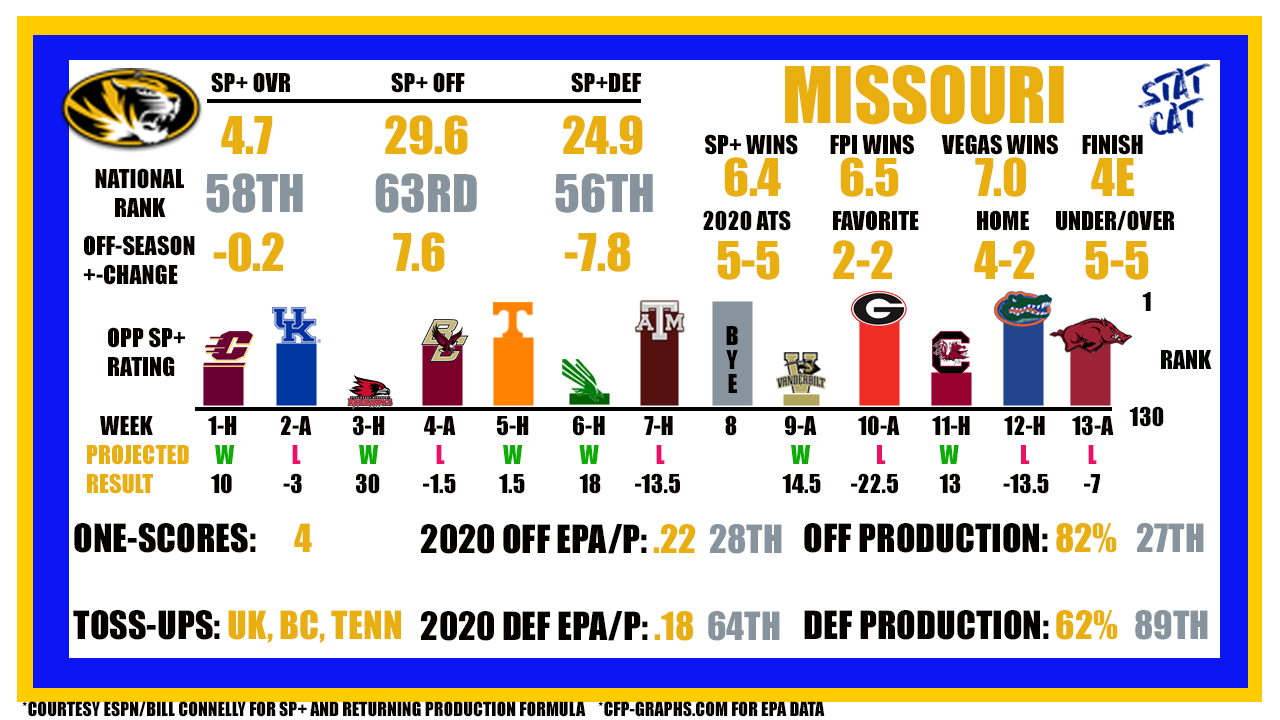
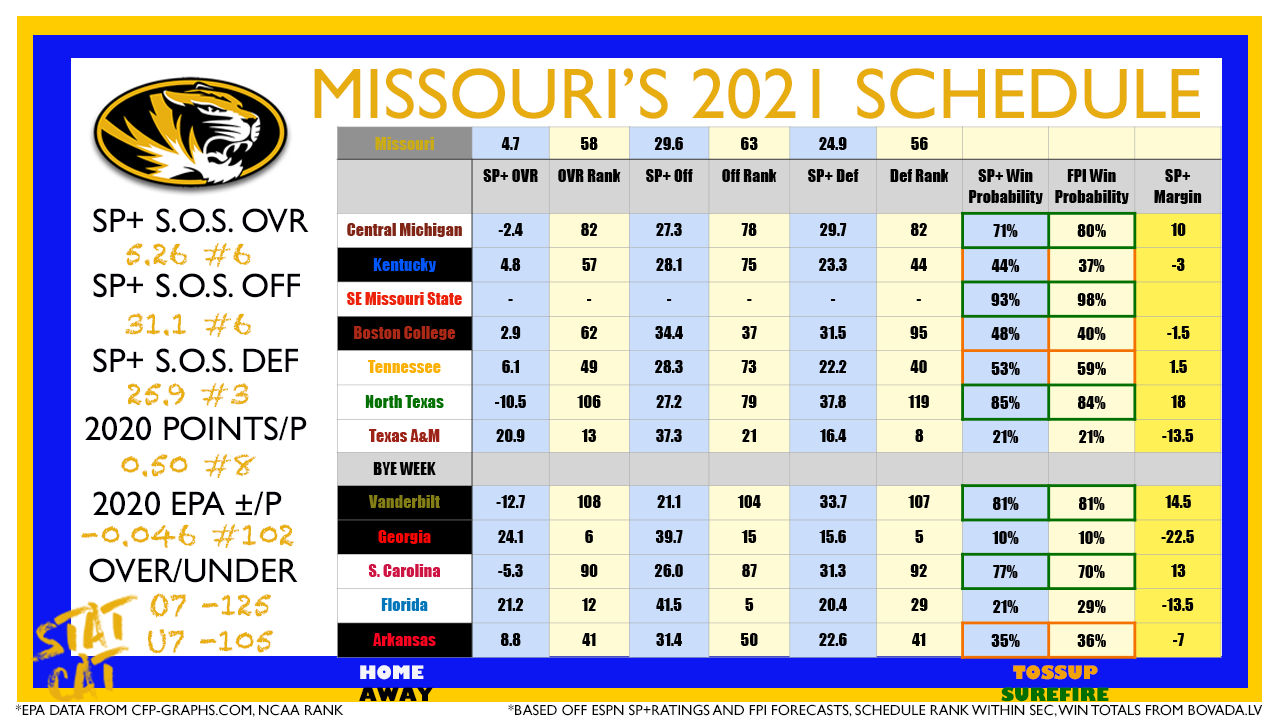
After the Tigers beat their 2020 expectations, ESPN’s SP+ has them right back in the thick of things in the SEC East. On the surface, six wins present themselves; five of which project to be double-digit victories. Assuming the Tigers can take care of business against its non-conference foes and the lesser teams in the division, Drinkwitz could deliver one helluva encore if the Tigers win their three tossup games against Kentucky, Boston College and Arkansas. Again, most expect Missouri to go bowling (ESPN’s Football Power Index gives them an 86% probability). But, bettors will be keyed on how things shake out regarding their one-score matchups. Since the Tigers’ current under/over win total is set at 7, Missouri has to win all of the games they’re supposed to in addition to those tossups (or get lucky against one of the three conference big dogs they face) for the over bet to come through. Looking at the schedule, degenerates won’t have to wait long to get a fantastic read on their wagers. Two of their one-score games occur during the first month of the season. Then in Week 5, Missouri hosts Tennessee in what forecasts to be one of their most contested victories. If Missouri splits or goes o’fer in those contests, Drinkwitz’s dissenters will be sitting pretty. Outside of the UT game, all of Mizzou’s one-score matchups occur on the road. And because of that, they are viewed as underdogs in each instance. Keep in mind, the Tigers went 1-3 outside of Columbia last year. Again while the odds like their chances to get to six wins, there’s a conceivable chance this team enters its bye below .500 if the road woes continue.
Playing in the East has the Tigers schedule on the softer side; especially offensively. Among the SECers, only Kentucky and Texas A&M collectively face less-challenging defenses in the eyes of the SP+ this season. Excluding FCS foe Southeast Missouri State, five of their opponents enter this season with a defense rated lower than 80. Boston College is one of those teams. As a top30 team in Expected Points Added/play and returning 82% of its offensive production, those matchups bode well for the Tigers despite rating as the 63rd unit. On the other side of the ball, six of their adversaries fall outside of the Top50 with two being UK and UT. The aura of Drinkwitz is palpable and easy to buy. But banking on getting by off a slim margin of error with so many close calls littering Missouri’s slate doesn’t seem to be in the Tigers’ favor. Both the SP+ and FPI projects this team to fall short of its set under/over win total. On both sides of the ball, the numbers and eye test agree that there’s a couple of missing elements in order for Mizzou to vault into another echelon. The SEC media concurs by picking them to finish 4th in the division.