2021 Vision: Previewing Tennessee
2021 Vision: Previewing Tennessee
With talking season winding down, preview season is among us! I'm sure this isn't the first preseason article you've viewed. You should know the drill by now with these bad boys. But if this is your first experience with StatCat, be ready to learn a thing or two about the Volunteers' three QB options, receiver room, rushers, OL, its most important stats to maintain and/or improve on both sides of the ball, and how South Carolina's schedule breaks down with help of ESPN's SP+ Rating!
Tennessee Passers
In terms of strategy, Tennessee’s passing game shouldn’t look too different. Tactically and stylistically, however, the Vols are set to scrap the old ways of doing things in favor of something more modern. The ample shots seen in Jim Chaney’s scheme should remain. But behind the “Baylor Spread” — or “Super Spread” for some — pace and spacing will be utilized like never before seen in Knoxville to maximize targets outside the numbers. The idea of running as much plays as possible and amplifying potency while simultaneously limiting risk is nothing new. And, plenty of teams have had fun taking presnap horizontal splits out-wide to the furthest extreme. The end game aims to isolate a playmaker one-on-one and win with an up-and-down route tree. The added tempo both aims to stress defenses lining up before the ball is hiked and winds coveragemen who might be asked to stop three straight shot plays. As opposed to being a secondary plan once the ground game stutters, vertical choice designs paired with copious no-huddle will now be this offense’s identity under Josh Heupel.
Naturally with a new offensive that plans to whip the ball around a considerable amount, the QB battle has taken center stage. Returning sophomore Harrison Bailey as well as veteran transfers Hendon Hooker and Joe Milton are all up for the job. None are necessarily statuesque passers, but the two newbies are far greater rushing threats than the sophomore. While natural playmaking abilities certainly will help the Vols find victories in the margins and negate mistakes, deep passing acumen should play an immense role for whomever ultimately wins the gig. In their previous schemes, Milton was the most vertical of the bunch with a 16.6% Deep Pass Rate. On the other hand, Bailey and Hooker only combined for 14 such attempts last year. With a mere seven 20+ chances a piece, that’s hardly a sample to build much of a case around. But for what it’s worth, Bailey drastically underwhelmed sporting the SEC’s worst Deep Accuracy% at 14.3%. Hooker managed to complete three of his attempts, but two were interceptable with one resulting in an outright pick. Despite being utilized more than that fashion than his new teammates, Milton was just as likely to toss an accurate deep ball as an interceptable attempt (19.1%). Only six of his 21 such passes resulted in a completion. At least, two of them resulted in points. Though throwing bombs in camp isn’t the same thing as slinging live rounds in conference action, one of these three has to emerge in that department soon. No doubt practicing dingers all off-season should refine their ball placement. But, reasonable expectations still must be met.
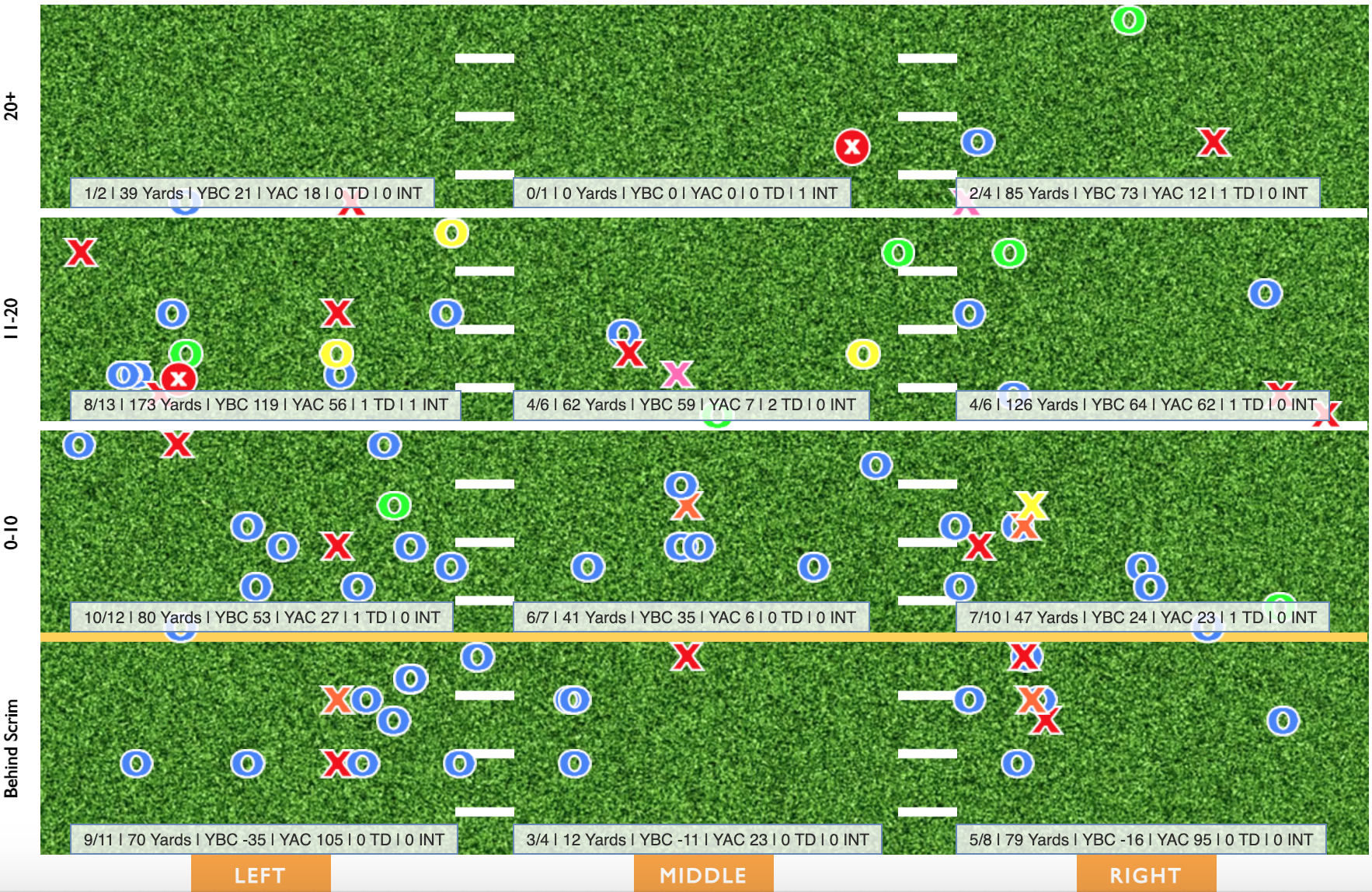
Hooker's Pass Chart vs. UNC (2H), Miami, Liberty, and Pittsburg
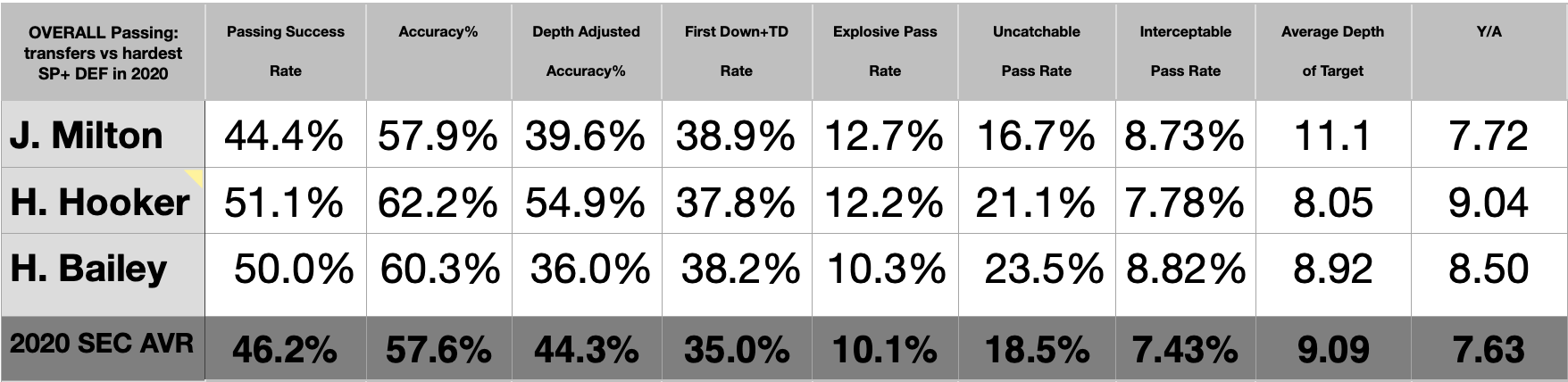
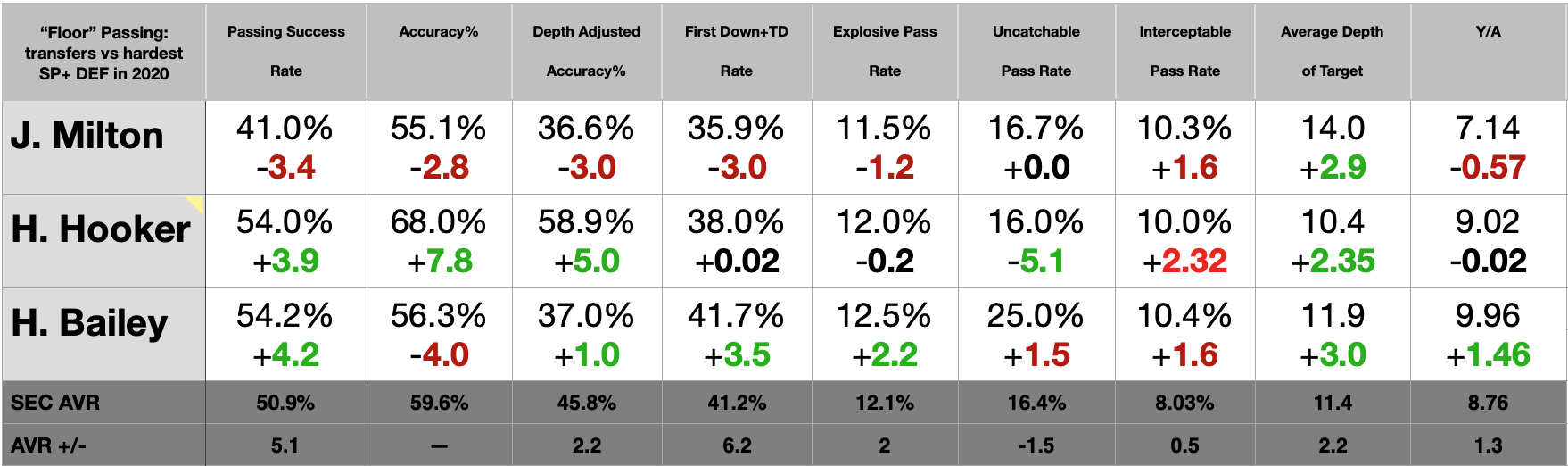
Deep passing ability aside, Hooker seemingly offers the highest floor. In a sample against his four hardest foes in the SP+ (whose average weight equaled the score of a typical SEC defense), he put up a Passing Success Rate over 50%, an Accuracy% in the 60’s, a Yards/Attempt over nine yards, and averaged a gain of 20 or more yards on an eighth of his throws. If we were to measure them against the 11 conference returners who logged significant snaps, all three would be top3 worthy ahead of this fall. But his scheme at work at Virginia Tech hardly asked him to do too much through the air. VT’s go-to pass concepts were riddled with curl+flat and spacing patterns meant to stretch opponents laterally. Nearly 59% of his sample’s throws failed to travel beyond ten yards downfield last year. Sure you can make the case his bottomline could’ve been boosted had his receivers not dropped about 9% of his targets, but projecting a 7.8% Interceptable Pass Rate and 21.1% Uncatchable Pass Rate on a would-be bottom3 average depth of target doesn’t reflect great throwing ability. So as nice as his 54.9% Depth Adjusted Accuracy is, that figure is immediately undercut by how Hooker was asked to operate. For what it’s worth, his 27.8% screen+RPO makeup would have only trailed Feleipe Franks and Bo Nix within the SEC last year. Breaking out those friendly tactics and measuring him from strictly dropback attempts when unpressured, Hooker’s profile more or less remains the same. He targeted relatively short, showed sound down-to-down accuracy and consistency, but failed to maximize moving the chains or diminishing risky throws. A tenth of his throws had turnover-worthy potentially, which is a great, big ole red flag. And, it’s never the best look when one’s Y/A moves backwards in this context. But it wasn’t exactly a major secret that Hooker’s biggest upside resided in his legs. From a versatile script of Power Veers/Tosses, Counter wrinkles, OZ Reads and Stretches, he logged a 7.54 Yards/Carry, 48.7% Success Rate, 28.2% Explosive Run Rate and Broken Tackle Rate. Plus, his 2.90 YAC average is very good for a QB.
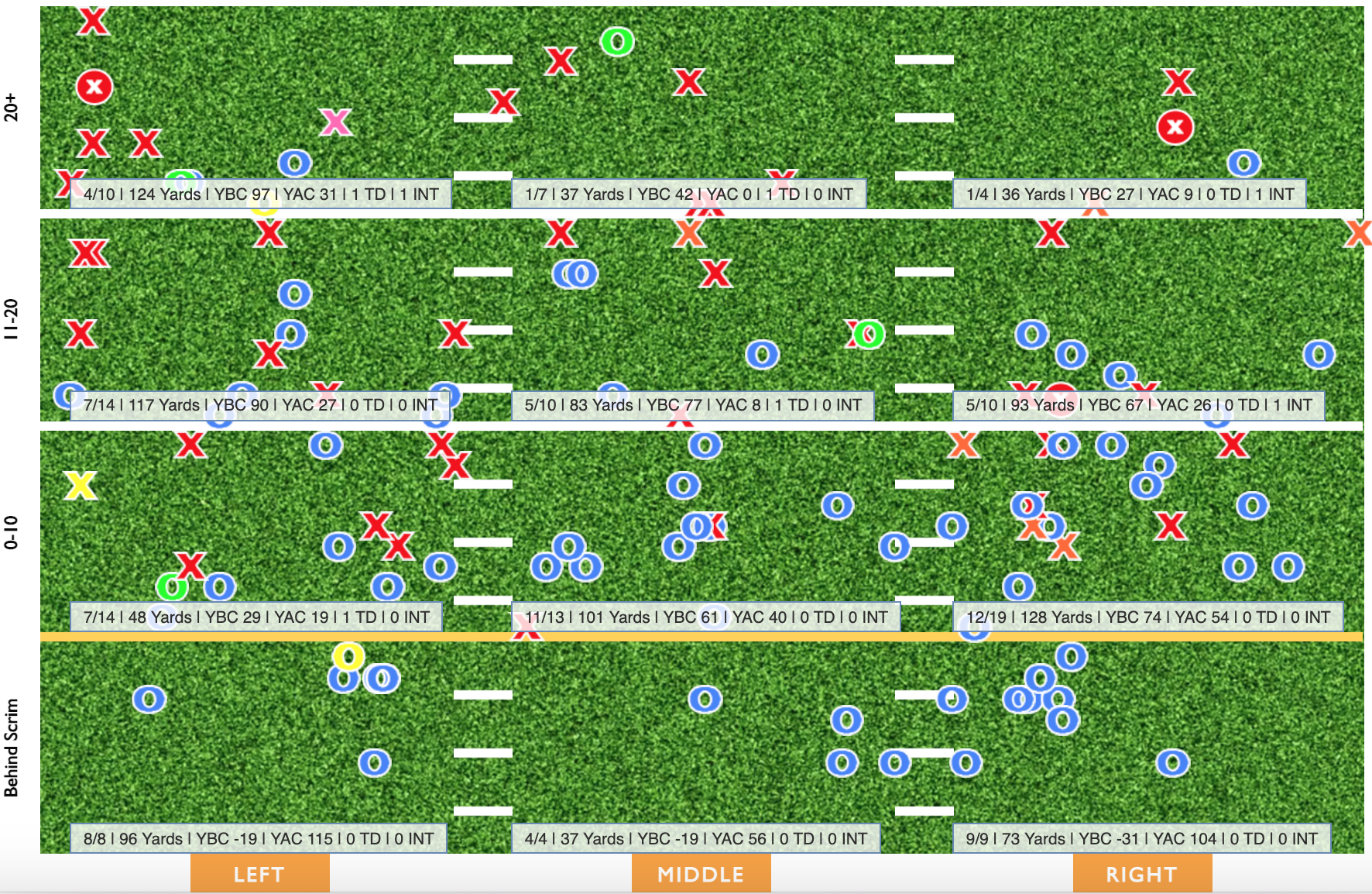
Milton's Pass Chart vs. Minnesota, Michigan State, Indiana, and Wisconsin
Despite having more girth to his frame, Milton also operated as a down-to-down ball carrier for his offense. That said, the former Michigan Man was utilized far less in the read game option. Instead, his work predominantly came via Q-power designs to the outside from nub formations. Commonly opposite RPO outlets like a bubble screen or slants, pin-pull Bases and Buck Sweeps buoyed his returns. Across his sample’s 15 designed carries, Milton put up a 6.27 Yards/Carry, 46.7% Success Rate, and 20% Explosive Run Rate yet only broke a single tackle. Though lacking to the former Hokie, these returns are serviceable enough. Plus, Milton is considered the more threatening downfield thrower of the two. Off a would-be 2nd-highest average depth of target, Milton projects to be a bang-for-buck passer ala his 38.9% First Down+TD Rate and 12.7% Explosive Pass Rate. While his 7.72 Y/A would be deemed top5-worthy, both of aforementioned those clips would hold the SEC’s bronze medal amongst returners. Though targeting Shot Variations and All Verts inflated his degree of difficulty, Stick concepts with slants were overly Michigan’s favorite patterns. In the end, his down-to-down process metrics are humble at best. Milton’s Success Rate, accuracy figures, and Interceptable Pass Rate all forecast mediocre or worse returns. And unfortunately, his outlook deteriorates when analyzing his floor. Clean+dropback situations are meant to strip away the superfluous elements of scheme and potential excuses. With less mess fudging the operation, a clearer picture of one’s down-to-down play within structure is created. Despite the sterile environments, Milton’s stats sunk across the board, which is extremely alarming. No other individual conference contemporary saw more than four of their such stats slide in this context, but seven of his figures dipped compared to his overall numbers. His “floor” Success Rate, Depth Adjusted Accuracy, First Down+TD Rate, and Yards/Attempt sit in the SEC’s bottom3. His arm might have more raw “talent”, but his past results present an enormous amount of pause.
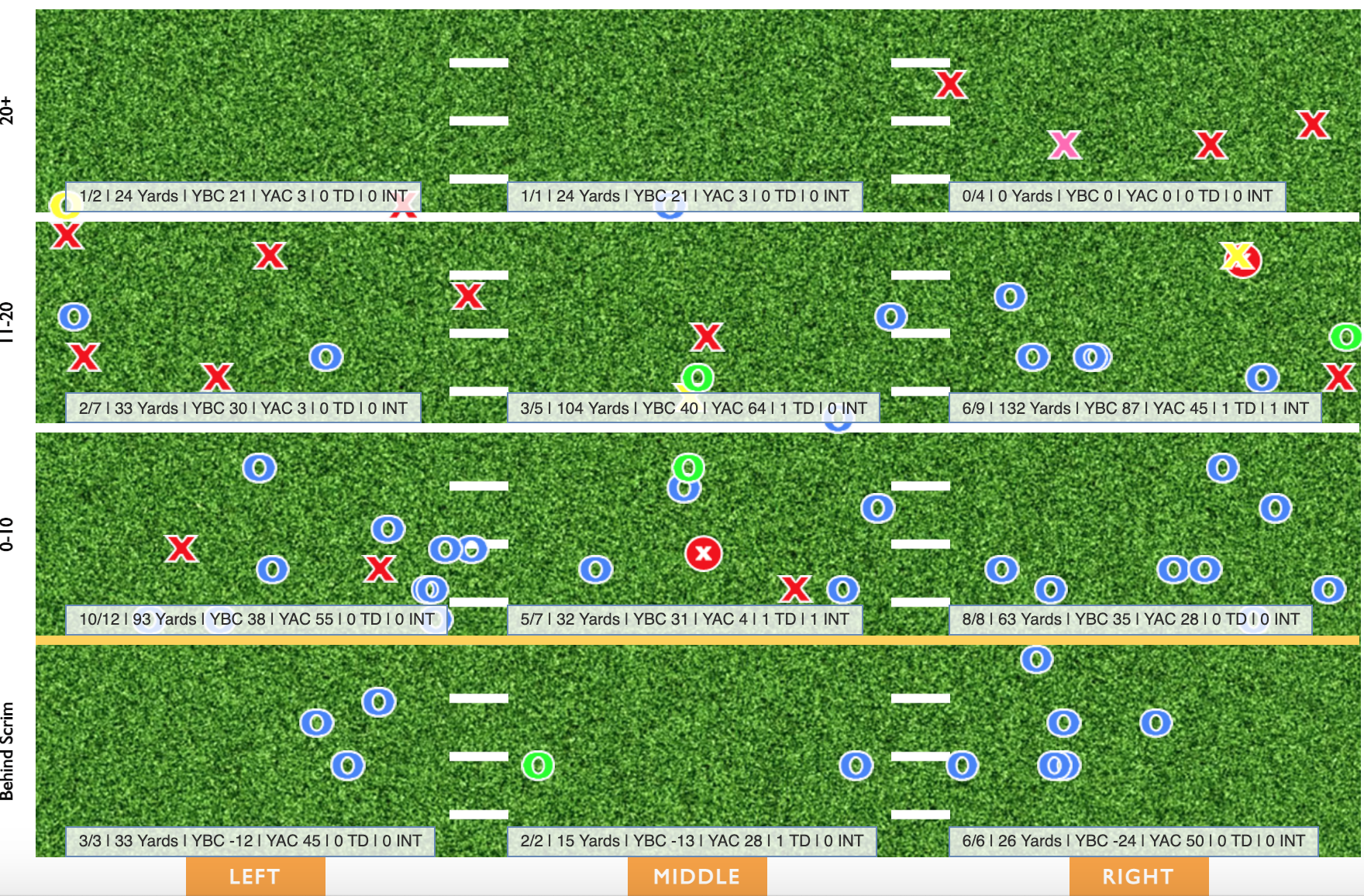
As a freshman, no doubt Bailey’s overall profile left plenty to be desired. Both his overall and “floor” output reflect a passer that snatched some completions but operated from a flawed process. While some of his result-based metrics stood out, his 36.0% Depth Adjusted Accuracy and Uncatchable Pass Rate are the lowest among his conference contemporaries while his 8.82% Interceptable Pass Rate is well into the danger zone as a bottom3 figure. But one of his best selling points comes from his output on first downs. Though Chaney was all about establishing the run (even when the evidence supported that he should’ve dropped back more early on), the current staff certainly will lean into passing more to start a set of downs. In those spots, Bailey commands the top Success Rate, Depth Adjusted Accuracy, First Down+TD Rate, Uncatchable and Y/A within the conference amongst returners. Plus, his first down Interceptable and Explosive Pass Rate are top3 worthy. As the most common situation in the game, these snaps generally are used to help prognosticate a QB’s production. Bailey also stands to be the SEC’s best short range thrower ahead of 2020. Perhaps a moot point due to the aforementioned strategy, but vertical choice routes still snap short when given ample cushion. That said, his down-to-down accuracy needs to significantly improve — especially attacking deep — if he wants a true shot at running out the the ones this fall.
Tennessee Rushers
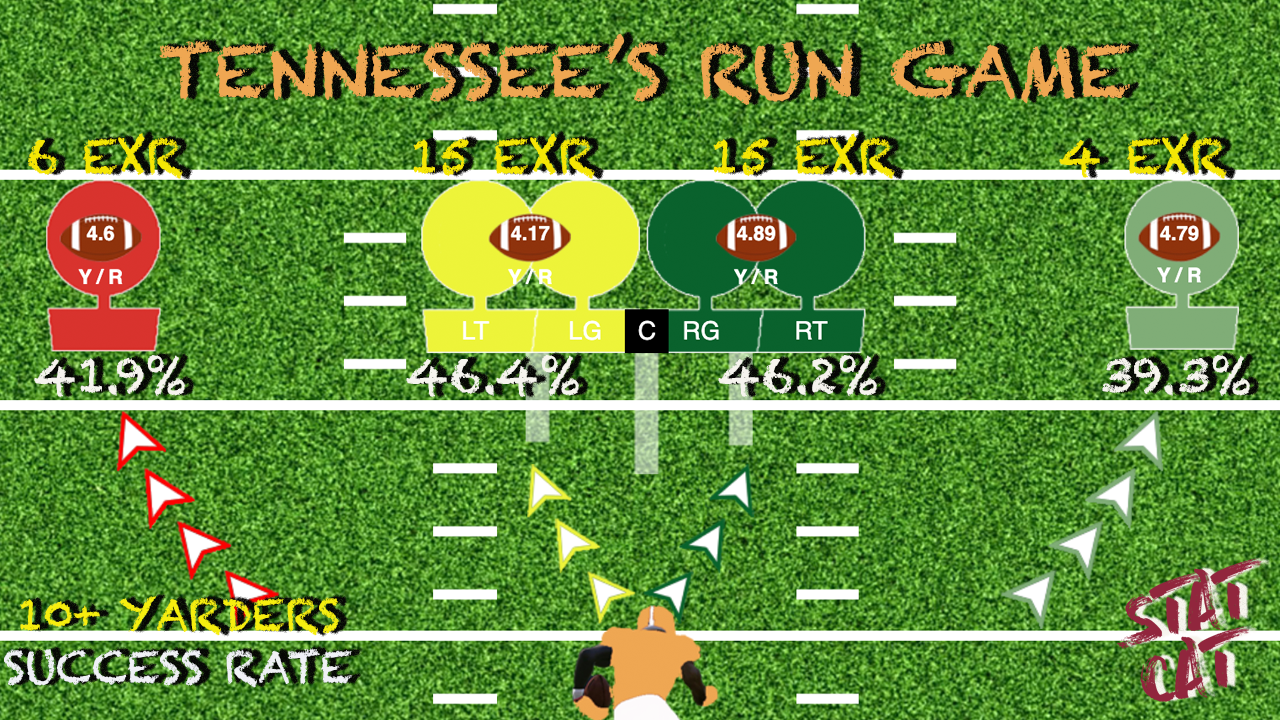
Big Orange’s running back room will be green. Any bit of numbers analysis would be a complete waste of time considering the most productive returning rusher only amassed 26 attempts for 117 yards in spot duty. That said, seeing where the previous staff left off on the whole could be beneficial in setting benchmarks for the new staff to beat. Last year wasn’t particularly kind to the Vols rushing game. Not that the Pruitt Era was known for a gashing ground games (for the most part, it was often quite the opposite). But, year-over-year against SEC opponents in meaningful minutes Tennessee’s Rushing Success Rate increased 7 percentage points to a 43.7% clip, which was fueled by the team's best rush yards before contact average since 2017. The average amount of cushion increased by over a half yard. Despite the uptick in consistency, they still remained 12th inside the SEC in Success Rate. For the third straight year, Tennessee finished with a bottom4 Run Havoc Rate, Explosive Run Rate, and Yards/Carry.
The past stylings of this ground game included an inside zone-based approach from multiple sets at a slow, lumbering pace. In other words, the previous staff really wanted to take the air out of the ball. Pruitt’s offenses generally averaged 20 less plays/game than Heupel’s much because of the differing philosophies behind tempo. With the former Vol coach being a defensive guy who recognized his team’s shortcomings, he opted to play small, bank on winning on 3rd downs with the occasional splash play, and execute sound defense. This old school approach begat the conference’s 4th-lowest Pass Rate in meaningful minutes with the 3rd-lowest on first downs. Though Chaney dabbled with no-huddle stuff on occasion, results tended to be modest. To be determined on what the results will be under Heupel, but pace will be used aggressively and with purpose. If Ole Miss or Arkansas' offense caught your eye last year, Tennessee is determined to join the party. Each scheme is rooted by the same idea and share many of the core run looks, which include standard inside zone, split zone, Y-Insert, counter, and bluff counter.
Jabari Small should be Tennessee's lead back. But at this point, it’s anyone’s best guess on whom wins the RB1 gig. Getting Tiyon Evans, one of the premier JUCO prospects, to remain committed after the coaching change was a huge win for this staff as was landing Jaylen Wright. Considering the dire need to round out this position group losing its two best guys to the transfer portal, finding two quality guys to step in and provide depth cannot be understated. Not that I care about spring games, but Wright looked capable even if he might not appear to be the most imposing ball carrier. Plus, Dee Beckwith showed some pop as a potential tertiary option. But again, that glorified scrimmage was only a small window into what’s been going on behind the scenes. Either way, it doesn’t make any sense for this staff to latch on to any one guy at this point in time. So this position battle is truly one of the most wide open the SEC has to offer ahead of 2021.
Tennessee Catchers
The operation for Tennessee’s pass catchers will be business as usual with the exception of the added pace. Though the overall verticality might improve, the Vols three main returning receivers averaged a 21% Deep Target Makeup. So again, it’s not like this trio will have to craft a completely new skill set. Big Orange’s pass catchers might not seem like an imposing bunch, but they’re absolutely competent enough to get beyond a coverageman and haul in a shot every once in awhile.
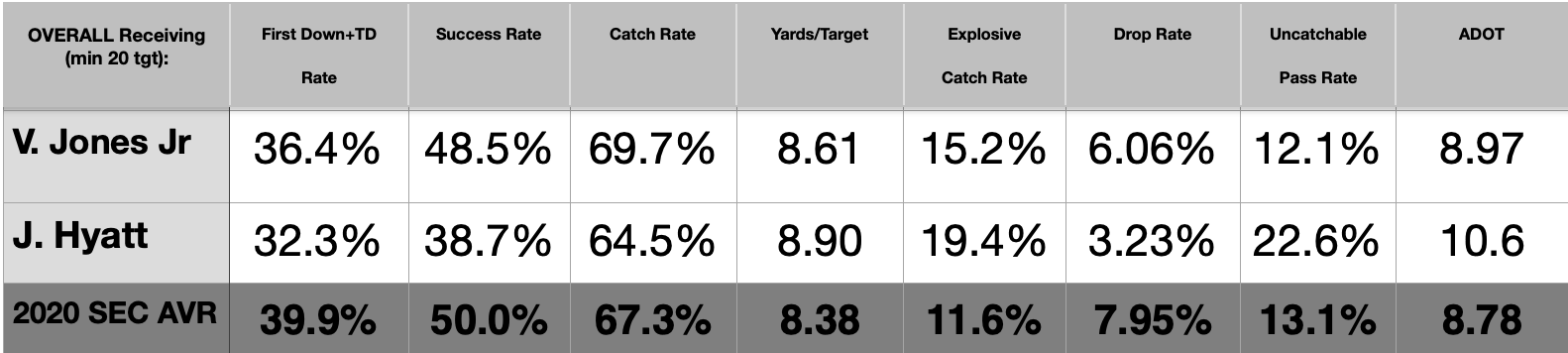
While the shot plays will get the headlines, whoever trots out with the ones better be smooth operators when secondaries provide cushion underneath. Velus Jones seemingly fits that bill. Along with being the Vols’ most voluminous returner, he is one of the best returning receivers after the catch in the SEC. Nearly 65% of his production came thusly as his 8.00 YAC average is the conference’s 4th-highest among non-running backs. Though it remains to be seen if Heupel fancies utilizing Jones via Utah tap passes or threatening as an at-the-motion threat, he knows that option is firmly on the table. For what it’s worth, that route accounted for his most targets followed by fade and back shoulders. All in all, his 48.5% Success Rate is the highest among team returners. If that figure sticks with the amount of volume and verticality he’s presumed to receive this season, he might finish with one of the more robust bottomlines in the SEC.
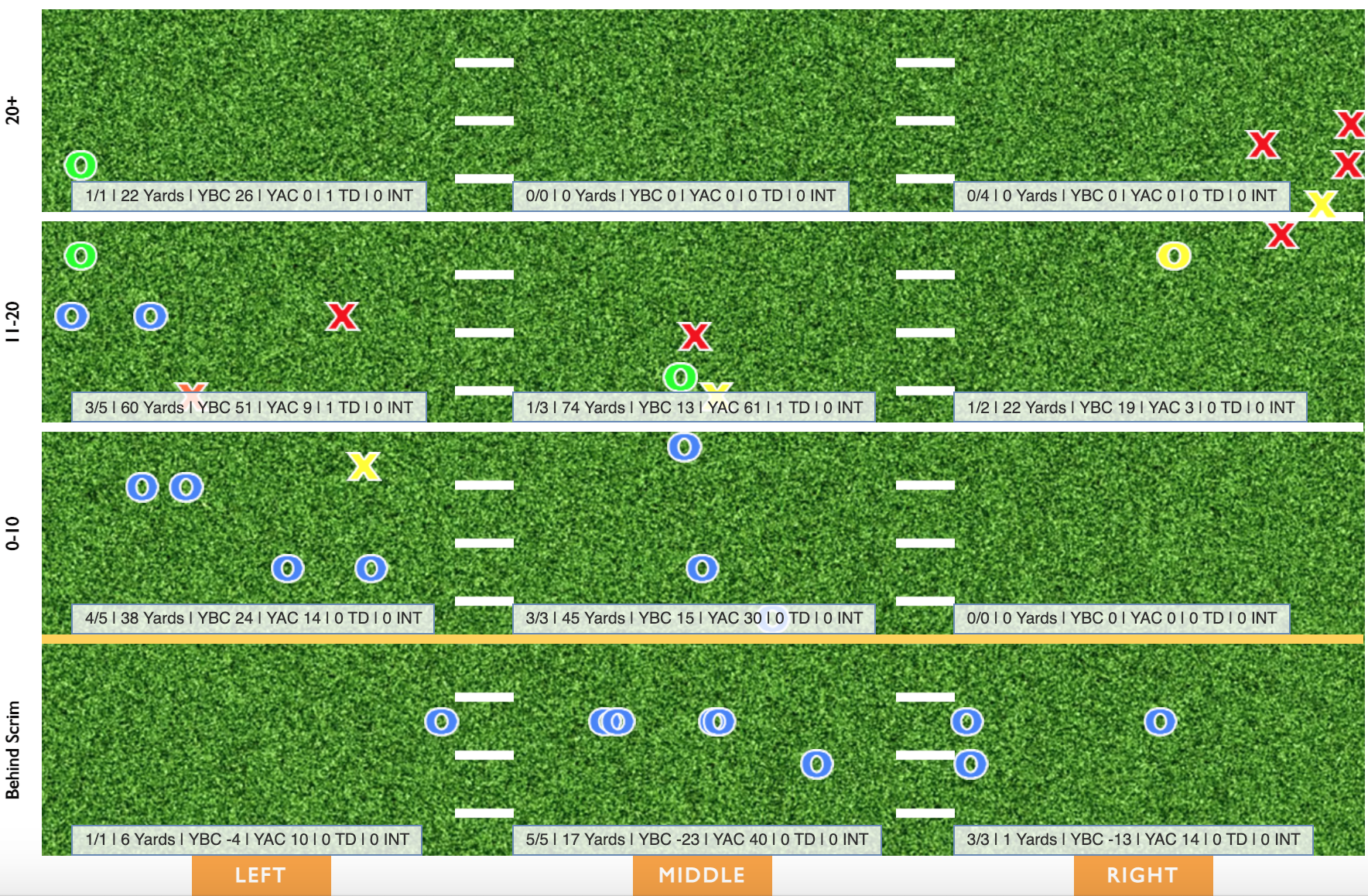
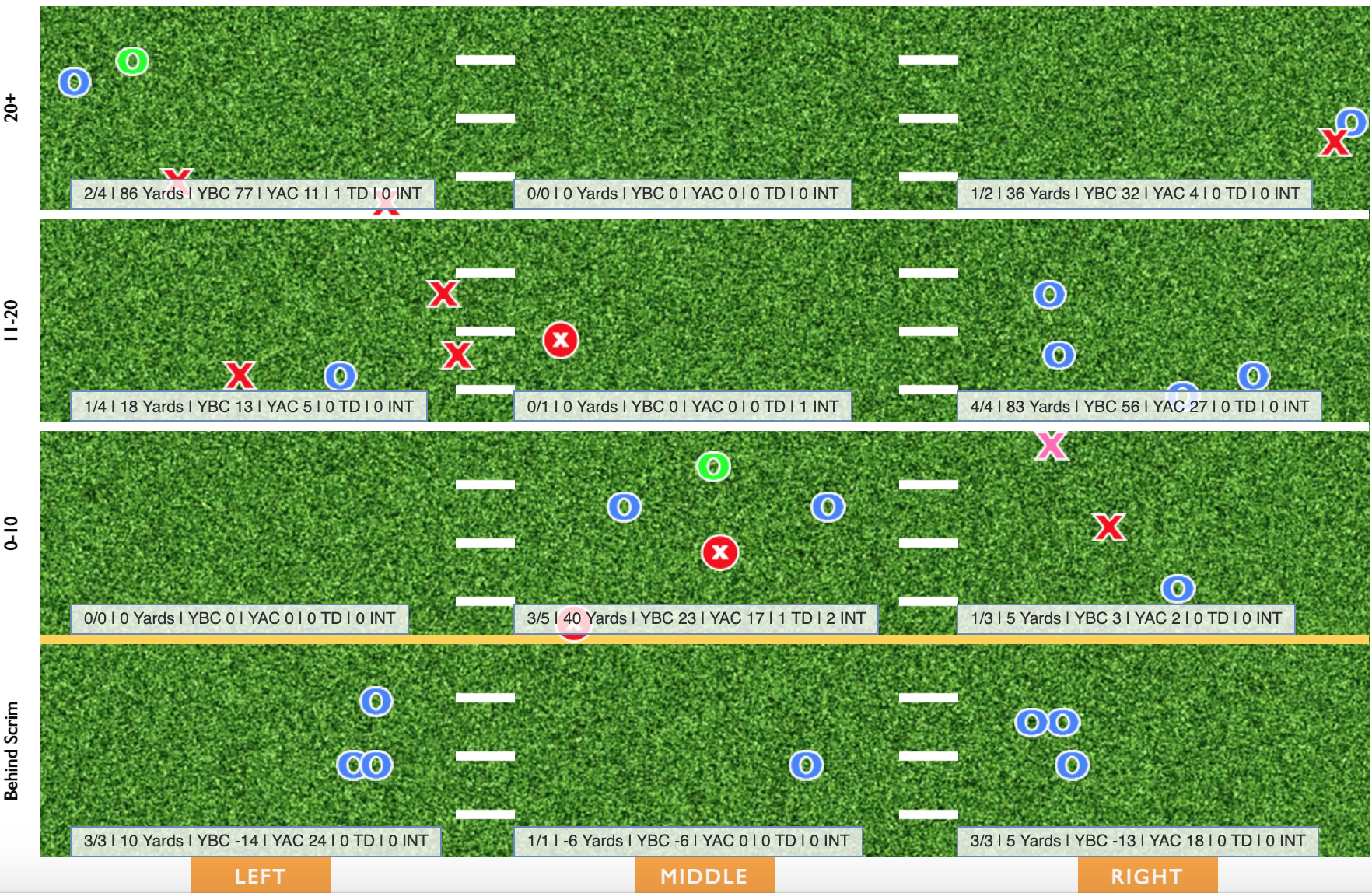
Velus Jones 2020 Target Chart Jalin Hyatt's 2020 Target Chart
Jalin Hyatt finished right behind Jones in terms of the counting metrics. And based on his previous explosiveness, the sophomore has a good as a chance as anyone to finish as the Vols’ top receiver. Fittingly for a player forecasted as a deep specialist, his most targeted route was a fade, and he managed to haul in half of his 20+ targets last year. In addition to logging a team-high Yards/Target and Yards/Catch, his 19.4% Explosive Catch Rate is the 4th-highest amongst his conference contemporaries. That level of potency against a 22.6% Uncatchable Target Rate hints Hyatt is capable of even more incendiary figures. Plus, he only logged one drop last year. He might not finish with the best down-to-down numbers, but Hyatt’s traits make him a very important cog for this offense.
Cedric Tillman, former-Mississippi Stater JaVonta Payton, Ramel Keyton, and Jimmy Calloway are the candidates to round out this position group. Considering their collective lack of sample size, StatCat isn’t going to try and pretend to be any bit of soothsayer to what these dudes might do in new roles. Ranging from 6’1-6’3, all have adequate size and upside to immediately produce. But, that’s incredibly wishful thinking based on the small on-field workload. Still, the odds are pretty good for at least one of these guys to break through and be a fruitful target in Heupel’s passing attack.
Tennessee’s tight ends are bound to continue their low usage and overly function as supplementary offensive lineman for the majority of their snaps. But, Princeton Fant and Jacob Warren will look to have a healthy rotation and offer serviceable hands. When this trio has been thrown the ball, they’ve so far been fine. But thanks to the modest parts they were asked to perform, their combined figures won’t blow anyone away. Still for what it’s worth, they’ve totaled 18 catches for 181 yards on an 83.3% Catch Rate the last two seasons. After all, these guys are converted wide receivers; wouldn’t you expect a halfway decent stat line? While they might not be asked to venture downfield too often, they have to provide value for the Vols in their limited opportunities.
Glancing at Tennessee’s Offensive Line
Like the Pruitt offense as a whole, the Vols’ front five has generally been a letdown over the last three seasons. In that span, Big Orange squeezed out a bottom5 rush yards before contact average in SEC play. As plenty of folks have seen, getting whipped more often than not in the trenches rarely yields good returns in this conference. After logging a forced fumble or contact behind the line of scrimmage on over a third of their designed carries since 2018, Tennessee has ranked 10th or worse in Negative Play Rate. You don’t get results like that unless there are some problems upfront. In turn, the early defensive engagement overly capped Tennessee’s efforts on the ground. Though UT had some capable backs, they faced the same level of adversity akin to that last glowing ember in the fire pit, which aches and yearns to keep burning into the night; only for some off-kilt bastard to come and piss it out. Like the Vols’ OL poor metrics would suggest, UT has finished inside the conference’s bottom5 the last three years in Rushing Success Rate, Yards/Carry, and Explosive Run Rate. On the other hand, their pass blocking has been sporadic. Though 2019 showed promise boasting a top3 Pressure Rate and top5 Sack Rate, the Vols were smacked with an 8.9% clip of the latter in the all-SEC gauntlet last year.
Tennessee won’t come close to making any bit of noise in Heupel’s first campaign by surrendering a similar figure to that gaudy mark. This offense is designed to erase moving backwards on occasion, but these underdog Vols can’t afford to make playing behind the chains commonplace. In other obvious statements, Cade Mays presumes to be this group’s best blocker. Though his past indicates he’ll continue at right guard, he has the wherewithal to flop around the front potentially filling it at left tackle. But assuming Mays stays put, his brother Cooper projects to be BO’s center. After a couple of spot starts last year, he seems capable enough. Either way, be ready for that Disney+ miniseries loosely based on the brothers’ exploits to drop in a few years. With Riley Locklear stepping away from the game, Jerome Carvin has the remaining guard spot on lockdown. Unless he flips to the other side of the formation, Darnell Wright looks to fortify the right side of Tennessee’s line at tackle, and offers incoming OL coach Glenn Elarbee some solace. Not that he’s a rockstar, but he’s a known commodity. On the flip side, the previous top-two options on the depth chart opted to dip set, which creates an interesting and important position battle. The left bookend could be veteran McMinnvillian K’Rojhn Calbert or the 6’7 hoss from Bluff City in Dayne Davis. No doubt, finding a bright spot on the blindside is crucial in order to round out this front and get the Vols playing competitively.
Key Offensive Metrics in SEC Play
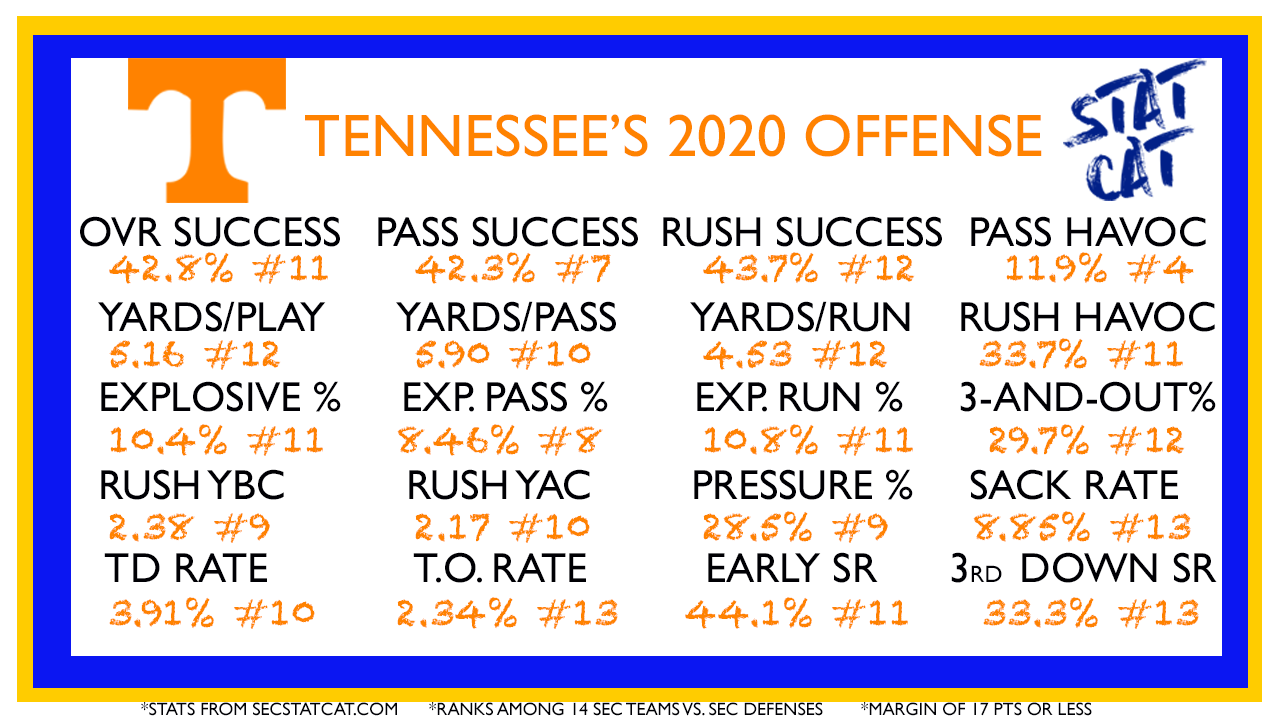
Riding behind an aggressive style that emphasizes speed, stamina, and shots, the single most important stat for the Vols will be generating explosive plays. Whether by ripping off chunk runs when the defense is gassed or late lining up or completing a deep ball when a coverageman is left on an island, these plays will decide if Tennessee contends or remains dismissible. Leaning into tactics to induce splash gains can be seen as an “all or nothing approach”. Well, based on the the recent events in this conference, Heupel might be onto something fading consistency in lieu of potency. No factor has had a higher correlation to victory in these conference the last few years than winning the explosive play battle. Roughly 63% of teams that have come out ahead in that statistical skirmish ended up ahead on the scoreboard. The returns for turnovers, the middle 8, and time of possession are still important, but they simply carry less weight than snatching big gainers. Heck, the Vols themselves have a decent case study for this theory. Two years ago, Tennessee closed hard and furiously down-the-stretch with six straight victories. The key to their wonderful turnaround? Besides being incredibly fortunate on the money down, only Alabama trumped the Vols Explosive Pass Rate within the SEC on both sides of the ball. Behind a small approach that relied winning situationally, the field flippers put the Vols in position to get points and squeeze out wins. But as execution dissipated, the Vols stumbled in 2020. In addition to seeing their top3 3rd Down Success Rate plummet to the SEC’s 2nd-worst clip, Tennessee’s Explosive Pass Rate fell below the conference average. Their overall clip of big gainers finished in the bottom4. Behind more downs and more opportunities, this offense’s total volume of splash plays should increase. But if the Vols want to beat expectations, these plays can’t be as infrequent as last fall.
Tennessee’s Pass Havoc Rate was the only one of their major metrics to finish in the SEC’s top5 last year. Inversely, 15 of their 20 such stats placed inside the conference’s bottom5 in league play. Though there is very little positive momentum for this offense to build upon, their performance limiting bad events when the Vols dropped back was commendable and should be looked to be maintained moving forward. Outside of allowing a poor Pressure Rate and the 2nd-worst Sack Rate, less than an eighth of UT’s attempts suffered from a form of havoc. No doubt the passing product is bound to increase with cleaner pockets and less chances under duress, but this aerial assault will have a hard time taking off if its QBs frequently put the ball into harm's way and have designs breakdown. The Vols have ranked 13th in Turnover Rate the last two years within this conference. While big plays hold more gravitas, gifting your opponent extra possessions is still a hard obstacle to overcome.
Key Defensive Metrics in SEC Play
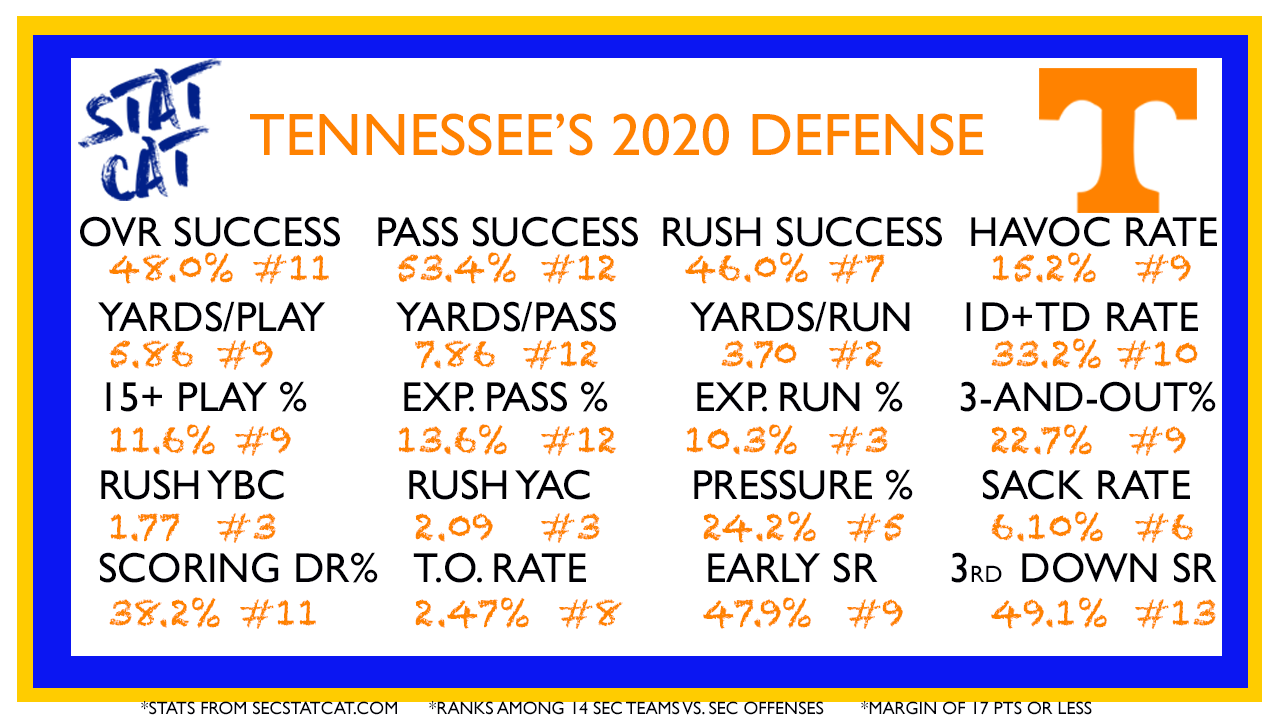
As an offensive guy, I generally gloss over defensive previews. Not that I don’t think individual defensive players aren’t valuable or dislike a blindside sack or athletic INT every once in awhile, but I typically treat that side of the ball as a collective unit. As only one guy, I can only track so much, yanno? You won’t get many fun defensive nuggets from me. That said, Tennessee’s defense was relatively weak in SEC play. Situationally, the Vols logged the the league’s 6th-worst 3-and-Out Rate, 5th-worst First Down+TD Rate, 4th-worst Success Rate, and 2nd-worst 3rd Down Conversion Rate. Coverage was an issue all season as the Vols finished inside the SEC’s bottom3 in Passing Success Rate, Yards/Pass, and Explosive Pass Rate. At least, they were adequate generating pressures and logging sacks. But when those events weren’t occurring, time and time again this defense faltered through the air. Against the run, however, Tennessee was one of the conference’s best units. Starting in the trenches, the Vols held opponents to the SEC’s 3rd-lowest yards before and yards after contact clips. The early engagement tended to cap opposing ball carriers to only an explosive run on a tenth of their tries. Per carry, only Georgia delivered a better figure than their 3.7 clip. Of the seven returning starters, the plurality land along the line. So with so many other areas to work on, it’s nice that the Vols should have a leg-up on the ground despite replacing a few backers.
New defensive coordinator Tim Banks has his eyes set on creating more havoc. In vacuum, these plays are overly desirable and certainly help make for a sexy defense. After all, what team doesn’t want to maximize pressures, sacks, TFLs, batted balls or break offensive designs? Leaning into disrupting opponents and getting them off-schedule is hardly a new concept. But those are often the elements in creating takeaways. Passively reacting to an offense is one way to go. But banking on them to make a mistake outright can take awhile. So to speed up their clock, trick their read, or test their acumen under the gun havoc plays help accentuate that process. But obviously these aggressive tactics tend to have a negative effect on one’s abilities to stop explosive plays. After all, LSU was the poster child for this conference’s havoc-driven defenses. Despite being the SEC’s best at creating such, takeaways, and winning on the money down, no defense put up a less preferable 15+ Play Rate. Considering the notion StatCat shared about how big gainers have fueled wins as of late, Banks’ plan could wind up failing spectacularly. At least, this offense is bound to help his own margin of error. But if the Vols themselves can’t stay on the field, a defense already planning to press might over-extend and get burned.
Glancing at Tennessee’s Schedule
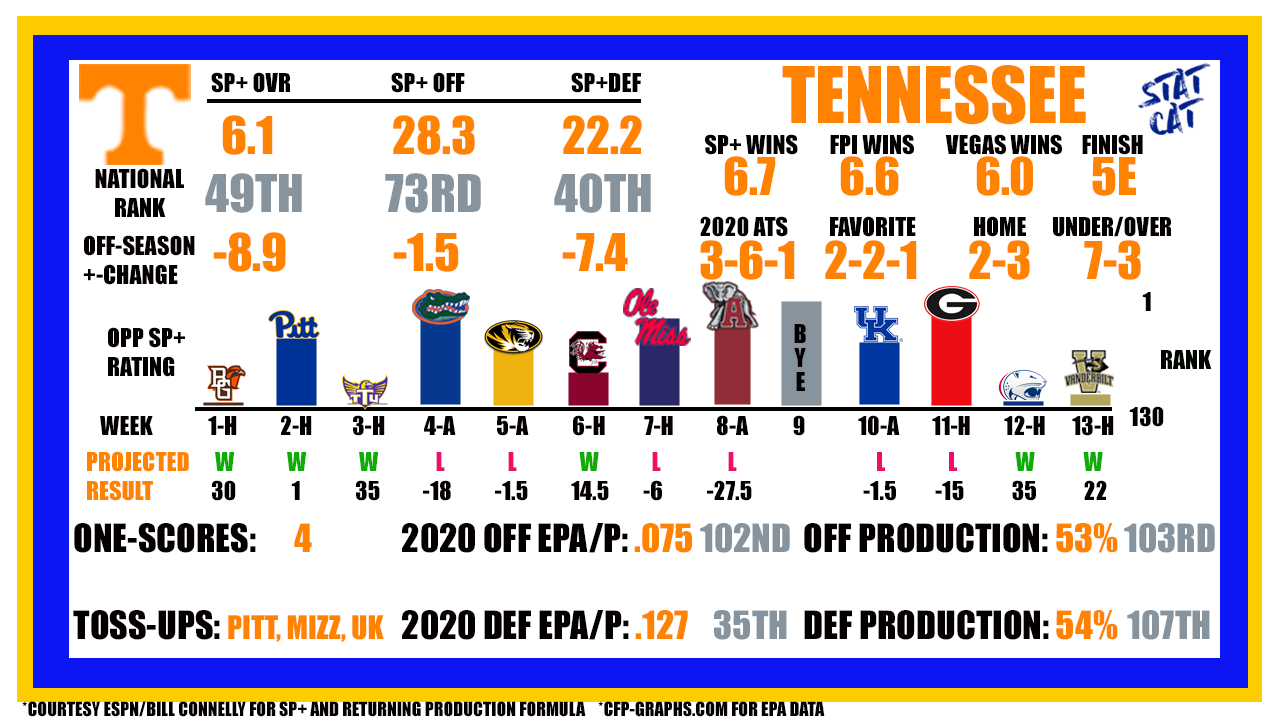
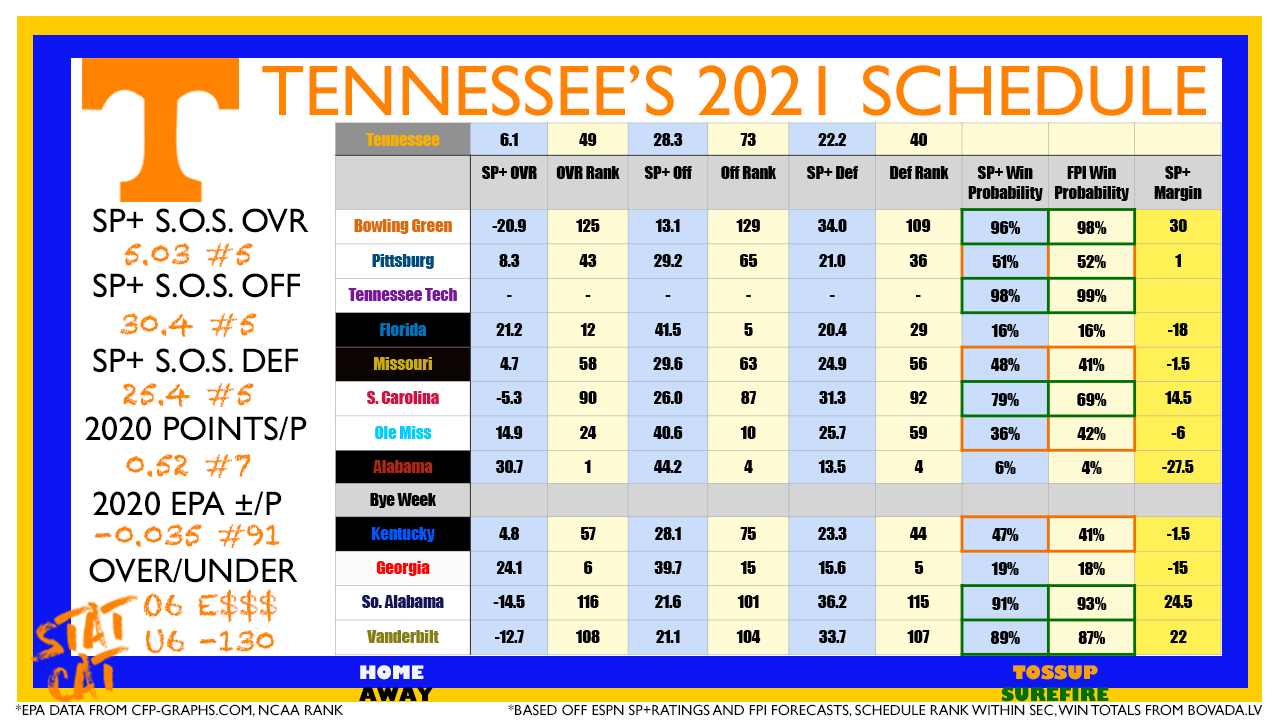
Despite losing a lot of bodies on both sides of the ball, most expect the Vols to bowl in 2021. Both ESPN’ SP+ metric as well as its Football Power Index projected Tennessee to have about seven victories when simulating the season. As a result, their current under/over Vegas win total is right at six — the threshold for bowl eligibility. Said departures and starting a brand new backfield has this team nearly nine points worse per that metric's standings. As one of the SEC’s worst units against the spread in 2020, deciding whether to buy or sell the Vols proves to be quite the quandary. Glancing across their slate, they’re outright favored in five games, four of which by at least three TDs. While having a slight advantage in a home tossup against Pittsburg, other one-score matchups include Missouri, Ole Miss, and Kentucky. Say the Baylor Spread slices and dices the SEC’s 5th-easiest schedule, eight wins is obtainable for Heupel. However, both the SP+ and FPI have the Vols as underdogs in all their conference games except Vanderbilt and South Carolina. Fitting for a team the media picked to finish 5th in the division.
Still, the Vols only need to nab one of its one-score matchups to earn a bowl bid. Though bettors will be hoping for an additional victory, a postseason appearance would undeniably be a step in the right direction for this program. The projected one-score tilt with Pitt in Week 2 seems like their best chance. Playing Mizzou in Columbia after spending the previous weekend in the Swamp diminished their odds of upending the Tigers. Capsizing the Cats seems like a more likely opportunity according to history, the fact UT is coming off its bye, and UK is returning to home after visiting Stark Vegas. Depending on the status of the team’s personnel following its off week, Tennessee could coast the final month of the season. Not to dismiss the Vols’ chances against Georgia, Florida, and Alabama. But, I am. StatCat would be utterly stunned if Tennessee clipped any of those conference blue bloods based on the construction of this roster. After all, Tennessee wasn’t exactly the most formidable group in league play before the flakeage. Five wins, four tossups, three losses. Though a bowl big is likely thanks to schedule whose head and tail are full of fat, Tennessee needs to win at least two of its 50/50 opportunities. Again, the odds favor the Vols besting their under/over line. And as of right now, it’s an even money pay day backing that proposition. But don’t discount the level of attrition this team suffered especially when squaring up with SEC opponents.