2021 Vision: Previewing Vanderbilt
2021 Vision: Previewing Vanderbilt
With talking season winding down, preview season is among us! I'm sure this isn't the first preseason article you've viewed. You should know the drill by now with these bad boys. But if this is your first experience with StatCat, be ready to learn a thing or two about the Commodores' returning QB1, receiver room, rushers, OL, its most important stats to maintain and/or improve on both sides of the ball, and how Vandy's schedule breaks down with help of ESPN's SP+ Rating!
Vanderbilt Passers

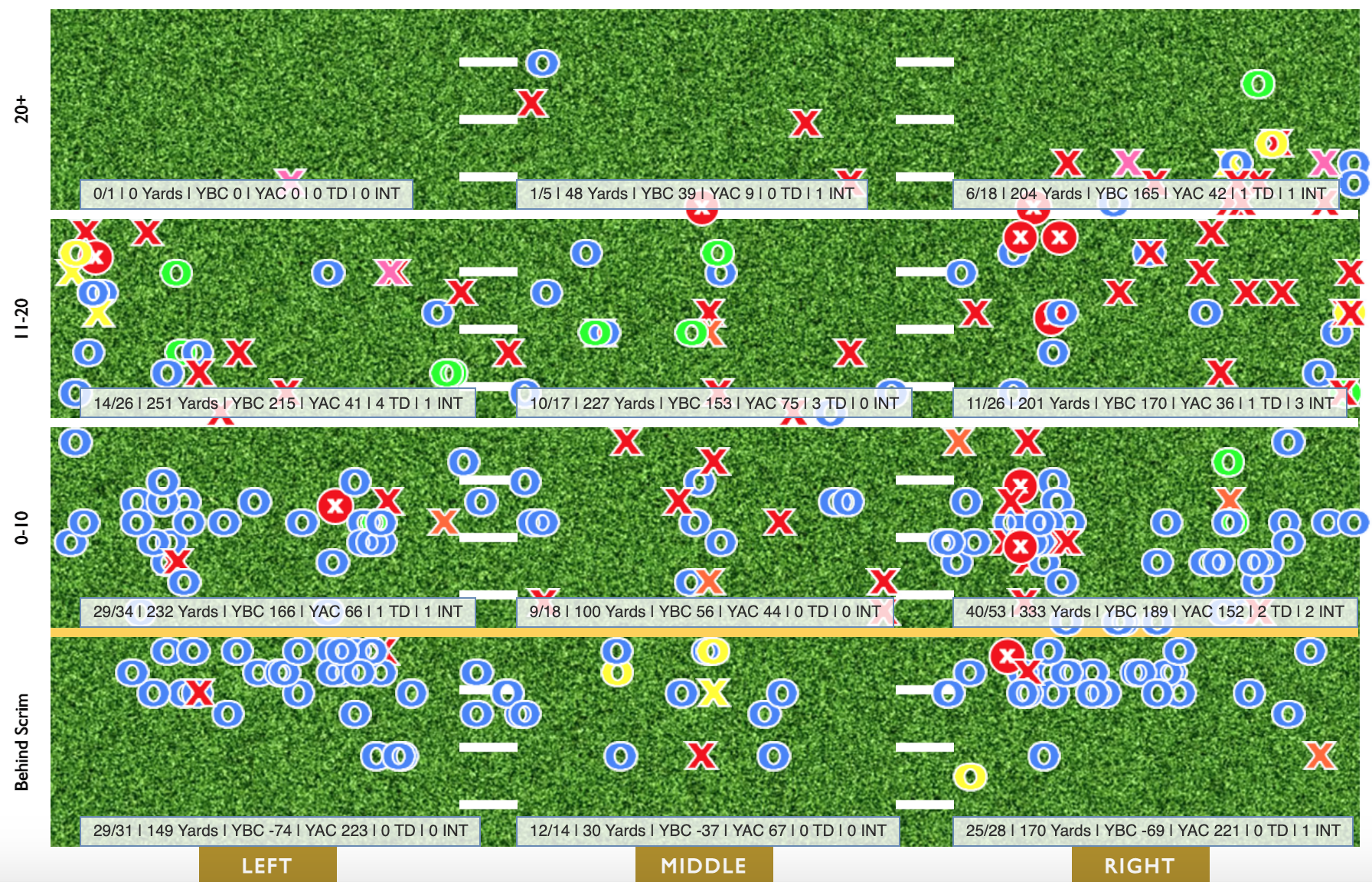
Ken Seals doesn’t have a strong reputation entering 2021. But, he still should be well-positioned to win the QB1 gig for the Commodores in Clark Lea’s initial voyage navigating the rough waters. As collectively bad as Vanderbilt was last year, Seals still helped double the team’s Passing Success Rate, improve its Explosive Pass Rate, and bring its Yards/Pass off of the conference floor. No power5 line was worse, which begat tons of pressure and heightened Seals already steep learning curve and degree of difficulty. Exactly a third of Seals’ attempts faced a form a duress last fall — a figure that was only topped by fellow freshman Luke Doty within the SEC. With that, it’s no real secret why the first-year struggled to standout on the stat sheet or help guide his guys to a victory.
Behind the worst returning Accuracy% and Interceptable Pass Rate the conference has to offer, Seals sits inside the bottom4 in Success Rate, Depth Adjusted Accuracy, First Down+TD Rate, Explosive Pass Rate, and Yards/Attempt. But despite these analytics souring his resume, the ‘Dore rocks the SEC’s 4th-highest Expected Points Added/att per CFP-graphs.com with a 0.32 figure. Securing conversions and scores within the red zone certainly was a major factor in his sturdy value-based metric. While cracking the conference’s top3 in red zone First Down+TD Rate last fall, none of his SEC peers returning for this fall can top his 47.8% figure. Plus, his such 42.6% Depth Adjusted Accuracy clip holds the bronze medal. But like you might guess from the guy who was hello-prone to throwing risky passes, over a fifth of his throws in this area of the field had turnover-worthy potential. None was worse. While EPA doesn’t take that kind of result into its equation, my tired eyes sure as hell noticed. So for the Vandy fans questioning why backup QB’s Mike Wright’s popped up in special packages inside his opponent’s 20, maybe that soul-crushing stat answers that concern. No matter the situation at hand, Seals constantly targeted tight windows and forced his receivers to win contested opportunities. No SECer commands a higher such makeup than his 30.6% clip. Luckily enough for him, his 55.0% Adjusted Completion% on these throws cracked the top5 in 2020. But as you can imagine, pressing in this fashion was super risky. Seals often got burned as a quarter of his contested attempts could’ve been picked off by my charting. Though it's normal for a young passer to exhibit some hubris around his arm talent, no passer can sustain success with that underlying characteristic constantly undercutting his other snaps.
Even in stabilized conditions, Seals had trouble cutting out turnover-worthy throws. From clean+dropback situations — or snaps where the quarterback is a pure passer and is asked to take care of business within structure with no excuses — his Interceptable Pass Rate worsened and remained the worst figure the conference has to offer ahead of this fall. That said, the rest of his output isn't as depressing. Sure, the ‘Dore doesn’t really standout relative to his conference contemporaries; but his metrics hint he isn’t a lost cause as a passer. Both his Success Rate and First Down+TD Rate noticeably best the SEC mean and increased by the 3rd-highest amount amongst conference qualifiers. While his ball placement figures remained dismissible, they at least bested his overall numbers in case you were desperate for some silver linings.
No doubt Seals took his lumps and still finds himself in a challenging predicament. While he might lack elite tools to deal with his endeavoring environment, he has enough going for him where the ‘Dores shouldn’t sink further statistically. Of course, that’s assuming he progresses his down-to-down decision making and limits those pesky turnover-worthy passes moving forward. With no one expecting him to set the world on fire, even delivering a modest encore will do wonders for his perception as a passer.
Vanderbilt Rushers
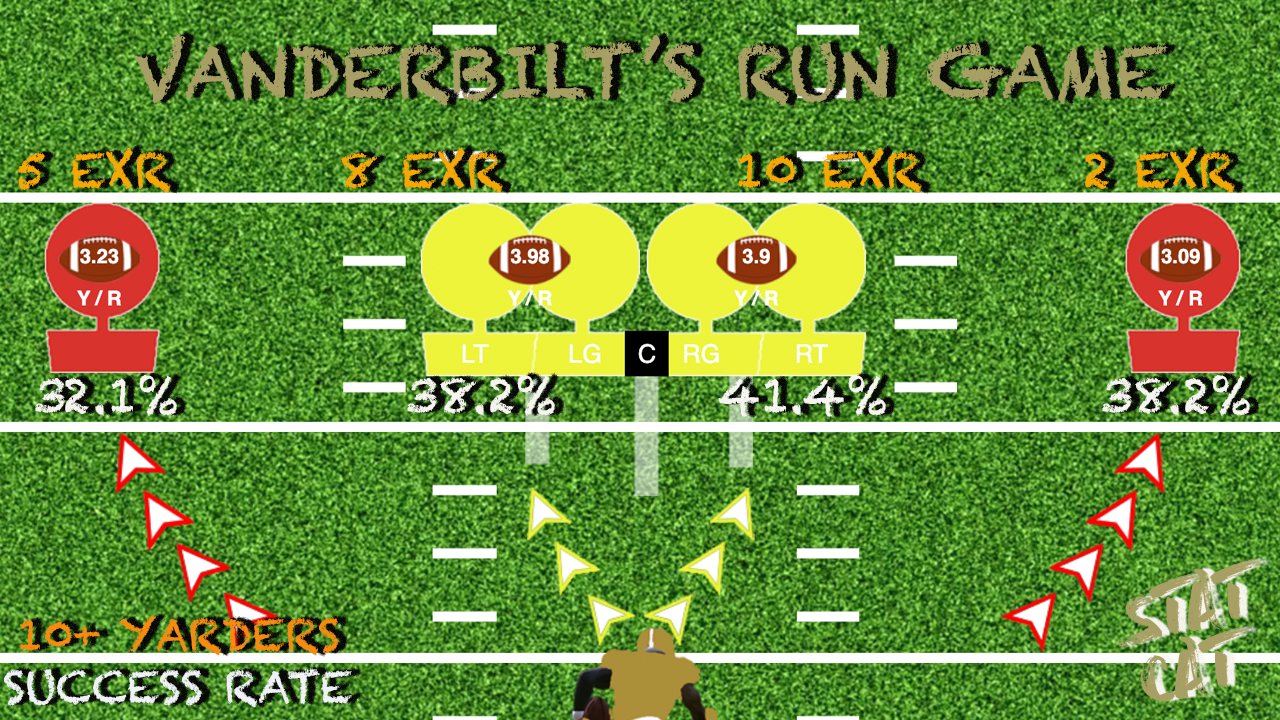
Outside of Tennessee, no running back room is as unproven as Vanderbilt’s. Though Keion Henry-Brooks fought, scratched, and clawed admirably, the prospect of playing again behind one of the most deplorable offensive lines in the nation was enough for him to throw up deuces and hit the transfer portal. Same with veteran Jamauri Wakefield who forewent a chance to spend his super-senior season in Nashville. As you might suspect with that information, the Commodores’ rushing attack last year was awful. Despite having some bright spots on their resume in 2019, the pandemic year saw them finish inside the SEC’s bottom2 in Rushing Success Rate, Yards/Carry, rush yards before contact average, and Explosive Run Rate. Their clip of the latter was almost sliced in half year-over-year against conference opponents. None of Vandy’s five most-featured run concepts posted a Success Rate over 41%. Talk about a whole lotta futility.
The leading returning rusher Ja’Veon Marlow failed to capture even modest efficiency as the Commodores’ beta back in 2020. Even though he led all team backs in YAC average, his 2.46 clip finished comfortably under the conference mean as did his bland 23.9% Broken Tackle Rate. For what it’s worth, both Henry-Brooks and Wakefield delivered almost the exact same stable metrics. So based on his showings last year, he appears to be a vanilla rusher who's reliant on better blocking to boost his bottomline, which again is not this unit's strong suit. Individually, he doesn’t appear to be capable of carving out his own path or making plays after engagement. But interestingly enough, Marlow rocked the team's only double-digit Explosive Run Rate despite posting the trio’s worst Rushing Success Rate.
Rocko Griffin was even more dismissible. Like Marlow, he was extremely hindered by an enfeebling rush yards before contact clip; but his figure was practically a half yard less. Marlow’s snooze-worthy stable metrics are dazzling compared to what Griffen logged. Across his 37 carries, he only totaled three broken tackles, ten successful tries, and one carry that gained more than ten yards. Do the math; those returns won’t cut it anywhere. If he too has to hold out hope for enhanced production upfront in order to look laudable on the stat sheet, he’s bound to be awfully disappointed based off last year’s returns.
Re’Mahn Davis, perhaps, could be the saving grace. Obviously, I don’t have advanced metrics on the Temple-transfer, but his tape dons shades of another recent ‘Dore rental in Keshawn Vaughn. Displaying natural ability in the open field, he could help Vandy find wins outside the bookends or provide a decent outlet in the pass game. His freshman stint as an Owl saw Davis almost cross the 1,000 yards threshold. But, he has only broken 100 three times in 15 tries. Though far from praise-worthy, he’s easily the most experienced option and exciting with the ball in his hands. Playing small through three yards and a cloud of dust has overly failed the past two years for this offense. Whoever gets the nod for RB1, they better be able to get chunk gains. For me, that dude appears to be Davis, but really any of these backs could ultimately win the job.
Vanderbilt Catchers
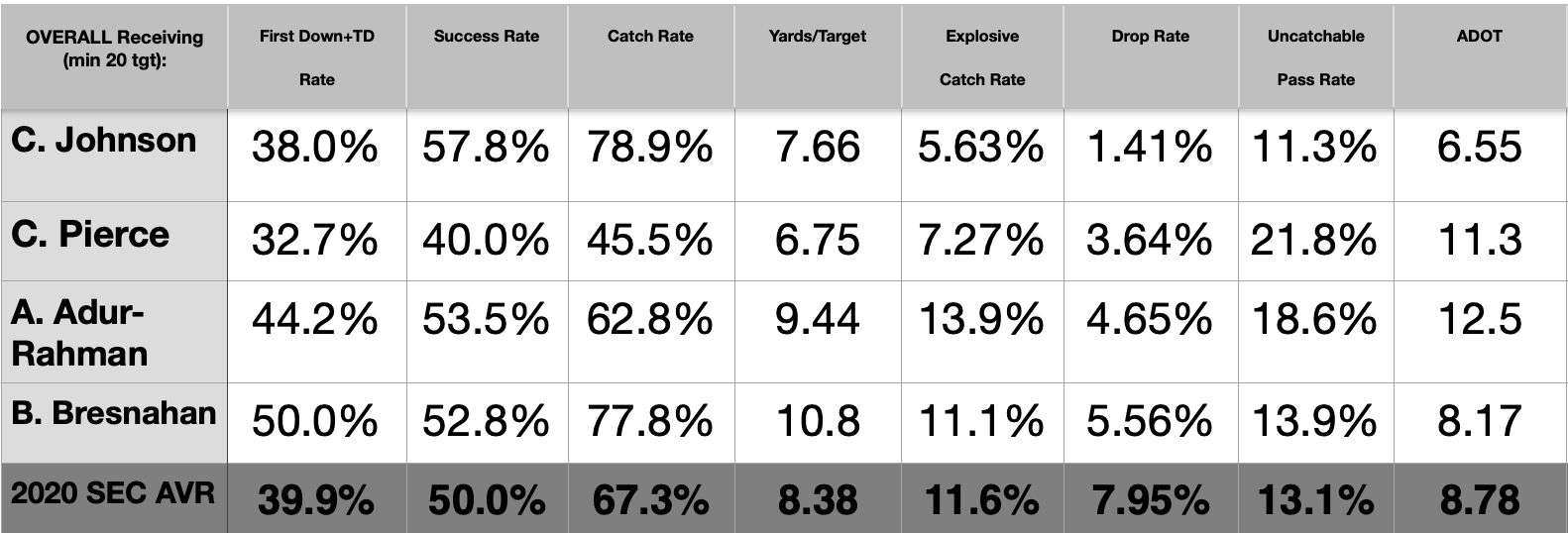
While most casual observers would be quick to dismiss Vanderbilt’s pass catchers based on the recent moribund returns from this offense, the Commodores have one of the most underrated receiving corps in the conference. All of their main returners suffered from a double-digit Uncatchable Target Rate (ranging from 11.3% to 21.8%). Yet of those four, only one finished with a Success Rate under 53% and a Yards/Target under 7.0. None sported a Drop Rate higher than the SEC average. Considering nearly 42% of the team’s total chances were labeled as inaccurate by StatCat’s charting, that’s awfully impressive even if the ‘Dores failed to generate an adequate amount of aerial splash plays.
From the slot, Cam Johnson is Vandy’s most mainstream option. He almost doubled-up the next closest teammate in catches and was the only ‘Dore to amass more than 500 yards. Like in year’s past, he predominantly functioned as an underneath outlet both within structure and off of RPOs. In 2020, almost 80% of his attempts occurred less than ten yards downfield with 30% coming behind the line of scrimmage. Outside of the Heisman, Johnson was the SEC’s most voluminous receiver off of bubble screens with 16 catches and 127 yards. Of his conference contemporaries with at least seven such attempts, only DeVonta Smith posted a preferable Yards/Target or Success Rate. Granted, most of his bubbles were opposite zone RPOs and — by their very nature — were designed to win situationally when targeted. Though the previous staff hardly got cute when orchestrated was to get Johnson the ball, his overall Screen+RPO Rate was relatively average even if those plays had an obvious effect to his bottomline. Despite the prevalence working short, he displayed nice hands hanging onto contested chances. In fact amongst returning SEC wideouts, he holds the best Contested Catch and Success Rate with his such First Down+TD Rate cracking the top5. Moreover, Johnson didn’t drop a single tight window throw last year. Behind consistency and copious pitch-and-catch opportunities, Johnson’s cumulative 1.41% Drop Rate is the SEC’s best by almost 2 percentage points over the next closest peer. While his verticality moving forward remains questionable, the ‘Dores have a very dependable inside receiver who’s a proven safety valve.
Outside receiver Chris Pierce was the aforementioned unlucky soul who suffered from an uncatchable attempt on over a fifth of his targets. Thus, he overly commanded Vandy’s least efficient stat line with a 6.75 Yards/Target and 40% Success Rate. Less than a third of his opportunities resulted in either a first down or a score, which was about eight percentage points below the SEC average. Based on that a low-note, it’s understandable why he opted back in for a super senior season in an attempt to go out with more fanfare. In-breakers like slant and dig were his most targeted routes. But no matter where or how he was thrown the ball, efficiency failed to follow. As a seasoned-vet and a big body (6’4, 231), he’s likely to remain out-wide and provide this unit some size and ability to contend for jump balls downfield or in the red zone. Not that his numbers killed in that area of the field, but three of his five TDs occurred in such spots last year. With even a moderate reduction in wayward passes, Pierce could be poised to produce a serviceable stat line.
Likely the ‘Dores’ other main man on the outside, Amir Adbur-Rahman is one of StatCat’s gems ahead of 2021. Despite fielding a top5 Inaccurate Target Rate within the conference, he finished as Vandy’s leader in Yards/Target, Yards/Catch, Explosive Catch Rate, and Creation Rate. He was just as likely to manufacture a catch for himself as drop a pass. Both of his respective 4.65% clips sit inside the SEC’s top10 for this fall. His pass catching prowess is further accentuated by owning the SEC’s 4th-best adjusted Inaccurate and Contested Catch Rates among his conference peers on the 10th-highest average depth of target. Speaking of skills working downfield, only Florida’s Jacob Copeland, Arkansas’ Treylon Burls, and Alabama’s John Metchie boast preferable Success Rates off one-cut vertical routes amongst SECers for this fall than his 57.1% clip. Last time I check, all three had better options at QB than Abdur-Rahman. In addition to that, the ‘Dore helped prop up his offense situationally. Rocking a 54% Success Rate both “behind the chains” and on 3rd down, each of his respective Yards/Target and Depth Adjusted Catch Rate sit inside the conference’s top10. Though his splits came in tough spots with lots of variables, Abdur-Rahman consistency elevated his team and made plays. His situation likely will prevent crazy traditional metrics, but he’s a name the film nerds, stat heads, and die hards should get to know based of his bang-for-buck showings last fall.
Last, but certainly not least, is Vandy’s tight end Ben Bresnahan. Regardless of position, he was one of the SEC’s most consistent and effective pass catchers last fall. Judging him strictly from dropback scenarios (ie no screens or RPOs), he owns a top3 Success Rate, Catch Rate, and First Down+TD Rate. Though some tight ends in the conference are more suited for operating near the line of scrimmage, Bresnahan was the SEC’s premier midrange target in 2020. Donning a perfect Depth Adjusted Catch Rate on attempts 11-20 yards downfield, his 92.3% Catch Rate and 16.7 Yards/Target were the best the SEC had to offer. While not dropping a single such attempt, a quarter of his targets resulted in points. Considering no SECer with at least 20 overall targets posted a higher Midrange Makeup than his 72% clip, the new staff should be aggressively searching for ways to exploit their tight end thusly. Situationally, Bresnahan fortified his metrics will strong showings within the red zone and on early downs. Doing what dudes with wide catch radii do inside opponents’ 20-yard line, he caught all of his attempts with half of his reps resulting in either a first down or a score. On first and second downs, his clip of the latter increased to 56.5%, which is the conference’s 2nd-best ahead of this fall. Furthermore as a big body, he was constantly counted on to come down with tight window and contested targets. Well, mission accomplished. Despite being slowed by an average Uncatchable Target Rate on contested attempts, he champions the SEC’s top such Success Rate, Catch Rate, Depth Adjusted Catch Rate, and First Down+TD Rate. If his helmet decal was different, there’s no question he’d be receiving more acclaim entering this season. Most folks won’t even do him the service of even learning his name, but he could quietly generate one of the most impressive outputs within his position group.
Glancing at Vanderbilt’s Offensive Line
Yea, things were pretty rough for the Commodores front line last year. As a unit held together by scotch tape and bubble gum, Vanderbilt’s makeshift makeup produced a lousy statline. Despite improving their Run Havoc Rate by six percentage points against SEC foes in meaningful minutes, the ‘Dores rush yards before contact clip shrunk by about a third of yard. As a result, they finished inside the SEC’s bottom2 in that respect in addition to their shoddy 36.9% Rushing Success Rate, 3.75 Yards/Carry, and 7.94% Explosive Run Rate. Though Vandy’s Pressure and Sack Rates both improved six and three points, respectively, both still finished inside the SEC’s bottom4. However, there’s optimism smoother waters lie ahead. In addition to returning two competent bookends, three pandemic opt-outs are back in the fold. Noted, this position group isn’t a thin as it was year year, but concerns remain on who exactly trots out with the ones. Tyler Sheen is the most “known” commodity for the Commodores having started all 21 games over the last 2 years — this past season on the left side. Though he spent some time at guard, sophomore Bradley Ashmore should plug in at right tackle. Based on his showings as a first year, he very well could be the future face of the program. It’s not every year a second-year lineman escorts his coach to media days, after all. Cole Clemens, Bryce Bailey, Julian Hernandez and Ben Cox all are candidates to nab one of the guard spots. Notching over two dozen career starts, the former has the best chance to be among the first five. Dan Dawkins has the inside track to win the center gig, but previous inconsistencies and logging the majority of his snaps at guard might allow else to come along and win the job. Glass half full, this new staff shouldn’t have to depend on true freshman like last year. Though still one of the weakest groups within the conference, the foundation is set for Clark Lea and Co. to at least best last year’s buhhhhh bottomline.
Key Offensive Metrics in SEC Play
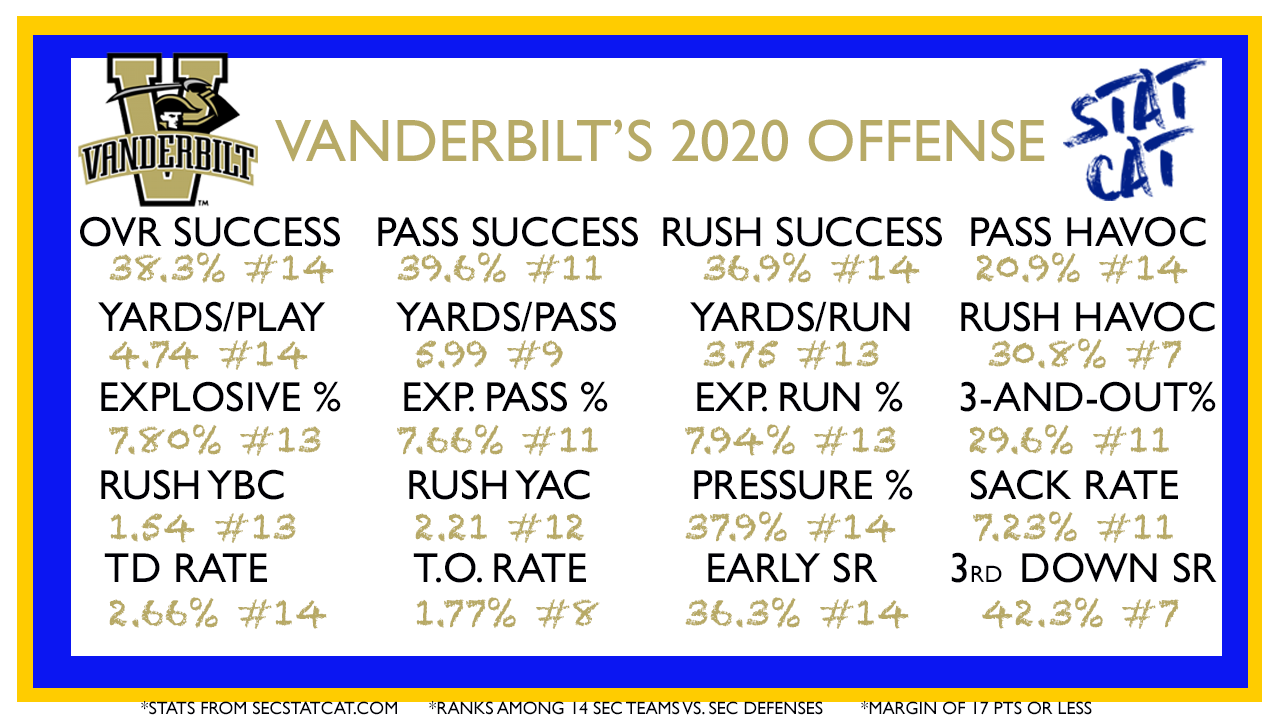
When an offense turns in one of the worst performances within the power5, suggesting across-the-board improvement is needed is hardly a novel notion. The Commodores logged the worst TD Rate, Yards/Play, Success Rate, Early Down Success Rate, Rushing Success Rate, and Pass Havoc Rate in SEC play. None of their 20 major metrics finished better than 7th. Vandy simply lacked consistency, potency, and dependability down-to-down. So singling out the most important stat for them to hone in on becomes a challenge. Though focusing on manufacturing big gainers is a trend the ‘Dores need to explore, establishing a new offensive identity is paramount. That will only come with sustained regularity executing their core concepts. Yes, their overall Success Rate improved by six percentage points year-over-year, but Clark Lea and Co. have to get this offense off of the conference’s floor in that respect. If Vandy ranks 14th in that metrics as well as Yards/Play for the 3rd-straight year within the SEC, there’s no question the on-field product will continue to be entirely dismissible despite returning a number of quality contributors. The ‘Dores don’t necessarily have to go from the cellar to the conference’s average, but logging a figure outside the the bottom10 would be a great momentum piece.
Key Defensive Metrics in SEC Play
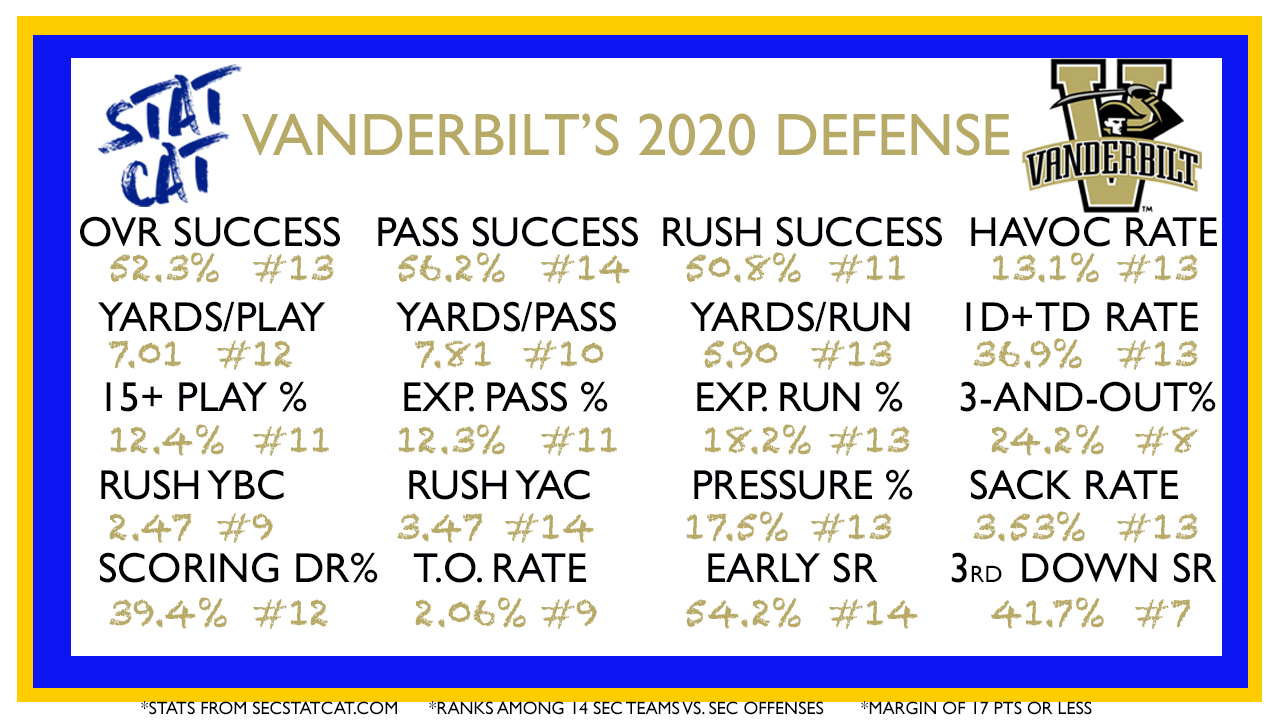
As an offensive guy, I generally gloss over defensive previews. Not that I don’t think individual defensive players aren’t valuable or dislike a blindside sack or athletic INT every once in awhile, but I typically treat that side of the ball as a collective unit. As only one guy, I can only track so much, yanno? You won’t get many fun defensive nuggets from me. That said, Vanderbilt was just as inept on this side of the ball as their flaccid offense. Optimism in this unit is lacking after the Commodores finished inside the SEC’s bottom4 in 15 of their 20 major metrics. Vanderbilt’s lone silver lining — if you want to call it that — was being average on 3rd Downs defensively. Their such Success Rate was nearly 13 percentage points better than their clip on early downs. Since defenses live to create one-off situations like those, the ‘Dores should hope to display that middling competence for the second-straight season. Because of their moderate play in these spots, Vandy’s 3-and-Out Rate was okay even if it left plenty to be desired. Based on the cumulative shortcomings littering their statical profile, this defense probably will continue to struggle down-to-down and capping big gainers. So when it finds itself with a chance to get an opponent off the field on the money down, this group better capitalize. Though the long term goals need to coincide with many of the same elements its offense needs to institute, a short term band aid for this defense will be controlling its own fate in one-offs.
Glancing at Vanderbilt’s Schedule
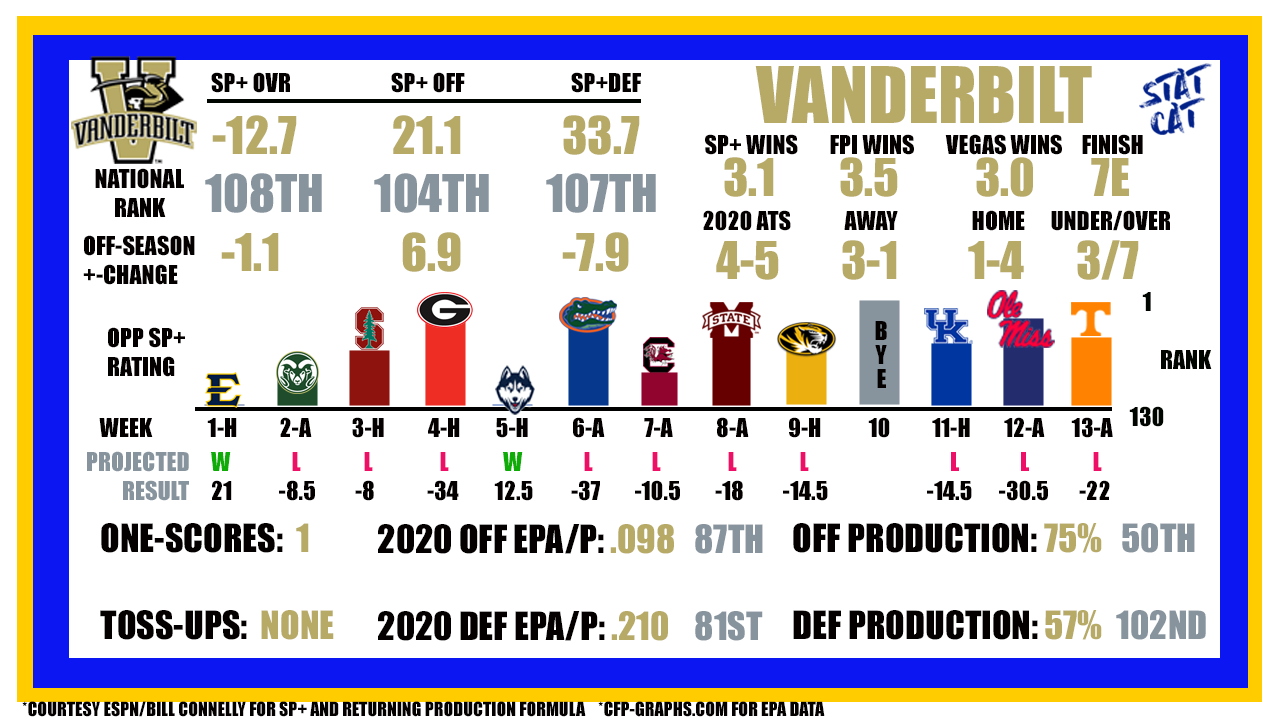
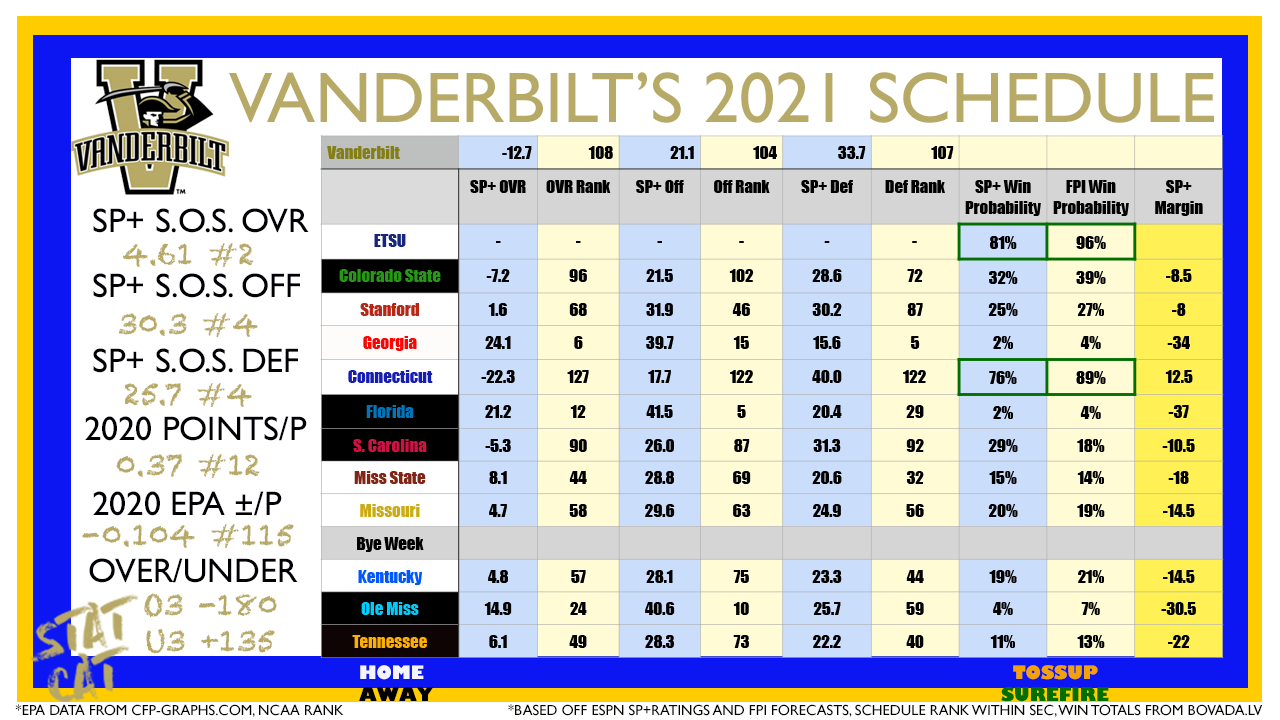
For good reason, ESPN’s SP+ metric doesn’t view the Commodores in a good light. They enter 2021 with their Overall, Offense, and Defense Ratings all nestled nicely ranked in the triple-digits nationally. Thusly, Vanderbilt is not expected to win a conference game for the second-straight season. Moreover, basically everyone expects them to rollover and log another losing campaign. But thanks to one of the SEC’s softest schedules, there’s hope Clark Lea and his cohorts are able to clip a few opponents. Cumulatively, Vandy’s foes total the 4th-easiest SP+ composite score on both sides of the ball. All in all, only Kentucky has a less-challenging slate in that metric’s eyes within the conference. Considering the ‘Dores don’t get to play themselves, that should stress the strength — or lack thereof — around their non-conference schedule. All three of their such opponents fall outside of the SP+ Top65. Tack on the average joes within the SEC East, and the majority of their slate falls outside the Top50.
Though the Vandy is only favored to top ETSU and one of the worst Power5 teams in Connecticut, they project to lose only by single digits to Colorado State and Stanford. Considering all four of those games come during the Commodores’ first five weeks of the season, there’s a natural sense of urgency for them to start strong and capitalize on capturing some positive momentum before the meat of their schedule kicks in. Plus, all but one of those games will be in Nashville. Their chances of upending someone drastically decrease after that. The ‘Dores’ remaining divisional brethren in South Carolina, Missouri, and Kentucky are all projected to thump them by multiple scores. All four of Vandy’s opponents with a preseason ranking in the Top50 are pegged to win by at least three touchdowns. In the end, both the SP+ and ESPN’s Football Power Index likes the ‘Dores to win around three games. Likewise, Vegas set their over/under win total right at that mark. Despite having little hope within conference and their advanced metrics hating their outlook, Vanderbilt is favored to top expectations this year based on the current lines (-180 over, +135 under per Bovada). That could be driven by SEC dollars, belief in Lea’s leadership, or pessimism in their non-conference opponents. But based on their scores and inauspicious standing within the conference, there’s money to be had fading the Commodores.