2021 Staturday Adventure: Week 6
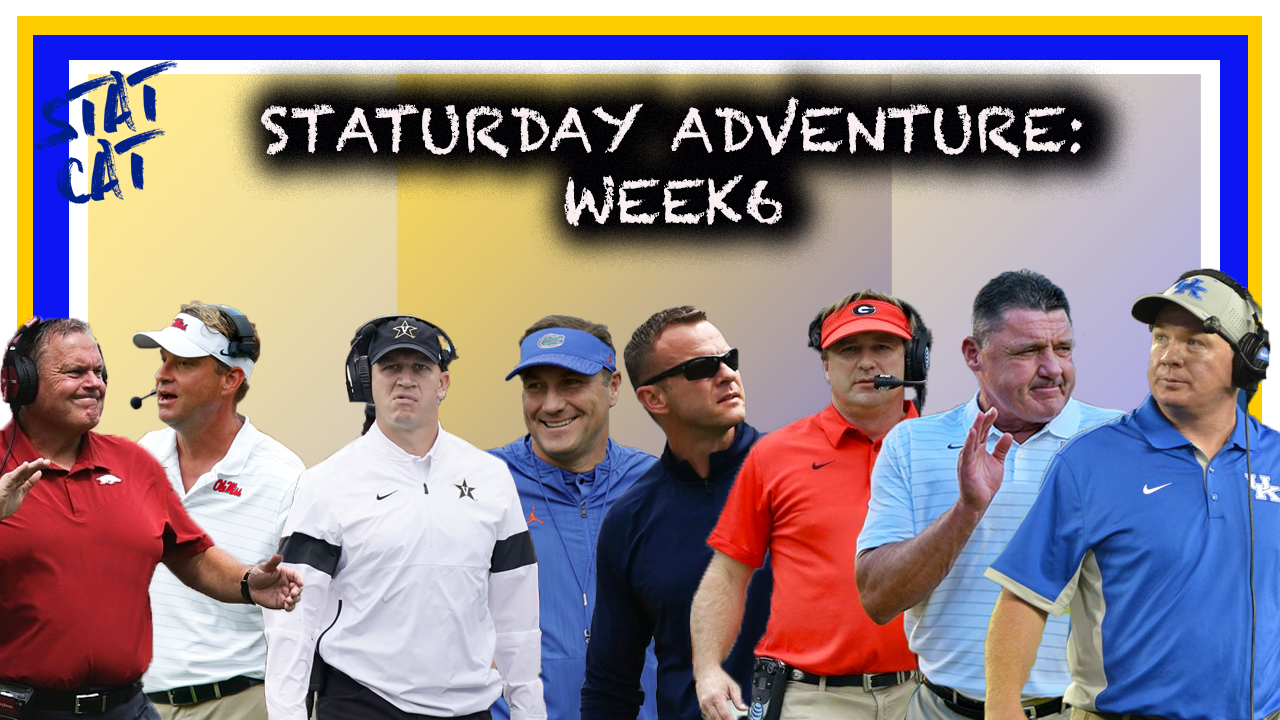
Staturday Adventure: Week6
How’s everyone been? Good, great, grand, wonderful? That’s marvelous to hear. Sorry to cut you off. I know you’d like to rattle off small-talk discussion points, but we have a lot of things to get to surrounding Week6’s SEC slate. While last weekend was fun, I can’t wait to see how these matchups unfold this Saturday. Of the seven games, five feature at least one ranked team. Though I wanted to touch base on every team, StatCat only has so much time operating as a one-man army. So, let’s get rocking!
Arkansas @ Ole Miss
The Razorbacks and the Rebels each took a haymaker to the face last weekend as road dogs. In “standard time”, these two offenses logged the conference’s worst Negative Play Rates, rush yard before contact averages, and Yards/Play. Arkansas had little answers for Georgia’s mighty front as they incessantly played behind the chains seeing an outlandish 60.9% Havoc Rate. The duress and constant disruption made it easy for the Hogs to log the SEC’s worst Success Rate last week. Though Barry Odom’s three-down defense has overly worked in making that bunch competitive, the Dawgs only had to pass the ball five times in meaningful minutes since their Rushing Success Rate neared 62%. By the game’s end, UGA averaged 3.0 rush yards after contact.
Ole Miss was just as lousy, if not moreso, on that side of the ball. Outside of Tennessee’s parade of points versus Missouri, Alabama logged a conference-high 68% Success Rate and 24% Explosive Play Rate in “standard time”. Biffing his pregame prediction, the Lane Train was prevented from snatching a single 20+ yard pass or 10+ yard run on such snaps. By the end of the game, only UK finished Week5 with a worse clip and total figure than the Rebels’ 4.8% and 3, respectively.
Despite last Saturday’s shortcomings moving the ball, both Arkansas and Ole Miss enter Week6 ranked in the top20 nationally and as the SEC’s top2 offenses in Explosive Play Rate. Derivatives of the “Baylor spread”, these squads feature a run-based approach drenched in deception tactics, eye candy, and and tempo. Thanks to their gung-ho approach stretching secondaries with prudent prods both horizontally and vertically, some folks straight-up refer to these schemes as “Super Spreaders”. In the pandemic age, that phrase could be met with disdain and vitriol. But there’s no denying the instant impact that style of play has had in some recent turnarounds. Both offenses sit inside the conference’s top4 in using at-the-snap motions, RPO Play Rate, and Turnover Rate. Plus, the Rebels and Hogs are quite fond of using play action to crumble their adversaries and facilitate splash gains. Both offense’s top receivers (Dontario Drummond and Treylon Burks) will come in with double-digit Yards/Target while sitting in the SEC’s top6 in YAC average and Explosive Target Rate.
Generally speaking, Ole Miss has the edge offensively. Only Alabama currently tops its 7.4% TD Rate and 55.1% Scoring Drive Rate with no conference unit trumping their 52.1% Success Rate. And, what was true five weeks ago still holds firm today: Most folks agree that Matt Corral is the SEC’s QB1. His personal 62.5% Success Rate and 62.3% Depth Adjusted Accuracy% are both league highs. Plus his Explosive, 1D+TD, and Interceptable Pass Rates are all top3. Without a single turnover-worthy attempt, he’s been accurate on 46.2% of his deep throws with a conference-best 60% Adjusted Completion%. Like you can imagine from a scheme rooted in disorientating adversaries, Corral’s 56.8% Action Rate is the highest in the SEC. Only UK’s Will Levis is more prone to using true dropback play action on a given attempt. Corral is also the runner-up compiling such yards totaling 370 so far.
If team’s sit back in a 2-deep shell, Kiffin and Co. largely bank on their RPO and ground game and dare defenses to rally towards the ball. A third of their early down offense consists of an Inside Zone Slam Read, Outside Zone Read, or a split zone/”Bluff” Read; nearly 43% of their designs constituting as RPOs in those spots. All in all, Ole Miss dons a 6.5 Y/A and 60% Rushing Success Rate on RPOs, which are good enough figures that typically force opponents’ hands. And of course once backenders start moving out of position or begin to anticipate what will happen next, that’s when this offense’s true magic manifests. While RPO outlets like slants, tunnels, and hitches compose a good amount of this offense’s reps, Ole Miss aggressively serves up the pass concept Cross to capitalize against single-high looks or when a safety eagerly collapses towards the box in an attempt to hinder the run. This weakside Flood is the lone dropback pattern to log double-digit opportunities. Only the Slam Read -- the foundation for many of their RPO designs -- has totaled more yards for this offense through the first month-plus. Additionally, this scheme is known for literal counters (as in the gap run design) as well as figurative ones like Deep Double Moves, Bullet Inserts and Pop Passes with backs and tight ends, Yankee Shots, and Power Veers with wide receivers that feast on defenses expecting one of this offense’s base looks. Even after burning the popcorn, Ole Miss ranks 8th nationally in Expected Points Added/play behind a 0.25 figure ahead of Week6.
However, StatCat shouldn’t need to remind you how Odom’s dudes thwarted Ole Miss in 2020. The Rebels turned in a season-low 35.6% Passing Success Rate with Corral throwing six picks and being noticeably agitated. The Drop8 style is usually passive, but it helped generate a 35.2% Havoc Rate in last year’s matchup; no conference defence delivered a preferable clip that week. The extra man in coverage naturally threw off Corral’s reads while restricting downfield passing windows. Though Corral has shown improvement facing that tactic, Arkansas’ defense enters Saturday with the nation’s 9th-best EPA/play including college football’s 3rd best figure against the pass.
Nose Tackle John Ridgeway is every bit of a game-wrecker as his 6’6 frame implies and will be key in leading a reduced pass rush’s efforts in crumbling the pocket or discombobulating Ole Miss’s interior. Whether or not the Rebels follow UGA’s plan of running around him, blasting him with gap scheme double teams, or adjusting avenues around his initial launch remains to be seen. But at the very least, his presence should alter how Jeff Lebby calls the game as his girth allows the Hogs to reallocate their resources to cap passes. If Ridgeway and the rest of the front lose their early battles, Arkansas’ backend will be forced to leave their shells, which again is when Ole Miss’s fangs come out. Jerrion Ealy should have chances to show off his zeal to get things rolling. His personal YAC average and Broken Tackle Rate are among the top half-dozen in the SEC. Plus while his 53.9% Success Rate is top10-worthy, his running mate Henry Parish sports a conference-best 61.1% clip with over a sixth of the duo’s carries resulting in at least 10 yards.
Though these two offenses are related, Arkansas has a clear preference to pound the rock. KJ Jefferson’s inconsistency and flaws operating from a pocket are part of the equation, but no matter how you slice it, Arkansas' 37% Pass Rate is a SEC-low (FWIW Ole Miss’s is 52% in meaningful minutes). Before facing the nation’s top defense, the Razorbacks saw over half of their designed runs find situational success. In standard time, over a quarter of their carries have gained at least 10 yards with no conference peer topping their 21 occurrences by volume. They share the same three base runs as the Rebels, but the desire to attack the edge from the get-go is especially apparent under Briles. Outside Zone Reads compose a third of Arkansas’ early-early offense (first downs in the first quarter). While averaging 7.0 Y/A, it's the only concept with double-digit reps in that context and has seven more tries than the next look in line. Yes, the Georgia game was a nice example of what this scheme looks like when it’s out-executed (UGA was able to have its cake and eat it too from a 2-safety alignment that usually allows rushing lanes). But once victories are had on the perimeter, Arkansas then looks to bash inside with Zones, Tackle Counter, Darts, and Q-run designs.
The pass game is a bit of an issue. Excluding screens and RPOs, Jefferson's 33.3% Success Rate is a conference low. Overall, Arkansas' clip as a team is the worst in the SEC. Individually, only TAMU’s Zach Calzada has a stinkier such Accuracy% than the Hogs' hoss a QB. But while consistency and precision concerns will likely persist all fall, Jefferson has managed to conjure significant completions at an outstanding rate. Presently, his 15.4% Explosive Pass Rate, 10.0 Y/A, and 50% Deep Completion% are conference highs. The passing might not always win, but when it does, gridiron real estate will be acquired in nice chunks. Interestingly enough from a scheme that essentially puppeteers a modern day triple option: the pass game mirrors the M.O. of the majority of those old school offenses.
While Kiffin has some neat patterns, Arkansas mostly relies on vertical shot plays like Solo deep routes or Divide/”989”/Middle Read that feast on single-high coverages. I mean, these designs truly are nothing special. But when backends get itchy, they have a proven track record of delivering big gainers. To date, only the Outside Zone Read has accumulated more yards for this offense than Shot Variants’ 309 (28.0 Y/A). Outside of being rudimentary, the Hogs will occasionally get cute with Double Passes, Dash Sails (delayed rollouts), Sluggos, and Fake Screens to generate more space downfield.
Ole Miss’s defense isn’t as bad as last year’s unit, but it’s still a liability. Entering this weekend, its EPA/play is ranked near the triple digits. The fact that this team is still top30 in EPA margin is pretty damn crazy and a testament to how fruitful the other side of the ball has been in 2021. But according to CFB-graphs.com, Arkansas trots in the 4th-worst clip offensively. This is undeniably a decent matchup for the Rebels defenders to find some footing within the conference. Facing the Whompers, how Ole Miss tackles could be the deciding factor. They logged a dismissible 3.6 YAC average and 38.5% Broken Tackle Rate defending Alabama’s rush attempts last week. In addition to his SEC-best 31% Explosive Run Rate, Jefferson currently leads the SEC with a 5.21 clip of the former. His 14 broken tackles on designed runs are the most on the team, and the team’s such rate is a respectable 32.5%.
Vanderbilt @ Florida
There haven’t been many instances in this matchup where Vanderbilt comes in fresh off a victory and the Gators are recovering from a loss. This game’s result should be Florida all the way. In case you aren’t the betting type and are line-agnostic, Florida is expected to reign supreme by at least five TDs. Quite frankly, digging into the stats for this matchup is a complete waste of time. But that doesn’t mean some items cannot be highlighted surrounding these two teams after their play through the first five weeks.
Frustrated Florida fans beat me to the punch bringing this to light. But, it's still worthwhile to discuss. The lack of potency in this passing game is costing the Gators ball games. Only UF's Week6 opponent has logged a lower number of 20+ yard completions than its 11. Plus, the Gators' 6.6% such rate is the SEC’s 3rd-lowest. Only the Air Raid’s dink-and-dunker enters Saturday with a lower Deep Pass Rate than Emory Jones’ 6.7% figure (Kyle Trask reached 14.2% last fall). He only has nine such throws on the year with two over the last fortnight. Considering the amount of single-high coverages this unit faces on account of its rushing prowess, this happenstance is befuddling many Swamp Dwellers.
Instead, the Gators have pursued more mellow patterns to win against one-safety coverages like Curl+Flats, Hoss, Cross, Bootlegs, Rub Variations like Mesh, and the handy-dandy Spot concept with Slants. There’s nothing wrong with these designs, but as onlookers have noticed, rarely do they begat significant completions without a dynamo in the open field. Per StatCat, Florida only averages 2.87 yards after the catch as a team, which is a bottom4 figure within the conference. Captain Obvious tells me that constantly asking an offense to string together double-digited play drives isn’t the best recipe for sustained success. As we saw just last weekend, that approach generally leads to 3rd down chances, which puts more strain on a unit to execute and minimize one’s margin of error. Including all snaps, Florida is a below average offense in points/drive and points/play despite averaging the 4th most plays/drive within the SEC.
Clearly, Mullen has seen enough to not trust his passer’s acumen testing secondaries. Despite the clamors for more colossal completions, film suggests there’s no reason to extend Jones the benefit of the doubt. Looking at his attempts beyond 16 yards downfield, the Gator QB is only 8/22 with 7 interceptable attempts this season. Regardless of the results, his career Accuracy% and Turnover-Worthy Pass Rate on these throws is an appalling 27.3% and 25%, respectively. With Jones just as likely to throw an on-target pass as a potential interception, I fully understand Mullen’s weariness to let him rip it; even with capable vertical weapons at his disposal in Jacob Copeland or Trent Whittemore.
Increasing play action usage has been floated as a potential answer to coax more aggression out of Jones and to further accentuate Florida’s run-minded methodology. The early returns do show enhanced down-to-down results in metrics like Success Rate (+19%), First Down+TD Rate (+14%), and Y/A (+1.8) compared to his overall numbers. However, play fakes apparently don’t do a damn thing aiding Jones unlock hidden accuracy. Despite a mere yard differential between his average depth of targets on pure dropbacks with and without play action, Jones’ raw Accuracy% worsens by 12 points, his Depth Adjusted Accuracy sours by 17 points, his Interceptable Pass Rate rises by 9 points, and his Uncatchable Pass Rate inflates by 7 points when feigning a run. Schematically, the plurality of the targeted concepts at work have been weakside Floods like Cross and Bootlegs -- aka intermediate patterns. Deep plays like Vertical Shots, Yankees, and All Verts have only combined for a 20% Success Rate. And when examining his 16+ yards attempts using dropback play fakes, not much positivity exists to further bolster the argument to try backends in such a fashion. The sample is pretty small; but over the last two years, Jones is 5/14 with a pair of interceptable passes; an improvement from his moribund metrics, but not good enough to make this suggestion bankable.
Mullen is one of the best minds at molding strategies around his available talent. That said, he can be a stubborn cat. I'm not holding my breath, but there’s a chance more aggression emerges from this braintrust. After all, Florida has lost half of its last ten games and is 0-2 in the conference to start 2021. And a kick in the rear with an abrupt tactical change or quarterback swap could be worth the risk. But assuming Mullen holds firm and rides the current M.O., I have a hard time believing the Gators will finish on the good side of average in terms of aerial explosiveness.
Florida is flawed, but it’s far from being broken even with its clear handcuffs. Though playing conservatively may decrease its room for error, this offense enters Saturday with college football’s 12th-best EPA/play and the conference’s top Passing Success Rate (61%) and Explosive Run Rate (28%) in standard time. Only Missouri currently reps a preferable rush yards before contact average among SEC schools in such spots. Speaking of the nation’s 3rd-highest rushing offense by volume, expect the ‘Dores to be a mat on marathon day and be all run over by the Gators’ ground game. Vanderbilt’s defensive EPA/rush attempt is presently rated 119th.
Straight gap designs -- like QB Power and Duo -- have been let downs through five games. The concept group sports a sub-40% Success Rate with a 3.91 Y/A. Though the Gators like to play the numbers game and seize space in an undermanned box, Inside Powers just haven’t deserved this offense’s 2nd-highest play share. Other than those, however, every major run look has delivered fantastic results. The Outside Zone Read, now this offense’s lead look with a 13.3% play share, has seen half of its tries end in success while averaging 6.0 Y/A. Tertiary plays like Inside Zone Slam Read, Bluff Read, and the Nakie (fake stab+Speed) Option all average clips in the double digits. The latter along with the Power Read (not the inverted veer) each rock Success Rates of at least 65% in meaningful minutes. Plus, half of the Outside Power Reads and Y-Inserts have worked; the latter is flaunting a 9.8 Y/A at the moment. No singular concept is “run” into the ground or forcefed onto the call sheet. The eclectic script, deep backfield, and mobility of Jones make this one tough onslaught to cap consistently.
In its two conference games, Florida’s defense has been responsible for 19 Havoc plays for a 20.4% Rate. A tenth of their snaps versus SEC foes have resulted in a TFL. While that’s okay, the Gators have allowed a subpar YBC average, 1D+TD Rate, and Explosive Play Rate. Again based on the level of competition and the motivation to let out some steam, all of those metrics should look better in a couple of days.
Vanderbilt’s offense is offensive. Entering Week6, Vandy is dead last in Explosive Play Rate, Success Rate, and Yards/Play within the SEC. Thanks to the Tide’s early season shakiness curbing pass rushes, only Alabama rocks a higher Pressure Rate than the ‘Dores’ 31% in standard time. Obviously the Commodores don’t have a deep bench or playmakers like other programs, but the ingenuity from its new play callers is pretty unsatisfactory. Last year, the ‘Dores did some interesting things with their designs. But outside of some added tempo and urgency early in ball games, it’s a pretty watered down operation. So far, a bevy of Sticks, Slants, IZ RPOs, and occasional Vertical Shots or All Verts are their core looks. In short, the quick game wants to pick coverages apart horizontally and big gains are sought via one-one go routes outside the numbers. For the most part, the underneath stuff has done fairly well for this forlorn lot. Sticks (55.6%), Slants (52.4%), and Quick Outs (81.8%) -- three of their five most targeted pass concepts -- all have seen well over half of their targets work. But as games progress and windows get tighter, Ken Seals and Co. struggle mightily to take the top off of defenses. Only a quarter of Vandy’s Shots and All Verts have worked. Other short to intermediate concepts like Spot/Triangle, Drive/Shallow, Chinas, and Floods combine for a nauseating 18% Success Rate.
Playing time has exploded for underclassmen Will Sheppard and Devin Boddie as last year’s most productive receivers in Cam Johnson, Ben Bresnahan, and Amir Adbur-Rahman are being faded. Chris Pierce is coming through as a half-cocked deep threat, but this group is constantly maligned by off-target and inaccurate attempts by Vandy’s QB1. The job should remain Seals’ for the time being considering the alternative is even worse in the passing department. But unfortunately, the ‘Dores will not be able to contend until this position group can stop sucking. Entering Week6, Seals falls into the conference’s bottom3 in Accuracy%, Adjusted Completion%, Success Rate, 1D+TD Rate, Uncatchable Pass Rate, Defender Breakup Rate, and Interceptable Pass Rate. In fact, only Jones has a higher clip of the former amongst SECers. None of Vandy’s top3 receivers have logged an above-average raw Catch Rate. They each place inside the SEC’s bottom8 in yards/target. Behind the trio seeing a fifth of their tries as uncatchable, the wasted chances simply are preventing their value from emerging.
And no, things don’t get rosier on the ground. The Bluff Read is Vanderbilt’s only run look that has seen multiple reps to log a Success Rate north of 50%. At least, that split zone play is ‘Dores’ 2nd-favorite rush concept. But unfortunately, other major runs like IZ Slam Read (35.6%), Off-Tackle (18.2%), and Power Toss Read (30%) haven't been as profitable. After all, underwhelming returns are to be expected by an offense whose YBC is almost a yard under the conference average.
Speaking of, their new RB1 Rocko Griffin commands a team-low 1.07 YBC average. Though used to fighting through carnage and earning his yards, he’s not particularly skilled at making dudes miss or falling forward. His 2.89 YAC average is among the 14-lowest in the SEC and his 25.5% Broken Tackle Rate is bottom10-worthy among peers with at least 30 carries. Even though Florida hasn’t been the most sound tackling defense in the last year-plus, the Commodores shouldn’t put up too much of a fight or steal hidden yardage after engagement.
Georgia @ Auburn
Last year’s rendition of the Deep South’s Oldest Rivalry was not as close as the final three-touchdown margin indicates. Georgia controlled the line, broke down the Tigers, and ruled the day with vigor. Since Auburn is coming off a Tiger Bowl where it suffered from 16 broken plays and league-high 45.3% Havoc Rate, the most formidable defense in the land appears well-positioned to replicate 2020’s rout. While breaking over a fifth of War Eagle’s offensive designs, UGA limited Auburn to a paltry 0.83 rush yards before contact average, 3.5 Yards/Play, and 33.9% Success Rate. The team’s Pressure Rate was a mind-numbing 45.5% as Chad Morris’s bunch surrendered 26 Havocs. While playing two of the East Division’s bottomfeeders helps pad the stats, the Dawgs currently rock a 78.1% defensive Success Rate, 14.8% First Down+TD Rate, 49% Accuracy% allowed, and 1.82 YBC clip versus conference foes.
In addition to passing many people’s Good, Ole Fashioned Eye Test with sturdy traditional metrics, ESPN’s SP+ views the Bulldogs as the nation’s top team with the most destructive defense. Presently, UGA is the only unit on that side of the ball with a SP+ score in the single-digits. In terms of Expected Points Added/play, no program dons a higher positive differential (OFF minus DEF) than its 0.252 figure. Georgia’s defensive clip of -0.358 is extraordinarily -0.14 points less than the next closest defense. Look, I know that can be hard to grasp... that's what she said. Better? Okay then. Just know that's pretty f******* good and more ammunition for the Dawgs to talk up its defense.
While Auburn looks to be a middling team as far as EPA is concerned, the SP+ still thinks the Tigers are a quality football team. Coinciding with their poll ranking, Bryan Harsin’s team enters Week6 as college football’s 18th-best squad heightened by a top15 defense. They sit inside the top22 in yards/game allowed and yards/play, which is obviously ameliorated by their first two weeks of action. But against LSU’s decent pass game and God-awful ground game, Derek Mason’s unit held the divisional rival to a 1.76 YBC, 5.6 Yards/Play, and 35% Success Rate. Though those figures will be hard to copy, Auburn’s defense must muck up this matchup to provide a path to victory on the Plains. The Tigers are better against the run; so notching some situational wins when the Bulldogs dropback is a must.
Speaking of UGA's dropback game, Todd Monken is orchestrating some of my favorite patterns in the conference. Of course, a scheme always looks better when passes are finding their marks. And it’s not like the Dawgs have overly been tested or had to lean on its aerial assault in crunch spots. But I can’t ignore the recent success of a particular route pairing. Over the last month, Georgia has generated incendiary numbers with the “Wheelie” concept that gets its name coupling a vertical wheel with a post/dig. Monken has called three different wrinkles with the combinations: the traditional two-man pairing, a fake screen action, and double posts. A form of this look has been seen ten times since Week2 producing eight outright targets, six completions, 238 yards, and 3 TDs. In other words, despite totaling 3% of this offense’s snaps, Wheelie and its variations have been responsible for nearly a fifth of UGA’s pass yards and the second most total by any concept.
The inside-out exchange from the receivers is known as a “switch” and it’s a terrific tactic to confuse 2-deep or match pattern assignments. Not to get too much into the thick of it, but coverages with two safeties back have natural vulnerabilities in the middle of the field. Sometimes coveragemen overcompensate by trying to negate or close the gap on in-breakers, which then leaves them susceptible to backdoor routes along the sideline like wheels or halfback leaks. And since these coverages usually only have one flank defender towards that side of the formation, squeezing the passing lane of a climbing route along the sideline can be an awfully tough assignment especially if play action is used. For what it’s worth, all of these UGA’s reps of this look have used deception elements. Plus, the criss-cross occasionally produces a deep rub where the friction facilitates separation between the DB and route runner. With 2-safety shells gaining in popularity across all levels of the game, offenses need to have patterns that can carve them up. But, it’s not like this pattern is completely useless against single-high either. Year-over-year, Wheelie’s play share across the conference is holding firm right at 1.12%. So while overall usage isn’t showing massive gains, I have found it interesting half of the league has already featured a version of the Double Post+Wheel combo this season either by swapping route assignments, performing it from trips, or getting a running back involved in the verticality.
Over the last month in standard time, Georgia boasts the conference’s highest Yards/Play (8.58), highest Explosive Pass Rate (21.4%), lowest Negative Play Rate (2.6%), and lowest Havoc Rate (16.7%). While the Wheelie Switch provided flair, the Dawgs haven’t had to get too complicated riding a conference-low 36.8% Pass Rate in these spots versus their overmatched opponents.
With JT Daniels still not completely healthy, it's probable Stetson Bennett will get his second consecutive start in this rivalry. Though Bennett has been serviceable as a starter, he faces clear physical shortcomings undercenter. He’s a short, slight fellow which restricts his passing lanes and vision. And, it’s not like he walks around with a God-gifted chooch. He can manage this offense well, but he cannot make all the throws. Sure, he’s wasting fewer downfield chances so far this year. But Bennett’s worrisome 9.76% Interceptable Pass Rate over the last two years cannot be brushed aside. He’s been incredibly fortunate only about half of those turnover-worthy throws have actually resulted in straight-up picks. That said, his -- like JTD’s -- Success Rate and Depth Adjusted Accuracy figures are comfortably over the 50% threshold ahead of Saturday. SB4 has been mostly good, but he still cannot shake some stupid slings from time to time.
Looking at its cumulative performance, the run game has been fine. Overall and in standard time, their rush yards before contact average bests the conference mean, but their Yards/Carry figures and Explosive Run Rate remain subpar compared to other SEC offenses. While a team-wide 3.09 YAC average in 35.6% Broken Tackle Rate are laudable on the surface, Bulldog backers are craving to see more worthwhile runs before garbage time.
Schematically, Georgia hammered Duos last week in an effort to impose its will on Arkansas’ 3-down defense. For the vast majority of the game, it seemed like Monken wanted to punish the Hogs’ titanic nose tackle with double teams. Mission accomplished. Almost half of that concept’s reps on the season took place last weekend and accounted for about a third of the Dawgs’ offense. On the year, Inside Powers -- that also include non-read Counters and Iso in addition to Duos -- are now this offense’s 2nd-favorite concept group. With Duo Dives and Jabs combined, Georgia’s lead look, IZ Slam Read, has only totaled five more tries all season. Together, they account for 58% of this offense’s runs. You better believe Monken wants to win inside the bookends. And when the looks merge for a +50% Success Rate and +5.0 Y/A, that approach is understandable. Plus, Georgia has been willing to test their speed with tosses on the outside once opponents start to peak, which share the 3rd-most tries from this rush attack and also command those aforementioned benchmarks. Additionally, Jet Sweeps, End Arounds, and Bash Reads are sprinkled in. Excluding pin/pull action on the frontside, pulling lineman has been lone blackmark for this ground game through five weeks. Tight end and Tackle Counters have combined for exactly one successful rep across their 10 tries.
While that might seem like an old-school mentality on the surface, especially since UGA lines up in 12 personnel on 30% of its snaps, the Bulldogs’ are seemingly going all in on the modern trend of exhibiting malleability before the snap. Nearly a third of this offense's plays have utilized pre-snap motion or shifts, which is easily tops within the conference. Looking at the latter, Georgia is in a class of their own. In standard time, they’ve performed 18 shifts (33 including all minutes) for a 12.2% Rate, which more than doubles the next closest SEC offense over the last four years. And guess what, the pre-snap movement is working! Compared to its overall figures, Georgia’s Yards/Carry (+0.3), Rushing Success Rate (+2.6%), Yards/Pass (1.8), and Passing Success Rate (9.9%) all increase when these tactics are utilized.
Auburn is also an offense that refuses to keep still for too long. Overall within the conference, War Eagle ranks 2nd in pre-snap motion (20.8%), 2nd in pre-snap shifts (2.3%), 3rd in Jet motion (10.7%), and 6th in Orbit motion (2.6%). But despite this tendency, these snaps haven’t aided the Tigers much on the statsheet. When a form of motion or re-alignment is used, Auburn falls below the SEC average in Yards/Play, Success Rate, Explosive Play Rate, and rush yards before contact. No doubt, hitting a moving target is more challenging for a defense. However, this offense has yet to master these tactics to where it could help provide an edge when facing a statistical stalwart like Georgia.
With the exception of the I-formation, Auburn’s ground game is fairly comparable schematically to UGA’s. Mike Bobo trots out two tight ends at a similar clip, and the pair’s three base runs are the same: IZ Slam Read, Duo, Toss in meaningful minutes. But to date, Auburn simply hasn’t been as sharp down-to-down logging successful runs. With a margin of 21 points or less, Bobo’s bunch have mustered a middling 46.3% Rushing Success Rate despite being pretty good at securing splash carries. Behind the SEC’s 2nd-best overall YBC clip (3.3), nearly 22% of their designed runs have gained at least 10 yards. Yes, some of this is inflated by untouched scampers outside the tackles, but most folks were aware Auburn’s ground game was going to lean into its physicality and be its offense’s backbone.
However, I’m sure most weren’t expecting Tank Bigsby to be so neutralized after five games. Despite entering 2021 as Pro Football Focus’ top running back in college football, Cartavious fails to crack the conference’s top10 in Yards/Carry, YAC average, Broken Tackle Rate, and Explosive Run Rate while falling inside the bottom10 in Success Rate and 1D+TD Rate. Sure, he still has respectable volume numbers. But no one should proclaim the second-year to be elite based on his sophomore showing thus far. His stable metrics are still okay and not worth abandoning hope. But there’s little doubt opponent’s have keyed in on eliminating his production; his YBC average is hovering around 2.0 (the SEC average is 2.16).
On the other hand, his backup is starting to develop quite a following. Though Jarquez Hunter unequivocally benefitted from tremendous cushion against Auburn’s lesser opponents and expecting to sustain a SEC-high 5.9 rush yards before contact isn’t feasible, the youngster presently places inside the SEC’s top4 in YAC average, Success Rate, Explosive Run Rate, and 1D+TD Rate. I mean, when one dons a double-digit Yards/Carry, the odds of that back’s figures looking fine are usually fairly strong. While Nix’s heroics helped the Tigers unbuckle the Bayou Bengals outside of structure, Hunter had the run of the night that set up the final go-ahead score last week. If Bigsby isn’t hurt, it’s pretty telling that a first-year has started to steal snaps away in crunch time. And so far, those decisions have worked. The carry share is certainly worth keeping an eye on in this matchup.
Now’s the time to rap about Mr. Nix. The legacy has usually delivered his most memorable snaps playing backyard ball endeavoring to make something happen. Entering Week6, Nix has the SEC’s best 1D+TD and Y/A on “broken” pass attempts with zero interceptable throws. As aforementioned, UGA did a wondrous job shredding Auburn’s front last year and breaking its designs. Across his 10 such tries last fall, Nix completed four passes for 17 yards with four uncatchable and 2 interceptable throws. Relying on Nix to turn Georgia into jelly seems foolish and a sign he's still lacking within structure.
Looking at Nix from clean+dropback+non-play action attempts (aka when a passer is asked to do his job as a thrower without the help of deception or adversity of pressure), he’s dead last in raw Accuracy% (52.9%) and 2nd-to-last in Depth Adjusted Accuracy (42.8%). Some of his result metrics like Success Rate and 1D+TD appear to offer glimmers of hope that he’s turned the corner. But with such a flawed process and subpar precision, he’s still prone to sour performances. His 32.2% “Tossup Rate” (essentially inaccurate but catchable attempts) signifies he still needs his receivers to finish plays. Plus, his Interceptable Pass Rate, Defender Breakup Rate, and Yards/Attempt are all below the SEC mean. Scheme, play action and play under pressure can help Nix display value and potentially pad his bottomline, but until he shores up his “passing floor” StatCat has a hard time taking him seriously week-to-week.
LSU @ Kentucky
Could Ed Orgeron’s job really be taken away with a road loss in Lexington? This isn’t a rhetorical question. StatCat is generally curious if Coach O has accumulated enough good will to keep his current gig past this fall. That glorious, historic, and fleeting championship effort seems closer to 19 years ago rather than 19 months based on the abrupt downturn of this program. Despite hoping to put 2020’s disappointments in the rearview mirror, the Tigers keep getting slugged in the jaw with bad breaks and ugly performances. Coming off a home loss to where the Tigers couldn’t hang onto a two-possession lead vs. rival Auburn appears to have sealed his fate barring an unlikely ascension in the back half of the schedule. The defense still plays lost, the lines somehow look even worse than last year’s effort, and the offense has glaring weaknesses and holes. From the outside looking in, the mood isn’t optimal and the momentum is inexistent.
Of course, that’s the exact opposite in the Bluegrass. Despite some rocky games, Kentucky enters this matchup undefeated overall, in the conference, and against the spread. While LSU is debating the possibility of dismissing their embattled coach, there’s serious noise Mark Stoops might be adorned with a statue.
Adopting the LA Rams’ scheme and producing early highlights made Kentucky a sexy dark horse pick to win the SEC East. Implementing more motion, condensed formations, play action, vertical shots, and perimeter-oriented rushing concepts were all recognizable traits. But after a month-plus of action, that novelty has long worn off as has this offense’s potency. While UK is still around the conference average in Explosive Play Rate, Yards/Play, Points/Play, Points/Drive, TD Rate and Havoc Rate, UK’s Scoring Drive Rate and Explosive Pass Rate fall inside the SEC’s bottom4. Over the last three games, the Cats only have 19 combined 20+ yard passes and 10+ yard runs for the 3rd-fewest within the conference in that span. Also in this stretch, UK’s rush yards before contact average of 1.69 is 4th-worst. The scheme isn’t creating open completions, beefing up room to run, or scoring points. Big Blue still boasts a top5 Success Rate, but this offense is starting to frustrate, which undeniably makes the Cats vulnerable.
Liam Coen has only dialed up one deep passing concept from stack or tight sets over the last two weeks. He called five against Week3 opponent Chattanooga alone. Considering how the Wildcats are growing all the more toothless, it’s curious as to why he’s fading attacking secondaries in such a fashion. On the year, stack set pass plays have a line of 10/14, 186 yards, 41.2% Success Rate, 5 1Ds, 1 TD and 10.9 Y/A. Tight sets are 13/18, 192 yards, 60% Success Rate, 8 1Ds, 2 TDs, and 9.6 Y/A. Not too shabby considering these formations have consisted of five Curl+Flat patterns, three screens, an RPO Bubble, a Stick, and an incomplete Yankee Shot through the air over the last two games. For what it’s worth, the last stack set pass that wasn’t designed to be a horizontal stretch play underneath was Will Levis' INT targeting a Deep Bench (that the Cats hit on earlier in the game for 39 yards) vs. the Mocs. Since UK will be without its beta receiver in Josh Ali, this unit’s potential lowers. Cutting their number of worthwhile receivers in half simply makes Cats easier to cap through the air. So, this offensive braintrust might have to get kinky with its formations to manufacture some downfield space or put LSU’s defense in a bind. With Derek Stringley out of this game and sidelined for the foreseeable future, passing vertically from stack and tight sets could strain LSU’s backend backups that have been known to bust a coverage or two over the last 12 months.
Robinson individually is one of the SEC’s most potent pass catchers and Pro Football Focus’ national leader in Yards/Route. Even with a healthy Ali, UK probed Robinson’s playmaking skills at a very high rate. No SEC player commands a higher Target Share than his 38.8% clip, which has helped him log the conference’s most receiving yards and 3rd-most catches thru five games. But like that PFF stat implies, Robinson yearns to make a difference with his chances. Excluding uncatchable throws, Robinson sits inside the SEC’s top8 in Yards/Target, Explosive Target Rate, and 1D+TD Rate. And despite UK deep ball drought, he still has 38 more yards and two more catches on tries at least 20 yards downfield more than the next closest SECer.
As an offense that has exhibited excellence off Inside Zones in recent years, Coen has been smart to keep those looks in the works for his rushers. To date, the Slam Read remains atop of Big Blue’s script accounting for a sixth of its plays and yards off a chesty 63.6% Success Rate and 6.8 Y/A. The Cats feature a good amount of run concepts, but Off-Tackles and Split Zones round out their favorite run looks. For the most part, UK’s rushing efficiency is pretty ordinary when ignoring their lead look on the ground. As a unit, this run game is still better than most, but UK’s EPA/rush falls outside the top60 nationally.
Chris Rodriguez is firmly Kentucky’s rock. This time last week, C-Rod was among five SEC ball carriers to sit inside the conference’s top10 in Success Rate, Explosive Run Rate, Broken Tackle Rate, YAC average and 1D+TD Rate. But flashforward to today, and he no longer meets that criteria. Only his 54.8% Success Rate satisfies for that honor ahead of Week6. UK should be proud of the SEC’s leader in rush yards, YAC yards, and first downs+TDs. But, the overall rushing efficiency must improve; especially if the deep passing game remains muted and Levis keeps throwing an interception each Saturday. C-Rod’s stable metrics are still sturdy and optimistic he can recapture his previous bang-for-buck ball carrying, but StatCat’s doubt is starting to swell surrounding his upside and good, not great numbers. I hate to sound like Antonio Proximo from Gladiator after a very loud off-season proclaiming Rodriguez’s greatness but: “You are good, Spaniard, but not that good...you could still be magnificent.”
While Stoops’ Troops’ defensive style isn’t overloading with pizzazz, it’s been awfully effective. UK ranks 11th nationally in Yards/Game and Yards/Play and shares the 21-spot with Boston College in scoring. Deploying a bend-don’t-break style that trusts foes will eventually make mistakes, the Cats have logged a blah 16.2% Havoc Rate, 7.6% TFL Rate, 68.8% Completion%, and 54% Defensive Success Rate. But while the passiveness has hurt UK from obtaining game-altering plays like sacks and turnovers, the Cats command the lowest Explosive Play Rate versus conference opponents with a 7.1% clip. The Cats might give up a boatload of underneath completions, but they’ll certainly strive to force LSU to string long drives together, which hasn’t exactly been the Tigers’ strength so far in 2021.
While Vanderbilt and South Carolina prevent StatCat from outright labeling LSU’s OLine as the worst in the SEC, it’s pretty safe to say this lot has disappointed more than any other unit. From this fall’s first snaps, the flaws and shortcomings were apparent. Mental mistakes, being hossed at the line of scrimmage, and failing to finish blocks have consistently been pains in the ass for this staff. Within the SEC, LSU ranks 12th in Success Rate (40.1%), 12th in Pressure Rate (32.4%), 13th in rush yards before contact (1.2), 14th in Broken Play Rate (16.4%), and 14th in Havoc Rate (39.5%). An absurd 28% of LSU’s designed runs have experienced defensive contact behind the line of scrimmage with 10.8% of them resulting in a loss. With the present hardships and lackluster zeal, LSU’s Broken Tackle Rate falls under 33% and its YAC average under 2.7, which are comfortably in the lower half of the league.
This has had a direct effect on LSU’s play calling. Sure, bringing back Jake Peetz and DJ Mangus meant the Tigers wanted to lean into concepts that helped the 2019 squad reach lustrous heights. But, I don’t think the braintrust wanted to be so dependent on the quick game in order to quell opposing fronts. When combined, Slant and Stick Variations account for a sixth of LSU’s offensive plays and 29% of its yardage. If we were to isolate targets down to the route (which StatCat has the capabilities to do), a fifth of the Tigers’ aerial production and a third of its passing first downs+TDs have come about by throwing the ball to a slant. For a reference point for the former, the Tua Tagovailoa-led Crimson Tide saw a yardage share of a mere 14% on slant targets in 2019. Despite the somewhat conservative nature of these designs, Slants and Sticks have each worked on over half of their targets with the quick-angle delivering a 11.1 Y/A. No other pass concept with five reps or more can presently best that figure.
LSU’s other notable dropback concepts include All Verts, play action Bootlegs, Levels with Smashes (in addition to China variants that toy with the break of the inside receivers routes to include posts and corners), Dagger, and Rubs like Mesh and pick Fades. Outside of PA Boots and Smashes, all failed to see at least half of its targets result in situational successful gains.
The ground game is streamlined into three looks: Outside Zone Reads, Inside Zone Slam Read, and Bluff Reads. No other concept has logged more than four tries after the first month-plus. Yet, all three of those core runs average less than 3.8 Y/A. Nothing has worked and LSU hasn’t felt the necessary need to explore dabbling with new designs in that facet. Y-Insert, Draw, and Counter have been seen by this group over the last few years. But Peetz seems disinterested to give his struggling group a new assignment. Instead, the pass-first offense had asked Max Johnson to shoulder the load resulting in the Tigers rocking the SEC’s 2nd-highest Pass Rate, which only trails the Air Raid.
Though relatively young, Johnson is now an experienced SEC passer. By now we have a pretty good feel for his game. He’s accurate enough, doesn’t make too many inexcusable throws, possesses average athleticism, but simply doesn’t have a “next level” arm. His balls die downfield, he is reluctant to zip passes on a line, and sometimes he can telegraph his intentions. Johnson is still a net positive for this offense and still could exit Baton Rouge as a great college quarterback; but looking at the type of kids scouts are craving these days, Johnson just doesn’t fit that mold of a “toolsy” passer who can win outside of structure and deliver downfield strikes; nor does his possess premier precision to override that shortcoming. Now, there’s something to be said about a QB who is aware of his own limitations and doesn’t play stupid. But, it’s apparent Johnson’s skillset doesn’t entirely satisfy. Judging his “floor” numbers from clean+dropback+non-play action attempts, he turns in a below average Depth Adjusted Accuracy% (53.8%), Success Rate (47.1%), and First Down+TD Rate (37.7%) compared to his conference peers. And looking at his deep passing splits, both his Accuracy and Success Rate are just average.
Seeing that UK negates the deep ball as good as anyone so far in 2021, Dee Smith and the rest of LSU’s vertical options should have a hard time winning downfield against a defense that periodically turns to three-safety coverages. That said, Kayson Boutte and Jack Bech are hella-nice weapons to have at one’s disposal attacking underneath and to agitate linebackers in space. UK’s umbrella style shell might prevent these two from logging a major gain, but they should see a good amount of open targets. Both are top15 in the SEC in yards and catches, sit inside the top10 in Success Rate, and place inside the top5 in 1D+TD Rate.
Of course, Boutte is as skilled as they come in these parts. While sharing the bronze medal in total catches with UK’s Robinson, KB1 trails the Wildcat in total receiving yards by 51. He is the Tigers’ main man on the outside. But thanks to this offense's aforementioned methodology, Boutte does most of his damage in the quick and intermediate game. Boutte is presently 4th on his own team in deep yards only has managed to haul in one of his six such chances so far.
Bech, a freshman inside WR/TE, has delivered superb efficiency when targeted behind the chains; a happenstance that constantly riddles this Tiger offense. (57% of LSU’s non-first down snaps have had a distance to gain of at least 7 yards). With a gap of just four yards from the top spot, Bech has totaled the SEC’s 3rd-most receiving yards, 3rd-most catches, 3rd-best 1D+TD Rate, 4th-best Yards/Target, 2nd-best Success Rate when thrown the ball after being disadvantaged by down and distance. Talk about a safety valve, amirite??
This matchup is one of the closest contests across the entire sport this week, which is probably why UK initially opened up as a 1-point favorite. The spread has since climbed to around 3; meaning if this game was played on a neural field, it damn-near would be considered a pick 'em. LSU could be triggered after last week’s stumbles and enter Fort Kroger with a chip on its shoulder, or they could let another winnable opportunity slip by and doom their skipper. LSU has the better dudes, but Kentucky has the better team.