SEC StatCat's Top20 QBs in the 2022 Transfer Class
SEC StatCat's Top20 QBs in the 2022 Transfer Class
The winds of change are certainly blowing during this blustery spring. Programs have undergone rebrands, players have sought out greener pastures – in more ways than one – and coaches have both bemoaned and boasted the Transfer Portal’s impact on college football.
No doubt some of the rumors surrounding big name talents ahead of May 1st’s deadline, the last date players could enter the portal and retain immediate eligibility for this upcoming fall, rubbed some folks the wrong way and partly highlighted some of the faults with the current system. Either way, I am still madly in love with the game between the lines and the players that display their creative and athletic talents on the gridiron.
While there are dozens of difference-makers in this year’s transfer group, quarterback is still the most important position and has the best opportunity to change a team’s trajectory. And after all, there are a number of gems in this year’s QB class.
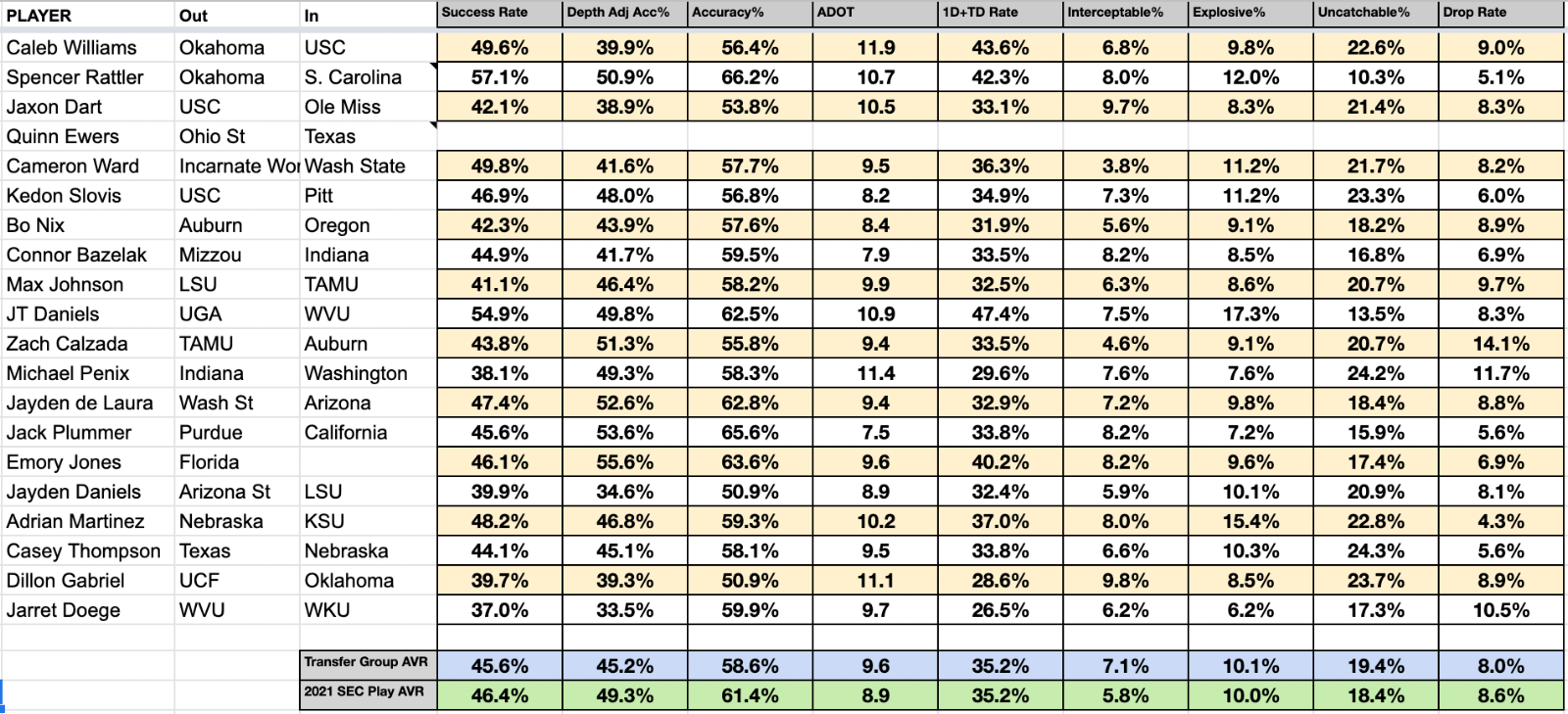
To gauge the group, I charted each against his five or six hardest opponents according to ESPN’s SP+. Some guys had multi-year samples and others were confined to a single season. For the former SECers, their profiles reflect their performances in conference play only. And instead of just focusing on traditional counting stats, I tracked more advanced metrics. Though not a complete resume, this exercise has proven to be an accurate prognosticating tool for passers. And for the purposes of this article, I broke out our passer’s profiles by overall results, downfield throws, plays against pressure, and “floor” projection. That latter being an attempt to gauge a QB’s offering within structure without the help of play action or hindrance of duress to affect throws.
On3’s Transfer Portal Rankings take into account a player's impact, but this list is all about who I believe to be the better passer. And not to tell you how to intake information or anything, but I’d recommend checking out the companion podcast I cut breaking down the QBs with expanded details and analysis.
20. Jarret Doege: 6’2, 208
West Virginia → Western Kentucky
Player Skinny
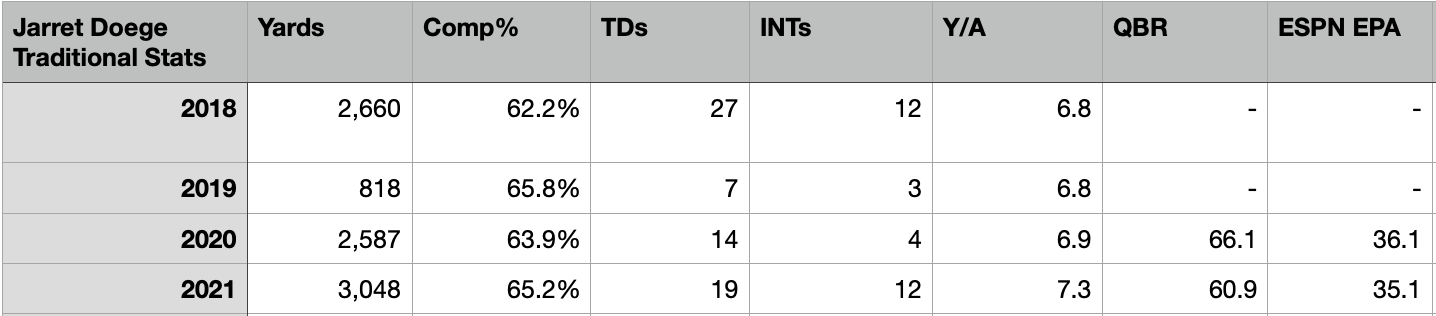
Despite being a QB with average verticality in his operation, his downfield results are some of the worst in the group; deep metrics are the floor. Functioned as a rinky-dink Air Raid distributor for the most part but tended to test tight windows. Targeting short enabled a decent Accuracy% Not overly skilled at throwing people open; furthest depth throw in sample was only 40 yards beyond the line of scrimmage. Plus, he took way too many sacks for someone with a below-average pressure rate. His previous scheme used below-average screen+RPO+play action; so what you see might be what you get. His sample was all against Top20 defenses, which he shouldn’t see much of at WKU.
Player Sample: Strength of Slate (3rd: very hard)
2020 Oklahoma State: 23rd OVR (12.6), 18th DEF (20.0)
2020 Iowa State: 11th OVR (18.7), 11th DEF (18.8)
2021 Baylor: 15th OVR (15.6), 13th DEF (17.1)
2021 Oklahoma State: 12th OVR (17.2), 4th DEF (14.3)
2021 Minnesota: 18th OVR (14.4), 8th DEF (15.4)

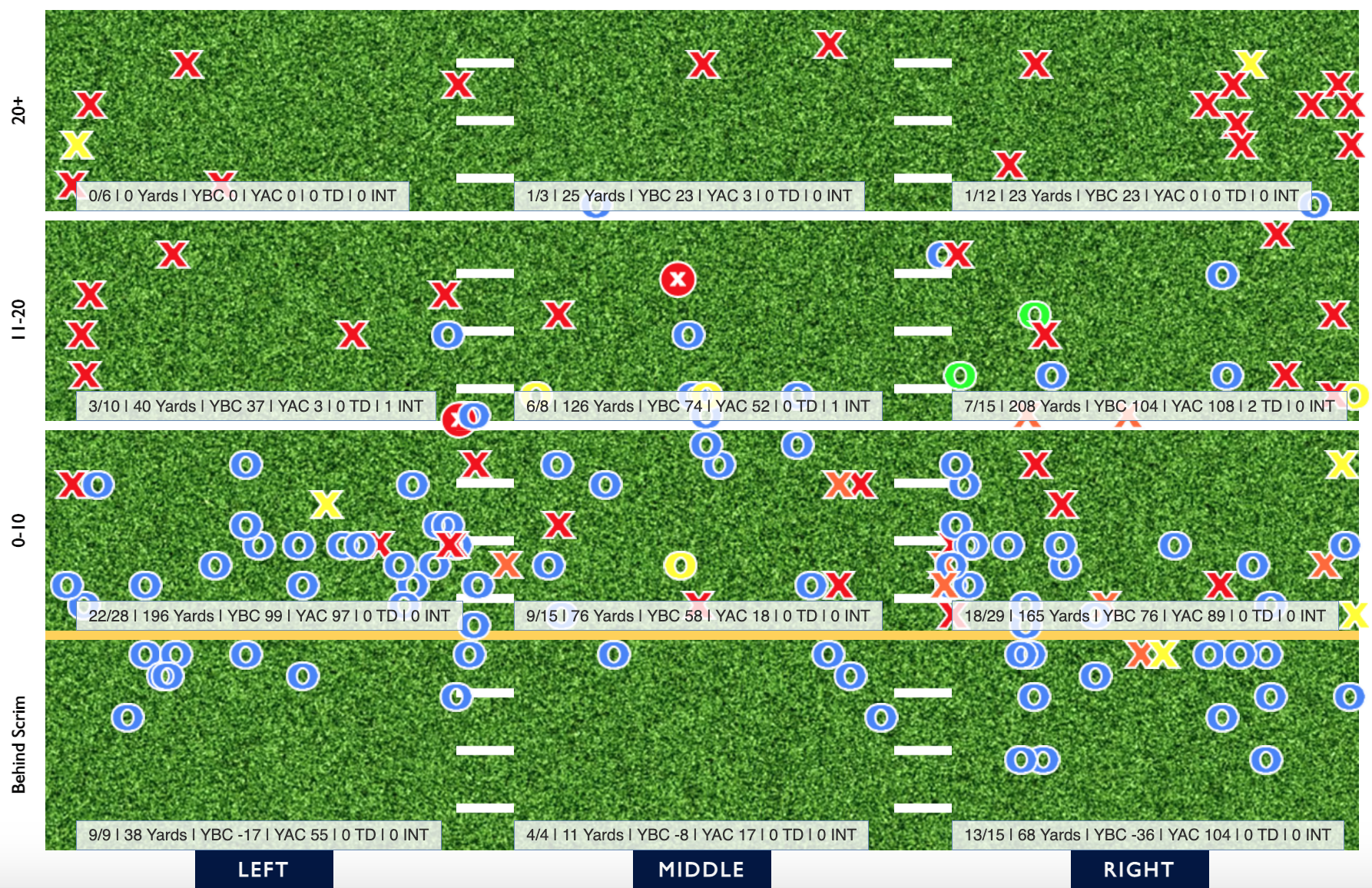
Doege suffered from a double-digit Drop Rate but was decidedly below-average in obtaining splash gains and conversions. His Depth Adjusted Accuracy% and Interceptable Pass Rate were soured thanks to his deep misfires across his sample.

He only completed a mere 2/21 of his attempts beyond 20 yards. More than half were uncatchable, and nearly a fifth were turnover-worthy. Throwing deep clearly isn’t his game. Moreover, he struggled to display mediocrity in the midrange game.

Doege was awful when under the gun. Though he logged a desirable Pressure Rate, his Sack Rate practically doubled the SEC average. Exactly two-thirds of his sample’s pressures on pure dropbacks resulted in a sack.

Though his offense didn’t shower him with props and guises, Doege’s passing floor failed to impress within structure. He apparently aims to be a hot-potato passer – getting the ball out quickly to space – rather than one who enjoys seeking highlight plays. In a vacuum, the vanilla approach would be fine if not for his downfield errancy and underwhelming results.

19. Dillon Gabriel: 6’0, 200
Central Florida → Oklahoma

Player Skinny
An undersized, left-handed passer coming from a QB-friendly “Super Spread” system. Displays a frantic style in the pocket but owns undeniable boogie and mobility. His overall consistency and potency in his sample is worrisome considering his style of play. The vertical operation partly explains the down-to-down inefficiencies, but his raw Accuracy% finished tied for worst in the group. Coincidentally, his sample featured an undesirable amount of uncatchable attempts and interceptable passes. The latter also came into the picture thanks to his high-arcing deep ball. Though a pretty trait in rhythm, underthrown chances constantly resulted in risky toss-ups. In the end, his downfield drive is middling but figures attacking tight windows accentuate his dismissible arm talent. That said, his new offensive coordinator should be able to generate laudable traditional stats with him in Norman.
Player Sample: Strength of Slate (17th: moderate)
2019 Pittsburgh: 49th OVR (4.1), 12th DEF (16.0)
2019 Cincinnati: 34th OVR (9.1), 32nd DEF (21.1)
2020 Tulsa: 39th OVR (6.8), 23rd DEF (20.6)
2020 BYU: 7th OVR (23.1), 21st DEF (20.3)
2021 Boise State: 42nd OVR (9.4), 23rd DEF (20.8)

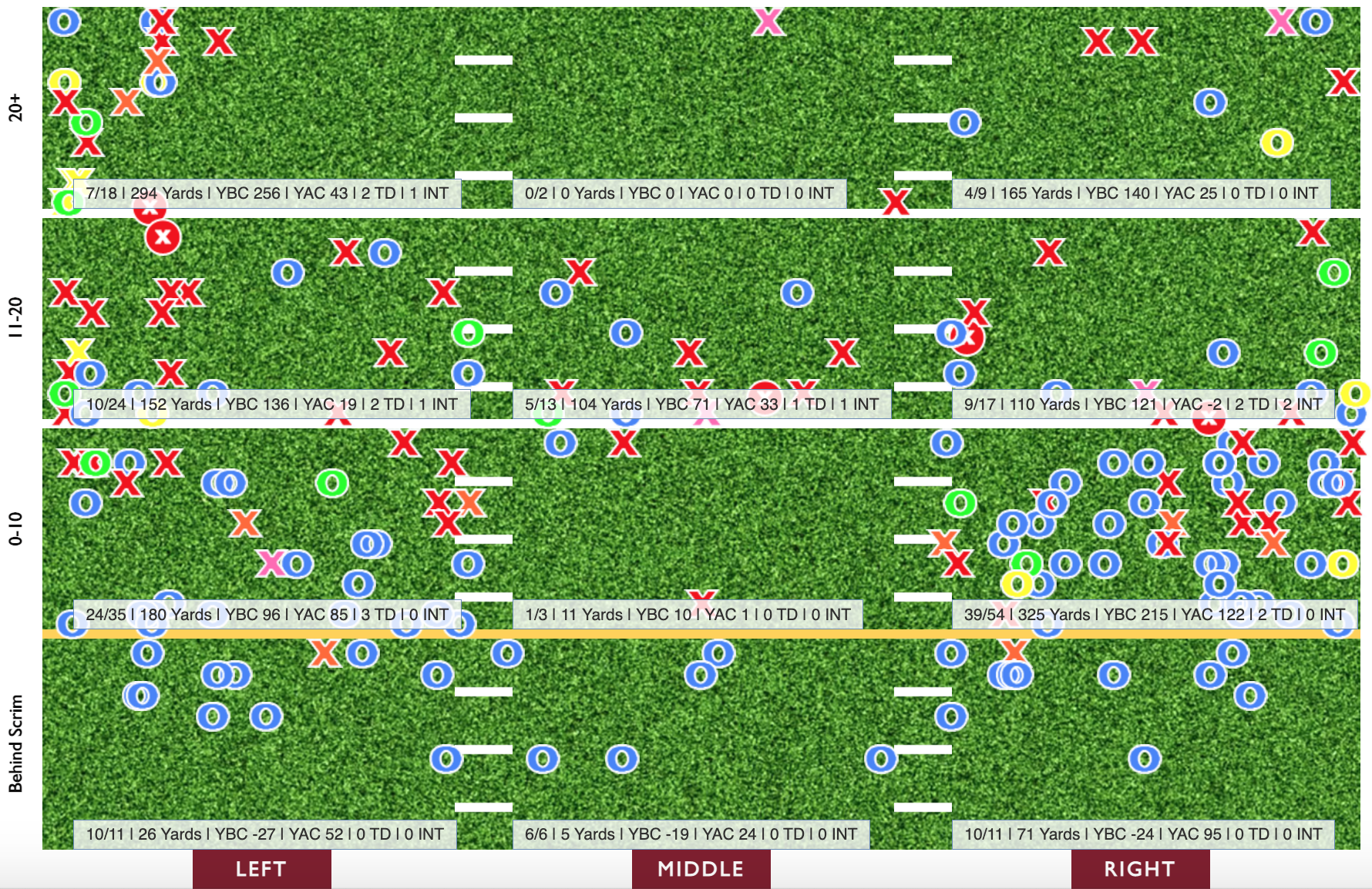
Josh Heuple’s play calling was aggressive and took chances resulting in Gabriel’s 11.1 average depth of target (ADOT). Only two other transfer QB’s topped that in their samples. But, that style of play paired with subpar ball placement produced the worst Interceptable Pass Rate, 3rd-worst Uncatchable Pass Rate, and 4th-worst Depth Adjusted Accuracy% among our candidates.

Gabriel’s “moonshots” are definitely highlights to his game. Generally speaking, his deep passes are pretty catchable; but that also applies to defensive backs. His stans will point to his serviceable Completion% and Accuracy%, but over a quarter of his throws 20-plus yards were interceptable. Plus, his midrange offerings were relatively putrid.

Despite his decent escapability and knack for not moving backwards, Gabriel’s bottomline when pressured wasn’t strong. His accuracy was fine on a per-chance basis, but far too many tries wound up in harm’s way with positive results being seldom.

As a bad passer when designed break down as well off of play action, his passing floor figures present some silver linings within structure. Inside of the pocket without duress or play fakes, Gabriel’s gung-ho M.O. is capable of putting up gaudy stats and respectable results. However, his greatest drawback heightens in these spots. All three of Gabriel’s process metrics reflected poorly to SEC standards.

18. Casey Thompson: 6’1, 192
Texas → Nebraska

Player Skinny
A mercurial, athletic passer who ultimately wasted too many throws. Almost a quarter of his attempts in his sample were uncatchable. He's coming from a scheme that hid him a decent amount with RPOs and a high Play Action Rate. A substantial amount of his targets were directed behind the line of scrimmage. The ample deception tactics in his previous offense boosted his bottomline, but his advanced stats are on par with numerous SEC standards. Without guises, he projects to be a sub-mediocre passer within structure. He has problems with ball placement when resetting or changing towards his second read; especially with inbreakers. Though he can move better than most, he isn’t a strong passer outside the pocket; these throws tend to lose mustard. And in general, his sample hints attacking tight windows isn’t one of his stronger traits. He didn’t take too many sacks. But despite his low clip and mobility, he wasn’t a special eraser. All in all, he’s an adequate plug-and-play option.
Player Sample: Strength of Slate (7th: hard)
2021 Oklahoma: 13th OVR (17.2), 58th DEF (25.6)
2021 Oklahoma State: 12th OVR (30.6), 4th DEF (14.3)
2021 Baylor: 15th OVR (15.6), 13th DEF (17.1)
2021 Iowa State: 19th OVR (14.3), 19th DEF (20.2)
2021 Kansas State: 21th OVR (14.2), 16th DEF (19.0)

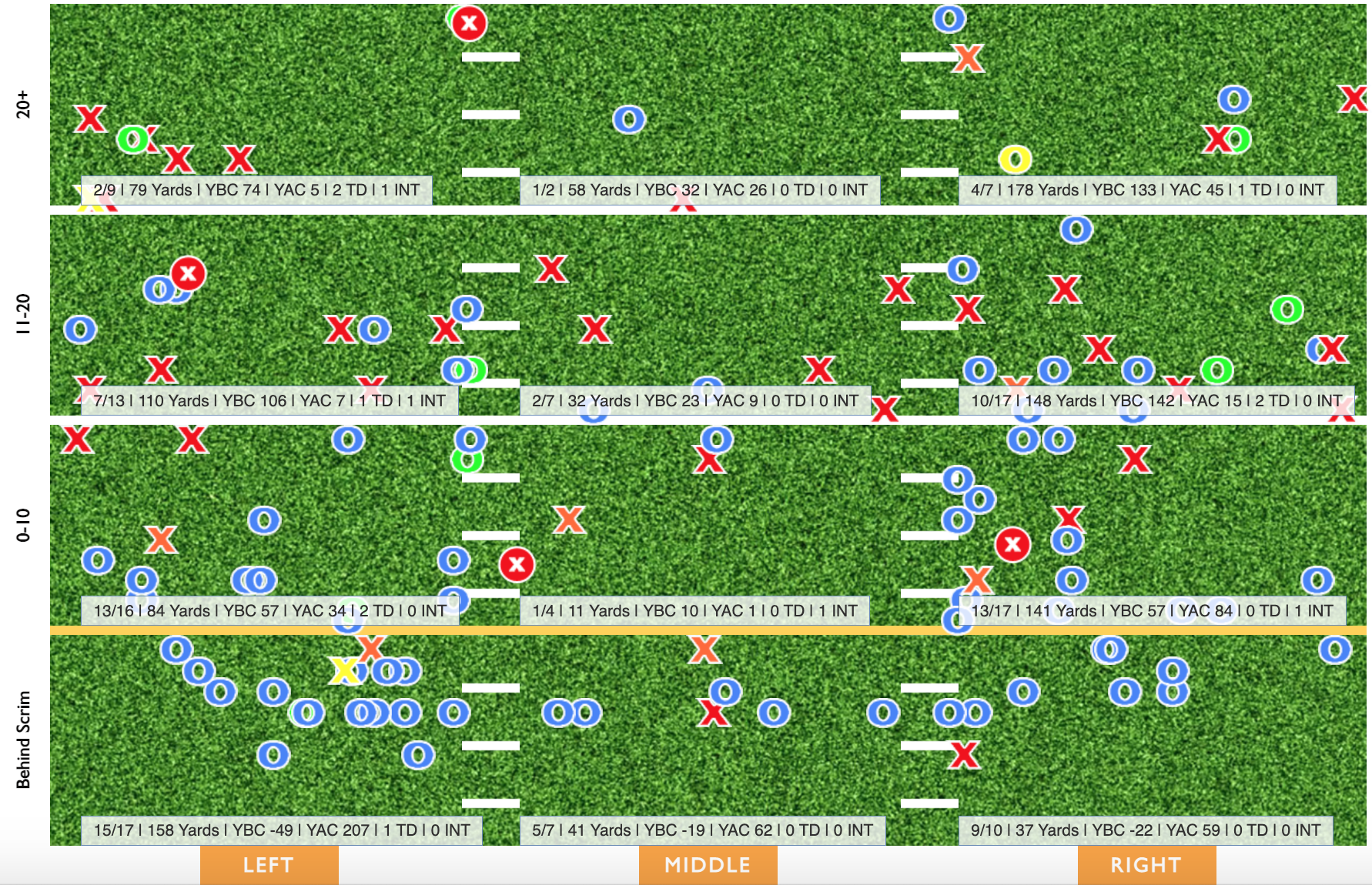
Though an Average Joe in many respects, Thompson threw an uncatchable pass on nearly a quarter of his attempts. No other transfer QB managed to match his putrid 24.3% figure. Finding gains is hard enough; the ante (and frustration) certainly get upped with that many biffs dampening his outlook.

Thompson was even-Steven to SEC averages on throws beyond 10 yards downfield. His numbers subsequently don’t jump off the screen, but he is a competent enough passer to deliver downfield wins on occasion.

Statistically speaking, Thompson was one of the best in the group negating sacks. But while his Pressure:Sack Ratio is one of the best in the group, his tape likens him to be a disappointing option on backyard ball extensions and fighting through contact. That said when pressured, he didn’t show a tendency to press the ball and found modest results relative to SEC standards. But, he still found himself tossing too many uncatchable passes.

Play action was a big friend to Thompson in Steve Sarkisian’s offense. It helped him top SEC benchmarks in Success Rate and First Down+TD Rate. But without it, his passing floor profile hardly excites. To his credit, he still can bring explosive gains and target downfield. His underlying ball placement concerns, however, persist. Drops could explain some of the result metrics being blah. But both his Depth Adjusted Accuracy% and Uncatchable Pass Rate in these spots were significantly under expectation.

17. Adrian Martinez: 6’2, 220
Nebraska → Kansas State

Player Skinny
A mobile option who failed to exhibit sturdy downfield accuracy. His arm talent is okay but his wheels are probably his best asset. He has an ability “blowby” around the edge or past flat-footed defenders both on scrambles and designed carries. In general, he was better than average at taking sacks. But ultimately, his line surrendered too much pressure to prevent him from making a few bonehead plays. Numerous negative game-altering snaps largely undercut his performance. He prefers a conservative approach with manageable throws for the most part. But, his game (potency, aggression) noticeably enhances when he uses play action. Using the tactic, he’s one of the best in the group. That said, his dependence on it to grease his operation is a hold-up. This passer has the capacity to be impactful, but not capable of carrying an offense.
Player Sample: Strength of Slate (1st: very hard)
2020 Ohio State: 2nd OVR (28.2), 10th DEF (18.7)
2020 Iowa: 10th OVR (18.7), 2nd DEF (13.4)
2021 Michigan: 4th OVR (23.4), 10th DEF (15.8)
2021 Minnesota: 18th OVR (14.4), 8th DEF (15.4)
2021 Ohio State: 2nd OVR (29.3), 20th DEF (20.6)
2021 Wisconsin: 7th OVR (20.1), 2nd DEF (10.8)

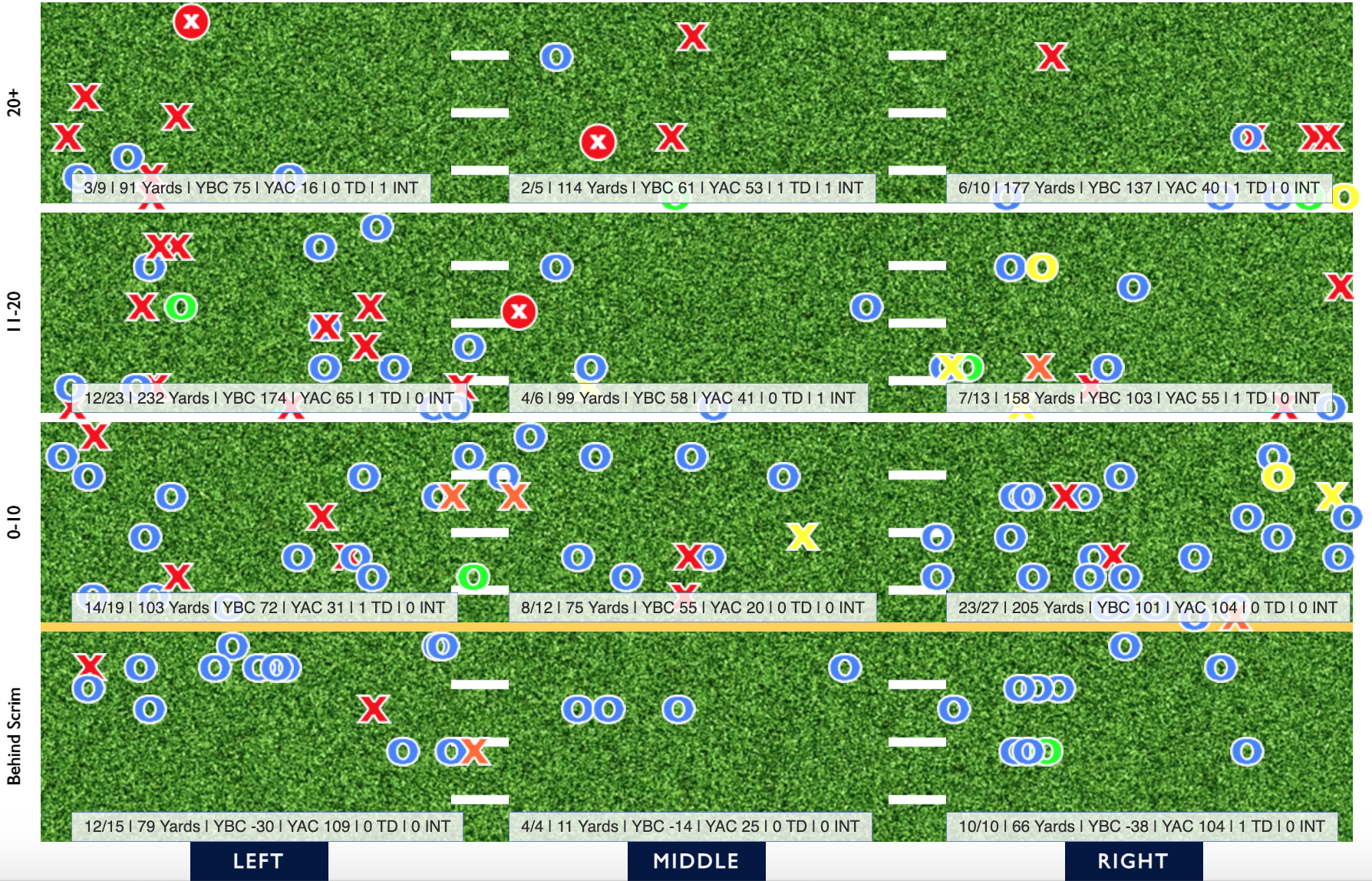
Martinez has 38 career starts; 14 of them against Top35 defenses. His career hasn’t had many layups and he’s faced plenty of scrutiny. That angst manifests through his high Uncatchable and Interceptable Pass Rates. But considering the degree of difficulty, his down-to-down showings are somewhat commendable. Though propped up by play action, his Explosive Pass Rate is the transfer group’s second-best figure.

Martinez found praise-worthy results with his downfield offerings, but his process appears to have been a bit flawed. Almost a fifth of his sample’s throws beyond 10 yards downfield could have been picked off. Additionally, both his deep and midrange Uncatchable Pass Rates fell on the wrong side of the SEC average.

He dealt with an incessant wave of duress but turned in an above-average Sack Rate and Pressure:Sack Ratio. Again, his legs overly rose-scent his offerings as a quarterback. But in this volatile window, both his pressured First Down+TD Rate and Accuracy% beat expectations. Risky passes still showed up. But according to these showings, Martinez could be an occasional playmaker.

We all have that friend who isn’t as fun sober as inebriated. If play action usage is booze in this lazy metaphor, then Martinez is one of those guys. He still can find situational wins, but his bottomline is a total buzzkill in these spots. On true dropbacks without play action or pressure inside the pocket, he was twice as likely to toss a turnover-worthy pass as a 20-plus yard completion. Without deception tactics generating defined reads or enhancing separation, his overall ball placement stress the major flaws in his game on probably why he won’t play on Sundays. Dishearteningly, Martinez rocked a mere 5.9 Yards/Attempt in these spots across his sample.

16. Jayden Daniels: 6’3, 185
Arizona State → LSU

Player Skinny
A QB who feasted on West Coast Offense patterns and underneath routes. Across his sample, he was typically anxious to scramble and lean utilizing his running ability. Most of his tackoffs were towards green grass up the middle and owns a good burst as a ball carrier. Presently not a great passer. However, he has adequate tools to potentially become a competent thrower one day. He has shown serviceable vertical drive – the longest depth throw in his sample tracked at 48 yards downfield. Plus, he dons a smooth delivery with little effort. That said, finding better consistency and eradicating erratic loops in his throwing motion will be paramount. His Accuracy% was tied for worst in the group and failed to deliver much substance with his arm. Plus, despite his reputation as a scrambler, he takes way too many sacks.
Player Sample: Strength of Slate (4th: hard)
2019 Michigan State: 42nd OVR (7.2), 13th DEF (16.1)
2019 Oregon: 15th OVR (19.0), 8th DEF (15.5)
2020 USC: 13th OVR (16.7), 29th DEF (22.1)
2021 Utah: 16th OVR (15.2), 22nd DEF (20.7)
2021 Washington: 83rd OVR (-0.7), 45th DEF (23.6)
2021 Wisconsin: 7th OVR (20.1), 2nd DEF (10.8)

Though his backers can point to various reasons for Daniels’ unimpressive stats, his individual process unequivocally is a worry entering this fall. Though he’s not reckless with the ball – in fact, it was often the exact opposite – his precision is dull. Along with throwing an uncatchable attempt on over a fifth of his sample’s throws, only one other transfer QB on this list posted a worse Depth Adjusted Accuracy%.

Despite flashing periodical wonderment, Daniels’ downfield offerings were mostly duds. Yes, his deep Completion% projects to be a fantastic figure by SEC standards. But his accuracy beyond ten yards downfield remains to be his greatest shortcoming as a passer. His midrange returns were particularly pathetic and were among the worst the group has to offer. His intermediate Completion, Accuracy, and Uncatchable% all tracked to be double-digit percentage points below the SEC play average.

Daniels logged exactly 28 scrambles and designed rushing attempts in his sample. In both respects, his Success Rate topped 60% and his yards after contact 3.3. Studily effective in both respects, he has playmaking potential and can do things with the ball others can’t. But when Daniels is unable to slither through the pass rush or find daylight, he fails to produce much value. His Sack Rate on true dropbacks almost doubled the SEC play average and his Pressure:Sack Ratio was among the worst in the portal.

In stable conditions, Daniels has the capabilities to deliver key completions and keep defenses honest with big gainers. His down-to-down consistency, however, remains to be a hangup. His Depth Adjusted Accuracy% is at a dangerous level, and nearly a sixth of such attempts project to be uncatchable. The streaky approach could mean his 2022 could be boom or bust. As of today, that favors the latter thanks to his halfcocked ball placement.
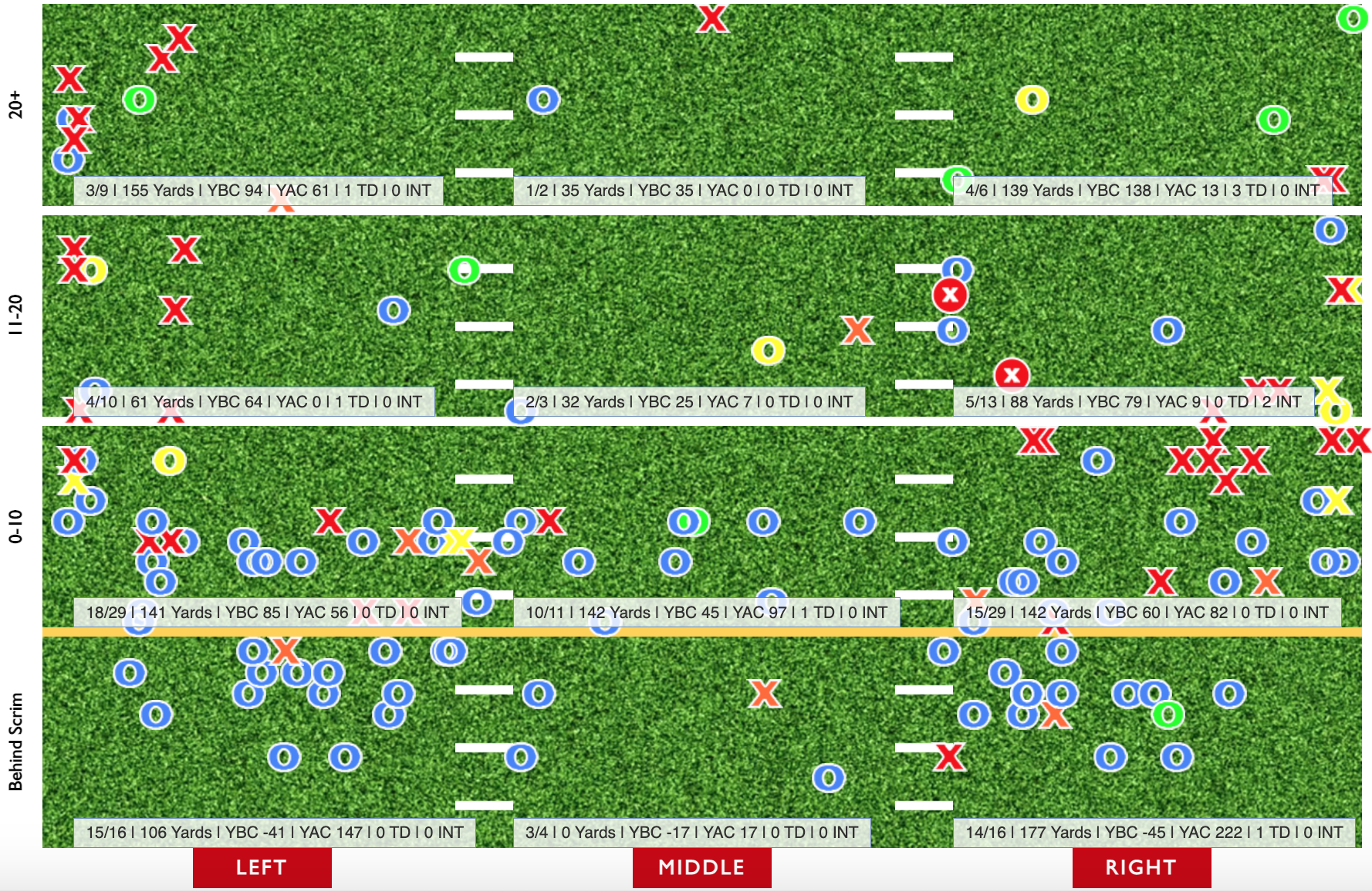

15. Emory Jones: 6’2, 211
Florida → TBD

Player Skinny
A passer with valuable natural traits but is still in need of further refinement. He possesses a strong arm and can make plays with his legs in the open field; but he wasn’t special hitting dingers or passing under pressure. He seemingly lacks confidence from time-to-time and can be hesitant to let passes rip. He was competent attacking the underbelly of defenses and saw enhanced results with play action. His best results came in the midrange. But that’s also the area of the field where most of his interceptions occurred. In general, he consistently placed passes within the defense’s reach and underwhelmed capturing splash gains through the air. But while concerns about him being a puppet of his former playcaller are real, his passing floor profile hints he might be able to go out on a high note.
Player Sample: Strength of Slate (11th: average)
13 appearances against SEC defenses across 2020+2021

As an apparatus for Dan Mullen, Jones delivered some of the best results in SEC play this past season. But the nickel-and-diming, infrequent shots, and a backbreaking tendency to toss turnover-worthy passes makes him a perilous passer moving forward. The risk-reward in his M.O. is drastically imbalanced in that sense.

Though technically a member of the “Toosly Archetype” of QB, his arm talent hasn’t translated to throwing a good deep ball. This past season, only a quarter were on-target while almost half had no chance of being caught. A fifth were interceptable. Again, his risk-reward is out of whack. But, his admirable midrange metrics help keep the hope alive that he can turn the corner and become a worthwhile passer – with the exception of his boo boo throws into coverage.

His athleticism has come through in avoiding sacks, buying time, and snatching occasional gains. Despite seeing a form of pressure on roughly a third of his dropbacks this past season, Jones took a sack on every ninth on average – one of the best clips in the conference. But as you can see, pressure is what often baffled and broke Jones into blunders. Almost a fifth of his pressured attempts had potential to be picked off; almost half had no chance of being caught and only a third were deemed accurate.

Though play action delivered some nice plays, Jones was also susceptible to interceptables using the tactic. His 11.5% such rate was four points over the conference average and significantly worse than his floor passing figure. Either way, his down-to-down efficiencies remained firm when stripping away superfluous factors. And even though his Explosive Pass Rate was nearly sliced in half without play action, his catchability tremendously improved.
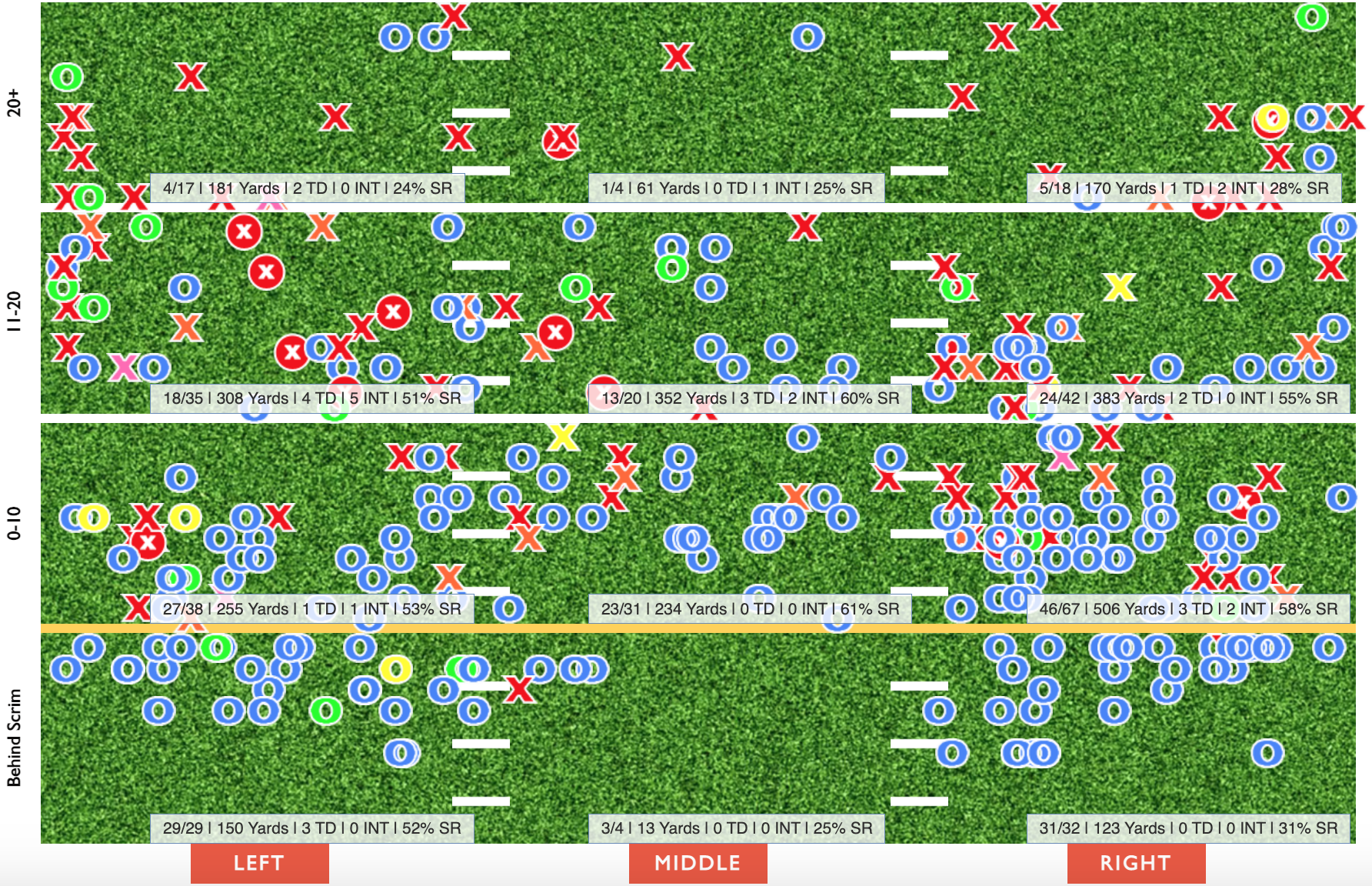

14. Jack Plummer: 6’5, 215
Purdue → California

Player Skinny
A tall, toolsy quarterback capable of making head-turning plays. He owns a big arm and moves fluidly. He acts a little antsy in the pocket but has numerous examples of standing tall against pressure. Exhibits a strong lower body and can break tackles. But contrary to his skill set and natural gifts, he overly operated targeting underneath and safe completions within Purdue’s Air Raid scheme. Occasionally, he will “lollipop” deep attempts (inexplicable underthrows) and showed a tendency to ground throws towards the short left. His nice arm disappointed in terms of delivering a satisfying amount of downfield completions and navigating tight windows, but he unequivocally logged a number of dimes in his sample. Despite commanding one of the group’s top down-to-down accuracy marks, he produced a high number of turnover-worthy throws with below average down-to-down metrics. Obviously having never survived a whole season as a starter, health is a concern.
Player Sample: Strength of Slate (15th: moderate)
2019: Iowa: 20th OVR (16.9), 6th DEF (15.2)
2020 Nebraska: 32nd OVR (9.4), 38th DEF (23.8)
2020 Minnesota: 34th OVR (8.6), 64th DEF (27.7)
2021 Notre Dame: 11th OVR (17.4), 15th DEF (18.9)
2021 Illinois: 64th OVR (4.3), 32nd DEF (21.8)

Despite Plummer having one of the most sexy arms in the group, dialing up shots and searching for homeruns weren’t prominent aspects of his previous offense. In fact, none of our transfer QBs posted a lower average depth of target than his. Again, he managed to find plenty of completions and stuff his process metrics thusly. But considering the conservative spray, his proclivity to tally turnover-worthy throws is entirely problematic.

Plummer throws a very catchable deep ball. Unfortunately, defenders often had equal opportunity towards these attempts as his receivers. A third of his deep passes in his sample could’ve been picked off. Sadly, the onager’s perilous placement was also present on his intermediate throws. Granted his accuracy on his downfield throws tracked to be just fine by SEC standards, but he gave opponents way too many stabs at his targets.

Plummer struggled to limit interceptables under duress. But besides that stain, the rest of his pressured profile stands up favorably to most of the group. His Accuracy% under the gun would’ve been a top5 figure within the SEC if averaged out over the course of an entire season, and his such Uncatchable Pass Rate was about ten points above-average. All the while, the hoss hardly went down behind the line of scrimmage. His Sack Rate was the lowest among our candidates.

Though screens and RPOs collectively weren’t a major part of Purdue’s passing game, Plummer experienced a healthy amount of play action. With it, his per-opportunity potency and accuracy ballooned. But, his consistency dwindled. Within structure omitting guises, his numbers displayed an inverse relationship. Almost a tenth of his attempts were turnover-worthy, which more than doubled his rate of explosive passes. However, his Success, First Down+TD, and Uncatchable Pass Rates as well as his Depth Adjusted Accuracy% all improved compared to his overall returns, which stresses his passing floor remains firm even if there’s a ways to go to round out his game.
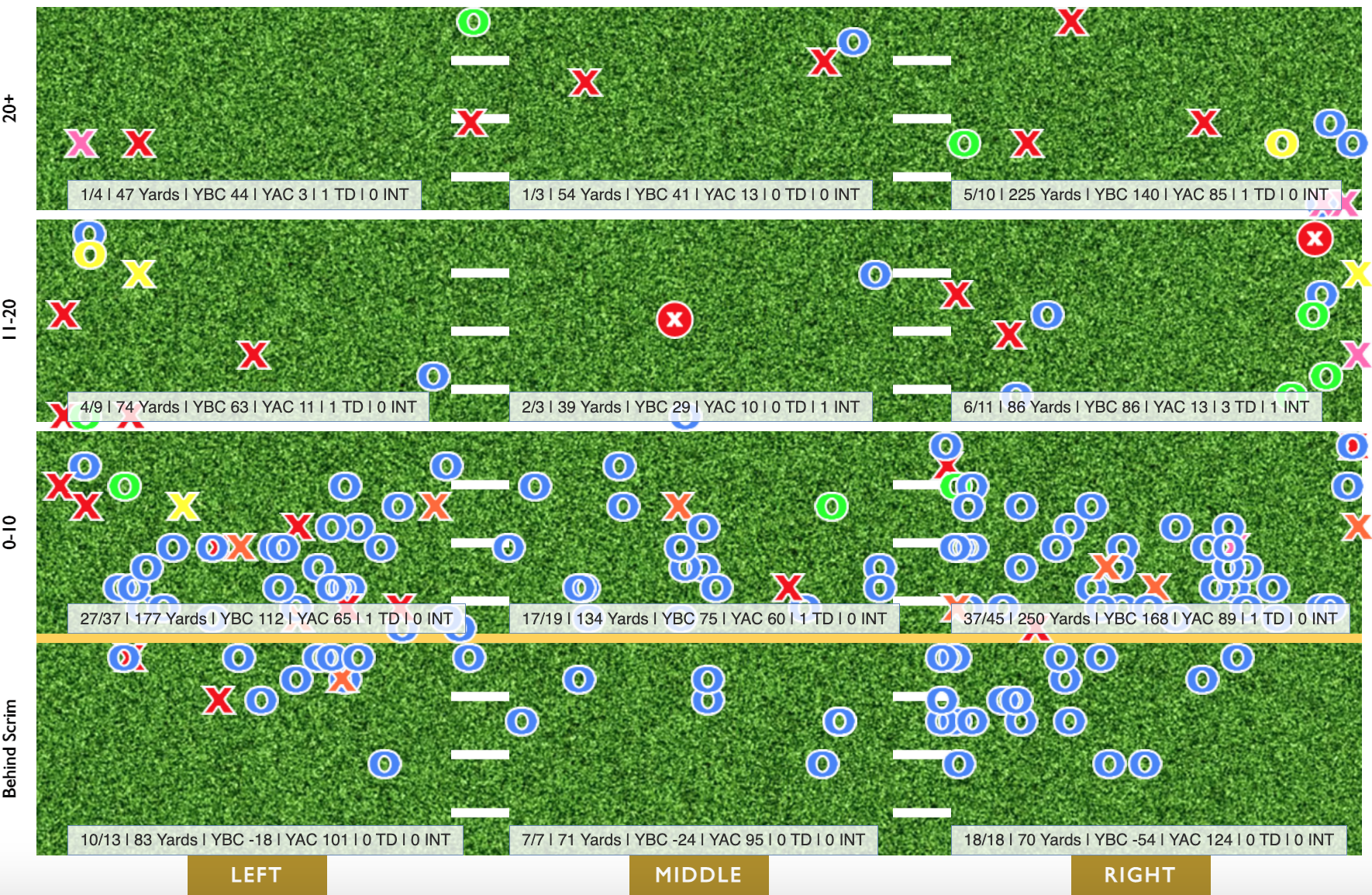

13. Jayden de Laura: 6’0, 190
Washington State → Arizona

Player Skinny
A pretty average passing prospect with below average size. Operated in a scheme that didn’t hide him much and his hints to be a fairly strong decision-maker. His arm talent is only so-so and he struggles to thrive deep; furthest downfield throw in his sample topped out at 42 yards. Moreover, he favored targeting underneath outbreakers and throws along the sideline. He sports a commendable midrange profile both statistically and on tape with big time throws. He’s a fairly mobile guy but was below-average at taking sacks and negating pressure. He will occasionally buffer and bring it on himself. Thankfully for an undersized passer, he does show relatively good returns outside the pocket. And behind his ample short attempts, he managed to turn in one of the top Accuracy% in the group. But he commonly wasted chances with over a fifth of his sample being charted as uncatchable.
Player Sample: Strength of Slate (16th: moderate)
2020: Oregon: 17th OVR (15.6), 24th DEF (21.0)
2020 USC: 13th OVR (16.7), 29th DEF (22.1)
2020 Utah: 22nd OVR (12.8), 26th DEF (21.4)
2021 California: 68th OVR (3.4), 52nd DEF (25.0)
2021 Arizona State: 26th OVR (11.8), 24th DEF (20.9)
2021 Washington: 83th OVR (-0.7), 45th (23.6)

De Laura is a middle-of-the-road option who can be trusted to step in and be adequate down-to-down. He likes to attack vacated space underneath but is also serviceable at finding big gainers. But while he can find wins, he isn’t immune from duds and risky passes.

Though throwing deep isn’t really de Laura’s strength, he proved that targeting that area of the field isn’t a major liability. But, he hangs his hat on his intermediate throws. Both his such Completion% and Accuracy% topped SEC standards. But when looking at all throws beyond ten yards downfield, almost a third were uncatchable and over a seventh had turnover potential. Even if the rest of those tries were accurate, which they weren't, that’s a high level of busted tries.

De Laura had the luxury of playing behind a great pass blocking line. His Pressure Rate on dropbacks was one of the lowest around, and his Sack Rate remained on the low side. But, his Sack Conversion Rate failed to quell concerns that he’s not a strong scrambler or TFL eraser. Despite his limitations, his showings under the gun provide a little more optimism in his potential. While turning in viable ball placement metrics, de Laura snagged a First Down+TD Rate six points better than his overall clip.

Since pressures and schemey elements played such a little role composing de Laura’s passing makeup, his floor figures generally reflect his overall stats. He continued to waste too many tries with a subpar weighted accuracy mark. And, his explosiveness worsened. Still, he showed to be a safe passer who found success on over half of his attempts.
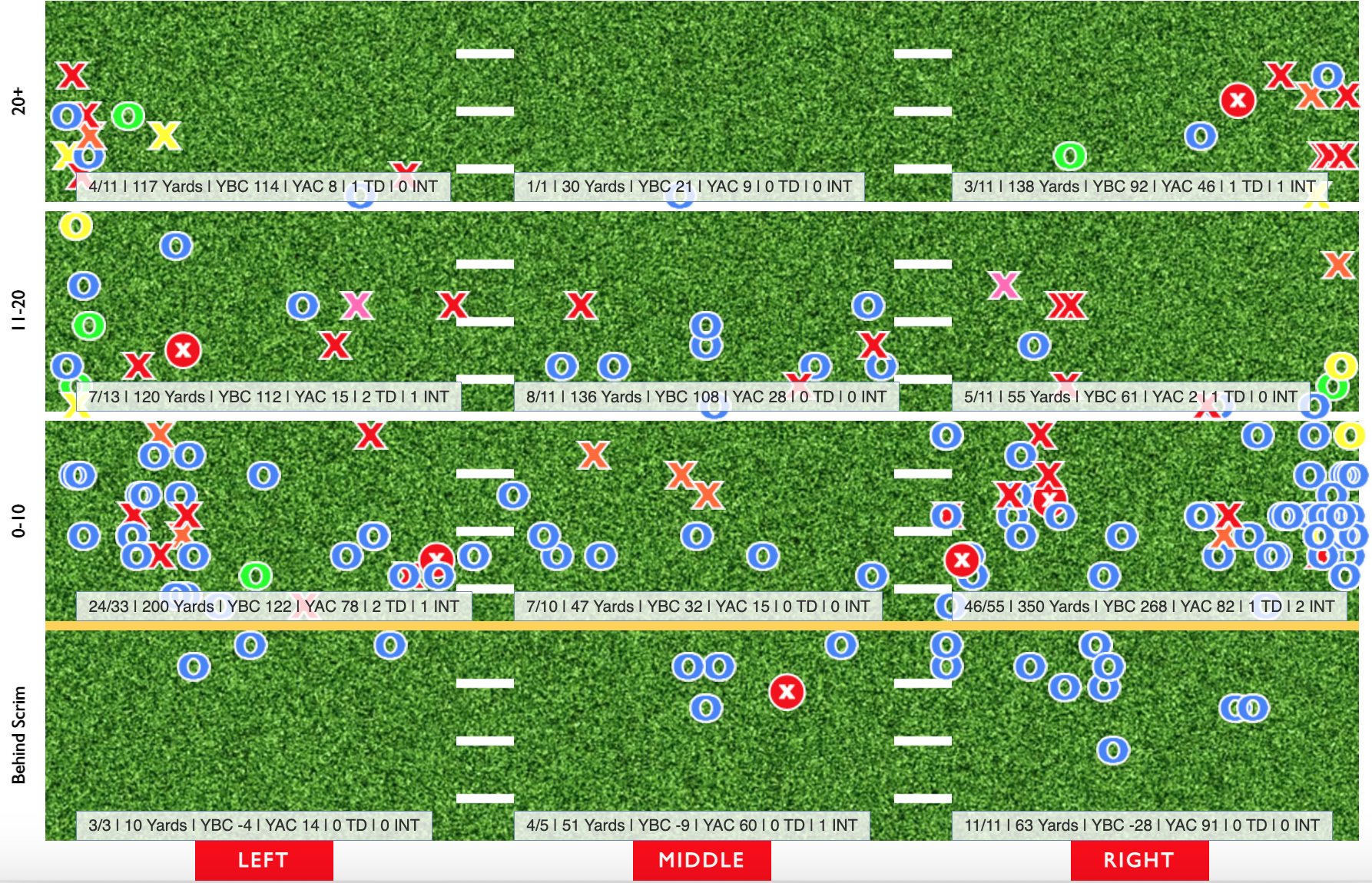

12. Michael Penix Jr.: 6’3, 218
Indiana → Washington

Player Skinny
A crafty left-handed passer pocket passer who has enough talent and savvy to find downfield wins in various ways. A rhythm passer who enjoys throwing passes on a line. He is capable of leading guys open vertically but is a fan of backshoulders. His previous scheme was averse to screens, RPOs, and overt play action usage and his sample is one of the most vertical in the group. His efficiency plummeted this past season with negative Expected Points Added accrued and 3 starts with a sub 50%. While worrisome, he suffered from a hazardous Pressure Rate and deplorable Drop Rate that absolutely dented his sample. Still, he was undeniably prone at serving up some slop; his Uncatchable Pass Rate was the 2nd-worst in the group. He shows promise managing sacks considering the volume of bullets he had to dodge. But he projects little value when under duress, outside the pocket, or targeting tight windows. His best work comes within structure. Play Action greased his numbers, but his floor passing figures hint plenty of value assuming his new receiving corps doesn’t suffer from the same case of butterfingers.
Player Sample: Strength of Slate (2nd: very hard)
2019 Michigan State: 42nd OVR (7.2), 12th DEF (16.1)
2020 Penn State: 18th OVR (15.2), 14th DEF (19.4)
2020 Ohio State: 2nd OVR (28.2), 10th DEF (18.7)
2021 Iowa: 27th OVR (11.4), 5th DEF (11.4)
2021 Cincinnati: 5th OVR (21.2), 11th DEF (15.9)
2021 Penn State: 20th OVR (14.3), 6th DEF (14.6)

Penix has some passing chops, and it’s assumed he’ll have cleaner pockets to help cut down on his panicked attempts and miscues. But, he was just as likely to log a 20-plus yard competition as throw an interceptable pass. Both clips were decidedly on the wrong side of the SEC average.

Penix had one of the highest midrange concentrations in the group but failed to display desired consistency on those targets. Drops hurt his bottomline but his ball placement was the bigger catalyst for the statistical shortcomings. Though his arm might not be extraordinary, he won deep in various ways in his sample. But; he’s predominately all or nothing. His such Accuracy% equaled his Uncatchable Pass Rate. While the former would’ve theoretically placed among the SEC’s best, the latter would’ve dwelled in the cellar.

Nearly 40% of Penix’s dropbacks suffered from pressure and nearly half of his flustered attempts were unsalvageable. Meaning, a significant slice of his throws were wasted due to duress, and the copious malfunctions bludgeoned his final projections. He wasn’t the most prolific scrambler but his quick release tended to negate a large portion of his pressures from resulting into sacks. But, his passing efficiency in this context again finished below standards.

On stable attempts, drops outright prevented Penix’s from seeing laudable results. Both his Success and First Down+TD Rate tracked to be seven points below SEC standards. And his already snooze-worthy Explosive Pass Rate shrunk in these spots. But Penix’s process metrics – like Depth Adjusted Accuracy, Uncatchable, and Interceptable Pass Rate – within structure hint he might be a hidden gem. In the conference where “it just means more”, his respective numbers would’ve been among the league’s elite. In pristine pockets, he rarely biffs his opportunities.

11. Zach Calzada.: 6’4, 210
Texas A&M → Auburn

Player Skinny
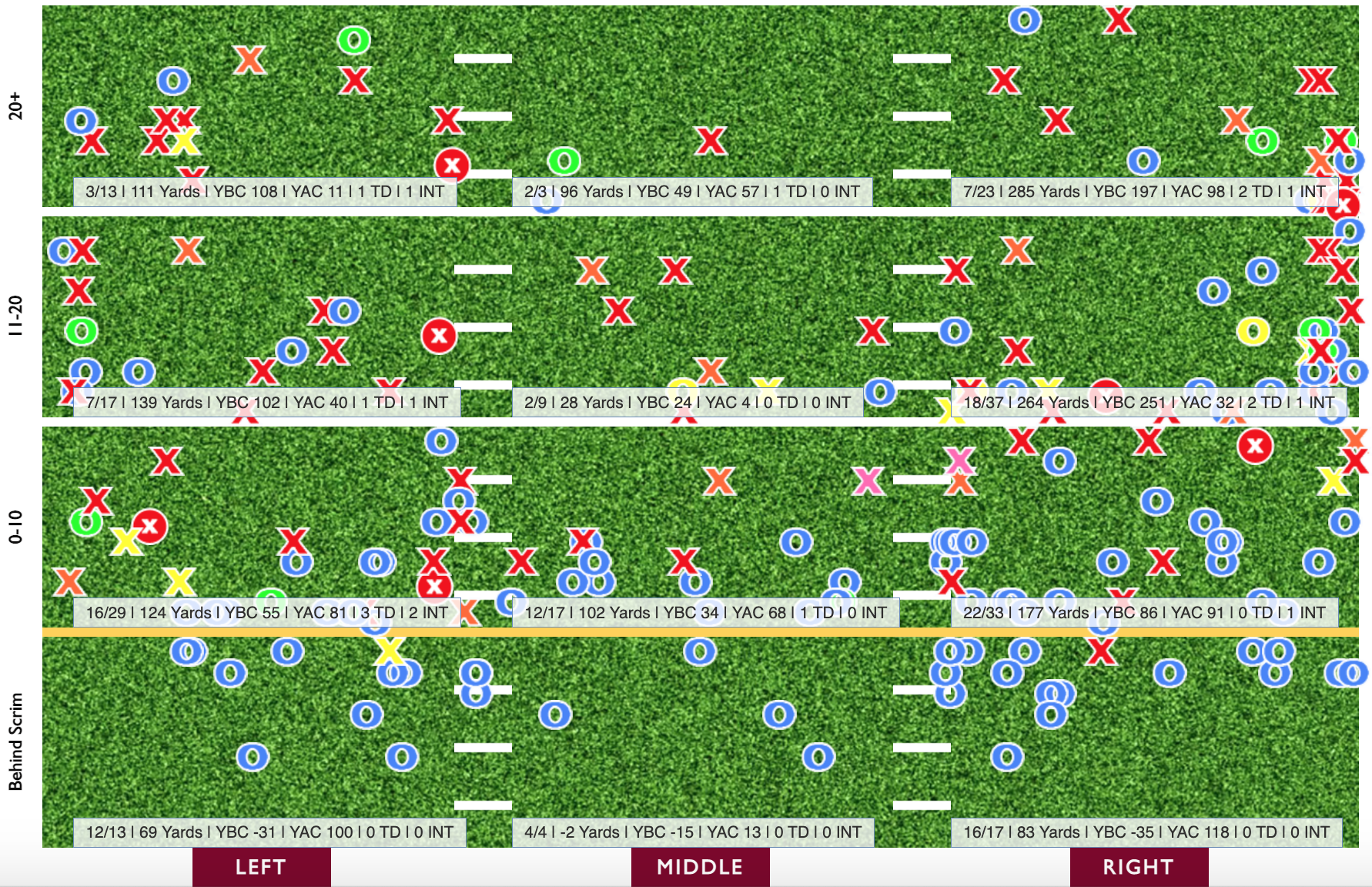
A Strong-armed passer with above-average mobility. Ultimately, he’s a boom or bust QB who needs to refine his full-body mechanics. But, he has clear talent slinging the pill. He throws a nice fastball , but it would be wise if he dabbled with some off-speed offerings moving forward. No other SEC QB logged a worse Drop Rate this past season, and his wayward heaters certainly played a part in his high clip. Overall, he donned ball placement issues and a proclivity to test tight windows to compensate for his targets’ lack of speed and inability to separate. His per-opportunity accuracy numbers totally disappoint. But he still came through with plenty of big time throws beyond ten yards downfield. His weight-adjusted figure hints he was one of the conference’s high-end talents. And while he threw nine picks, his Interceptable Pass Rate was one of the better ones within SEC play.
Player Sample: Strength of Slate (12th: average)
8 2021 SEC conference games

Even with the drops and duds, Calzada’s results flirted with mediocrity. And while he wasn’t the most vertical passer, rocking an Interceptable Pass Rate and Depth Adjusted Accuracy% on the good side of the conference average are figurative merit badges for his dropback game.

Even though Calzada’s downfield results appeared middling on the surface, his process was golden. Both his deep and midrange accuracy figures placed inside the SEC’s Top4 and rarely did he give defenses a stab at takeaways. He did have an “all or nothing” approach with his homers. But again supported by his top-notch Interceptable Pass Rate, either his guy was catching it or nobody was.

Though Texas A&M’s line found a groove paving run lanes as 2021 progressed, they stayed rusty all season maintaining pockets. Calzada saw pressure on a third of his dropbacks; but thanks to his athleticism and poise, he turned in the SEC’s 5th-best Sack Rate and Pressure:Sack Ratio in league play. But, pressure clearly affected his operation. The green passer never found sustained success with defenders barreling towards him.

In structure, Calzada projects to be an admirable quarterback. He maintains decent verticality, doesn’t overly press, and displays effective ball placement. Assuming those pesky drops are fixed – think how insane it is over a fifth of these attempts found his target but resulted in an incompletion – he might be one of the SEC’s big surprises this fall. But, his strong arm must keep dealing downfield dimes without serving up gifts for secondaries.

10. JT Daniels: 6’3, 210
Georgia → West Virginia

Player Skinny
A former five-star prospect entering his third collegiate stop. Due to a changing modus operandi the past three seasons, he remains to be a bit of a mystery. His arm talent and overall accuracy are fine but not assets that will blow folks away. At Georgia, he was one of the SEC’s most efficient passers in terms of results and per-opportunity stats but consistently struggled at displaying precision on long throws. Despite only playing in a few games, he finished with the conference’s 3rd-most “created catch” yards in 2020. Yet, the passer dazzled in the midrange game. He might lack elite ball placement, but he doesn’t waste too many chances and tends to give his receivers a stab at the large majority of his targets. He is a strong down-to-down decision-maker keen at keeping an offense on track and ahead of the chains. That said, he isn’t immune from turnover-worthy passes. In structure, his stats hint sterling ability to gobbling up yardage, but he must improve negating pressures and navigating muddy pockets.
Player Sample: Strength of Slate (13th: moderate)
5 SEC games across 2020+2021

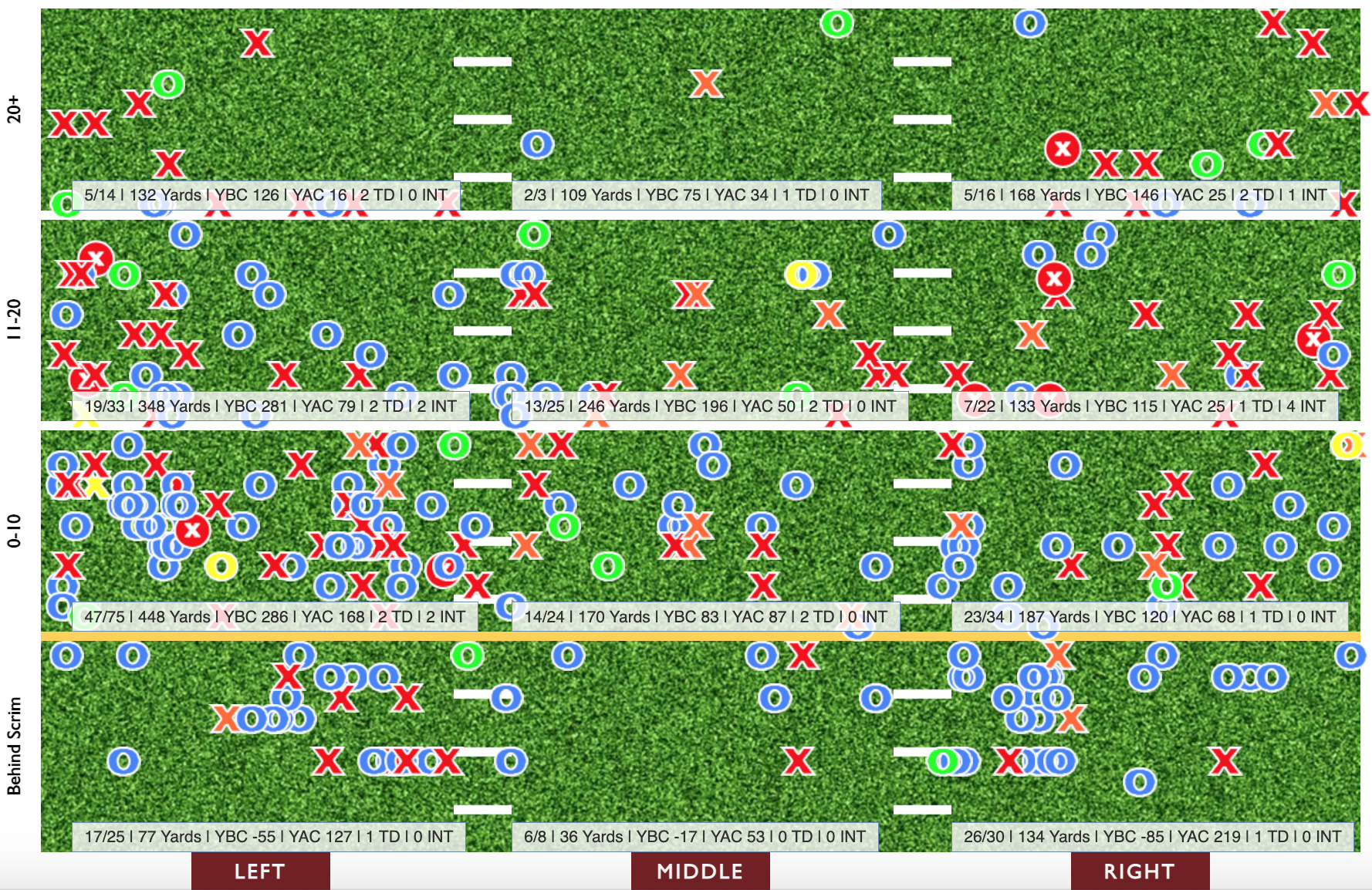
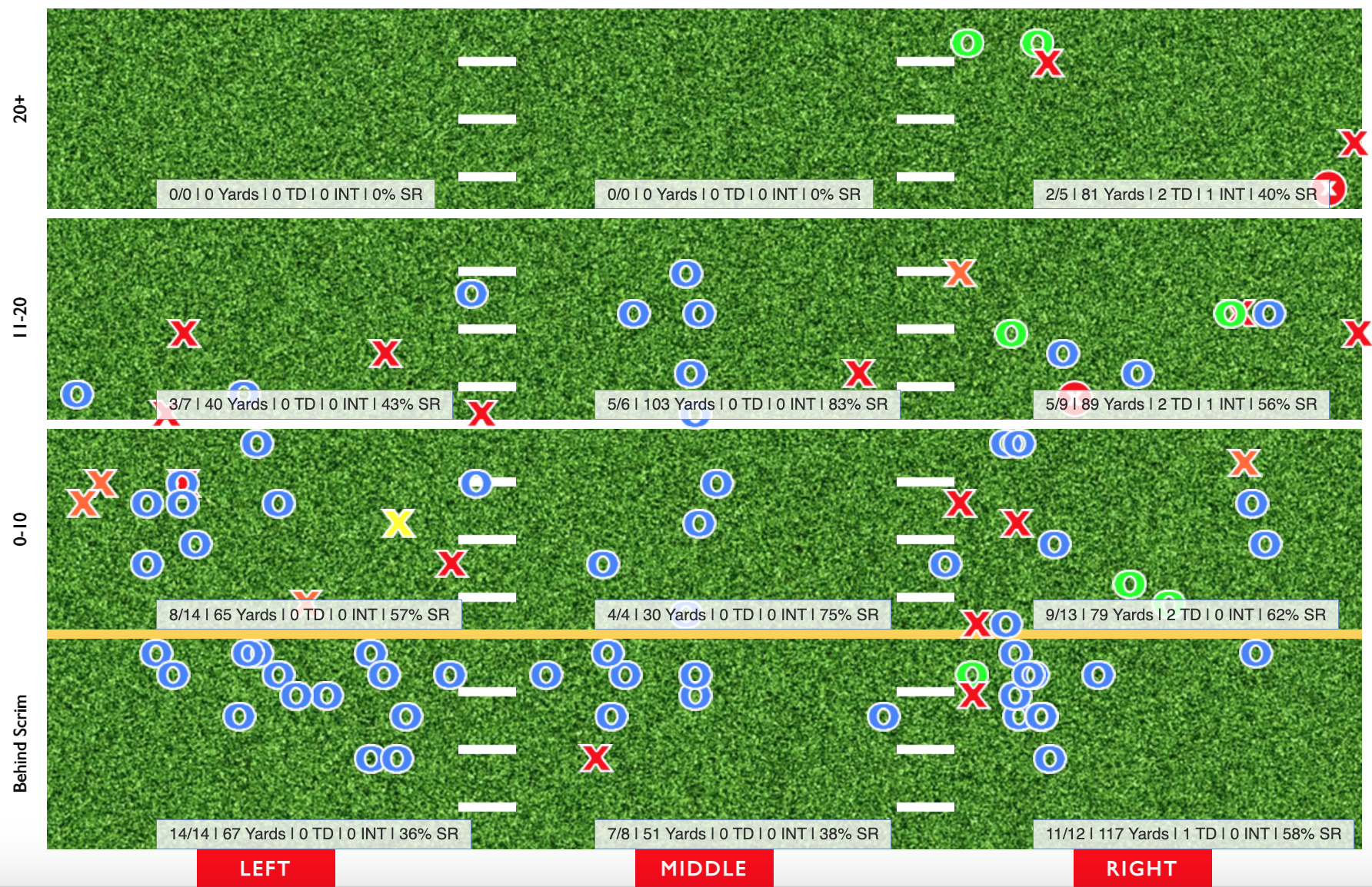
Against SEC competition, surrounded by terrific teammates, Daniels seized some of the conference’s most impressive results during his time in Athens. In 2020 he led the conference in Yards/Attempt and Explosive Pass Rate. But his health saw him experience an abrupt change in style of play this last fall before he was finally benched. And despite seeing a significant increase in screens, RPOs, and play actions year-over-year, his Interceptable Pass Rate reached 7.5% back-to-back campaigns.

Daniels is a great case study on analyzing a player’s results against his process. He throws a high arcing deep ball that is very catchable; but he found difficulty in throwing perfectly placed bombs. Despite completing half of his deep attempts at UGA, only a quarter were on-target. Though he failed to limit risky passes beyond ten yards downfield, his midrange metrics are mighty and boost his overall passing profile.

Daniels only logged 12 pressured dropbacks as a Bulldog. These snaps simply didn’t hold major weight nor overly affect his bottomline. For what it’s worth, he never tossed a single interceptable pass in these spots in SEC play but projects a disappointing track record for negating sacks per opportunity.

Living up to his five-star pedigree, Daniels results within structure are next-level. Over two-thirds of his unpressured dropback attempts inside the pocket resulted in situational success, a first down, or a score. Over a fifth gained 20 yards or more. No one can challenge those findings, but they can call out his dented process. His catchability projects to persist, but both his Depth Adjusted Accuracy% and Interceptable Pass Rate sit comfortably on the wrong side of the SEC average.
JT Daniels' complete 2021 pass chart

9. Max Johnson: 6’5, 219
LSU → Texas A&M

Player Skinny
A tall, slender, mobile passer who strives to get by with his pre-snap process, decision-making, and timing. As an underclassmen, he was nothing more than a middle-of-the-road option with clear limitations. Though his vertical drive is serviceable, his arm talent presently isn’t next-level. Over a fifth of his throws as a Tiger were deemed uncatchable, and his career Depth Adjusted Accuracy% failed to reach conference standards. Plus, he has yet to command worthwhile results throwing beyond ten yards downfield. He appears to be his best self getting the ball out quickly or performing concepts on the move within structure. He has a tendency to buffer, have batted balls, and make things challenging for his targets. Though he was pretty slippery as a first-year, his athleticism hardly did him any favors breaking out of sacks in 2021. Overall, his performance versus pressure was muted and his passing floor isn’t too lofty. However, changing teams and playing for a “QB guru” could see him take a leap.
Player Sample: Strength of Slate (10th: average)
12 appearances in SEC play across 2020+2021

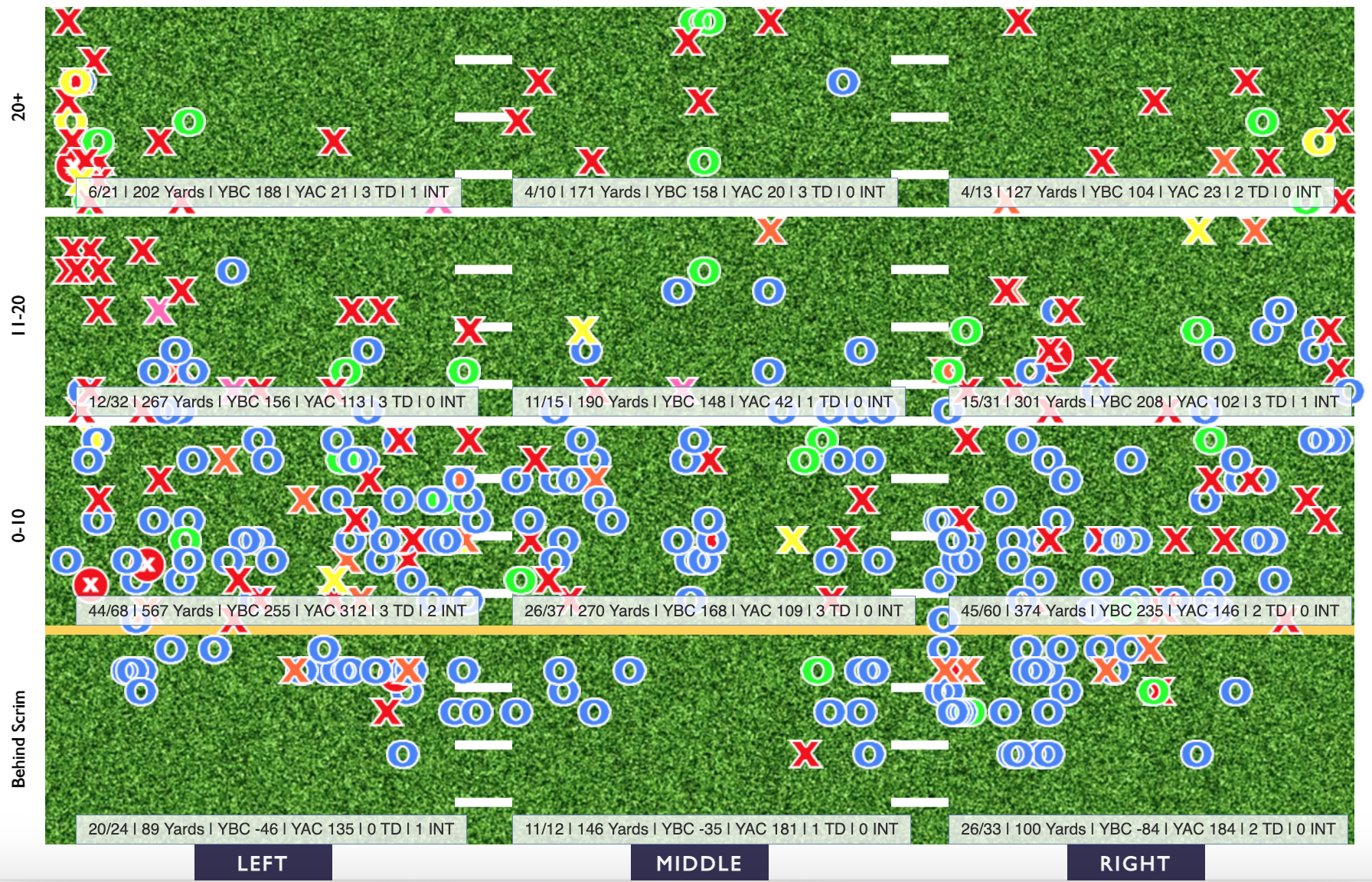
The lefty has yet to prove he is an above-average SEC QB. Though seeing nearly a tenth of his targets result in drops had a clear effect on his stats, his overall metrics all finished below the conference mean behind a tendency to toss unsalvageable passes. This past season, Johnson turned in the SEC’s 3rd-highest Contested Target Rate at 20.4% clip. Vanderbilt’s Mike Wright was his only peer to have a worse Defender Breakup Rate than his 11.8% figure.

Johnson’s downfield results highlight his to-date passing imperfections. Though he turned in an above-average Uncatchable Pass Rate both deep and intermediate, he donned underwhelming ball placement and results. Plus, almost a fifth of his deep balls against SEC defenses had turnover-worthy potential.

At best, Johnson appears to be an average passer when under the gun, but he is downtrending in this context. This past fall, his metrics stabilized to the SEC average after his strong freshman showing. And, no conference passer posted a worse Sack Rate or Pressure:Sack Ratio. Since he isn’t the most gifted QB, he must avoid granting opponents favors and stay ahead of the chains.

Johnson’s ho-hum perception is solidified by his flavorless passing floor profile. Much like his overall metrics suggest, his top-end accuracy isn’t up to snuff, he’s devoid of dingers and big gainers, and projects to be iffy at obtaining key completions. Though a solid foundation for his new staff to build upon, plenty have concerns further construction and investment might not be fruitful.
Max Johnson's complete 2021 pass chart

8. Connor Bazelak: 6’3, 212
Missouri → Indiana

Player Skinny
Though poised passer with underrated mobility, he has predominantly operated as a game-manager with little luster against SEC defenses. His environment was never the best; and even with occasional razzmatazz play calls, he fails to drum up much excitement. He commonly feasted on horizontal passing concepts and consistently struggled connecting on his deep chances. His 2020 campaign was inspiring. But after a sophomore slump, a persistent conservative approach, middling arm, and worrisome stats present flaws are easy to spot. However, he has been exceptional both years as a starter negating pressures and not taking sacks. Against pressure outright, his arm has yet to prove equal value. But all in all within structure, he’s an adequate decision maker and overly an average option.
Player Sample: Strength of Slate (8th: average)
17 SEC conference games across 2020+2021

Thanks to a regression in ball placement this past season, Bazelak’s process metrics are a little concerning. Both his Depth Adjusted Accuracy% and Interceptable Pass Rate were below-average by SEC standards. Considering his low average depth of target , that should be a hold-up for anyone. But, his results tended to flirt with the league average.

Bazelak’s biggest backstep in 2021 came with his midrange passing. All of his metrics helped buoy the conference average during his first year as a starter. But this past season, his intermediate Completion% and Accuracy% finished more than ten percentage points under par and over a fifth of such throws were interceptable. All four stats on the above chart worsened by at least 15 points year-over-year. And unfortunately for Bazelak, he’s never been sturdy. Bombardier. Almost a fourth of his deep throws could’ve been picked off each of the last two years in SEC play.

Again, Bazelak’s best trait is his ability to avoid rushers and squirt forward. His Pressure:Sack Ration was more than half of the league average. In case you noticed, so did his Sack Rate. He accomplished both benchmarks each of the last two years. But since a sixth of his pressured dropbacks resulted in an interceptable pass and his results were disenchanting, his flair seems to be flat under the gun.

Without guises or the threat of pressure, you can see why Bazelak is respected by some. His down-to-down results are acceptable with over half of his throws beating situational goals. He can be a plug-and-play option for most offenses. But since his accuracy and ball placement is shaky, his recent woes could continue if he fails to shore up his process.
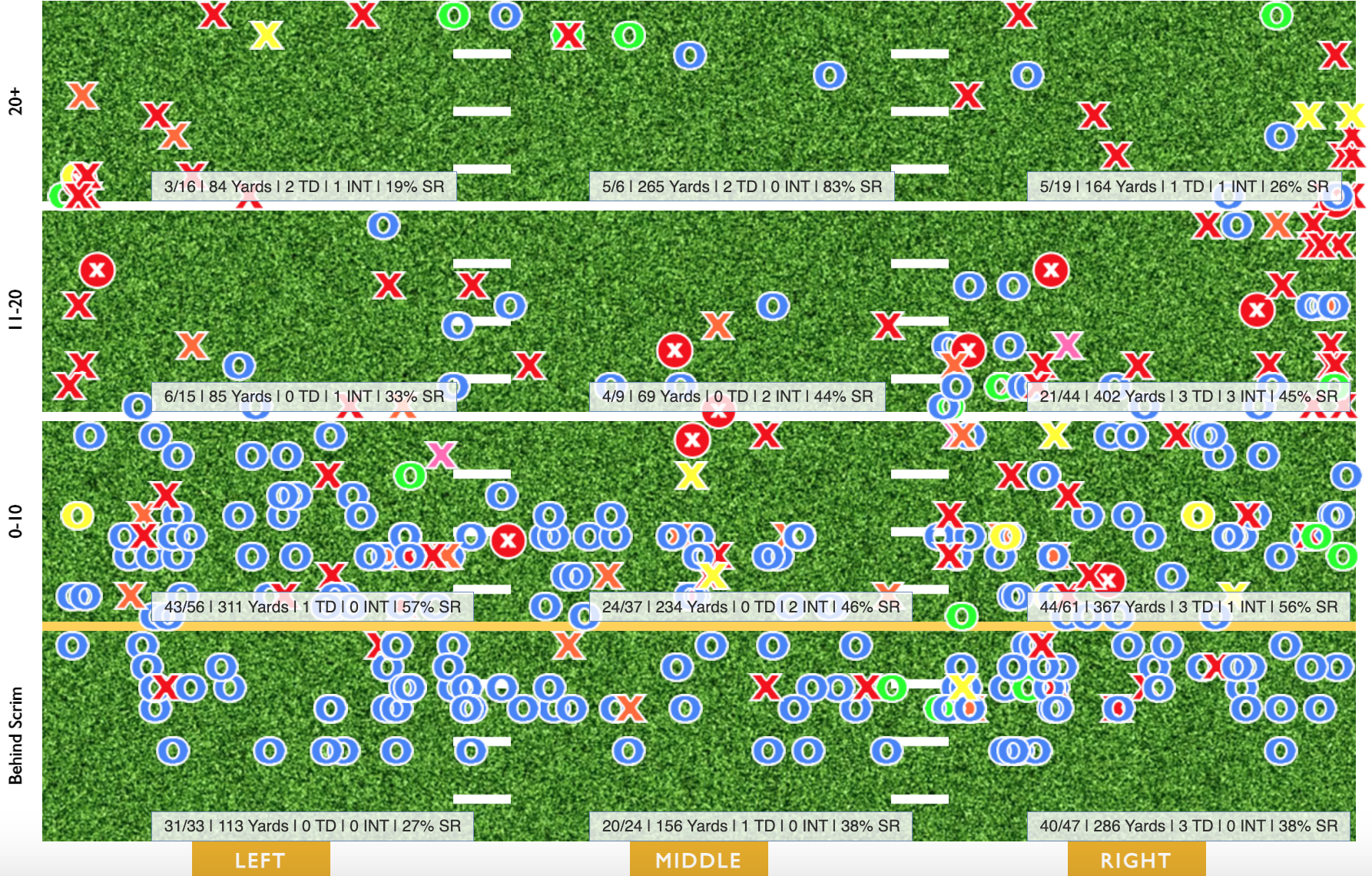

7. Bo Nix: 6’3, 215
Auburn → Oregon

Player Skinny
A quarterback with dazzling highs and depressing lows. He falls squarely into the “Toolsy Archetype” thanks to his ability to whip the ball all over the yard, backyard ball talents, heightened knack for doing things normal passers cannot. Though his decision-making improved this past season, he has a reputation for making too many misguided decisions, which isn’t typical for the son of a coach. He undeniably faced loads of adversity via his schedule and subpar blocking. This created an underlying mistrust between him and his lineman and led to occasional stints where he sought to play Superman behind arm hubris and an embedded hero complex. His upside is easy to see on tape, but his wonky operation has hurt his dependability. Inside of structure, he remained volatile with ups and downs, which lowers his floor as a passer. That said, he’s coming off his best season in a multitude of ways. And, the old heads will surely like his Completion% and Y/A have increased each year.
Player Sample: Strength of Slate (6th: hard)
24 SEC conference game starts across 2019+2020+2021

Athletic and gifted passers sometimes are not the most reliable. Since they know they are capable of making plays with a higher degree of difficulty, sometimes they pass up taking the easy ones right in front of them. Some of that can apply to Nix. But while at Auburn, Nix rarely was a heat-seeker and was sound with this placement. Despite having raw precision moments, his 2021 seasons saw him finish inside the SEC’s Top3 in Depth Adjusted Accuracy% and Uncatchable Pass Rate.

Nix has potential to make opponents pay downfield, but his results have thus far been unfulfilling. But while topsy-turvy outputs have encouraged many to dismiss his case moving forward, there’s a real case for optimism. His deep Interceptable Pass Rate in league play has taken home the bronze medal for three straight seasons. And in the years without Chad Morris around, Nix finished inside the SEC’s Top3 in such Accuracy% and Top5 in such Completion%. Though his first two campaigns saw him flounder attacking between 11-20 yards downfield, Nix commanded the conference’s 2nd-best midrange Completion% and Accuracy% with the top Uncatchable Pass Rate.

This past season, Nix shined under the gun. Though pressured and broken snaps exacerbated his underlying issues when he was an underclassmen, he finished inside the SEC’s Top3 in pressured First Down+TD Rate, Accuracy%, Uncatchable Pass Rate, Sack Rate, and Pressure:Sack Ratio. None of the remaining stats in the above chart finished lower than 5th in league play. Sure, duressed dropbacks are volatile and unpredictable year-to-year, but folks at least know Nix has the skill to take care of business under pressure.

Again, stats tend to be the least kind to the toosly kids. And presently, they don’t dig Nix’s aptitude. His ball placement is trending in the right direction, but he seems like an ordinary passing option on paper thanks to so-so potency and sour accuracy.
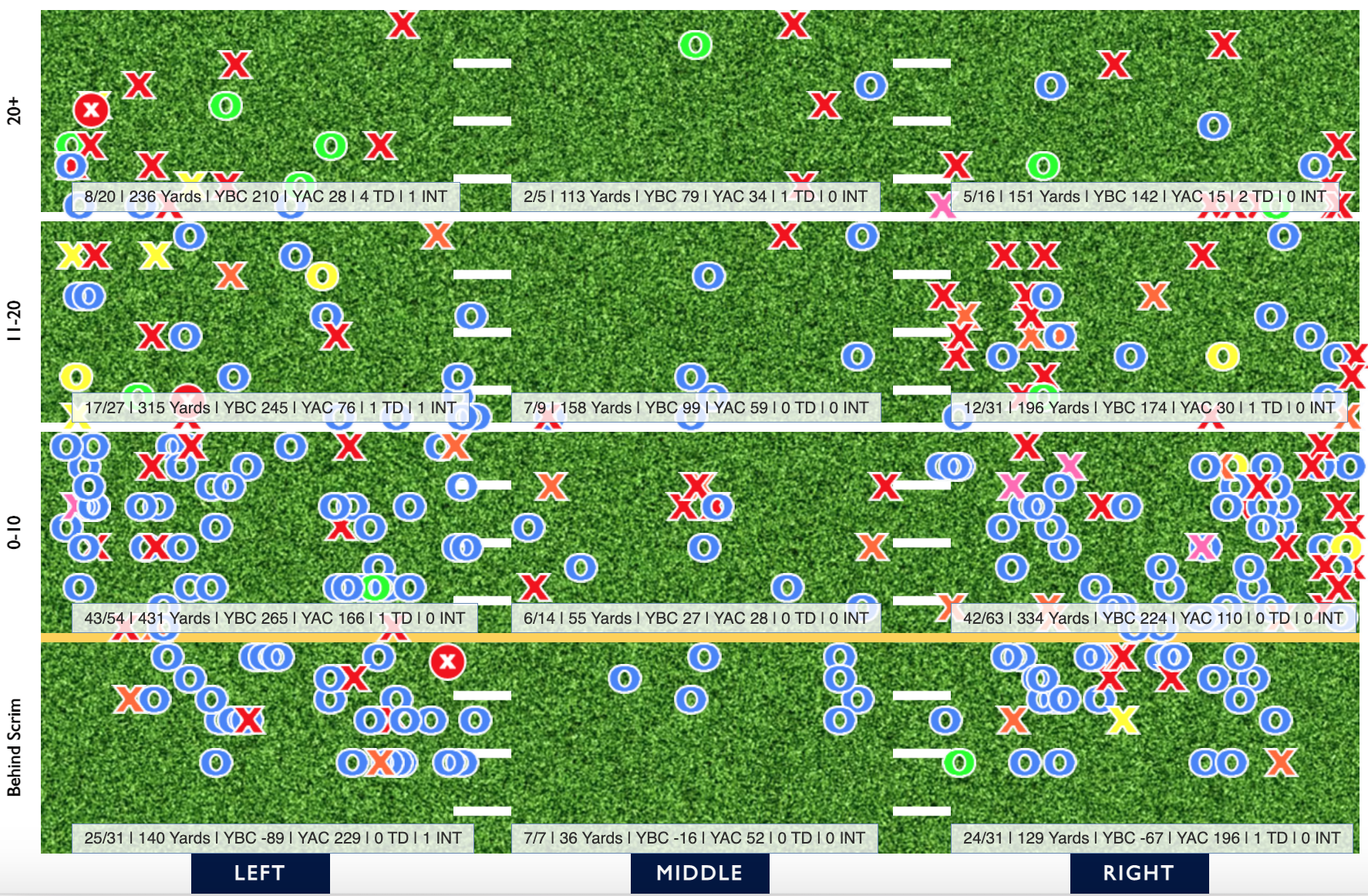
Bo Nix's complete 2021 pass chart

6. Kedon Slovis: 6’3, 205
USC → Pittsburgh

Player Skinny
A pocket passer who built a decent reputation with sound accuracy. But, his Completion% and Yards/Attempt worsened each subsequent season. His throwing operation prefers to target short and has a tendency to favor outside passes; a good chunk of his miscues came targeting the middle of the field.He has average arm talent when he wants to use it, but he’s not the most skilled vertical driver. Instead of leading the upfield shoulder, he prefers backshoulders and underthrows towards space; a borderline nibbler. His escapability is slightly underrated but he’s only a moderate athlete and not dependable under pressure. He’s a good distributor but he wastes a good amount of throws and tosses plenty into harm’s way. But his upside remains high due to his proclivity for finding completions beyond ten yards downfield.
Player Sample: Strength of Slate (5th: hard)
2020 Arizona State: 21st OVR (13.5), 25th DEF (12.8)
2020 Utah: 22nd OVR (15.2), 26th DEF (21.4)
2021 Utah: 16th OVR (15.2), 22nd DEF (20.7)
2021 Notre Dame: 11th OVR (17.4), 15th DEF (18.9)
2021 Arizona State: 26th OVR (11.8), 24th DEF (20.9)

Down-to-down, Slovis didn’t mind dinking and dunking – his average depth of target is among the lowest in the group. And, that approach helped him obtain decent results. But his unexceptable Interceptable and Uncatchable Pass Rates each emphasize his outstanding red flags.

Slovis projects to be a threatening downfield passer if his interceptable attempts are reigned in. Though he wastes throws beyond ten yards downfield, his sample’s deep and midrange Accuracy% would have been Top5-worthy by SEC standards. The upside is tantalizing but kept in check by the periodic recklessness. And as hinted, a relatively low percentage of his throws targeted these areas.

When pressured, Slovis largely sought to pass the buck. Instead of holding the ball an extra beat to let a route come open and hurl deep, he gladly pursued checkdowns. Yet, nearly half of his duressed dropbacks logged an uncatchable attempt, and only a third were on-target. As an average athlete, he shows commendable sack erasing skills. Both his Sack Rate and Pressure:Sack Ratio finished ahead of SEC standards despite facing disruptive pass rushes.

Slovis’ passing floor presents a mixed bag. A tenth of his attempts were turnover-worthy and nearly a sixth were uncatchable. Coincidentally, his Depth Adjusted Accuracy% placed seven points below average. Though he established a reputation for being a pinpoint prince, he can no longer adorn such a title with such precarious process stats. But to his credit, things like Success, First Down+TD, and Explosive Pass Rate all track to be superb in this context.
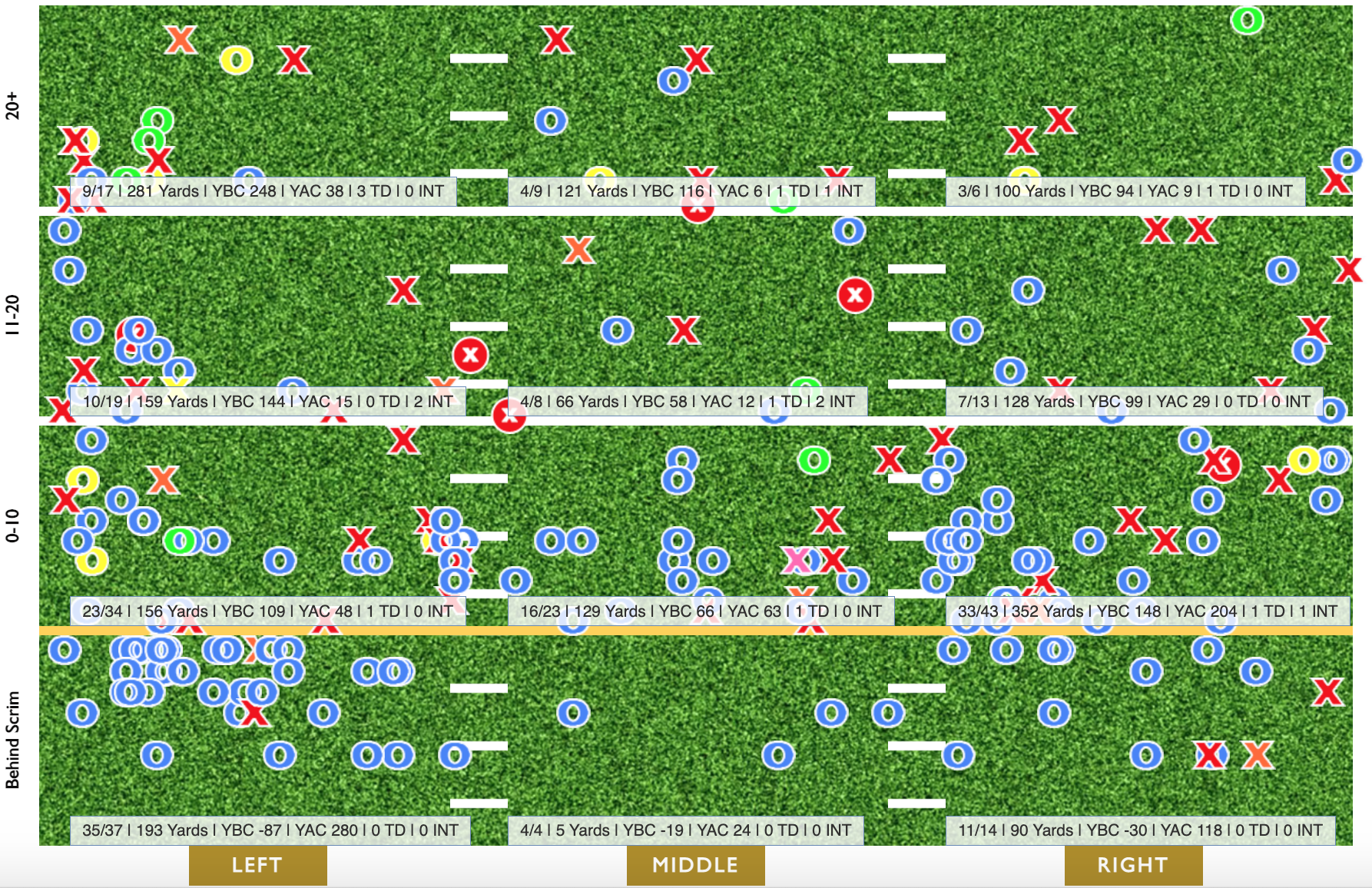

5. Cameron Ward: 6’3, 205
USC → Pittsburgh

Player Skinny
Bottomline: this is a fun prospect. But he’s raw and needs better coaching. He occasionally carries the ball like a breadloaf and can try to do too much with his upper body on some deep throws. He buffers some, but his line wasn’t the best even by FCS standards. He also performed favorably when pressured, outside of the pocket, and targeting tight windows. He isn’t afraid to let it rip downfield and he has one of the most impressive vertical drives in the transfer group. Despite functioning with wonky mechanics, he has a natural quick release and thrust; the furthest downfield pass in his sample tracked at 54 yards beyond the line of scrimmage. Though a sexy trait, his top-end accuracy is wayward and halfcocked. Chances past ten yards downfield especially see a high rate of wasted opportunities. But all else considered, he’s smart with the football and doesn’t press.
Player Sample: Strength of Slate (19th: easy)
2020 SE Louisiana
2020 Sam Houston State
2021 SE Louisiana
2021 Stephen F. Austin
2021 Sam Houston State

Ward looks to transition nicely to the Power5 with his decision-making and ability to prevent turnovers. But, his general accuracy is a red flag and something to monitor.

Ward’s bazooka has been scattershot and has fired copious duds. He’s a toosly kid; so stats might not carry the most weight until he reaches his prime. But, his big arm has a long way to go before it can be deemed war ready. So Washington State might need to be patient or have a backup plan handy.

Ward faced pressure on a third of his dropbacks but never gave off the sense that he was flustered or overwhelmed. Moreover, he proved to be a fairly competent QB at avoiding tacklers. Though his degree of difficulty will soon increase, he boasts one of the transfer groups best Accuracy% when under duress. Whipping around on-point darts begat a First Down+TD Rate that was better than a good amount of players’ overall outputs.

Within structure, Ward failed to display improved accuracy. And while he projects to do well down-to-down, over a fifth of his attempts had no shot at being hauled in; his Depth Adjusted Accuracy% tracked under the SEC average by almost a dozen points. But, his Explosive Pass Rate more than doubled his Interceptable%. Both stats topped standards. Moreover, his down-to-down results stats hint he might have the chops to climb up draft boards assuming he can refine his precision.
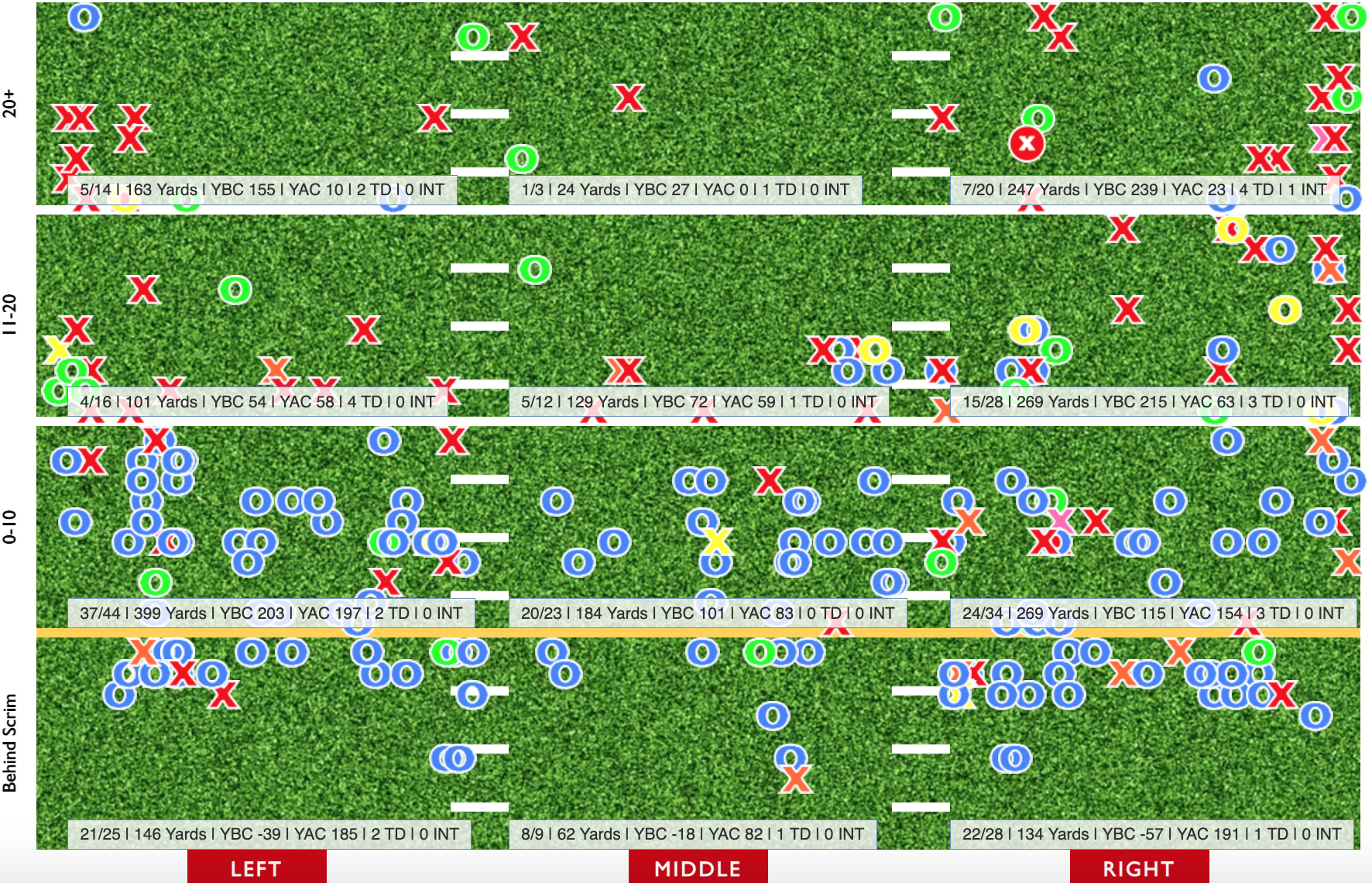

4. Quinn Ewers: 6’2, 200
Ohio State → Texas
Player Skinny
This fresh-haired phenom has been the talk of the recruiting ranks for the past several years. And thanks to his NIL exploits, he has just as many headlines for his off-the-field successes than his on-the-field ones. As one of the most heralded QB prospects by the modern recruiting services, he appears to don next-level arm talent with a slashy, compact release. Plays with advanced timing, often throwing the ball before receivers show themselves to be open. Sees the field naturally. Willing to stand in the pocket in the face of pressure and deliver downfield. But since he skipped his last year of high school and saw zero gametime in Columbus, it’s fair to question if his long-term development was hindered.
3. Jaxson Dart: 6’3, 215
USC → Ole Miss

Player Skinny
A young, confident passer who hardly passed up an opportunity for a big play. It’s hard to tell if that was a reflection of his predisposition to press or due to game context. Naturally strong and aggressive with an apparent chip on his shoulder. Pretty good arm for his age, but he’s still a work in progress and is sharpening his precision, which placed among the bottom5 of the transfer group. Plus, only one logged a less preferable Interceptable Pass Rate. That hungry, vertical style hurt his down-to-down ball placement figures and results, but his traits present a fabulous foundation moving forward. As a runner, he carries his weight hell and has deceptive might. He can run through tackles and be a challenging rusher to tackle. He ironically resembles a young Matt Corral.
Player Sample: Strength of Slate (18th: easy)
2021 Washington State: 57th OVR (6.7), 61st DEF (26.0)
2021 Arizona State: 26th OVR (11.8), 24th DEF (20.9)
2021 UCLA: 41st OVR (9.4), 76th DEF (27.8)
2021 BYU: 46th OVR (8.9), 79th DEF (27.9)

Big plays matter, but so do giveaways. If you needed more evidence Dart might need to be subdued after watching Ole Miss’s spring game, he was more likely to toss a turnover-worthy pass than log a 20-plus yard completion across his sample. Sure he’s still learning how to play the position. But a sub-40% Depth Adjusted Accuracy% and unsettling Uncatchable Pass Rate, highlight the drawbacks that could prevent him from coming out with the ones.

Dart’s downfield results were pretty on par with SEC averages. So his resume isn’t a total wash. But, it bears stressing that his accuracy and ball placement in this area of the field hardly has lived up to a five-star pedigree. Over a quarter of his deep balls and over an eighth of his intermediate throws could’ve been picked off. Plus, his respective Accuracy% fell below his new conference’s standards in each spot.


Dart’s weighted-accuracy was simply its best self without guises inside a clean pocket. Sure, he still found difficulty placing passes consistently and avoiding hitting defenders with the football. Plus, his result metrics didn’t strengthen significantly in this context. But the gung-ho thrower managed to see an uptick in consistency. That might be irrelevant considering his new scheme. For what it’s worth, he found clear boosts on his bottomline using play action at the expense of his accuracy.
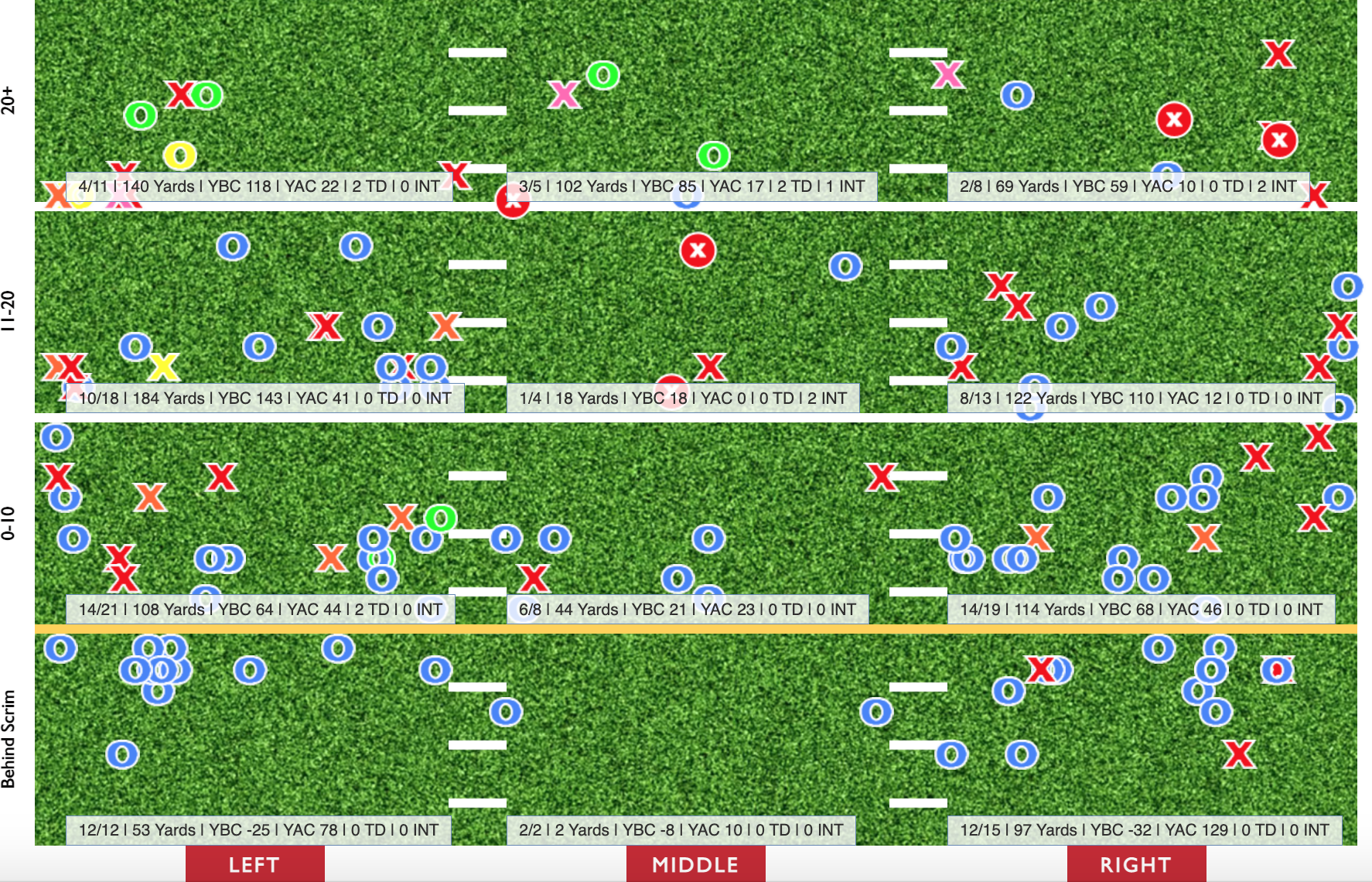

2. Spencer Rattler: 6’1, 200
Oklahoma → South Carolina

Player Skinny
A slightly undersized passer with envious – but not elite – physical tools. His pressing concerns might be inside his helmet. He went from an aggressive, potent, and effective downfield thrower to a risk-averse turnover machine in the span of a year. He frequently attacked tight windows and logged abundant interceptable passes. He still possesses abilities most passers don’t own, but there is real concern he won’t shake off the rust and ditch his recent perception as a drive killer. That being said, his sample’s Success, First Down+TD, and Uncatchable Rates all would’ve been the best marks within the SEC this past season. When he’s not buffering, second-guessing, or overthinking his assignment, he can deliver premier efficiency. Leaning into the recent fad of guys who yearn to play backyard ball, his game levels up when operating outside the pocket. His bottomline was also noticeably greased by play action. On the flip side, questions regarding his sustainability come into play due to his modest metrics when passing inside the pocket without guises.
Player Sample: Strength of Slate (9th: average)
2020 Iowa State: 11th OVR (18.7), 11th DEF (18.8)
2020 Oklahoma State: 23rd OVR (12.6), 18th DEF (20.0)
2020 TCU: 37th OVR (8.1), 16th DEF (19.8)
2021 Nebraska: 37th OVR (10.3), 28th DEF (19.6)
2021 Kansas State: 25th OVR (12.0), 16th DEF (19.6)

Barring his boo boos, Rattler’s result metrics hint he could be in store for a terrific season in his new stop. He rarely wastes passes and dons above-average downfield accuracy. That being said, the boo boos shouldn’t be entirely ignored. His Interceptable Pass Rates from both his 2020 slate and 2021 slate each tracked to be bottom4 figures within the SEC.

His potency is also worth monitoring. Year-over-year, Rattler’s average depth of target shrunk nearly five yards within his sample. And as you can see, a good amount of his downfield attempts had interception potential. Yet, his upside was on full display when he targeted further than ten yards past the line of scrimmage. All of his remaining deep stats on the above chart tracked to be no worse than 4th by SEC standards; while the intermediate figures all would’ve commanded the conference’s gold medal.

Rattler invited pressure and often suffered from seeing ghost rushers in his passing lane. Though a frustrating crutch, he overly handled duress well. Both his pressured First Down+TD Rate and Accuracy% would’ve placed inside the SEC’s Top5. And while interceptables remained to be a thorn, his low number of untouchables further rose-scented his profile in this context. Plus despite experiencing a Pressure Rate on the high side, he negated sacks at a favorable clip.
As a quick aside, I just wanted to articulate how special Rattler’s sample outside the pocket was. Pressure or no, about a third of his attempts were launched beyond the bookends. And he sported a 85% Adjusted Completion%, 69% Accuracy%, 52% First Down+TD Rate, 62% Success Rate, 12.3 Adjusted Net Passing Yards/Attempt, which all helped buoy his bottomline.

Unpressured dropbacks inside the pocket without play action are believed to project one’s passing trajectory since the criteria strips away extra elements that might influence one’s output through scheme, deception, or randomness. Plus these snaps generally makeup the plurality of a QB’s pass attempts; so their sample size is strong and predicative. But, Rattler had a relatively low usage rate in these spots. So his findings carry less weight. Still, his passing floor appears to be just fine with a stupid low Uncatchable Pass Rate and sturdy result metrics. But when confined to the pocket without guises, his Interceptable Pass Rate balloons and his Explosive Pass Rate crumbles.
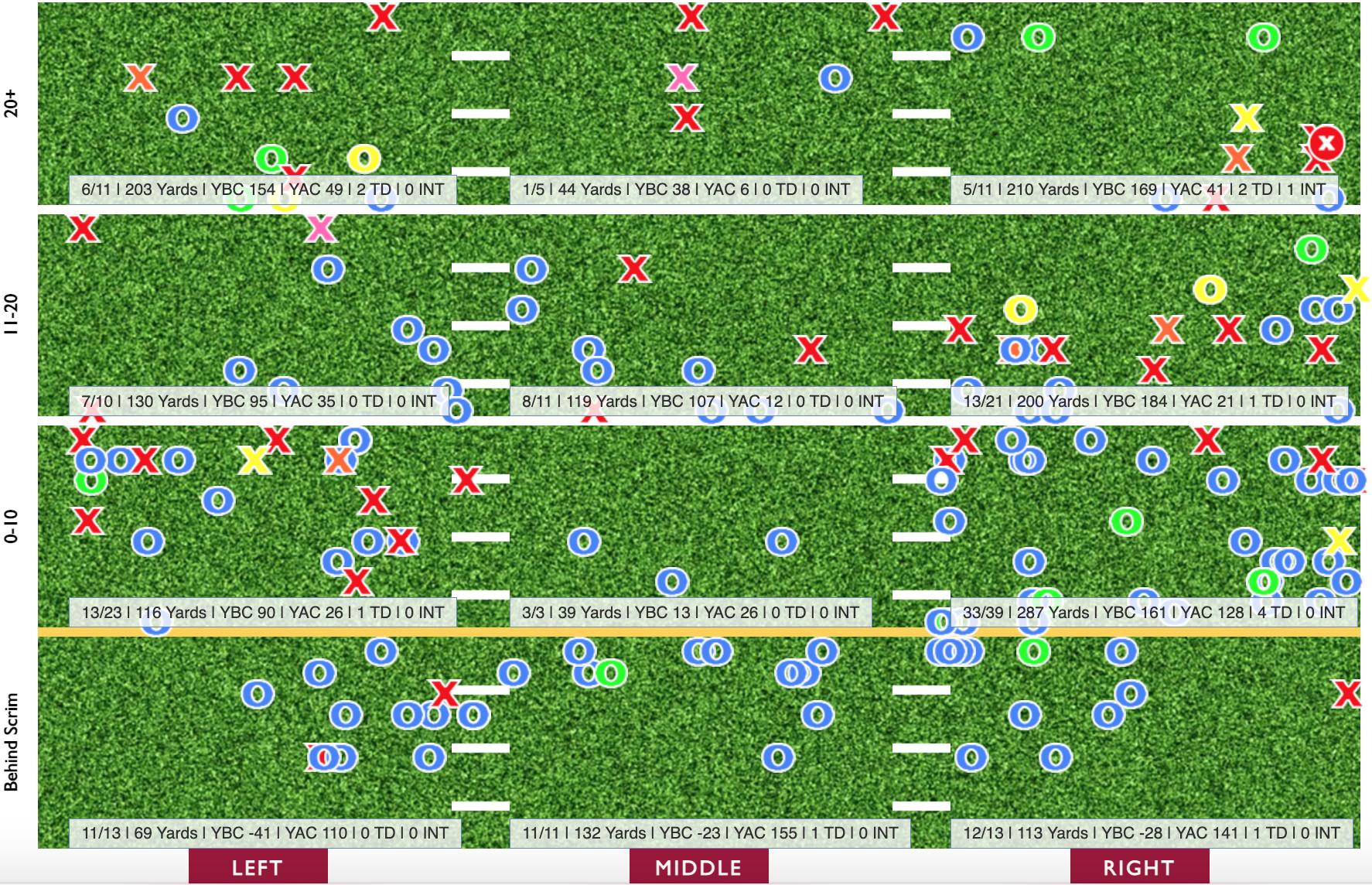

1. Caleb Williams: 6’1, 218
Oklahoma → USC

Player Skinny
Arguably one of the most talented players in college football with a clear high ceiling. Stronger than his average frame suggests; sturdy lower body. Owns a total cannon and logged the transfer groups biggest average depth of target. His sample includes an example of a 41-yard rope beyond the line of scrimmage with another 54-yard incompletion. Despite his thrust top-end precision is presently lacking. The errancy concerns can be traced to iffy mechanics and a prevalence to throw on the move. Plays with poise beyond his years. Functions with minimal movement in the pocket until threatened. Has instinctual touch. Throws a catchable ball within structure but wasted too many chances overall especially 10+ downfield. Deception tactics juiced some of his numbers. Even though he can negate sacks, he wasn’t a standout under pressure as a first-year.
Player Sample: Strength of Slate (14th: average)
2021 Texas Tech: 40th OVR (9.8), 69th DEF (27.1)
2021 Baylor: 15th OVR (15.6), 13th DEF (17.1)
2021 Iowa State: 19th OVR (14.3), 19th DEF (20.2)
2021 Oklahoma State: 12th OVR (17.2), 4th DEF (14.3)
2021 Oregon: 38th OVR (10.2), 60th DEF (26.0)

Despite playing a truncated slate in 2021, Williams captured the Big 12’s most Expected Points Added and one of the nation’s top QBRs. Among the transfer group, his First Down+TD ruled supreme and would have been the SEC’s best mark. Though back-for-buck, Williams’ verticality resulted in a large number of wasted throws, turnover-worthy attempts, and a middling return on investment. He’s bound to refine his ball placement, but only four other transfers tracked to have worse weighted accuracy than him.

Speaking to Williams’ poor Depth Adjusted Accuracy%, both his deep and midrange ball placement figures failed to meet standards. In fact, he was more than twice as likely to dial up an uncatchable pass 20-plus yards downfield as an on-target attempt. His intermediate returns weren’t as concerning. But his such Interceptable Pass Rate was nearly six points above the SEC average.

Despite moderately relaxed body language under duress, Williams struggled to provide consistent value when pressured. Like his deep attempts, this was another well of wasted opportunities with too few accurate passes. His aggression persisted in these spots ala his lofty ADOT and sore INTA%. And while his athleticism flashed periodically, he wound up not being that special at negating sacks.

Like Rattler, Williams’ experienced a relatively small number of snaps to gauge his passing floor. But for what it’s worth, the young gun’s potency also took a hit when play action was taken out of the picture. And while his accuracy metrics using the tactic undeniably pad his profile, Williams’ floor projects his catchability improves immensely without play fakes. Still, not too many of the transfer QBs saw their Depth Adjusted Accuracy shrink compared to their overall clip in these spots. Honing in on that fact is important, but so is the fact Williams’ First Down+TD managed to beat benchmarks even though he was slashed by a 17.1% Drop Rate.
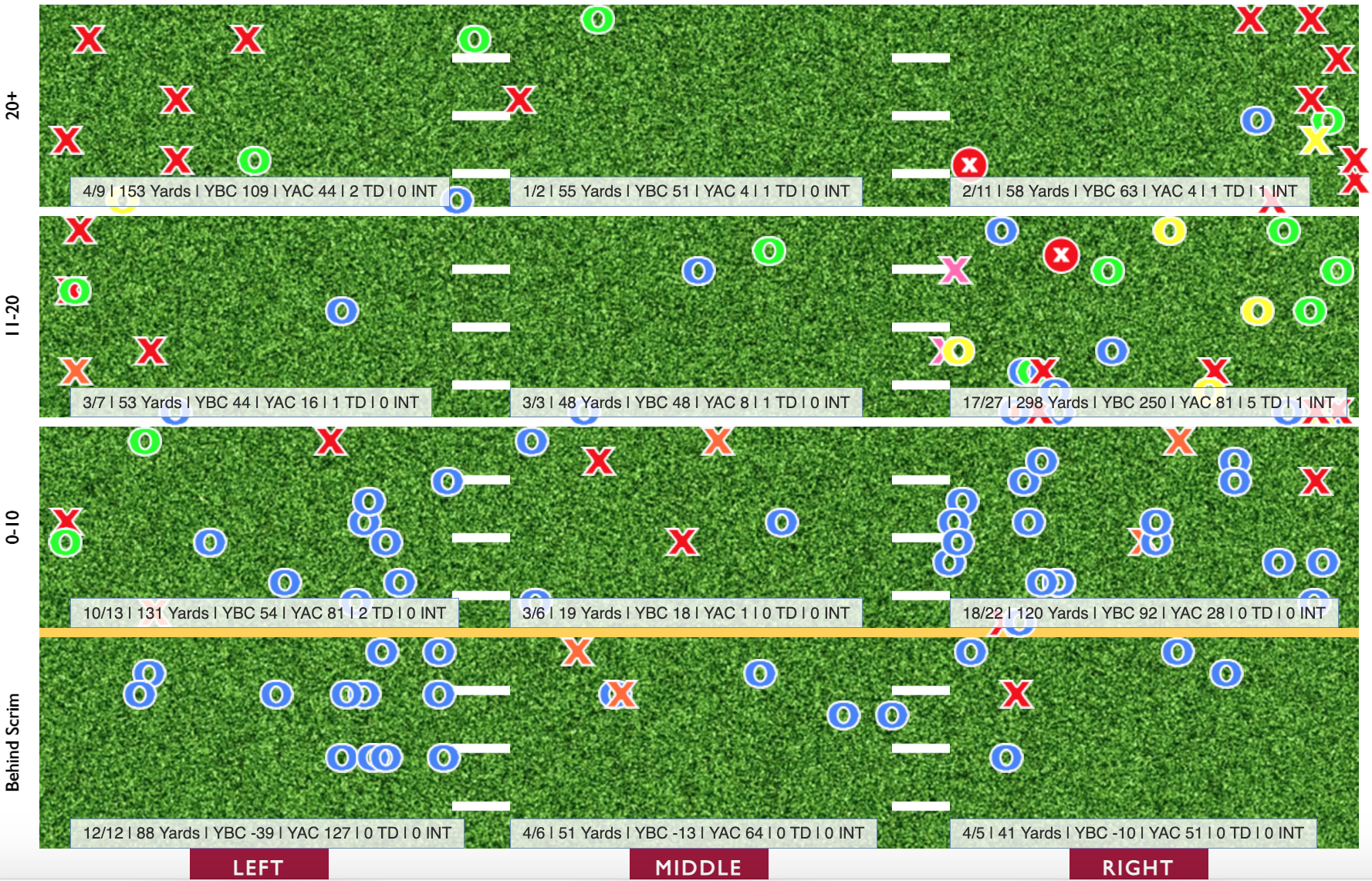

The Group at a Glance