Scouting the SEC's Top5 Impact QBs ahead of 2023
2023 SEC Impact QB Scouting Reports: Top5
Everyone loves quarterback talk. Since it's the most important position in the sport and a passer's ability often can be the difference between a victory or defeat, extra weight is put into analyzing these fellows. While most fans are content with volume stats like completions, yards, and touchdowns scored, the archaic metrics do little to tell the story of how a passer actually operates. What if a passer leaned more on screens or lived on the wild side by pressing downfield more often or benefited from being a game manager?
To cut through the clutter and actually provide some illuminating content this time of year, I decided to chart all 30 of On3’s top Impact QBs against their most challenging defensive opponents to get a better understanding of how the group functions. Instead of letting matchups against Poop State infiltrate our passers’ profiles, focusing on quality opponents present much firmer samples and strong indications of how this lot projects to the next level. Using ESPN’s SP+ Ratings and Expected Points Added/pass to set our benchmarks, each QB was charted against a 5-6 game sample. Some guys still had much easier slates compared to their peers. Nonetheless, this methodology is very helpful in exposing one’s true colors.
Though 8 SECers track to start the season among the nation's 30 best passers, this piece will focus on the five most impactful QBs in the Land Where it Just Means More. We’ll breakout our crop's profile overall, throwing downfield, working under pressure, surviving outside the pocket, targeting tight windows, operating the dropback game (along with play action), and their “passing floor'' based on how he performed in structure without adversity or schematic elements.
(To optimize graphics on mobile, tilt device horizontally)
| Height | Weight | Passing Yards | Pass TDs | INTs | ESPN QBR |
| 6'1 | 215 | 3,026 | 18 | 12 | 59.3 |
The Skinny:
A volatile, combustible, explosive passer with tantalizing arm talent. Mercurial results. Still trying to find the right balance of risk/reward. Strong downfield thrower; but either by preference or coaching tends to feast short. Smooth mover and has flashed outside of the pocket.
The Fat:
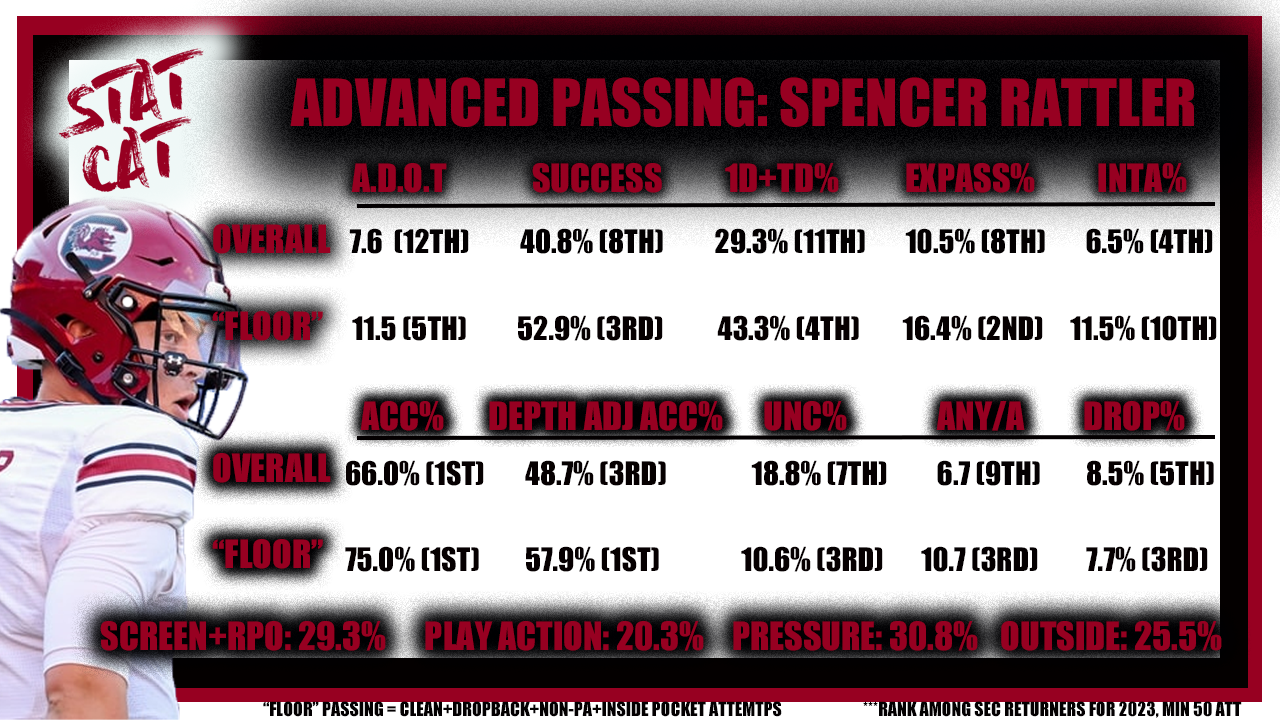
In terms of talent, Rattler is near the top of his position. Besides donning a mini Howitzer for a right arm and being a natural playmaker outside of structure, he’s mobile and offers a multi-faceted skill set; meaning he’s capable of running any required scheme. That’s good, because he’s about to have his third new offensive coordinator in as many seasons. Across 2023, he was consistently one of his conference’s most accurate throwers beyond ten yards downfield. In fact, he owns the SEC’s top raw Accuracy% ahead of this fall. But he’s yet to pass the Good, Ole-Fashioned Eye Test thanks to mistakes, hubris, and failing to overcome his surroundings. Our heart wants to truly believe he’ll put all the pieces together in stride. But our heads are understandably weary of his inconsistency.
Though always a strong down-to-down placer, Rattler has a history of trying to do too much and play hero ball. There’s plenty of “no no no…YES!” plays on tape. At Oklahoma, he was one of the nation’s best outside the pocket and creating chances for himself. That diminished this past season, but Rattler still holds mad belief that his arm can make any throw and dot any target. Some of his highlights suggest he might not be too far out from that class. Still, he logs way too many turnover-worthy plays to outright ignore; especially if his late-season potency was just a mirage and he falls back into being a Checkdown Charlie. It’s fair to mention, accurate passes are easier to come by with less-challenging targets. Will Rogers was the only other SECer last year to record an ADOT under 8 yards. And despite slinging more “sure-things”, his efficiencies fell on the wrong side of the league’s mean.
Assuming his new play caller will take off his handcuffs and let him rip it a little more, Rattler’s explosiveness should be among his conference’s best and bolster his bottomline. And even though he did tend to pepper people short with outlet screens and log interceptables, his passing floor solidified this past season to reflect his exciting potential. His in-structure body language has visibly improved. And, his mechanics are attractive. Still, it all boils down to being more consistent. Show more sparks when facing pressure or staring down a blizter. Stop pressing closed windows. Keep up the laudable per throw accuracy. If Rattler does that, don’t be surprised if he’s in the discussion to be drafted on Thursday. Still, his play last year against quality foes accentuates why his stock remains tepid.
Largest Strength: Toosly Traits
Largest Area of Opportunity: Prudence, Turnover-Worthy Plays

The Stats: color-coded to reflect percentile standing within impact class (green = great, white = mid, red = bad)
Spray:

Overall:

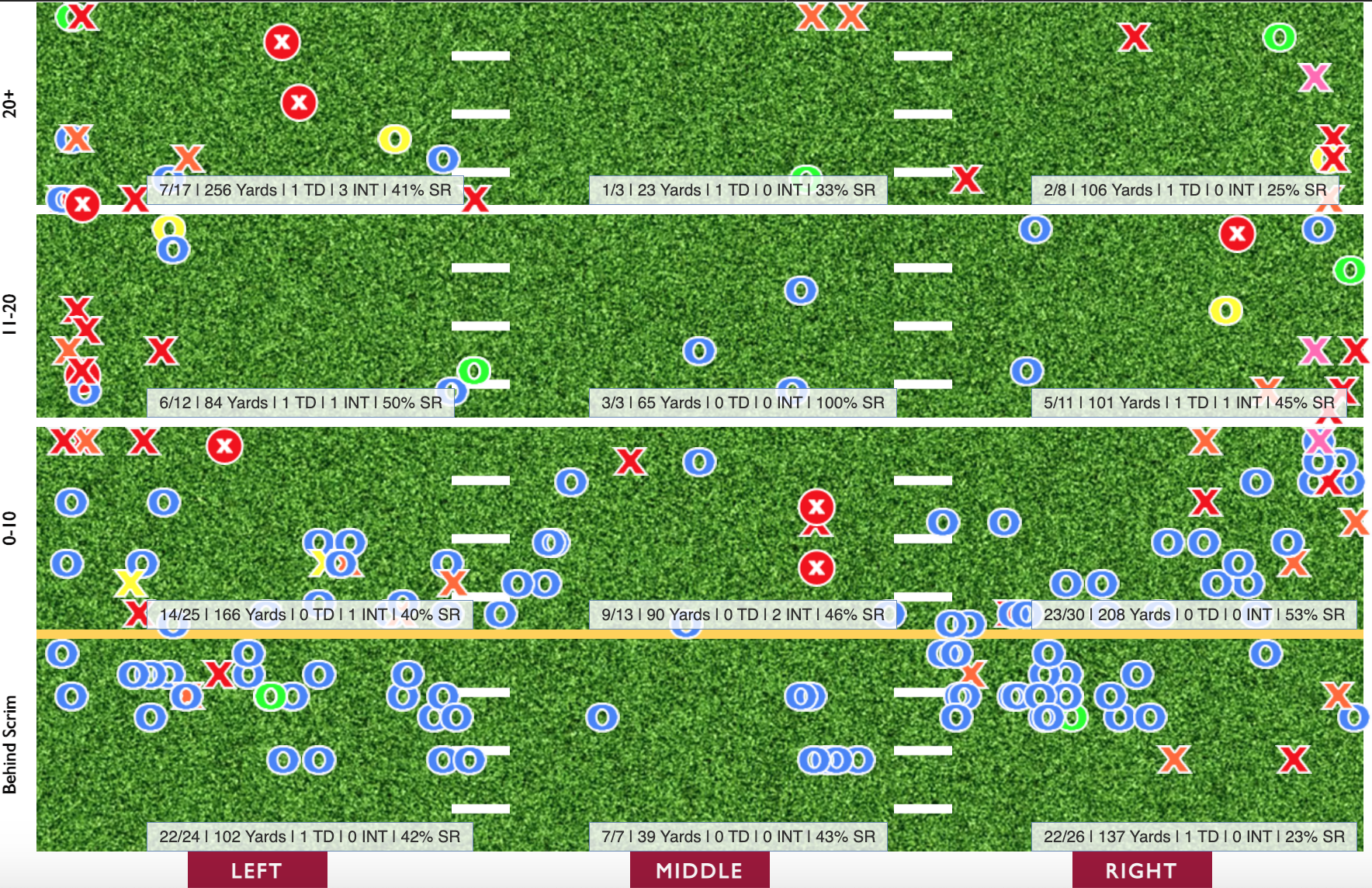
Despite possessing one of the group’s best upsides, Rattler totally lost his fangs against quality opponents. Versus one of the hardest slates in our study, he buffered, he drifted, he pressed, he misfired. Since he is only average-sized, seeing the field can be a problem and he avoided the middle of the field. Despite ample scheme help to dictate his decisions and attempt to maximize his offerings, the Gamecock’s 5.2 ANY/A was 2nd-worst among the group. Furthermore, he was hindered by constant pressure that ensured he’d see considerable adversity. As a result, most of his metrics were resoundingly dismissible. He placed damn-well near the group’s floor in terms of Success and First Down+TD Rates. The only stat that laid out any hope was his 2nd-best 77.9% Adjusted Completion%. But again, the scheme’s guidance was more a catalyst per his bottom3 ADOT. His precision was pedestrian and his Interceptable% was the Impact study’s highest. To reiterate, Rattler will remain overly toothless unless he can optimize his offerings to be more bang-for-buck.
Downfield:

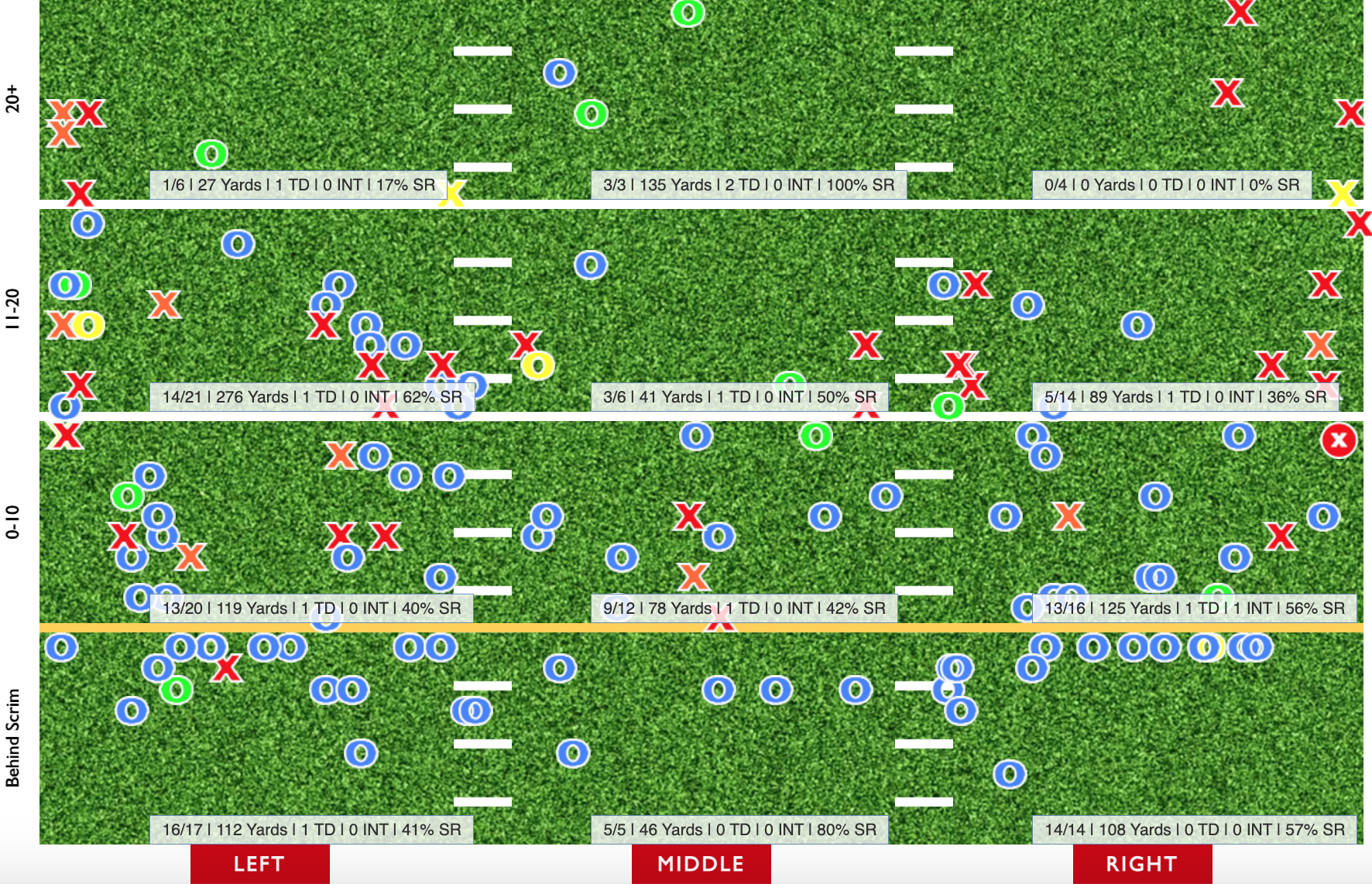
Rattler’s downfield throwing ability is one of his selling points. Passes can arrive quickly, in-stride, and in spots few others can dot. But his marksmanship against the meat of his schedule was pretty sprayed. His catchability remained okay and tended to give his guys a stab at making plays. Still, his composite downfield Completion% was poor. Only 40% of his passes beyond ten yards downfield in our study were on-target, which put him in the group’s bottom8. A fifth of his such targets could’ve been picked off; only two of his peers were more prone to these boo boos. A man of his talents simply needs to do better.

Opting to lean into dingers in this context, Rattler was the only other Impact QB to dedicate a higher target share to deep tries than midrange ones besides Caleb Williams. No one’s midrange makeup was smaller than our guy’s 12.5% clip. But despite his favoritism, Rattler’s intermediate passing projects to be the best the SEC has to offer. When including all games, his such 56.7% Accuracy, 58.3% Depth Adjusted Accuracy%, and 21.0% Uncatchable% all track to be tops amongst his conference-mates. Perhaps his usage increases. Still, these attempts against his hardest foes don’t foster much hope thanks to his knack for putting the ball into harm’s way.
Pressured:

Rattler’s overall operation is unstable. So, analyzing his play becomes even more slippery when measuring his performance in spots like pressured dropbacks. Still, he was one of the most agitated QB’s in our study. An absurd 46% of his pure pass attempts faced a form of pressure. Only one other Impacter experienced a figure north of 37% on dropbacks. Suffice to say, these snaps affected his overall output considerably. And like his sour stats suggested earlier, Rattler crumbled under the gun. Often with his options running out and attempting to find somewhere to go, Rattler made plenty of throws that drew some expletives in disgust. With an Interceptable% greater than his Explosive Pass% and wayward passes scuffing up his placement metrics, his ANY/A barely finished in the black. Taking a step back to include all games, 8/12 INTs occurred on these throws (and half of those came on deep balls). Hoist the red flag!
For whatever reason, Rattler was more effective against pressure as a Sooner. Still, our guy has typically done a good job negating sacks. Sure with the amount of havoc he saw last year, he was bound to take some sacks. But his figure against his hardest opponents tracked above the group average, and his cumulative clip beat the conference’s mean. He can erase and extend. Plus, he’s gotten much better keeping his eyes downfield. These remain to be his bankable skills. And while risky throws kinda come as an add-on, his talent teases of future situational wins. Moreover, since these snaps are unpredictable year-in and year-out, who’s to say Rattler can’t regain his old form or even take it up a level?
Outside the Pocket:

Already a passer who liked drifting or was given chances on the move, Rattler’s pressure problem bled over into more attempts outside the pocket. Nearly a quarter of his sample’s throws met these conditions. Naturally, the righty was flushed to his dominant side where 70% of his playable passes were directed. Including all games, about a quarter of these throws resulted in throwaways – only three of his conference-mates claimed a higher rate. These, in turn, sliced his sample’s output and ballooned his Uncatchable%. But even with those biffs, his placement stats were somewhat respectable. Additionally, his INTA% was doubled-up by his EXP%. Ultimately, he was a pretty middling option on a per attempt basis. Though his metrics are rather meek, there’s still some evidence Rattler has plenty of juice to make plays outside of structure and further raise his ceiling.
Contested/Tight Windows:

Without sugarcoating it, this was a stained section on Ratter’s profile. It illustrates his try-too-hardness, arm hubris, wincey decision-making, and why some folks will never hop aboard his bandwagon. Not to add more gas, but this tendency to toss turnover-worty plays paired with an shortsighted pass spray just isn’t a cost-effective way to spend one’s targets. The volume of screens and RPOs deflated his overall number of tries that tested tight windows. And looking at his repulsive INTA%, you can understand why Marcus Sattersfield wanted to limit such throws. No one can get by with every third contested throw potentially resulting in a takeaway. On the year, it was still ludicrously high at 28%.
But if you can overlook his most inexcusable throws, the rest of Rattler’s contested stats show some underlying value. After all, he believes he can complete them for a reason. On the group’s 3rd-highest ADOT, our heatseeker captured the 2nd-best Explosive Pass% and Uncatchable%. Additionally, both his raw and weighted accuracy metrics track above the standard. The meh down-to-down results and his abysmal proclivity serving lollipops to opponents are very real concerns. But the occasional wow play keeps us coming back and holding out hope Rattler will figure it out. One way or another, he’ll continue to be a difference-maker attacking tight windows.
Dropback:

Again, pressure maligned Rattler’s metrics; particularly on pure dropbacks. And like his stinky overall results, the Gamecock struggled to look good against the meat of his schedule. A below-average Drop Rate certainly was a factor, but no other Impact QB turned in a worse Success Rate. Plus, he was 1/3 in our study to produce a First Down+TD Rate under 30%. Without gimmes and outlets to pad his completions, less than half of his dropback attempts were on-target and over an eighth were turnover-worthy. Rattler did snag explosives, displayed more verticality, and helped curb takedowns, but he decidedly failed to elevate his offense on these tries. Even with the adversity, more should be expected out of him.
Dropback Play Action:

Used to operating with scheme elements, Rattler was fine off play fakes. His placement remained unrefined, but he managed to maximize the tactic to a respectable Explosive Pass% compared to his peers. Drops plagued him. By assuming those are shored up, Rattler still is a fairly threatening passer in this context. His arm doesn’t need much extra space to capitalize on designs and these often can be one-read patterns to ease his thinking. While cracking the group’s top10 in Adjusted Completion%, half of these passes found success. Nothing sexy but it’s another tool in his box that offers some worth.
“Floor” Passing:

When not pestered by pressures, propped up by screens/RPOs, or roaming outside the pocket, Rattler’s passing floor has bright spots. Though certainly not used in this manner as much as his peers, it's assuring to notice over two-thirds of these throws were on-target, only an eighth were uncatchable, and his Depth Adjusted Accuracy was one of the 10-best in our study. Butterfingers did botch his down-to-down results as Rattler’s Success and First Down+TD Rate were candidly mid.
While South Carolina’s plan aimed to handcuff him and scrub out recklessness, Rattler has an innate desire to be a playmaker. As seen, his gung-ho heaves can be a double-edge sword. And, the YOLO ball lifestyle has clear drawbacks. Still with clean conditions with clear lanes, the unafraid Rattler hunted for big plays. No Impact QB was more prone to explosives or interceptables than Rattler in this context. Interestingly enough as a guy who struggles to balance his aggression with prudence, his respective rates equaled one another. Curbing the backbreaking decisions while still allowing him free reign to attempt big time throws has proven to be quite the quandary for Rattler’s coaches. Few challenge his toolsy traits and how they might translate to the next level; but not too many professional passers that log blunderful turnovers survive.
Cumulative (all attempts) One-Sheet
| Height | Weight | Passing Yards | Pass TDs | INTs | ESPN QBR |
| 6'3 | 245 | 2,648 | 24 | 5 | 81.4 |
The Skinny:
A large, strong, rumbling dual-threat. Capable of producing big plays by land and air. Smart and coached-up well within a friendly scheme, which propped up production. Catchability usually isn’t a problem. Fine distributor, but accuracy is dull; much sharper against mid opponents
The Fat:
Jefferson is a bit of an oxymoron QB. He’s nimble yet clumsy. He’s inaccurate but throws a catchable ball. He’s heady yet is buoyed by a Super Spread scheme. His stats are firm but the operation is flimsy. Still, his burly – and generally acceptable – play makes him one of the more attractive returning QBs ahead of this season. Arguably, there are shades of a young Big Ben Roethlisberger in how he works. Even though technically a run-first philosophy, He's asked to carry much of the load in Arkansas’ offense. Sneakily, the Razorbacks’ affinity for RPOs and trickeration is a constant test to Jefferson’s awareness and ability to execute the offense optimally. So far, mostly so good. Typically tuning in passable grades, he enters 2023 one as the SEC’s heralded names – being the only player amongst returners to place inside the conference’s top3 in both rushing and passing First Down+TD Rate. Only Tennessee’s titan thrower boasts a better ANY/A than his 9.0 figure versus all opponents.
On the surface and from afar, there’s definitely a lot to like about KJJ. His process might be pretty wonky. But, the dude gets results with help of the scheme’s designs. Still, seeing his cumulative Accuracy% and Depth Adjusted Accuracy dip by 6 and 7 percentage points, respectively, in the span of a year creates pause. This concern is amplified when isolating his play against quality competition. Though Jefferson logs conversions and key completions, his iffy placement opens the door for backsteps and potential biffs. For what it’s worth, his cumulative 14.3% Uncatchable% didn’t budge year-over-year and tracks to be one of the SEC’s best. With sunken shoulders and occasionally dead feet, his throwing mechanics could use some tooling. Though not an every snap thing, you can see how it’s an anchor preventing some of his stats from souring. And again, he’s shown to be more concerned “just getting it there” than placing perfect passes. Tossing catchable passes certainly isn’t a bad thing. But it’s never the best idea to constantly ask your receivers to make adjustments on airborne attempts.
His stature is undeniably sturdy. But you’d like to see that fantastic frame flash a little more. Jefferson has numerous 40+ yarder bombs on tape; yet none of his attempts have traveled beyond 45 yards downfield. Red flag? No, but it hints his verticality is capped and isn’t among the game’s elite. What might be one, however, is his takedown total. Each of the last two years, KJJ has finished within the SEC’s bottom2 starters in cumulative Sack Rate. On average last year, a third of his suffered pressures resulted in a sack. And despite his brawn, Jefferson’s 23.0% Broken Tackle Rate placed inside the conference’s bottom-dozen (5 of which were QBs) with only average YAC. Not too many people will question his ability to move the pile. But despite some top-notch traits, Jefferson could stand to show more boogie in addition to down-to-down consistency without guises to prove he can stick at the next level.
Largest Strength: Physicality and “Catchability”
Largest Area of Opportunity: Refined Accuracy

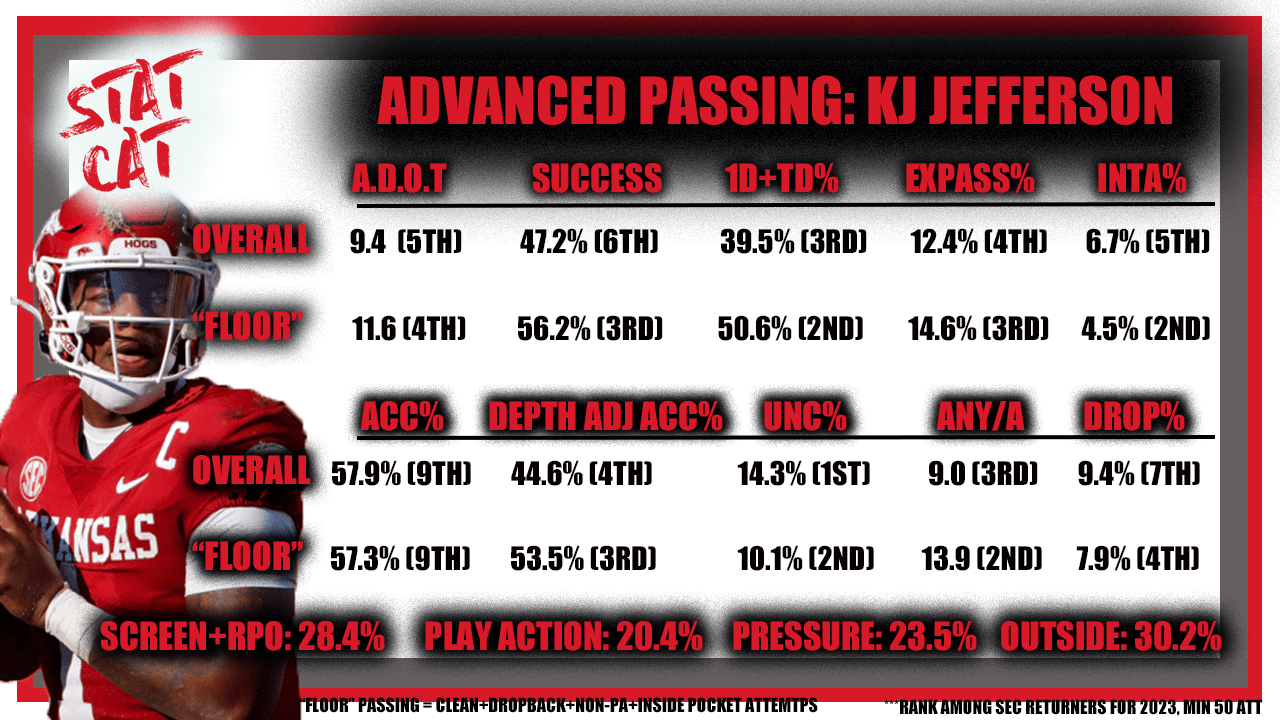
The Stats: color-coded to reflect percentile standing within impact class (green = great, white = mid, red = bad)
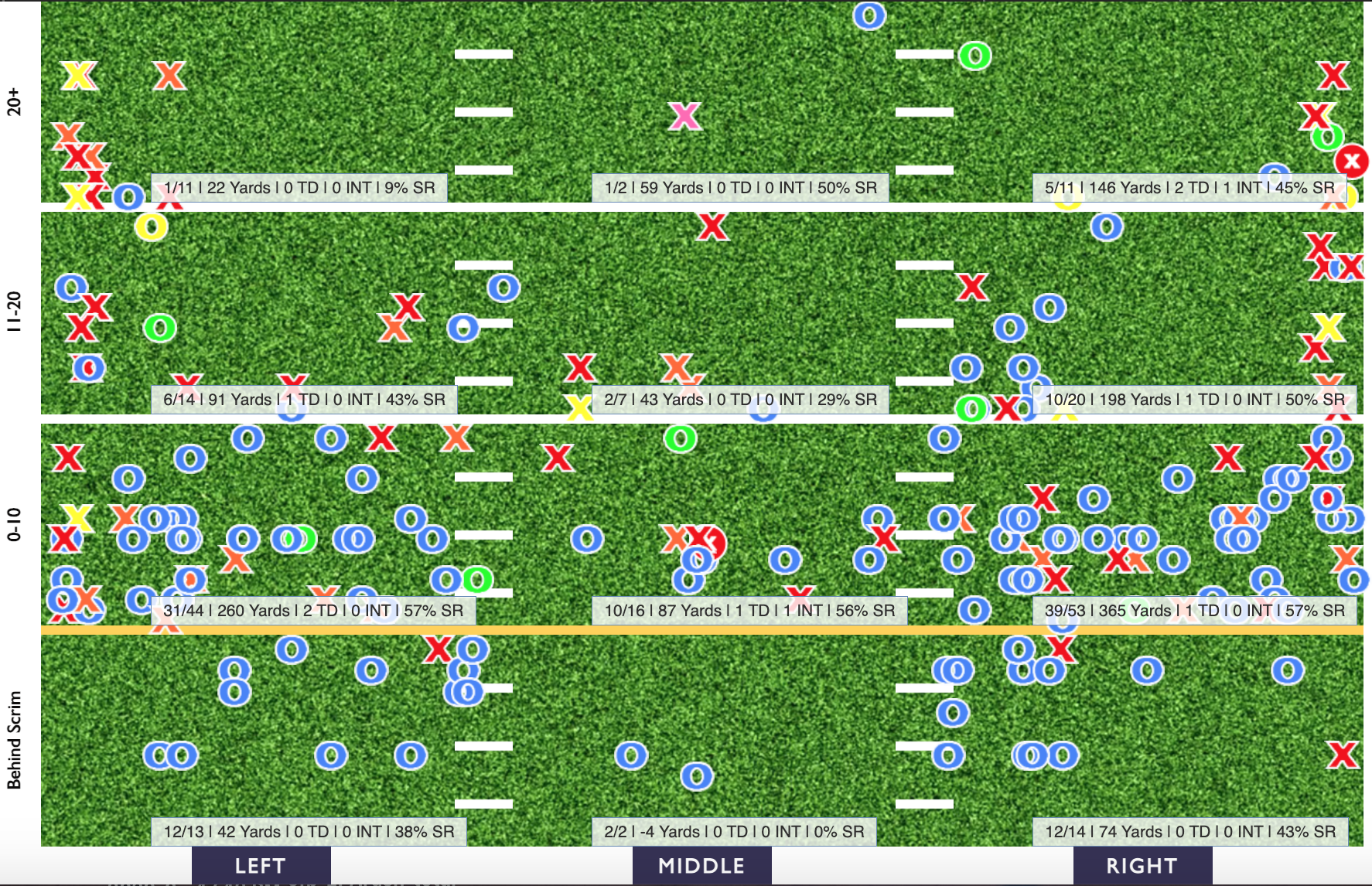
Spray:

Overall:

Many people consider Jefferson to be the SEC’s QB1 ahead of this season. And while that’s TBD, Arkansas has previously schemed up copious completions for their statuesque slinger to pass the Good, Ole-Fashioned Eye Test. Over half of his sample’s attempts came off either an RPO, screen, or dropback play action, highlighting just how much Kendal Briles propped up him. And with defined reads, he dispatched tries to his guys smoothly and somewhat consistently. Though his potency was pedestrian, his ANY/A placed inside the group’s top8 with a top5 First Down+TD Rate.
The orchestrations guided him, but Jefferson still had to make some throws. No Impact QB turned in a lower overall Uncatchable% than his 15.0% clip. And with more usable attempts, his targets had more opportunities to snag them. Despite facing one of the hardest slates, KJJ bested the group’s average in Success Rate, Adjusted Completion%, and Interceptable%. For many, checking these boxes is enough to fast-track him. Still, his subpar accuracy against his quality foes shouldn't be entirely dismissed. Moreover, his 39.2% Depth Adjusted Accuracy% finished dead last amongst Impacters. I told you this dude was a little bit of an oxymoron.
Downfield:

Like many in our sample, Jefferson was a lesser version of himself targeting downfield against the meat of his schedule compared to when facing mid opponents. But like his sample as a whole, his knack for serving up catchable attempts fueled his production despite lacking the most refined precision. Though his process allows DBs to recover, deflates potential yardage, and potentially throws his receiver off his mark, he’s been fortunate enough to produce a desirable amount of downfield completions. Still, it’s a clear stain seeing his Accuracy% on throws beyond ten yards downfield was 2nd-worst in the group.

Compared to his 41.0% cumulative clip that stands to be the best the SEC has to offer ahead of this fall, only 31% of his deep attempts in our sample were deemed on-target. He was just as likely to toss a turnover-worthy try in this area of the field. But the main blow to his bottomline came via his putrid 34.2% midrange Accuracy%. He was one of two Impacts to record a clip under 39%, in case you needed some evidence how severe his misplacement was. Though he’s not one to try too many dingers, his intermediate makeup was one the highest in the group. So behind his midrange misfires, another seed of doubt is planted under his profile.
Pressured:

Arkansas’ OLine tended to keep Jefferson clean. But on pure dropbacks, the Hogs’ front five was more likely to falter. And thanks to broken plays, buffers, and other boo boos, adversity seeped into Jefferson’s operation. To reiterate, taking sacks presents to be one of his largest areas of opportunities. Against his hardest opponents, he was one of four other Impacters to suffer a sack on over half of their experienced pressures. On pure dropbacks, only one of KJJ’s peers topped his crushing 17.1% Sack Rate.
Despite those knockbacks, he recorded an okay ANY/A. How? Ironman was sound under the gun. Though his precision metrics in most contexts were tart, Jefferson’s 58.8% Accuracy% and 75.9% Adjusted Completion% joined his normally low Uncatchable% atop the group’s leaderboard. In turn, his down-to-down result stats were lifted. However, it wasn’t all golden. KJJ is normally a prudent passer not looking to press. But when pressured, his judgment suffered. So even if his raw efficiency was in the green, his bang-for-buck raised eyebrows. His Interceptable% outshined his Explosive Pass% by 3 percentage points. Not a good look.
Outside the Pocket:

On the move, Jefferson can lack urgency at times. Scanning the field, sometimes taking rollouts to the last possible foot, he continued to come thru with workable passes. But thanks to being occasionally boxed out by ensuing rushers that force his trigger finger, his placement remained poor highlighted by an alarming 18.2% Interceptable. A fading base and moderate fastball can only negate. And despite showing a little more verticality in these spots, his explosiveness went backwards. His First Down+TD Rate was relatively fine. But since only a third of these attempts beat situational goals on a per throw basis, his playmaking ceiling is lowered. The next level is looking for guys who can create out of chaos. While Jefferson’s might has him in the conversation, he’s on the outside looking in until his performance outside of structure gets more sizzle.
Contested/Tight Window:

Jefferson’s tight window profile projects to be one of his most notable regression points. Riding one of the group’s lowest Drop Rates, he posted a top3 Success Rate and top5 First Down+TD Rate. Thus, only Sam Hartman thwarted his beefy 7.7 ANY/A on contested targets. But while a passer who generally throws useful attempts, Jefferson’s marksmanship was decidedly unattractive. His was 5x more likely to log an interceptable than an explosive. Since Jefferson doesn’t necessarily have to be pressured into making these throws, sirens should sound. The results were cash. But, replicating them is far from bankable.
Dropback:

By volume, Jefferson had the fewest number of true dropback attempts of any other Impacter. And when you see the prolonged inaccuracy and tendency to suffer from sacks, it makes sense why his play caller proactively avoided putting him in these spots. Like his overall counterpart, KJJ’s Depth Adjusted Accuracy% was the worst in the group and his raw figure was firmly bottom3. Moreover, his Explosive:Interceptable Ratio was unideal. Still, his catchability gave his targets chances to make plays and obtain respectable output. Across an above-average ADOT, he nabbed the 5th-best ANY/A and First Down+TD Rate. A new offensive coordinator could see some new core concepts tweak Jefferson’s functionality. But despite acceptable decision-making, he remains untrusty thanks to his top-shelf accuracy.
Dropback Play Action:

About a quarter of Jefferson’s dropback attempts came off true play action. But despite another healthy deception tactic oiling his stats, he wasn’t much of a standout against his better opponents. He still threw catchable attempts well. But since half were off-target and his men biffed another seventh away, he was unable to record worthwhile returns. He was average or worse basically across the board in comparison to other QBs in our study. Additionally, throws using this manipulation tended to be worse than their overall counterparts. These unassuming figures swiftly undercut any would-had momentum. However, there is a silver lining to the buzzkills: Jefferson doesn’t need to rely on play fakes in order to be his best self or bring about heightened efficiency.
“Floor” Passing:

Like his dropback makeup, Jefferson's usage in clean pockets without guises or scheme elements was one of the lowest in the group. And again, thanks to Arkansas’ apprehension to use its passer in these situations, his small sample makes these findings somewhat flimsy; especially since a new play caller is in town. But since we’re here, the Razorback’s floor is majestic. Without adversity tightening his screws to force a decision or scheme elements lowering the bar, he captured one of the best Y/A, ANY/A, and First Down+TD Rates in the group. Plus, he was more than twice as likely to throw a big gainer as a turnover-worthy pass. And seeing that both of those metrics improved upon his overall stats hint KJJ could have more in the tank and further increase his down-to-down expectation. No doubt, continued errancy will hurt his stock and might ultimately kill his profile. But behind savvy completions and versatility, his floor might be firm enough to make the Hogs a divisional dark horse.
Cumulative (all attempts) One-Sheet
| Height | Weight | Passing Yards | Pass TDs | INTs | ESPN QBR |
| 6'3 | 200 | 2,913 | 17 | 3 | 79.2 |
The Skinny:
Risk averse, west coast style operator who loves attacking unoccupied space. Great offensive executive making underneath choices. Though his legs raise his bar, he can hold the ball too long. A scary number of sacks. Can be timid to throw downfield. Must increase passing potency
The Fat:
Daniels is a complicated prospect. No doubt, he exceeded expectations last year helping the Bayou Bengals champion over the SEC West. But, there are unavoidable hangups on his profile he must address before he can be taken entirely seriously.
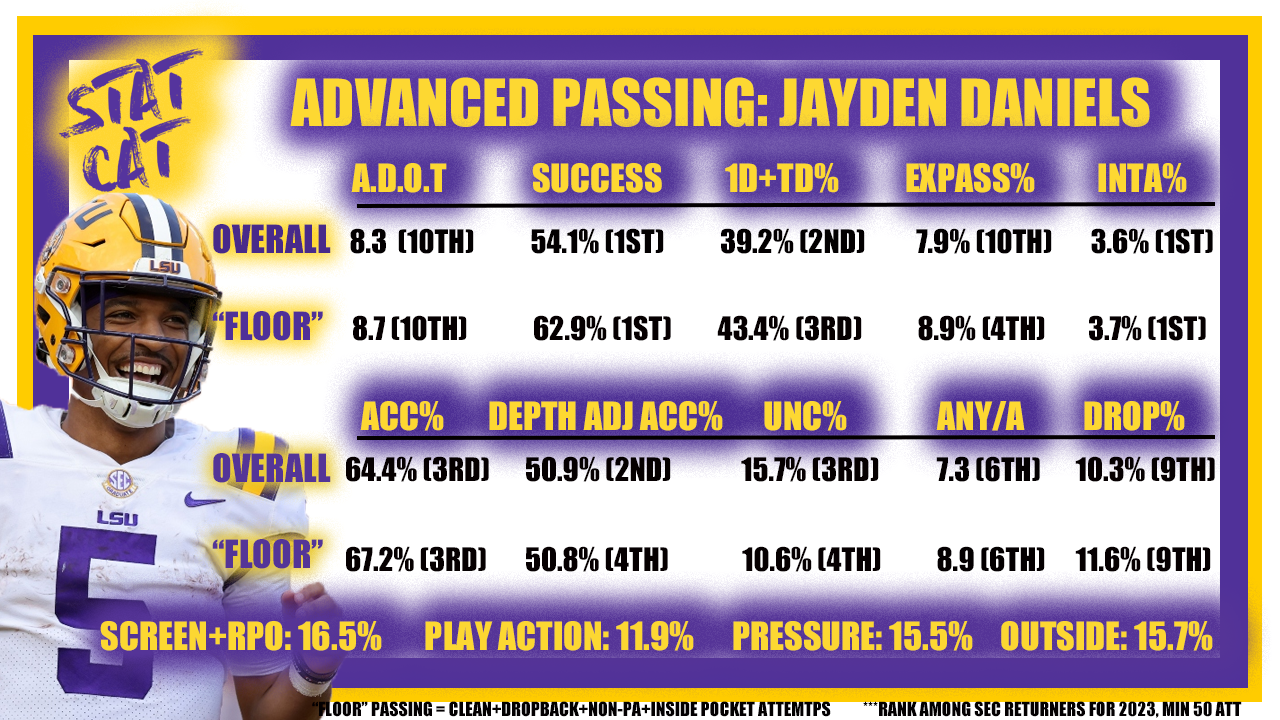
LSU’s play calling fit his conservative modus operandi well presenting him pre-defined outlets with relatively low degrees of difficulty. Amongst returning SECers, his cumulative 54.1% Success Rate, 39.2% First Down+TD Rate, and 64.4% Accuracy% rank 1st, 2nd, and 3rd, respectively, ahead of this fall within the conference. Fueled by short designs and rudimentary reads, Daniels also captured a career-high Completion%. Aged and somewhat self-assured, he’s now a dependable distributor in structure capable of enhanced efficiency.
But his hesitation to let it rip, has been unequivocally frustrating. Yes, his cumulative Interceptable% was one of the lowest within the SEC in recent memory. And, Daniels can certainly be categorized as ‘safe’. Still, he leaves way too many plays on the field. His anticipation must improve. Either due to his lack of bravery, confidence, or vision from the pocket, he routinely passes up open men. Among our Impact QBs in our study, only three of his peers logged a lower Deep Pass Rate than Daniels’ 7.9% clip. Plus, only four were less accurate on a per throw basis when targeting beyond ten yards downfield against his hardest opponents. There’s a clear reason why LSU lacked explosiveness and had to rely on double-digit drives.
Though gun-shy, Daniels still found ways to produce big gainers; with his legs. He posted a team-best 35.7% Broken Tackle Rate, 57.1% Success Rate, and 23.8% Explosive Run Rate across the entire schedule. In case you were curious, all of those figures are good enough to crack the top3 amongst returning SEC rushers. Simply, he’s a vital cog to LSU’s ground game; particularly gashing on zone read keepers – as you can see – to great effect.
Yet, Daniels’ timidness has birthed boatloads of broken plays. Holding onto the ball for too many extra beats, he’s noticeably prone to takedowns behind the line of scrimmage. Despite his skill for making men miss on designed runs, his small frame fails to muster much might to consistently erase sacks. There’s little question on his scrambling ability to gobble up undefended real estate. But folks at the next level will discount his game if he continues to be puny rather than proactive against pressure. And when looking at his returns against his hardest opponents, it’s not a hot take that some have already labeled him as a lost cause and nothing more than fool’s gold.
All else considered, Daniels’ stock is in a healthy place entering 2023. Though already on many’s shortlist for pre-season honors, rumors of increased verticality this summer have boosted his popularity to be a Heisman dark horse. LSU itself is reportedly exploring ways to be more bang-for-buck to better suit their QB’s style. Either way, his floor is penthouse-adjacent. But until he consistently carves up good defenses or shows more aggressiveness downfield, his ceiling and upside cannot be considered sexy or desirable. After all, it’s not like his play against the meat of his schedule was overly inspiring.
Largest Strength: Risk-Aversion, WCO Decision-Maker
Largest Area of Opportunity: Downfield Production, Potency

The Stats: color-coded to reflect percentile standing within impact class (green = great, white = mid, red = bad)
Spray:

Overall:

LSU’s offense was active but it typically aimed to stress opponents horizontally. Outside of RPO slides, flats, tunnels, and slants, the Tigers’ pass offense fed on a healthy portion of Sticks, Spots, and Smashes. Weakside Flood Cross was also very visible. But as aforementioned, Daniels had trouble finding big gainers. Already a passer with affinity for the short stuff, his receivers collective yards after the catch average flirted with placing near the bottom of the SEC. So when you see his paltry 4.4% Explosive Pass% represented the Impact group’s cellar, you can at least know why. Thanks to his modest approach, he still threw a relatively catchable ball. And while the SEC West is one of the harder slates, his accuracy metrics were just okay. Considering he faced the group’s 4th-lowest Pressure Rate despite facing those formidable foes, that middling placement is all the more deflating.
Daniels still brought value thanks to his trusty decisions. Almost an eighth of his sample’s throws were dropped. Yet, he did an admirable job dinking and dunking to keep LSU ahead of the chains. And let’s not forget, he played keepaway better than any other Power5-er in our study. His miserly 3.3% Interceptable% was more than half the group average. Again high floor, but Daniels’ ceiling is difficult to calibrate.
Downfield:

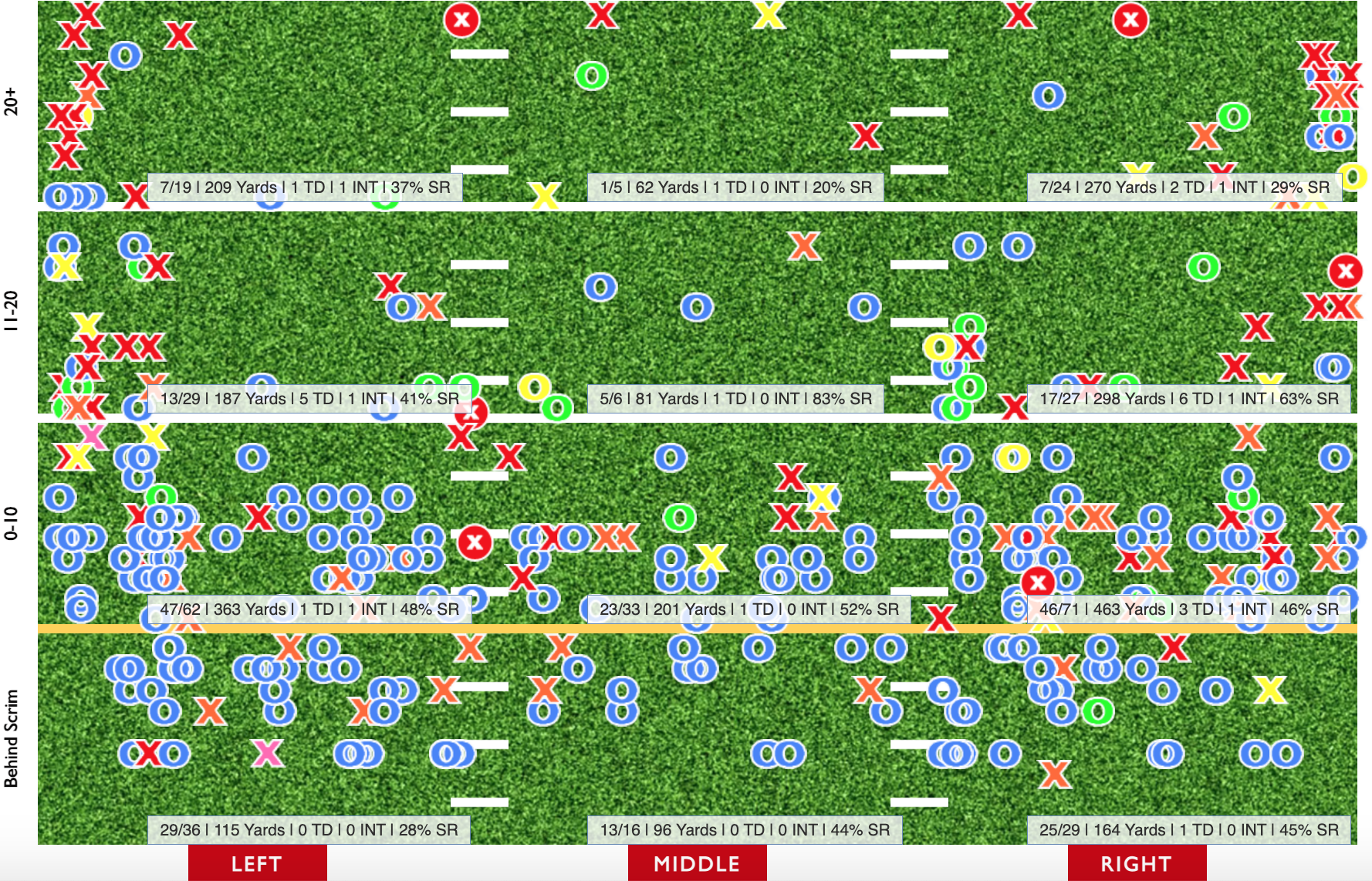
Outside of fellow SECer Will Rogers and Washington State’s Cam Ward, no other Impact QB favored targeting short more than Daniels against their hardest opponents. Less than 26% of his throws topped ten yards downfield. When peeping at his performance, his aversion to these attempts makes a whole lotta sense. Though he was much more serviceable across the entire season, the biggies held him to a bottom8 Completion%, Accuracy%, and Uncatchable% in our study. No bueno, Bayou Bengals. As you might suspect, Daniels’ deplorable deep offerings were the primary culprit. Judging by the beat red hue on his stat square, one can easily visualize how his imprecision handcuffed LSU’s offense. His accuracy on a per opportunity basis was fine in the midrange game. But still, far too many tries were biffed to feel good about this part of his game.

Pressured:

Again, LSU’s front five did a wonderful job maintaining pockets and limiting duress for Daniels to deal. But on those seldom occasions where a rusher won, the Tigers’ QB was flummoxed and foiled. Sharing the worst Y/A in our study, only battered Brennan Armstrong recorded a worse Pressure:Sack Ratio. Well over half of his experienced havocs resulted in a takedown. For someone with a reputation as a scrambler, that’s abhorrent. These consistent backsteps firmly fizzle his ceiling in this context.
When Daniels managed to get the ball out, however, he was justifiably fine in a number of areas. His Interceptable% actually decreased (if you needed any more evidence he played conservatively) in these spots and the rest of his ball placement stats tracked to be above-average. All the while, a large chunk of drops kept his results muted (are you tired of me saying that about him yet?). Assuming he can remain somewhat sturdy with his accuracy and LSU’s receivers can start hauling in these chances, his steady stock could become more bully.
Outside the Pocket:

Behind bootlegs, extended RPO tries, and backyard rollouts, a sizable chunk of Daniels’ attempts came outside the pocket. However, he wasn’t too spectacular when on the move. Sometimes getting a little too front loaded on offerings with positive inertia, all of his placement stats skewed below standards. And with blah offerings, his Y/A and Success Rate placed inside the group’s bottom8. And based on his previous impotent passing, I’m sure you deduced Daniels’ again failed to capture explosive completions in this context. In fact, he didn’t log a single one against his hardest opponents.
Contested/Tight Windows:

The risk-averse Daniels naturally didn’t like threading the needle too often. Only about a fifth of his attempts against his heightened slate were contested. And when he did, he was pretty forgettable. His Accuracy% was bang-average as was his ANY/A. But despite being a low-key performer, he recorded okay results. He beat the group standard in Success Rate, First Down+TD Rate, and Adjusted Completion%. Though it should be fairly clear Daniels isn’t built to live and die targeting tight windows, he’ll be asked to complete some if LSU wants to remain relevant and he wants to continue playing football beyond this fall. At least, some solace can be had since he delivers decent value from time-to-time.
Dropback:

Since a small number of attempts were dedicated to screens and RPOs, Daniels’ dropback returns generally mirror his overall figures. He lacked potency, honed in on short and medium passes, and kept the ball out of harm’s way. His placement metrics remained relatively mellow as well as his receivers logging a high Drop Rate. Sure a down-to-down dumper isn’t flashy. But, let’s say LSU’s butterfingers are cut in half. His Success Rate, even with the miscues, tracks to be respectable. With less drops, his game gains some teeth. Plus, Daniels is more than capable of carving up his more questionable opponents. But even Drew Brees took shots before his dead arm kicked in! Daniels feasting on the underbellies of coverages is fine. However, he needs a more rounded diet pushing the pill around unless he’s fine remaining stale.
Dropback Play Action:

LSU didn’t feature much true play action against Daniels’ hardest opponents. Typically, game situations never called for it; but Denbrock’s scheme didn’t favor the tactic regardless. He only logged 11 (!!) true play fake attempts across a six game sample. So these numbers are mostly meaningless. But, it’s a little alarming Daniels biffed over half of these throws.
“Floor” Passing:

Again, since Daniels’ bottomline was decimated by drops, conceptualizing what his profile would look like with less of them is nebulous. But within clean pockets without guises, our guy projects a high floor thanks to his knack for slicing secondaries sideline-to-sideline short. His placed 6th within the group in Success Rate, 7th in Adjusted Completion%, and 8th in First Down+TD Rate despite the boo boos from his targets. He is keen on where to go with the ball and can be a sound pre-snap processor. Additionally, he’ll be one of the most efficient designed rushers returning to college football’s best conference. He’s just got to open his game up when he’s presented a look he wasn’t expecting. Both by finding guys outside of his rhythm (and potentially normal progression) and busting thru rushers when a design breaks down. Folks should feel just fine about his reaffirmed floor. But will it be enough to elevate LSU to where it wants to go; especially with gung-ho Field-stretcher Fred waiting in the wings?
Cumulative (all attempts) One-Sheet
| Height | Weight | Passing Yards | Pass TDs | INTs | ESPN QBR |
| 6'1 | 215 | 1,265 | 11 | 4 | 55.7 |
The Skinny:
A slight passer with a snappy delivery. Excellent down-to-down accuracy. Light on his feet with decent escapability skills. Can matriculate but has good vertical juice and tends to lead men downfield. Subpar frame results in occasional biffs; especially when vision is obstructed.
The Fat:
In case you haven’t heard, Leary’s stock took a hit last year. After posting one of the most efficient marks in college football in 2021, his 2022 campaign once inflated by high hopes quickly crashed and burned thanks to injury and regressed play. But while his results and process soured, making any definitive conclusions from that hobbled performance would be foolish; as would blindly assuming he’ll find his old form in a brand new environment. Odds are, his play will likely fall somewhere in the middle of those two extremes. So to conservatively gauge what he’ll bring to the table for 2023, Leary’s Impact sample includes five of his hardest foes from each of the last two seasons.
In addition to backbreaking double-digit Drop Rates that decimated his bottomline, his key traits carried over year-to-year. Leary’s main selling point is his golden accuracy. Though some of his operation was fueled by screens and RPOs, he proved to be a confident and consistent pre-snap processor and snappy post-snap distributor no matter the design. There’s little wasted motion in his tight, compact rotation and passes arrive quickly. Plus, his placement tends to be away from defenders. But while his arm gets the focus, Leary has some of the best feet in the class. He might not be a burner or buster. But his vision, nuance, and balance finding lanes in and outside of the pocket allow him to elevate his offense. This nimbleness is all the more paramount since his stature can result in periodic obstructed vision and misfires from muddy pockets. Captain Obvious wanted to chime in to say that it’s a lot easier for QBs to hit their targets when they can see them.
While sometimes he chooses to play it safe with his offerings in terms of depth, Leary can find completions all over the field. Despite his unassuming size, he had multiple attempts in his sample top 50 yards beyond the line of scrimmage. However, a torn pectoral had an obvious effect on his deep accuracy last year. As a somewhat prudent shot-taker, his potency falls off a cliff if he cannot connect on dingers. He can nickel-and-dime with the best of them, but the jury is still out on if he can regain previous efficiency without recapturing moderate production deep. Leary might not press in terms of distance, but he’s not one to shy away from targeting tight windows when hunting for completions. Perhaps this tendency discontinues with speedy receivers and tweaked operation. But if his tunnel vision sticks, the BBN should have some solace that his performance in this context has been noteworthy.
Largest Strength: Knifing Accuracy

The Stats: color-coded to reflect percentile standing within impact class (green = great, white = mid, red = bad)
Spray:

Overall:

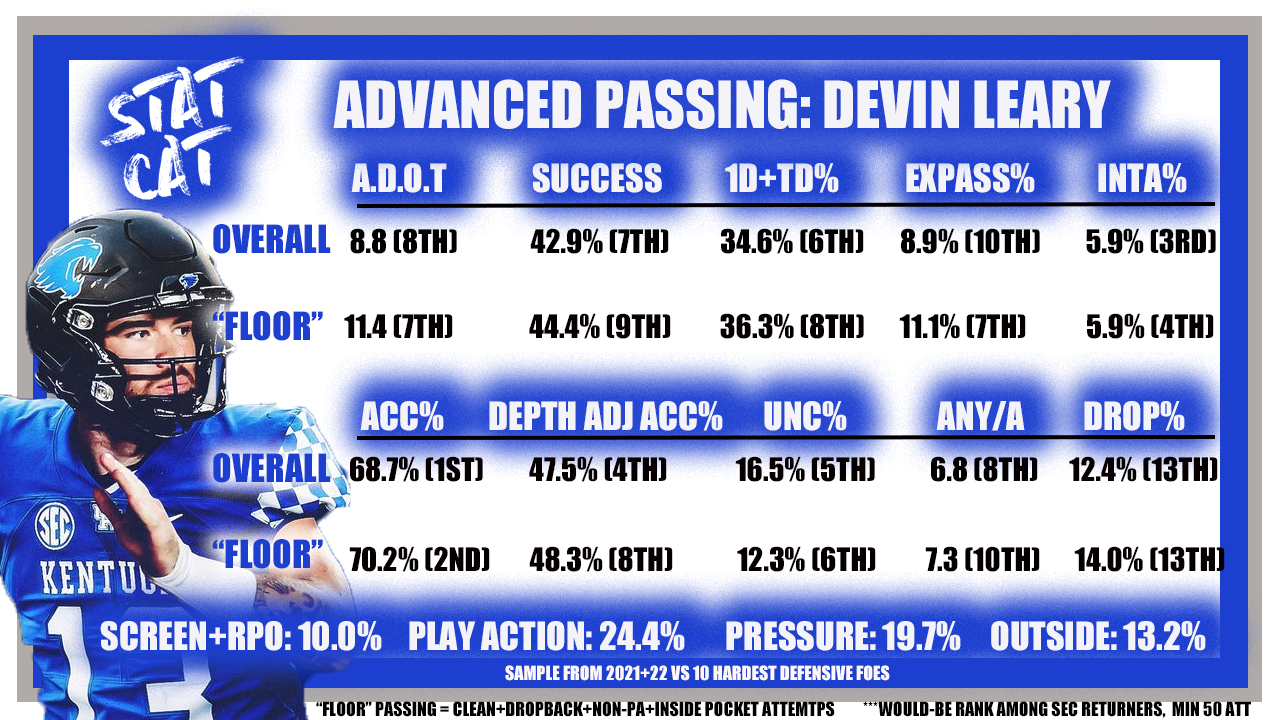
Again, if we were to only analyze Leary based on his returns from last year, he’d be a pretty hard sell. He tracked to have a bottom10 ANY/A, Explosive Pass%, and Depth Adjusted Accuracy among our Impact QBs. Oof. But even with drops damaging his profile, he projects to be one of the nation’s most precise passers. He just has a knack for throwing catchable attempts. All of his placement metrics on his composite topped the group’s standards. In fact, no other Impact Power5-er logged a preferable Accuracy%. Targeting short lowered his degree of difficulty as well as his explosiveness. That said, there’s underlying optimism his bottomline will bolster he sees less butterfingers in the Bluegrass thanks to his sturdy process.
Outside of drops, he didn’t experience too many volatile elements that drastically skewed his stats. His Pressure Rate was one of the better one’s in the class, he only used a moderate amount of deception tactics, and he overly preferred to operate inside the pocket. He consistently has peppered opponents sideline to sideline underneath and fancied working outside the numbers downfield. While there were some nice midrange completions near the hashes, he was one of the 10-most likely Impact QBs to target outside the numbers excluding outlets. And though he completed a backshoulder or two, Leary is quite good putting air under the ball and limiting ducks.
Downfield:

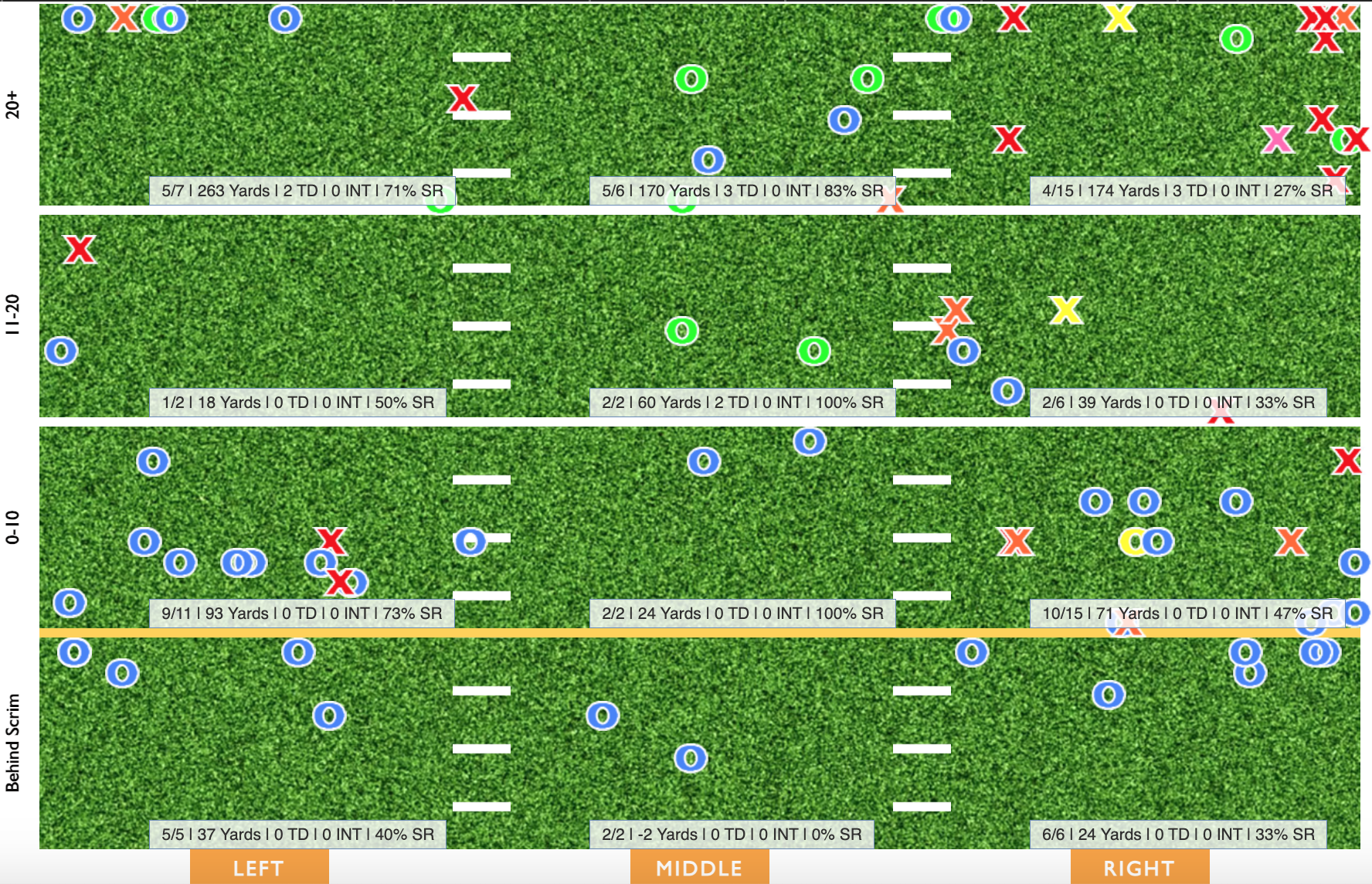
Plagued by a torn pectoral, Leary’s downturn throwing deep was perhaps his greatest backstep last year. His 2022 figures were all below the group standard including his bottom5 22.7% Completion%. Last year, he was practically averaged two uncatchables per every on-target pass beyond 20 yards downfield. Obviously, that’s a major red flag. However, since he was rather sound throwing deep in 2021, his composite managed to be palatable, if not forgettable. About a third of his such attempts were equally caught, accurate, or biffed. Off-season reviews indicate he’s back to his old self. And, Kentucky is optimistic Leary will TCOB (take care of business) in this area of the field. Even a middling performance might be satisfactory enough. But if he replicates last year’s rotten offerings, folks at the next level might lose interest.

But while his deep figures have fluctuated, Leary has been a standup midrange thrower each of the last two years. His composite 56.3% such Accuracy% projects to be a top5 Impact figure. However, for the ‘what have you done for me lately’ crowd, seeing his placement dip 8 points and his Interceptable% double YOY isn’t too reassuring. In turn, his composite downfield profile leans more towards fine than fantastic.
Pressured:

Leary’s spring-action release and nifty feet are useful traits to negate pressure. Of course during his breakout season, he averaged 2 erased sacks per contest against his hardest opponents and topped key stat standards across the board. But duressed dropbacks are volatile, full of variables, and very hard to predict. Subsequently, Leary saw his play versus pressure crumble last fall. Already susceptible to drops and restricted throwing lanes, his body language palpably deteriorated and he appeared to be more stressed out than in 2021. His 1.2 ANY/A in this context would’ve been inside the group’s bottom3 and among his new conference’s worst figures. For what it’s worth, the guy Leary is replacing rocked an SEC-high 6.9 clip.
Even though his backers expect to see his accuracy recalibrate, the fact Leary placed below the group average back-to-back years in pressured Interceptable% and Pressure:Sack Ratio articulates underlying flaws in this context. His feet allow him to move smoothly and carefully. Still, he lacks the strength of some of his peers and can be bothered into errancy. If it’s not a sound base, it's a muddy pocket preventing a follow-through, rushing a read, or nudging him off his mark. Again, Will Levis is 6 '4, 229 compared to the 6’1, 215 Leary.
Outside the Pocket:

The moderately-sized Leary doesn’t appear to be much of a standout when breaking rank. His per attempt accuracy stays passable. However, these are the spots where he traditionally has been his most reckless. Either because he cannot see the field as well, misjudges windows, or has his mechanics altered, his metrics outside the pocket were decidedly subpar compared to his Impact peers. His such INTA% more than doubled his EXP%; and over of third of these throws were deemed uncatchable. In recent years, UK has visibly featured play action bootlegs that require its passer to be a dependable distributor on the move. But with Leary’s previous shortcomings, his new staff might deviate course and prefer to keep him guarded within the pocket.
Contested/Tight Window:

Roughly a quarter of Leary’s sample’s attempts were contested (92 by volume). Thanks to his polished precision, Leary hints to be a commendable passer when targeting tight windows; even though there were a few snaps with mistimed outbreakers or lollipops. No Impacter topped his 55.1% such Accuracy% from this past season and his composite score still would’ve cracked the top3. With plenty of on-target tries, his result metrics bested the group average across the board even though about a fifth of these attempts were dropped. Only two of his peers trumped his composite 6.8 ANY/A and only three outdid his 14.1% Explosive Pass%. Folks at the next level ought to love Leary’s ability to optimize these completions without being too reliant on their outcomes in order to power drives.
Dropback:

Leary wasn’t a strong dropback passer last fall, which might explain why the offensive braintrust decided to spoonfeed him more screens and RPOs compared to the previous season (29% vs 21%). His 2022 Interceptable% topped his Explosive Pass%. Plus, both his Depth Adjusted Accuracy and ANY/A projected to be bottom4 Impact figures. Patterns working outside were particularly putrid. Floods, All Verts, and Smash Variations – NC State’s three most-targeted dropback concepts – pooled together for a despicable 21% Success Rate. Yikes. Even with relatively admirable down-to-down accuracy and catchability, that’s undeniably alarming.
However, because of Leary’s ability to typically throw on-target, sunny-siders believe his firm process will eventually lead to worthwhile results. Furthermore, he tends to have good eyes reading coverages, manipulating defenders, and creating lanes for himself – a dire necessity due to frame. Even with his history of unlucky drops nuking his numbers, his composite placement stats reflect one of the nation’s best pinpointers and a QB with serviceable vertical offerings.
Dropback Play Action:

Only about a tenth of Leary’s sample used play fakes. Deception tactics were not a major part of his operation. That said, he remained relatively accurate, risk averse, trusty on where to go with the ball. In fact, despite a sixth of these such throws being dropped, his Success Rate, First Down+TD Rate, and ANY/A all improved with this tactic. Yet, his Explosive Pass% slightly shrunk. Though play action can unlock a passer’s aggressive side and goad more verticality, Leary didn’t mind checking it down. His ADOT was over 5 yards under the group mean. For what it’s worth, Levis logged similar marks each of the last two years despite using true play action on over a quarter of his dropbacks.
“Floor" Passing:

Leary’s pass floor within structure is desirable. (Not to sound like a broken record) Yes, drops remained a problem and kept some of his result stats tepid compared to his peers. However, most of his composite stats in the context improved upon his already respectable resume overall. While increasing his ADOT by a few yards – and above the group mean – his raw Accuracy%, Uncatchable%, and ANY/A all enhanced. In fact, Leary was the only Power5-er in our study to be on-target on over 70% of these throws across above-average distance on a per-throw basis. Plus, his such Explosive Pass% basically doubled his Interceptable - implying he has the needed juice to capture big gainers without playing too carelessly. His deep placement curbed his weighted accuracy. But with more speedy targets, folks feel that will round into form.
Buzz is growing that Leary could be a dark horse draftee to sneak into early round conversation. A good decision-maker and on-point, he should excite the BBN for what he can bring to UK’s offense. Leary isn’t at burly or toosly as Levis; but he’s steadier with the ball, more trusty attacking tight windows, and has much better feet to navigate pockets and throwing lanes. Public Service Announcement: The last time Liam Coen called plays in Lexington, the Cats led the SEC in Offensive Success Rate – a sign of consistency and situational dominance. Leary’s strong down-to-down placement will play a huge role on if Kentucky can regain its past efficiency and potentially win double-digit games.
Cumulative One-Sheet
| Height | Weight | Passing Yards | Pass TDs | INTs | ESPN QBR |
| 6'5 | 245 | 971 | 10 | 0 | 83.8 |
The Skinny:
A big, mighty, vertical-minded QB with demigod arm strength. One of the position's highest ceilings that is further elevated by his aggressive scheme. Displays inconsistent mechanics which mutes his accuracy, consistency and potency. Fantastic flashes but still a work in progress
The Fat:
Milton is one of the most intriguing players ahead of this fall. Despite previous errancy and untrustworthy quarterbacking, his undeniable talents continue to tantalize on ‘what could be”. His recent showings indicate things might have finally clicked for him. Still, some of his past bugaboos pop up to dent his bottomline and allow dissenters to object to his apparent metamorphosis. But one thing is unequivocal, Tennessee’s offense will facilitate his role, reads, and operation for both him to be his best self and the Vols’ upward trajectory to continue. Like his predecessor, Milton will be fed ample outlet screens and dump offs to space short or behind the line of scrimmage with an abundance of vertical shots. While there is value in the midrange game, Josh Heupel prefers either taking the sure thing or going all in with little in-between.
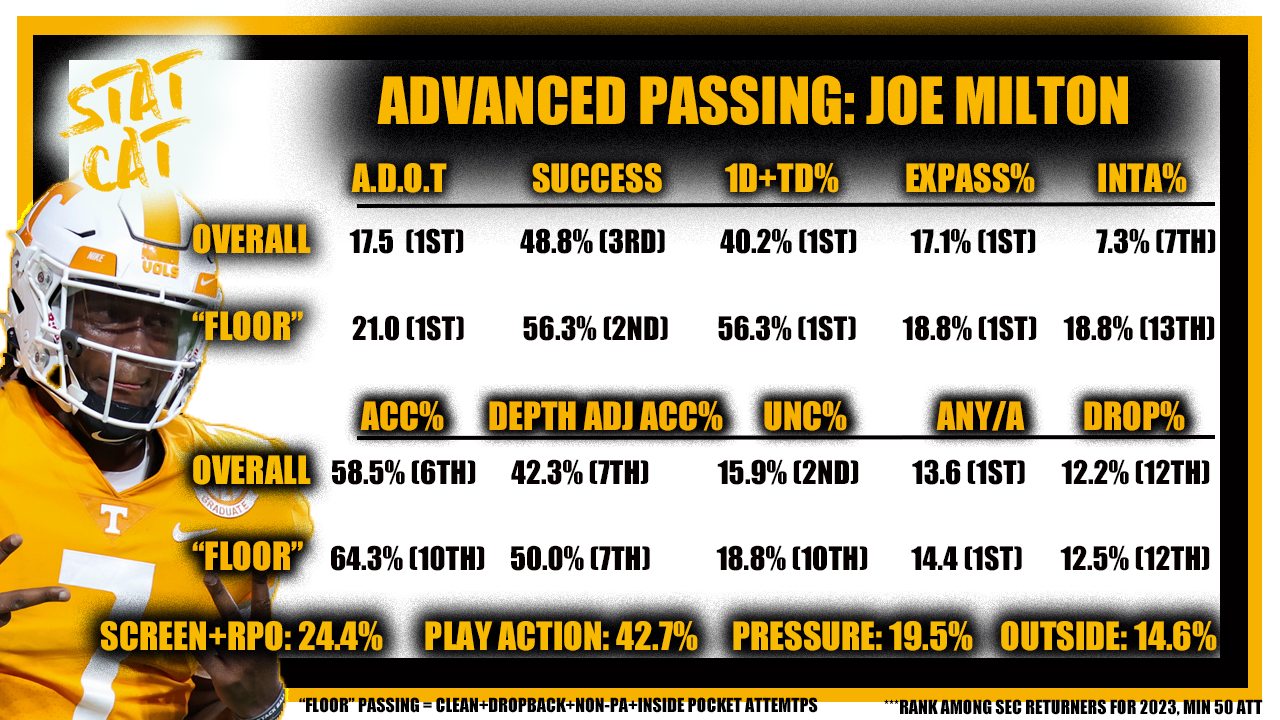
This exercise is dealing with a truncated sample compared to other Impact QBs, but Milton’s numbers echo his incredible upside. His 13.6 ANY/A was practically 3 yards better than anyone else in the SEC. FYI, the next man in line was Hendon Hooker. And signs of further optimism are rooted in the fact Milton was the only passer to place inside both conference’s top3 in Uncatchable% and First Down+TD Rate (min 50 att). Though less sound with his ball placement than his predecessor, no target is too far and any busted play – of which the Vols logs plenty – can go for six. In case you didn’t know, even with the reduced games, Milton totaled more completions with a depth of target over 45 yards downfield (6) than anyone else in our study.
Tennessee has one helluva trebuchet on its hands. But there are still noticeable kinks destabilizing his down-to-down mechanics both when stationary and on the move. Naturally with a more aggressive M.O. that yearns to get his awesome arm on tape, his degree of difficulty is upped. But Milton’s major driver for his numerous biffs and clear downfield choke jobs on his profile is his wobbly operation. He’ll string together a few plays straight with a tight, compact, confident delivery. Then, he will regress with hip chucks off his back foot. When a passer knows he can make off-platform throws or wow with unreal highlights, sometimes he’ll simply put less weight into a consistent operation. His surroundings and next-level traits should see Tennessee continue to challenge within the conference and keep his floor high. But if Milton truly wants to become a household name, he must refine his ailing inconsistencies with his mechanics.
Largest Strength: Rocket Launcher Arm Strength
Largest Area of Opportunity: Overall Accuracy and Improved Process Metrics

The Stats: color-coded to reflect percentile standing within impact class (green = great, white = mid, red = bad)
Spray:

Overall:

With only 82 attempts and a full fledged start against lowly Vanderbilt, Milton’s figures carry much less weight than most of our Impacters. Even if just a flimsy snapshot, however, his stats can illustrate how far he’s come and how far he still has to go. Blessed with a divine scheme and angelic arm talent, Milton blew his opponents away. Both his Y/A and ANY/A comfortably sat in the double-digits, a threshold none of his peers came close to achieving. His verticality and lofty ADOT promoted high returns of big gainers as a sixth of his attempts generated at least 20 yards. An absurd 67.1% of his attempts occurred on either a screen, RPO, or dropback play action. This should hammer home how much of his results were simply executing the greater scheme at work as well as how extra mechanism might be needed to goad his greatness.
But all in all, there should be little worry that Milton will fizzle. His accuracy metrics are still pretty sour, but his catchability has improved tremendously thanks to his proactive play caller. And with more tries in play, nearly half of his throws last year found situational success, and his 40.2% First Down+TD Rate would’ve made the Impact top5. If his receivers drop an eighth of his throws again, his bottomline will take a hit; especially if his overall accuracy remains drunk. But he’ll overly be placed in spots to kick ass and do what he does well: dial up dingers and capture key completions.
Downfield:

The Mighty Righty completed half of his downfield throws last year; and his Accuracy% tracked to be near the Impact top10. While QBs in our sample averaged a depth of target of 20.7, Milton’s figure was a robust 33.7, signifying his affinity for deep attempts. Of his 38 tries beyond ten yards downfield, only 10 were midrange targets. His astronomical 34.1% Deep Pass Rate was over a dozen points higher than the next Impact QB. Now, sustaining that clip across a season would be unheard of. But, it shows you Milton doesn’t need much convincing to chuck it deep. And with noticeably improved consistency on his placement, he projects to be all the more dangerous with increased reps.

Pressured:

Milton only had 16 pressured attempts last year. So these numbers are even more unstable for our analysis. But if you care, Milton’s toolys traits propelled him to dynamic results. Behind relatively sound accuracy figures, a usual flaw in his game, he captured the group’s would-be best Y/A, ANY/A, Success Rate, and Explosive Pass%. Again, take these with a grain of salt. But only one other Impact QB posted a preferable Uncatchable%. His stony stature appears to be more composed and unbothered by blitzing bugs. And if Milton can remain a cool customer under the gun, his stock will keep on rising.
Outside the Pocket:

Milton is a big guy. He isn’t designed to win too many footraces. He only logged a pair of scrambles versus 4 taken sacks last year. His value outside the pocket comes from extending broken plays with his plowing lower body and being able to hit guys on scramble adjustments downfield. He saw limited usage in this context last year. But one of his most impressive completions – an effortless 50-yard fling to Squirrel White in the waning moments of the SC game – came on the move to the left. You think everyone can do that?
Contested/Tight Window:

Due to bountiful scheme elements and speedy receivers, Milton didn’t have to press tight windows too much last season. But when he did, his arm hubris of believing he can complete any pass emerged. Though he was relatively accurate in these spots, he was more prone to log a pass breakup than an on-target attempt. Plus, over a quarter were turnover-worthy. But while there were some pretty precarious throws attacking tight windows, Milton ended the year with 3 TDs and 0 INTs, which further hypes up his capacity for winning in the margins despite an untrusty process.
Dropback:

Milton’s wonderful results were maintained when excluding screens and RPOs. And with fewer rinky dink throws included, his verticality ballooned. Every one of his result metrics outside of his 53.7% Success Rate – which tracked to be a top5 Impact figure – would’ve been a group-high. Though half of these throws were inaccurate and over a fifth were straight-up uncatchable, over a quarter resulted in a gain of at least 20 yards. But along with the dipped accuracy, Milton was more prone to throwing interceptables. And, his such 11.1% clip was well into the dangerzone. There’s evidence his bottomline will buckle under the weight of prolonged inaccuracy. Robby Ashford was the only other SECer with a sub-51% Accuracy% and +10% INTA on true dropbacks last year. Not the company you’d like to keep. So while the returns he logged are entirely commendable, that wonky of a process is pungent and cannot be dismissed even if the video game numbers continue.
Dropback Play Action:

Milton’s dominating dropback numbers were noticeably boosted by play fakes. Exactly half of his attempts featured the tactic. In fact by volume, play action was so prevalent within his game that he logged more such snaps than the majority of his peers in our study. So while some breakouts are flimsy, Milton’s incendiary passing off dropback play action appears to be firm. As you might suspect, no Impact QB came close to matching his down-to-down output according to his kingly 25.8 ANY/A. And while his placement when not using manipulative scheme elements is still very much TBD, Milton seems to display more accuracy when his man is clearly defined, open, or the backend has one less defender in coverage.
“Floor” Passing:

Milton’s passing floor is high. Don’t kid yourself. Leaning into downfield throws accentuated by an aggressive, fast-paced offense only makes him all the more effective; especially considering the top-speeds of Tennessee’s targets. That said, his passing floor is unquestionably shaky due to the volume of tricks, guises, and tactics Heupel used to butter Milton’s bottomline. Less than a fifth of the Vols’ attempts met this criteria; only Jaxson Dart – another “Super Spread/Veer and Shoot” operator – claims a lower makeup among returning SECers.
His placement stats didn’t lose too much ground, but Milton’s accuracy remained unsatisfactory and a clear red flag ahead of this fall. Moreover, an 18.2% Interceptable% within structure is just plain horrendous. Time will tell whether his stupendously high scheme element usage is more of a reflection of his shortcomings operating on straight dropbacks or his play caller’s fancy to optimize the greater game at work. Still on a per throw basis, few passers will have higher expected outcomes than Javelin Joe.
Cumulative One-Sheet