2024 Impact Study - One Thing You Didn't Know
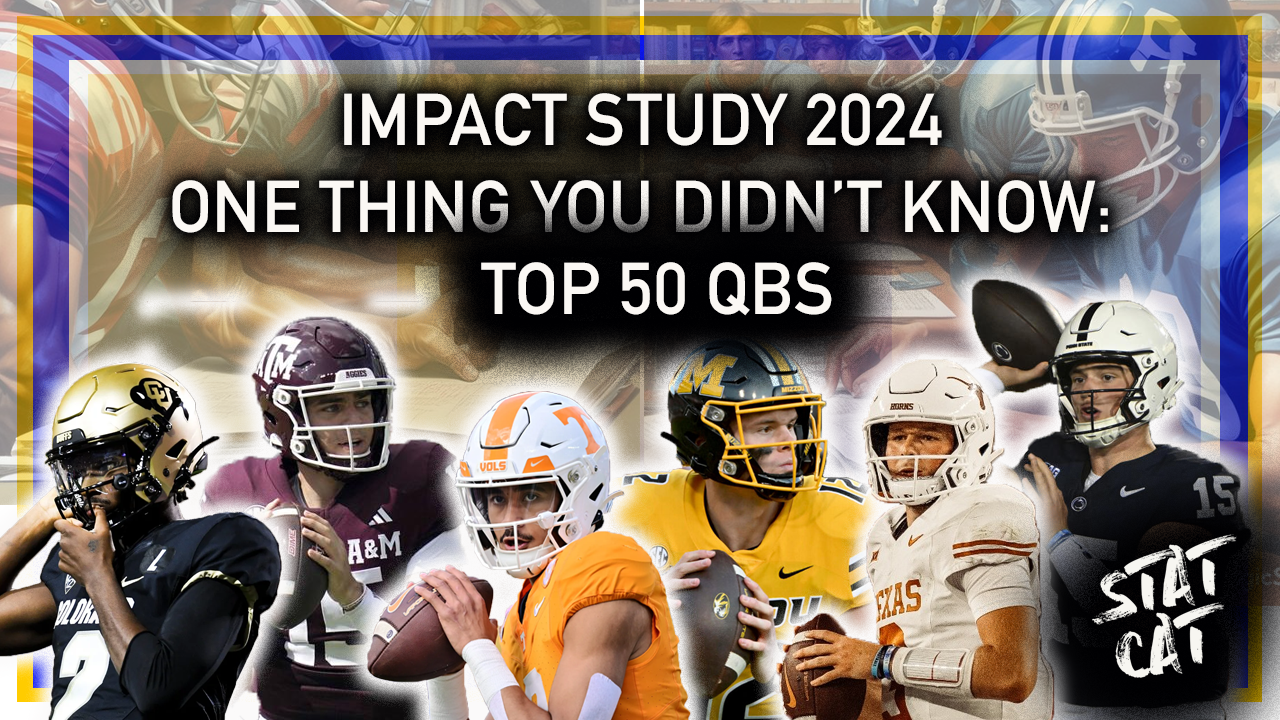
One Thing You Didn’t Know (For Each Impact Top50 QB)
While Summer is a time to hit the outdoors and soak up the sun, it’s also the season where thirsty football fans eagerly drink up knowledge in preparation for the rapidly approaching season.
With not much else going on in the sports world, analysts are given free reign for depth chart deep dives, film studies, and schematic research. Speaking of, StatCat just completed his latest exercise regarding everyone’s favorite topic: quarterbacks.
Charting the top returning options against heightened adversity not only presented statistical strengths and weaknesses, but plays on tape also further highlighted key traits and characteristics. Performance versus Last Chance U just does not carry the same weight as snaps against defenses full of future professionals.
Even after attempting to “standardize” each passer’s slate, no two samples were the same. In fact, some QBs’ schedules were so soft that they were excluded from the study at large. Still, the study presented incessant insights regarding the returning passing crop.
But for the sake of everyone’s attention spans, here’s ONE thing you didn’t know about each of the top50 QBs in On3’s preseason rankings.
“High Volume” Impact Qualifications (38 passers)
+88 Pre-Season On3 Impact Grade
+125 pass attempts in 5/6/7 game sample
+2 games vs Top50 SP+ AND EPA/Pass DEF
Key Terms:
Accuracy% - percentage of perfectly placed, on-target passes that don’t require unnecessary adjustments
Uncatchable% - percentage of passes that had no chance of being completed due to off-target placement
Depth Adjusted Accuracy - weighted Accuracy% that gives more risk/reward based on distance of target
ADOT - average depth of target, or how far a receiver is when thrown the ball on average
“Floor” Passing - clean, non-Screen/Play Action/RPO attempts inside the pocket
Dropback - non-screen/RPO attempts
Downfield - targets over 10 yards past the line of scrimmage
Deep - targets over 20 yards past the line of scrimmage
Explosive Pass Rate - a pass that nets 20 yards or more
Interceptable Pass Rate - a pass with potential to be picked off due to bad timing, vision, ball placement
ANY/A - adjusted net passing yards per attempt
Carson Beck: Georgia – Scheme props him up
For the past three seasons, a Georgia QB has landed in the SEC’s bottom3 in True Dropback Rate (non-play action/RPO/screen attempts). While Beck has been very good behind-the-chains and within structure, nearly 60% of his output last year came off a scheme element. And without guises, his passing produced a giant red flag. On true dropbacks, Spencer Rattler was the only SECer who tossed more interceptable passes. Beck’s 11.1% such rate placed him in the league’s bottom5. No matter how sturdy your resume is in other spots, that level of carelessness is one quick way to drop down draft boards.
Quinn Ewers: Texas – Really successful outside the pocket
Though the Longhorn has made strides becoming more dependable down-to-down, his attributes have routinely popped when throwing outside the pocket. Even his hardest opponents over the last two years have failed to curb his knack for finding completions on the move. In back-to-back Impact studies, Ewers has led his peers in Adjusted Completion% while also seeing his Success, First Down+TD, and Interceptable Pass Rates comfortably finish above the group average when passing beyond the bookends. His cumulative 64% raw Accuracy% in those games dwarfed the Impact standard by 15 percentage points. Plus, all 7 uncatchables in this year’s study were throwaways.
Jaxson Dart: Ole Miss – The SEC’s King of the Curl
Basically a sixth of Dart’s production last year came off hitch/curl targets. No other SECer topped 13% in that respect. By volume, his 580 yards and 27 conversions expectedly also sat atop the conference. No returner logged more such completions either. And with nearly 80% of these throws being on-target, his 10.0 Adjusted Net Passing Yards/Attempt (ANY/A) held a share of the league’s gold medal. But admittedly, you can thank Ole Miss’s pass catchers for providing extra juice to these short patterns. Over 17% of these attempts gained over 20 yards - a league high by about 7 percentage points.
Shedeur Sanders: Colorado – Not strong outside the numbers
Though he can drive it up the seam and carve underneath, Sanders struggled to show precision targeting the perimeter. Against his hardest opponents, less than half of his throws outside the numbers were deemed on-target. For context, only two SECers failed to crack that threshold. Adjusting for depth, his sample’s accuracy would’ve been bottom5 within that league. Moreover, his 26.3% First Down+TD Rate tracked to be 2nd-worst. Of his 10 interceptables in those games, 7 came outside the numbers. On the year, Sanders only completed a third of his perimeter downfield throws (+10). For what it's worth, Ken Seals was the only SECer with a worse clip this past season.
Jalen Milroe: Alabama – SEC’s Duke of the Deep Ball
Rocking one of the highest average depths of target in the nation, Milroe was in a class of his own launching bombs within the SEC. While it might not be a shocker that his 23% Deep Pass Rate was by far the league’s highest clip, over 40% of Milroe yards came on these targets – the highest figure in the history of SEC StatCat’s charting (2018). No regular starter topped 35% this past season, and the previous record came in under 38%. By volume, no returning Core4 nabbed more deep yards. And no college passer can trump his 52.2% Completion%.
Dillon Gabriel: Oregon – Massive improvement on the money down
Oklahoma’s 3rd Down Conversion Rate barely cracked the top50 in Brent Venables first year at the helm but shot into the top10 last year. Isolating Gabriel’s play versus his hardest foes, he was more likely to log an uncatchable (39%) than a successful completion (33%) on 3rd down in 2022. But in our recent Impact study, those figures improved to 48% and 10%, respectively. Plus while seeing his Defender Breakup Rate being sliced in half, his already solid 51% Depth Adjusted Accuracy% boosted to a sizzling 67%. Though there is no guarantee this will manifest again at Oregon, you gotta like how the matured Gabriel can put it on his targets in these spots.
Cam Ward: Miami (FL) – Rarely used true play action and that will probably continue
Year-over-year, Ward’s Play Action Rate dwindled from 14% to 5% against his hardest opponents. While RPO usage remained strong, it was clear Washington State’s staff wanted to limit instances of Ward taking his eyes off the defense. Already a passer prone to buffer if he doesn’t like what he sees, that was a sound approach. According to Pro Football Focus, Ward's usage across 2023 was the lowest in the Power5. And even though he completed 77.8% of these attempts, he’s transferring into a scheme that also prefers to just drop back instead of duping defenses. Former Miami QB1 Tyler Van Dyke fell into the Power5’s bottom8 in makeup. And, most of those were actions to set up convoy screens.
Will Howard: Ohio State – 5 career downfield completions targeting a blue chip
Kansas State isn’t a program that brings in top-notch talent. Over the last decade, the Wildcats have only had a single recruiting class crack the top40. In short, Howard has lacked the luxury of targeting great pass catchers. Only one of his receivers – Keagan Johnson, a 2023 transfer – rated as a prep 4-star. And though the Howard-Johnson connection was somewhat productive, the duo only hooked up five times on tries over ten yards downfield. The Impact study’s owner of the best Accuracy% on 10+ yard attempts should see much more downfield blue chip production this fall. Howard will have a roster with 8 4-star TEs and WRs… Oh, and 5-stars Emeka Egbuka and Jeremiah Smith.
Riley Leonard: Duke – Great at finding success with core concepts
To say Leonard had a stable 2023 would be a lie. Still, his value of keeping his team on track kept popping up on tape. Already one of college football’s top rushers at the position, Leonard executed his offense’s favorite concepts with laudable efficiency. On Duke’s four most-featured concepts that made up 30% of his snaps against his hardest opponents (Slant Variations, Spacing/Curl+Flat, Rubs/Meshes, and Spot/Snag), Leonard captured a robust 60.5% Success Rate. FYI - LSU’s mighty No. 1 offense turned in a clip under 57%. He should see more scheme elements in his operation at Notre Dame. But even if Leonard overly remains a straight dropback guy, his legs, mind, and arm are quite capable of keeping the Irish ahead of the chains.
Brady Cook: Missouri – Pressed extra getting Burden the ball
Missouri’s desire to feature Luther Burden’s talents was no secret. After all, he commanded the league’s top Target Share (33.9%). Trying to get the ball in your best player’s hands is hardly a sin, but Cook sometimes forced things LB3’s way. Over 40% of his contested attempts targeted his WR1. Moreover, these throws contained half of Cook’s interceptables on the year with his overall 5.2% rate increasing to 8.4%. Subsequently, of his 6 picks last fall, 4 occurred looking Burden’s direction.
Garrett Nussmeier: LSU – Likes targeting stuff along the sideline
Despite uneven showings over the last couple of seasons in both process and results, Nusmeier has consistently targeted perimeter boundaries. Among SECers with 70 attempts, no one has logged a higher percentage of throws trying sidelines each of the last two seasons. This past fall, nearly a quarter of Nusmeier’s throws attacked the paint with over 31% of his production coming on these tries, which was 9 percentage points higher than the next SECer in line.
Nico Iamaleava: Tennessee – Should see usage outside the pocket
Since Josh Heupel landed on Rocky Top, the Vols’ vertical-choice, super spread offense has preferred to keep its passers anchored inside the pocket. Over the last three seasons, no SEC offense has seen a lower percentage of passes come outside the tackle box than Tennessee. Less than 5% of Hendon Hooker’s Big Orange throws met that criteria – by far the lowest figure in the StatCat era. And though Milton doubled that figure, his makeup was still the lowest of any SECer with at least five starts last year. Due to his new passer’s clear athletic traits and mobility, however, Heupel has teased tweaking the scheme to suit Iamaleava’s strengths. But how well the ideas and execution mesh together, of course, remains to be seen.
Noah Fifita: Arizona – Might the the nation’s most accurate QB
In our Impact study, Fifita owned the group’s best raw Accuracy%, Uncatchable%, and Adjusted Completion%. Though targeting short allowed him to pad these stats, his 52.7% Depth Adjusted Accuracy – that applies more risk/reward for on-target passes the further they travel downfield – beat the group standard by 6 percentage points. Moreover when Fifita was clean within structure, that metric shot up to 65.7%, which was the group’s 3rd-best figure; just like his sturdy 59.2% Success Rate. Not a bad start for a first-year passer, who’ll look to build upon that performance with one of college football’s best receivers at his side.
Donovan Smith: Houston – Above-average process metrics, below-average results
Though Smith’s stats hardly sizzle, his operation is sound and hints he could be a breakout candidate. Objectively, his throwing mechanics within structure are among the prettiest in recent memory. Even after cutting out the fat from his profile, every single of his overall ball placement scores finished above the Impact average. In fact his Accuracy% and Adjusted Completion% cracked the group’s top10. But since he suffered from a 13% Drop Rate – the 4th-worst in our study – his bottomline was subpar. His Success Rate, First Down+TD Rate, Y/A, and ANY/A all fell into the Impact bottom15. With more secured targets, Smith’s sound process could produce some nice numbers in 2024.
Joey Aguilar: App State – Much better throwing inside the numbers than out
Understanding his limitations as a passer and opting to shorten the distance of his throws, Aguilar centralized his attempts towards the inside. On the year, less than 40% of his attempts traveled outside the numbers. And when breaking out his showings against the meat of his schedule, evidence suggests he was wise to avoid the perimeter. In our Impact study, inside throws produced a 69% Accuracy%, 82% Adjusted Completion%, 8.5 ANY/A, 7.7% Breakup Rate, and 4.8% Interceptable Pass Rate. Pretty solid stuff. But when targeting outside, these figures worsened to 46%, 63%, 6.5, 12.6%, and 10.1%, respectively. Moreover, nearly 22% of his perimeter throws were uncatchable, which more than doubled his clip when eying the middle. That’s not going to cut it for a guy with next-level aspirations.
Kaidon Salter: Liberty – Accuracy plummets without play action
Though an elite G6 playmaker, Salter failed to show elite precision. Against heightened competition, both his raw Accuracy% and Uncatchable Pass Rate finished inside the Impact bottom8. And, that’s including all the gifts his scheme created for him. On dropbacks without play action, less than half of his passes were on-target, and over a fifth were wasted when omitting throwaways. Plus, his 39% Depth Adjusted Accuracy% hardly impressed. His results were still moderate (55% Completion, 45% Success, 7.5 Y/A). Replicating those returns hardly will help Salter shed the offensive executive label.
Jackson Arnold: Oklahoma – There’s a good chance he leads the Big12 in play action production
Basically half of Dillon Gabriel’s dropbacks over the last two years used play fakes. In fact, no Core4 passer had a higher clip or total production off the tactic this past season. Why bring this up? Well, considering Arnold’s size and relative inexperience, there’s a fair assumption the staff will serve him up a similar rate of deception tactics. After all, 69% of his attempts versus Power5 opponents last year used scheme elements.
Conner Weigman: Texas A&M – SEC’s highest pressure rate
In the SEC StatCat era, no multi-year SEC starter with at least 75 attempts has experienced a higher percentage of attempts coming against pressure in their career than Weigman. Former teammate Max Johnson did challenge for that honor with back-to-back seasons sporting a clip over 40%. But, MJ’s time as a LSU Tiger kept his cumulative figure under 33%. An absurd 37.8% of Weigman’s attempts over the last two seasons have experienced pressure. But despite the adversity, the Aggie has shown gumption under the gun. This past fall while placing inside the league’s top6 in pressured Accuracy% and ANY/A, no SECer topped his such 41% Success Rate. Only Graham Mertz had a lower Interceptable Pass Rate.
Garrett Greene: West Virginia – Heightened play outside the pocket
Undersized and a sound sack avoider, Greene commonly operated outside the tackle box. In fact, no Impact QB had a higher percentage of such throws than his 29.8% clip. But, Greene didn’t just break rank to throw balls away or scramble, his extension skills helped elevate his profile. Compared to his overall numbers against his best opponents, Greene experienced an enhanced Accuracy%, Depth Adjusted Accuracy%, Adjusted Completion%, Success Rate, and Interceptable Pass Rate when passing outside the pocket.
Jalon Daniels: Kansas – Pretty darn good under pressure
As a passer who plays plenty of backyard ball, Daniels naturally has shown flashes when stressed. Going back to 2022 – when he was relatively healthy – he was one of the Impact study’s most successful performers under pressure. Compared to this year’s crop, his raw Accuracy%, Uncatchable Pass Rate and First Down+TD Rate were the 2nd-best amongst his peers. Moreover, his Depth Adjusted Accuracy and Success Rate tracked to be top5-worthy. Tallying interceptables was concerning; but Daniels was still more prone to explosive completions on a per pass basis when under the gun.
Miller Moss: USC – Lincoln Riley’s 4th-straight blue chip starter
No college coach has a longer active streak of starting top-notch talent at QB besides USC’s head coach. Heisman-winner Baker Mayfield – who notably began his college career as a walk-on – was the last 3-star to be Riley’s QB1. Reminder, Mayfield graduated in 2017.
Seth Henigan: Memphis – The only active QB with 3-straight 3,000+ yard seasons
Yep. He’s the only one. So, that’s pretty cool. But will he top 4,000 yards for the first time?
Graham Mertz: Florida – He really prefers his dominant side
Mertz was the first full-time SEC starter to dedicate half of his targets outside the right hash since 2021. Those tries generated 54% of his completions and 57% of his yards – league-highs by 5 and 7 percentage points, respectively. And while it would be safe to assume this spray was influenced by pressure forcing Mertz to his dominant side, he still remained the SEC’s most dedicated righty when clean. Statistically, targeting right buoyed his bottomline considerably. Compared to all other targets, Mertz’s rightward throws produced an advantage of +11% in Completion%, +12% in Success Rate, +6% in Explosive Pass Rate, +8% in First Down+TD Rate, +8% in Depth Adjusted Accuracy, and +7% Uncatchable Pass Rate. And if all that wasn’t enough, his ANY/A held a 3 yard gap compared to middle and left tries. The “z” in Mertz might stand for Zoolander. Though it’s nice he can shred one side of the field, pro scouts won’t be enamored by a guy who cannot turn… or target leftward.
Tyler Van Dyke: Wisconsin – Convoy Screen Fiend
An eighth of the yards TVD produced versus his hardest opponents last year came targeting a convoy screen. For context, no full-time SEC starter since 2019 had a higher makeup targeting ALL screens let alone just the jailbreak variety. For what it’s worth, Wisconsin wasn’t the most prolific screen team last year (10.1% usage on a 5.0 Y/A across all types). So, he might have less dinks moving forward.
Drew Allar: Penn State – Even after explaining excuses, ball placement is meh
Hmmm what don’t you know about Allar? You probably noticed he suffered from quick pressures, drops, and maddening WR errors that hurt his numbers. But surely, if you knew that, then you’d also be aware of his penchant for avoiding negative plays. After all, no Core4 QB had a lower PFF Turnover Worthy Play Rate than his miserly 0.9% mark; and his 3% Sack Rate was among the 10-best in the Power5. Plus, there’s a good chance you are aware that he was 1/5 Impact QBs with a sub-50% Accuracy% on true dropbacks in our study. Or, that his 9.2% Deep Pass Rate was one of the lowest in college football (and fell to group-low 6.0% against heightened competition). And naturally, you’d piece together from that info that he was terrible at producing explosive plays (4.4% was another group-low). So, what don’t you know? How about the fact even when you strip away pressured attempts, throwaways, and broken plays outside the pocket that sour as well as scheme elements that pad, Allar presents mediocre ability to place passes? On clean dropbacks in structure without guises, both his raw Accuracy% and Uncatchable Pass Rate fell below the Impact average. Additionally, his Depth Adjusted Accuracy fell outside the group’s top15. Broadening the scope to look at all sample throws that traveled over ten yards, all of his placement metrics were subpar compared to the standard except his sterling Interceptable Pass Rate.
Brock Vandagriff: Kentucky – Big Big’s first bluechip starting QB since 2017
Though Kentucky’s football program has a history of stars known for slinging the pill, the Cats haven’t had a highly-touted recruit be their QB1 since Mark Stoops’ 4th-season in Lexington. Productive transfers Stephen Johnson, Terry Wilson, Will Levis, and Devin Leary were all 3-stars or worse as prep prospects. As far as On3’s Industry Ranking tool is concerned, the former Georgia Bulldog, Vandagriff, is the most talented passer to don the blue and white this millenia. That said, pedigree alone won’t propel the Cats toward the playoff. The time has come to prove he’s worth the fanfare.
Anthony Colandrea: Virginia – He was poor in final stanzas
Colandrea is a promising passer. But the youngster typically showed his age and inexperience trying to close out ball games last year. Half of his appearances were decided by a score, and the Cavs lost all but one of those contests. His implosions had a direct effect on the team’s win totals. Excluding the VA Tech game, Colandrea went 28/55 for 322 yards 2 TDs and 5 INTs in the 4th quarter. FYI, he only tossed one pick in the other 3 quarters against his hardest foes. But, traditional stats weren’t the only things that stunk in this context. Less than half of his passes were on-target and over a quarter were charted as “tossups”. Even excluding throwaways, his 32% Depth Adjusted Accuracy and 24% Uncatchable Pass Rate were undeniably bad. Moreover, he was more than twice as likely to toss an interceptable pass than an explosive (12.7% vs 5.5%), which ultimately yielded a mere 2.3 ANY/A.
DJ Uiagalelei: Florida State – Poor bang-for-buck on dropbacks
So far in his collegiate career DJU has not shown to be a dependable passer. Despite coming off his best season, he still finished inside the Power5’s bottom10 in Adjusted Completion%. His figures were just as concerning in our Impact study. Versus heightened competition on non-screen/RPO attempts, all of his ball placement metrics came in below the group average. Subsequently, failing to hit his targets resulted in DJU posting a negative bang:buck ratio ala a 7.8% Interceptable against a 7.1% Explosive Pass Rate. But it wasn’t just that he failed to nail big gainers. On a bottom7 Y/A, less than 40% of his dropback throws found situational success.
Sam Leavitt: Arizona State – First Oregonian to start a game for the Sun Devils this century
Not overly recruited by the Oregon programs, Leavitt initially took his talents to Each Lansing, Michigan. But once Oregon State’s coach took the main MSU gig and brought along with him another young gun, Sam again felt the sting of not being wanted and hit the transfer portal. Landing at Arizona State, Leavitt had a solid spring, outplayed fellow soon-to-be sophomore Jayden Rashada, and earned the inside track to start for the Sun Devils. And if all goes according to plan, he’ll be rewarded as the first Oregonian to be ASU’s QB1 since 2000.
Kyle McCord: Syracuse – Showed better accuracy when not targeting Marvin Harrison Jr
Many folks will claim McCord was just a product of his wonderful environment and prevented the Buckeyes from reaching their potential. No doubt he pressed too much at times and didn’t always show the best decision making. But, this dude isn’t a lost cause. And, there’s a number of silver linings across his Impact profile. The most notable, however, was that all of McCord’s ball placement metrics improved when not looking towards his WR1. In the games versus Ohio State’s toughest foes, he gained an advantage by +8 in raw Accuracy%, 7% in Depth Adjusted Accuracy%, +3% in Uncatchable Pass Rate, and +1.5% in Interceptable Pass Rate. Since Marvin Harrison Jr will be on the Arizona Cardinals and not the Syracuse Orange, that’s a fairly encouraging nugget ahead of this fall.
KJ Jefferson: UCF – Has finished inside the SEC’s top5 in YAC average 2/3 years
A clear pile pusher, Jefferson is the quintessential fall forward quarterback. On designed runs, the burly KJJ has averaged 3.8 yards after contact across the last three seasons; one year leading the SEC outright with a formidable 4.4 clip. Obviously one not to move backwards, his 5.5% Negative Run Rate since 2022 was top5-worthy within the league. Though his grit hasn’t translated to being a sack eraser, his dual threat offerings can’t be dismissed. If he can shed tacklers on the reg in the conference where it just means more, then it’s presumed he’ll bash Big12 opponents handily.
Preston Stone: SMU – Played a soft-ass schedule
Stone was a bit of a paper tiger in 2023. Despite tallying nearly 3,200 yards and scoring 32 total TDs, he only faced two defenses that finished inside the top60 in EPA/Pass. His relatively soft schedule ended up excluding him from our Impact study, actually. But, that was last year. According to ESPN’s preseason SP+, he'll face at least five defenses of that caliber this fall with only two ranked in the triple digits.
Haynes King: Georgia Tech – Not a dot
King’s game showed signs of growth, but he still was rather inconsistent placing the football last year. Nearly 5% of his snaps were turnover-worthy. And against the meat of his schedule, nearly 9% of his passes were interceptable with almost a quarter being uncatchable. Targeting tight windows especially exacerbated his errancy. Nearly 20% of his attempts were contested in our Impact study. And on those throws, King’s Success Rate matched his Interceptable Pass Rate at 29.4% – a backbreaking level of inefficiency despite his modest 6.0 Y/A.
Cameron Rising: Utah – A lot of people go to college for 7 years.. But what about 8?
Thanks to medical hardship waivers, a free COVID year, and the US Department of Justice again shoving the NCAA into a locker prohibiting enforcement of its old Transfer Eligibility Rule, Rising has the opportunity to suit up for two more seasons. In case you forgot, Cam the Man was a member of the 2018 signing class. You can read about the specifics as to why that’s the case elsewhere. Either way, Rising prolonging his amateur status is a nice homage to our boy Thomas Callahan III. In the NIL age, why not stay in school as long as you can?
Lanorris Sellers: South Carolina – PFF’s highest graded returning passer
Facts are facts. No QB posted a better Pro Football Focus passing grade than Seller’s 95.5 mark last year. Haters and believers in proper sample sizes will say 4 dropbacks isn’t enough to make such a ruling. Still, he tossed twice as many TDs as Arizona State’s Trenton Bourguet despite logging 264 less snaps.
Aidan Chiles: Michigan State – Tallest starting Spartan QB since the Obama administration
The last Michigan State QB to start a game listed over 6’3 was Damion Terry. At the tailend of the 2016 season, he led the Spartans into an unceremoniously ass-kicking courtesy of a top10 Penn State team. He only lasted 12 snaps before things got out of hand and he had to sit. Here’s to a brighter outcome for Chiles and Co.
Will Rogers: Washington – Subpar potency every year
Though Rogers has compiled impressive passing numbers, he’s not one who yearns to stretch the field vertically. Mike Leach’s final Air Raid focused short with standard staples. But even outside of the designed underneath targets, practically a tenth of Rogers’ career completions have been charted as checkdowns per SEC StatCat. His aggression slightly increased this past season trying out the “Spread-a-han” offense, but he still had trouble nailing big gainers consistently. Not only has Rogers never had a season with double-digit Explosive Pass Rate, he’s never finished above the SEC average.
Rocco Becht: Iowa State – Likes the short stuff, but not behind the line
While there’s a decent number of players whose dads played professionally, no one else’s father is a head coach of a UFL team. Similarly, a fair amount of passers like to focus their efforts short, but not all of them lean on stuff behind the line of scrimmage. Becht falls into the latter group. Across the entire 2023 season, only DJ Uiagalelei turned in a lower percentage of tries targeting behind the line. Plus in our Impact study, he had one of the 5-lowest Downfield Pass Rates (+10) with the crop’s lowest clip targeting negative real estate at 9.6%. And when excluding screens and RPOs, no Impacter posted a lower ADOT than his 9.1 figure.
Kyron Drones: Virginia Tech – High Disruption Rate
If you have no clue what Disruption Rate is, you’re not alone. It’s a relatively new statistic, but it can be quite helpful articulating how often a passer logged incompletions outside of his control. Think of it as the inverse to Adjusted Completion%, where instead we focus on how many dropbacks were nixed by batted balls, being hit when throwing, drops, and throwaways. By volume across 2023, Alan Bowman, Drew Allar, and Cade Klubnik experienced the most disruptions last fall. But on a per attempt basis, no Core4 passer suffered as many as Drones. Nearly 18% of his snaps qualified, topping the next contemporary in line by about 1.5 percentage points.
Taylen Green: Arkansas – 20% of Impact study yards came on 9 screens
Working as a designed rusher, setting up play actions, and featuring ample screens and RPOs, Green was often a vessel for his scheme last year. For instance, his longest pass attempt in our Impact study came on a flea flicker (41 depth of target). But no more is that notion better expressed than the fact he benefited from 9 homerun screens – all to Ashton Jeanty – that accounted for a fifth of his total passing yards against his 8 hardest opponents. Based on his spring offerings, his M.O. will once again be tweaked to suit his play caller. But, that pocket of production was an interesting find nonetheless.
Cade Klubnik: Clemson – 2023’s lowest Deep Pass Rate
On a per throw basis, no QB targeted beyond 20 yards downfield less often than Klubnik. Only 6 passers rocked a single-digit Deep Pass Rate, and his was the smallest one. Considering the aggression he shows in other aspects of his game, that is a bit of a shocker. In our Impact study, he was even less prone to push it vertically. But in this context, five of his peers posted lower clips.
Avery Johnson: Kansas State – Not really an efficient runner vs Core4 defenses
There’s optimism Johnson’s legs will propel the Wildcats’ offense, but his initial carries weren’t incredibly blazing. He was just as likely to log a stuffed run as an attempt that resulted in either a conversion or a score (30.2%). Moreover, over a fifth of his tries topped ten yards; just like his clip that went for a loss. Though Johnson did show fire as a tackle breaker, his 2.7 YAC average was completely lackluster. And ultimately, if a 5.1 Y/A is replicated, he won’t set the Big12 on fire.
Byrum Brown: USF – Impact Study’s worst First Down+TD Rate
Downtown Byrum Brown’s scattershot offerings made it difficult for him to nab consistent wins. Overshooting guys deep, being a beat behind on the midrange, and targeting short of the sticks simply resulted in a lack of key completions. And in our study, none of his peers posted a lower First Down+TD Rate than his 23.8% figure. Moreover, only Drew Allar was less prone to producing big gainers in this context.
Alan Bowman: Oklahoma State – Nation’s Top Throwaway Artist
Not the swiftest of foot nor the strongest of arm, the Cowboy was a lame duck outside of structure. But while his physical limitations still resulted in mistakes, he didn’t take many sacks. His 6.0% PFF Pressure-to-Sack Ratio was the Core4’s 2nd-best mark. Content to take copious incompletions and to live to fight on another down, Bowman logged 42 throwaways last fall – the most in college football by 11. That number was the most in a season since 2016.
Josh Hoover: TCU – Better than most targeting tight windows
Hoover wasn’t perfect threading the needle, but he was better than most on contested tries. And though he’s bound to the Big12, he displayed competence compared to SEC standards in this context. His 34.8% First Down+TD Rate versus heightened competition was better than Heisman winner Jayden Daniels’s clip across 2023. Additionally, Hoover tracked to place inside the conference’s top6 in raw accuracy (46%), ANY/A (5.9), Success Rate (37%), and Interceptable Pass Rate (15.2%). Plus, only two SECers bested his Impact study’s 40.5% Depth Adjusted Accuracy targeting tight windows.
Dequann Finn: Baylor – Super high average time to throw
Back-to-back seasons, Finn has finished with one of the 5-highest average times to throw in college football. No other top50 QB, let alone returning passer, can presently say the same. A backyard baller through and through, less than 36% of his attempts came out in less than 2.5 seconds last year – a bottom10 mark. With a meh environment at Baylor, his play extension skills and creativity will be counted on to help the Bears contend.
Kurtis Rourke: Indiana – First Canadian Hoosier QB
According to a half-assed google query, Indiana has never had a passer hail from The Great White North.
Chandler Rogers: California – Unique TD streak
Dating back to Week 7 last season, Rogers has tossed at least two TDs in every game. Among passers 6 '0 or shorter, no one presently has a longer active streak than his 7-game run. California surrounded him with additional talent via the portal in turn pairing him with one of the nation’s best RBs in Jadyn Ott. Let’s see if he can get his streak into the double-digits.
Blake Shapen: Baylor – Surprisingly high usage outside the pocket
Despite giving off undersized pocket passer vibes, a considerable amount of Shapen’s attempts came outside the tackle box last year. Specifically against his three hardest opponents, nearly 29% of his tries were outside the pocket. And for the most part, he showed competence. His raw Accuracy, Success, and First Down+TD Rates tracked to beat Impact standards. But he still logged a few boo boos as 5 of those 34 such attempts could’ve been picked off. Miss State’s Super Spread scheme will likely anchor Shapen inside the pocket. But with how that offense tends to generate broken plays, his skills on the move should come in handy presuming he can take better care of the ball.
Hudson Card: Purdue – Played from behind a lot
Bad teams tend to play from behind a lot. And that was certainly true for the Boilermakers against the meat of their schedule last year. Over 91% of Card’s attempts in our Impact study came when he trailed on the scoreboard. Though there wasn’t much demonstrative difference between these snaps and ones when tied or ahead, Card was forced to press more. All 4 of his sample INTs came when trailing and his Interceptable Pass Rate was almost twice as high in comparison.